Preamble
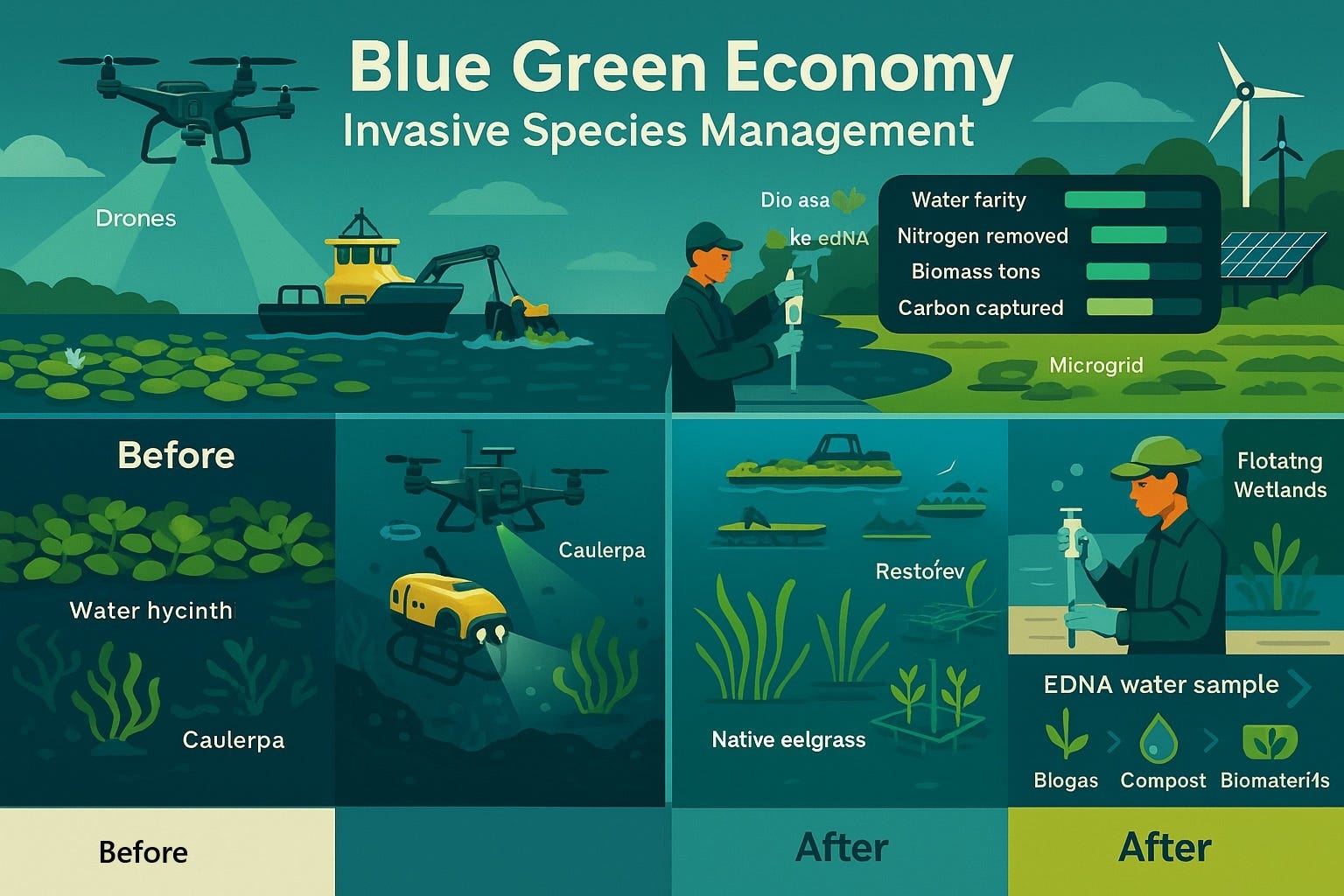
This specification turns invasive plant control into a value engine for lakes, rivers, estuaries, and harbours. It outlines an Integrated Aquatic Biosecurity approach that starts with prevention, adds precision removal, and finishes with restoration that you can measure and monetize. The work uses eDNA for early detection, drones for mapping and targeted application, and ROVs for underwater extraction. The market is growing, with global spend near 1.7 billion dollars in 2023 and a projected 2.8 billion dollars by 2030. Read the primer that inspired this work: https://open.substack.com/pub/cabusinessdesignconsultancy/p/ideas-trigger-10-the-blue-green-economy?r=59m4go&utm_campaign=post&utm_medium=web&showWelcomeOnShare=false
There is a need for a Code of Ethics for Invasive Species Management which acts as Guardrails built into invasive species management to balance profitability, investment duration, and ecological objectives, without creating a perverse incentive to sustain the problem for profit
Overview
The process of extracting and eliminating non-native invasive plants—whether in saltwater or freshwater environments—is broadly referred to as invasive species management or invasive plant control. More specifically, depending on the context and method, it may be called:
General Terminology
- Eradication: Complete removal of an invasive species from a given area.
- Containment: Preventing the spread of invasive species beyond current boundaries.
- Suppression: Reducing the population to minimize ecological impact.
- Restoration ecology: Rehabilitating ecosystems after invasive species removal.
Saltwater Context
- Marine invasive species control: Targeted removal of species like Caulerpa taxifolia or invasive algae.
- Techniques include:
- Manual harvesting
- UV or thermal treatments
- Biological controls (e.g., grazing species)
- Barriers or bottom covers to block light
Freshwater Context
- Aquatic weed management: Common for lakes, rivers, and wetlands.
- Targets include Elodea canadensis, Hydrilla, and Water hyacinth.
- Methods include:
- Mechanical harvesting
- Herbicide application (regulated)
- Drawdowns or dredging
- Biocontrol (e.g., grass carp)
Cross-Environment Strategies
- Biosecurity protocols: Preventing spread via boats, gear, ballast water, or garden waste
- Rapid response frameworks: Early detection and fast action to prevent establishment
- Integrated pest management (IPM): Combining physical, chemical, and biological methods
Market Size
The market is large, fragmented, and primarily driven by government expenditure.
- Global Estimate: The global invasive species management market was valued at ~$1.7 billion in 2023 and is projected to grow to ~$2.8 billion by 2030 (CAGR of ~7%). This includes terrestrial, aquatic, and insect pests.
- Aquatic Segment: A significant portion of this is aquatic. For perspective:
- The state of Florida alone spends tens of millions of dollars annually on aquatic plant management.
- The U.S. Army Corps of Engineers has multi-million dollar programs for specific threats like Great Lakes sea lamprey control.
- Drivers: Climate change (allowing species to spread to new areas), global trade (ballast water transfer), and increased recreational boating are expanding the market.
Existing Technologies & Programs
Established Technologies:
- Mechanical Harvesters: Boat-mounted conveyors that cut and collect plants (e.g., for water hyacinth in lakes).
- Hydro-razors: Underwater cutting blades used by divers or mounted on boats.
- Dredges: For suctioning up plants and roots from sediment.
- Benthic Barriers: Tarps laid on the bottom to block sunlight and smother plants.
- Controlled Herbicide Application: Using EPA/regulated aquatic herbicides via targeted spraying or submersed injection systems.
- Biological Controls: Introducing specific insects (e.g., Neochetina weevils for water hyacinth) or fish (sterile grass carp) that feed exclusively on the target plant.
Key Government & NGO Programs:
- U.S. National Invasive Species Council (NISC): Coordinates federal action.
- EPA Aquatic Nuisance Control Programs: Registers pesticides and provides guidelines.
- USDA APHIS: Leads efforts on plant health and pest management.
- The Great Lakes Restoration Initiative (GLRI): A major funder of invasive species control in the region.
- Local & State-Level Programs: Most states have aquatic invasive species (AIS) committees, “Clean, Drain, Dry” campaigns for boaters, and inspection stations at water bodies.
Framework: The Integrated Aquatic Biosecurity (IAB) Framework
This framework is built on the principle that proactive management and ecological restoration create more value than reactive removal. Profitability is derived from multiple revenue streams across a service lifecycle.
1. Core Philosophy & Value Proposition
Name: EcoSynthesis Solutions (or a similar forward-thinking brand)
Tagline: From Removal to Resilience: Profitable Ecosystem Stewardship.
Core Idea: We don’t just remove problems; we invest in the health of water systems. Our profitability is directly tied to the measurable increase in the value and resilience of our clients’ aquatic assets. We monetise Prevention, Precision, and Proof.
2. The Three-Pillar Service Model (The Profit Engine)
Profitability is stacked across three integrated service pillars, moving from defence to offence.
Pillar A: Consult & Protect (The Proactive Revenue Stream)
Focus: Prevention & Risk Assessment. This is high-margin, advisory work.
- Services:
- Biosecurity Audits: For marinas, aquaculture farms, waterfront estates, and local governments. Assess risk from boat traffic, equipment, etc.
- ‘Clean Vessel’ Certification Programs: Partner with marinas to offer inspections and certifications, creating a market differentiator for them.
- Early Detection Monitoring Contracts: Subscription-based drone and eDNA (environmental DNA) monitoring services to alert clients to new invasions before they become costly problems.
- Revenue Model: Retainers, subscription fees, one-time audit fees.
Pillar B: Extract & Contain (The Operational Revenue Stream)
Focus: Precision Removal & Control. This is the core operational business, made profitable through efficiency and technology.
- Services:
- Mechanical Harvesting: Using custom-equipped, low-impact boats. Target clients: municipalities, hydroelectric companies, lakeside communities.
- Precision Herbicide Application: Not blanket spraying, but targeted, regulated application using GPS-guided systems and submersible ROVs (Remotely Operated Vehicles) for deep-water targets. This reduces chemical use (cost savings) and improves public perception.
- Deployment of Bio-Control Agents: Sourcing and distributing approved biological controls (e.g., insects for specific plants, grass carp).
- Installation of Benthic Barriers: For high-value, small areas like coral reefs or drinking water intakes.
- Revenue Model: Project-based contracts, per-acre/hectare fees, equipment leasing.
Pillar C: Restore & Verify (The Value-Added Revenue Stream)
Focus: Ecological and Economic Enhancement. This is where true value is created and captured. You charge for the outcome, not just the action.
- Services:
- Native Revegetation: After removal, we profit from replanting with native species that outcompete invaders, restoring fish habitat, and preventing erosion.
- Ecosystem Service Verification: Quantify the positive impact of the work (e.g., carbon sequestered in restored wetlands, improved water quality, increased biodiversity). This data is incredibly valuable for:
- ESG (Environmental, Social, Governance) Reporting: For corporate clients with waterfront assets.
- Carbon Credit Programs: Selling credits from restored mangrove or seagrass meadows.
- Grant Applications: Providing the necessary data for governments/NGOs to secure conservation funding.
- Revenue Model: Premium project fees for restoration, data-as-a-service subscriptions, a percentage of secured carbon credit value.
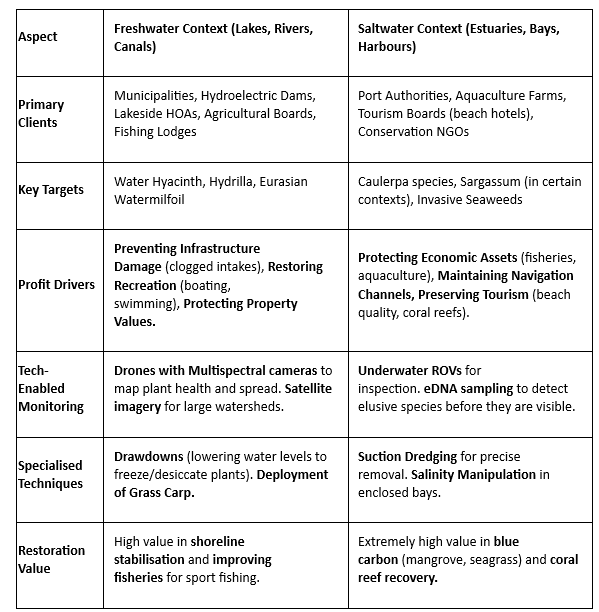
3. Comparative Strategic Map: Saltwater vs. Freshwater
This modular framework allows for tailored approaches based on the environment.
4. The “Eco-Synergy” Flywheel: How it Becomes Scalable and Profitable
This framework creates a self-reinforcing business model:
- A Consult & Protect client (e.g., a marina) pays for monitoring.
- Early detection triggers a Extract & Contain project, containing costs and saving the client money.
- The successful project leads to a Restore & Verify contract to replant the area and measure the success.
- The verified data from (3) proves the value of the initial monitoring in (1), justifying the renewal and expansion of the Consult & Protect contract.
- This data also becomes a powerful marketing tool to acquire new clients, restarting the flywheel.
5. Editorial Storytelling Angles
- The Proactive Investor: Frame the work not as environmental cleanup, but as investing in natural capital. A healthy lake is a more valuable asset than a choked one.
- The High-Tech Ecologist: Profile the use of drones, ROVs, and eDNA—showcasing this as a cutting-edge, precision field, not just manual labour.
- The Carbon Gardener: Focus on the saltwater restoration pillar, positioning the company as a leader in the emerging “blue carbon” economy.
- The Community Defender: Tell the story of a town that saved its tourism industry or a native tribe that restored its traditional fishing grounds.
Outcomes and consideration of the framework
This framework transforms invasive species management from a cost centre into a strategic, tech-enabled investment in resilience, generating profit through expertise, technology, and verifiable ecological outcomes:
1. Novel Approaches (The Green Goldrush) This is where the high-profit, high-innovation opportunities lie.
- eDNA (environmental DNA): Taking water samples and analyzing them for the unique genetic traces of invasive species. This allows for ultra-early detection before a population is even visible, enabling cheap and effective rapid response.
- Phyto-Remediation & Bioeconomy: Instead of just landfilling harvested plants, turning them into resources.
- Biogas/Biofuel: Anaerobic digestion of water hyacinth to produce methane.
- Fertilizer & Compost: Processing nutrient-rich plants into soil amendments.
- Biomaterials: Creating sustainable products like paper, fiberboard, or even feedstock from harvested biomass. This creates a revenue stream from the “waste.”
- Genetic Biocontrol: Highly experimental but potentially revolutionary. Using gene drives to make an invasive population sterile or introducing genetic traits that make it susceptible to a native disease. This is still largely in the research phase due to ethical and regulatory hurdles.
- Precision Automation: Developing smaller, cheaper, autonomous robots (see below) that can work 24/7 to identify and remove individual plants, drastically reducing herbicide use and labor costs.
2. The Role of AI, Drones, & Robots Technology is the ultimate force multiplier, moving the industry from brute force to precision medicine for ecosystems.
- Drones (UAVs):
- Mapping: Equipped with multispectral or hyperspectral cameras, they can identify specific plant species based on their unique “spectral signature” and create detailed GIS maps of infestations.
- Monitoring: They can rapidly survey vast or inaccessible areas (e.g., large wetlands) to track treatment progress and regrowth.
- Application: Drones are already being used for highly targeted herbicide spraying, minimizing drift and collateral damage.
- AI & Machine Learning:
- Image Recognition: AI models are trained on thousands of images to automatically detect and classify invasive plants from drone and satellite imagery, turning raw data into actionable maps.
- Predictive Modeling: AI can analyze historical data, water flow patterns, weather, and boat traffic to predict where an invasion is likely to occur next, allowing for proactive resource allocation.
- Robots (ROVs & AUVs):
- Underwater Removal: Remotely Operated Vehicles (ROVs) can be equipped with cutting tools or suction devices to precisely remove invasive plants like Caulerpa from sensitive seafloor environments without disturbing the sediment.
- Automated Harvesting: Autonomous Underwater Vehicles (AUVs) could, in the future, be deployed to continuously patrol and manage sub-surface infestations.
3. Crowdsourced Mapping & Databases: A Critical Role, this is a game-changer for early detection and public engagement.
- Platforms: Apps like iNaturalist and EDDMapS (Early Detection & Distribution Mapping System) are critical.
- How it Works:
- A boater, angler, or hiker sees a strange plant.
- They take a photo with their phone and submit it via the app.
- The photo is geotagged and either identified by an AI or sent to a network of expert verifiers.
- Once verified, the sighting is added to a public, real-time distribution map.
- The Value: This turns thousands of citizens into a distributed sensor network, dramatically increasing the odds of catching a new invasion early when it is cheapest and easiest to eradicate. This data is invaluable for government agencies and researchers.
4. Synthesis: The Tech-Enabled Future
The future of profitable invasive species management lies in integrating these technologies into a seamless workflow:
- Predict: AI uses models and crowdsourced data to flag high-risk zones.
- Detect: Drones and eDNA sampling are deployed for confirmation, creating a high-resolution map.
- Act: A precision strategy is chosen: a micro-dose of herbicide applied by drone, a swarm of small robots for mechanical removal, or the deployment of a targeted bio-control.
- Verify: Drones re-survey to measure success and AI analyzes the data to confirm efficacy.
- Value-Create: Harvested biomass is sent to a biorefinery, and the restored ecosystem’s health is quantified for carbon credits or ESG reporting.
This tech stack reduces costs (less labor, less herbicide), improves outcomes (precision targeting), and creates new revenue streams (biomass, data), making the business model highly attractive and scalable
Conclusion
Treat invasive species as a solvable operational problem and a restoration opportunity. Lead with biosecurity audits and early detection. Use precision tools to cut cost and chemical use. Restore with native species, then verify gains in water quality, biodiversity, and blue carbon. Package the data for ESG reports, nutrient removal credits, and grants. The result is healthier waters, lower lifecycle cost, and new revenue tied to measurable ecological outcomes.