
AI in June 2026 has moved beyond software hype into infrastructure, governance, energy, finance and workforce transformation. This article explores the current state of AI, the most likely futures through 2031, and the risks that could reshape the industry.
Publication and Dissertations
29 posts
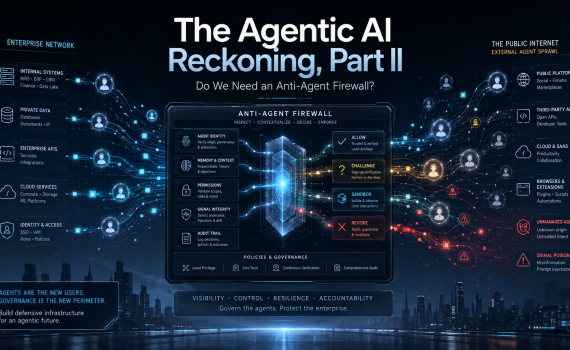
AI agents are moving beyond chatbots into systems that can act, call tools, store memory, trigger workflows, and influence public signals. This article explores the rise of agentic threats, external agent sprawl, information bombs, and the emerging debate over whether we need an Anti-Agent Firewall.

Agentic AI is transforming the enterprise, but governance is lagging behind adoption. As organizations deploy thousands of AI agents across SaaS platforms, RPA workflows, embedded applications, and emerging vibe-coded solutions, a new risk is emerging: AI Agent Sprawl. This article explores why AI governance, agent registries, ownership, security, auditing, and lifecycle management will become essential capabilities for every modern enterprise.

This article develops the synthetic organism as a disciplined alternative to both speculative AGI and shallow agentic automation. Building from the Abstraction Fallacy, it argues that AI systems should not claim consciousness through scale, complexity, or embodiment. Instead, artificial agency can be designed as a governed, memory-bearing, context-aware, and auditable system bounded by what creators can describe, test, supervise, and govern.

Pre-crime may not arrive as a single dystopian machine. It may emerge through the quiet fusion of lawful systems: facial recognition, ALPR, CCTV analytics, police records, broker data, social media monitoring, digital identity, smart-city infrastructure, and AI summarisation. This article argues that the real danger is convergence, where evidence becomes inference, inference becomes a score, and a score becomes consequence before any person has been accused, charged, or convicted.

Traditional institutions no longer control how expertise is created or shared. In a world shaped by AI, social media, and real-time information flows, new bodies of knowledge are emerging faster than academia and professional accreditation systems can respond. This article introduces Adaptive Knowledge Systems, a framework for building knowledge that is rigorous, socially adaptive, governable, and fit for rapidly changing environments.