Preamble
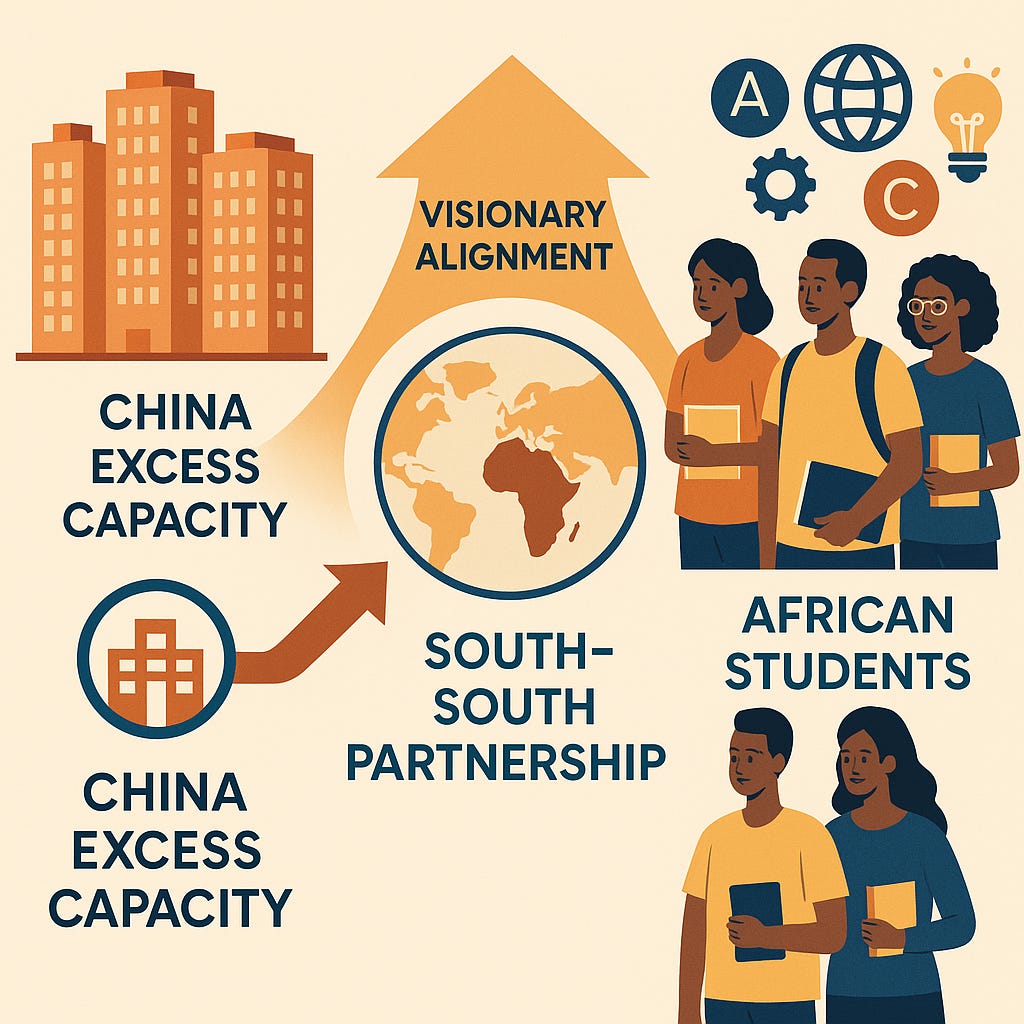
In an era defined by demographic shifts, geopolitical recalibration, and the urgent need for scalable development solutions, a unique opportunity emerges—one that turns excess into advantage, and untapped potential into human capital. With millions of African students facing systemic barriers to tertiary education and China housing vast amounts of underutilized infrastructure, a visionary alignment is not only possible but necessary.
This groundbreaking proposal outlines a South-South partnership of unprecedented scope: a strategic initiative to repurpose China’s surplus real estate into vibrant learning ecosystems for African students. By fostering multilingual education, technological innovation, and circular brainpower, this concept reimagines education as a diplomatic, economic, and developmental bridge.
What follows is not just a blueprint for international collaboration—it is a model for rethinking global education, resource utilization, and shared prosperity. With careful execution and shared commitment, this initiative could catalyze a new paradigm in how nations partner for mutual growth.
Executive Summary
A transformative educational initiative leveraging China’s excess residential and office capacity to create large-scale tertiary education opportunities for African students, addressing the massive gap between secondary school graduates and tertiary education access across Africa.
Core Concept
The Opportunity
- African Education Gap: Millions of African secondary school graduates lack access to tertiary education
- Chinese Overcapacity: Significant unused residential and office space in China
- Strategic Alignment: China’s market development goals + Africa’s human capital needs
- Exploration of Novel or Alternative funding: Diaspora (voluntary opt-in on electronic remittances .5-2%) or through .5-2 % surcharge on all electronic payments in each country for education fund for this initiative (see appendices)
Detailed analysis in appendices
The Solution
Create satellite tertiary institutions in China’s excess buildings, offering trilingual education programs that prepare graduates to return and develop their home countries.
Key Components
1. Educational Structure
Language Framework
- Primary Instruction Languages: English, French, Spanish (covering 60-80% of African official languages)
- Mandatory Chinese: 30%+ of coursework in Mandarin
- Trilingual Outcome: Students graduate fluent in their primary language + Chinese + one additional language
Program Types
- Traditional University Degrees: 3-5 year programs
- Polytechnic/Skills-Based Programs: Practical skills with academic rigor (modernized HND/HNC model)
- Accelerated Programs: Intensive year-round study reducing degree time
- Postgraduate Skills Conversion: For unemployed graduates needing market-relevant skills
2. Pre-Departure Preparation
- Mandatory Local Year: Chinese language + academic accreditation + cultural preparation
- Embassy Liaison: Visa processing and cultural orientation
- Skills Assessment: Ensuring academic readiness regardless of educational background variation
3. Return Mechanism
- Certificate Collection: Degrees awarded only upon return to home countries
- Transparency Requirements: Students sign commitments affecting future cohorts
- Skills Database: Matching graduates with regional opportunities across Africa
Funding Model
Revenue Sources
- Government Contributions (Not desirable, Optional): Each African government pays for their students (optional due to corruption and the desire to take charge and repurpose funds, They should seize the opportunity to build education infrastructure)
- Diaspora Development Fund:
- Target: 1-10% of $60B annual African diaspora remittances
- Potential: $600M-$6B annually
- Governance: Independent body, not government-controlled
- Matching Funds: Governments provide matching contributions
- NGO contribution
- Corporate sponsorship
- African individual contribution to scholarship fund
- Paying fees + scholarship Hybid
- Paying Fees
- Electronic Transactions: Diaspora (voluntary opt-in on electronic remittances they choose;[.5-2%]) or through 1-2% surcharge on all electronic payments in each country for education fund for this initiative (see appendices)
Cost Considerations
- Technology infrastructure for remote/hybrid teaching
- High-level auditing and transparency mechanisms
- Recruitment of bilingual teaching talent
- Student support services
Staffing Strategy
Teaching Resources
- Local Chinese Faculty: Core instruction in Chinese institutions
- Remote International Faculty: Diaspora academics teaching via advanced technology
- Retired/Semi-Retired Professionals: African diaspora mentors and part-time lecturers
- Teaching Assistants: Local support for labs and practical sessions
Technology Requirements
- Advanced holographic or immersive teaching platforms
- Quality assurance and monitoring systems
- Student progress tracking and support systems
Strategic Benefits
For China
- Resource Utilization: Monetize excess building capacity
- Market Development: Create educated consumer base in Africa
- Soft Power: Educational diplomacy and cultural exchange
- Economic Partnership: Develop long-term trade relationships
For Africa
- Scale Solution: Address massive education access gap
- Skills Development: Create market-relevant human capital
- Brain Circulation: Educated diaspora returns with international experience
- Leapfrog Development: Learn from global best practices without repeating mistakes
For Students
- Access: Overcome local capacity constraints
- Skills: Trilingual capabilities + technical expertise
- Network: International connections and perspectives
- Employment: Regional job placement assistance
Implementation Considerations
Quality Assurance
- Accreditation: International recognition of qualifications
- Monitoring: Transparent progress tracking and auditing
- Standards: Maintain academic rigor across programs
Sustainability Factors
- Environmental Responsibility: Sustainable development practices
- Cultural Preservation: Respect for African cultural values
- Economic Justice: Avoid exploitative relationships
- Health and Safety: Universal healthcare and student welfare
Risk Management
- Gaming Prevention: Robust monitoring and transparency mechanisms
- Political Stability: Multi-government coordination through African Union
- Economic Viability: Sustainable funding model
- Student Welfare: Comprehensive support systems
Expansion Possibilities
Program Diversification
- Research Partnerships: Joint research initiatives
- Industry Collaboration: Corporate internship programs
- Regional Specialization: Programs tailored to specific African regional needs
- Professional Development: Continuing education for working professionals
Geographic Scaling
- Pilot Programs: Start with select countries/regions
- Phased Rollout: Expand based on initial success
- Regional Hubs: Develop specialized centers for different skill areas
Success Metrics
Short-term (1-3 years)
- Student enrollment and retention rates
- Language proficiency achievements
- Infrastructure utilization rates
- Funding stability and growth
Medium-term (3-7 years)
- Graduate return rates
- Employment placement success
- Skills-job matching effectiveness
- Regional economic impact indicators
Long-term (7-15 years)
- African economic development acceleration
- Trade relationship enhancement
- Brain circulation vs. brain drain metrics
- Sustainable development outcomes
Next Steps for Development
- Feasibility Study: Detailed market research and cost analysis
- Stakeholder Mapping: Identify key government and institutional partners
- Pilot Program Design: Create detailed implementation plan for initial cohort
- Technology Development: Design and test educational delivery platforms
- Funding Structure: Establish diaspora fund and government partnership agreements
- Regulatory Framework: Navigate international education and immigration requirements
Conclusion
This concept represents a potential paradigm shift in international education and development cooperation. By aligning China’s excess capacity with Africa’s human capital needs, it could create a sustainable model for large-scale skills development while fostering genuine South-South cooperation. The key to success lies in maintaining transparency, ensuring quality, and creating genuine value for all stakeholders while avoiding exploitative relationships.
The idea’s strength lies in its recognition that development challenges require innovative, large-scale solutions that can operate across traditional boundaries. With proper implementation, this could become a model for other regions facing similar education access challenges.
Appendices
Appendice A: Policy Innovation Proposal: Introducing a 1–2% Surcharge on Electronic Payments to Fund the China-Africa Education Partnership
I. Rationale
The China-Africa Education Partnership seeks to scale tertiary education access for African youth by utilizing China’s surplus infrastructure and a globally coordinated education model. However, to achieve and sustain this initiative at scale, an innovative, inclusive, and recurring funding stream is essential.
With the increasing digitization of financial transactions across African economies, a small surcharge on electronic payments offers a scalable, low-friction mechanism for mobilizing substantial domestic resources to complement diaspora remittances, government allocations, and donor funds.
II. Proposed Mechanism
Name: Africa Future Learning Levy (AFL Levy)
Rate: 1–2% surcharge on all electronic payment transactions (mobile money, card payments, bank transfers)
Scope: National or continental implementation through central banks, fintech regulators, and regional blocs (e.g. ECOWAS, EAC, SADC)
III. Revenue Potential (Illustrative)
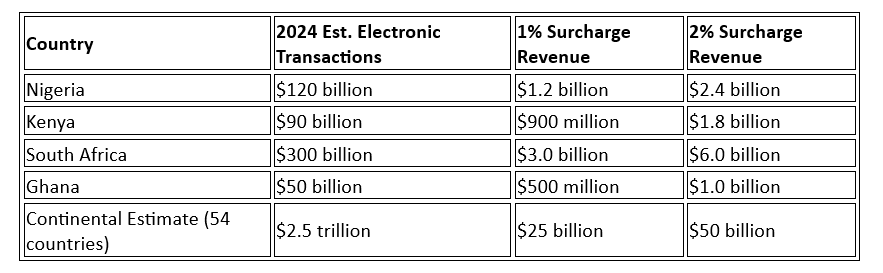
Assumptions: Includes bank transfers, card payments, mobile money transactions (e.g. M-Pesa, Flutterwave, OPay, etc.)
IV. Fund Governance and Use
- Governance: Independent transnational trust managed by a coalition of:
- African Union (AU)
- African Development Bank (AfDB)
- Educational NGOs and academia
- China Education Development Agency (as technical advisor)
- Allocation:
- 70% to student tuition scholarships
- 20% to infrastructure, tech platforms, teaching systems
- 10% to monitoring, quality assurance, and innovation grants
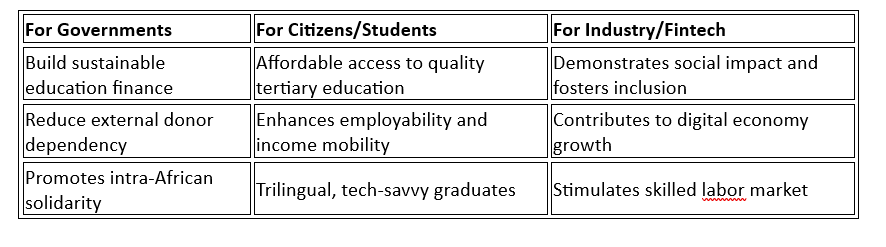
V. Strategic Benefits
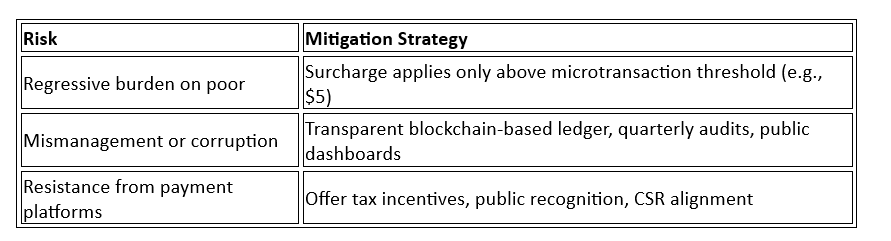
VI. Risk Mitigation
VII. Integration into Existing Strategy
This model can be layered onto the proposed funding mix in the original concept document:
- Diaspora Development Fund: $600M–$6B/year
- Government Contributions: Shared with AFL revenue
- NGO/Corporate Sponsorship: Remains unchanged
- New: AFL Levy – potential to generate $5B+ annually continent-wide
VIII. Conclusion
A 1–2% digital transaction surcharge—transparently managed—can power a new era of continental educational transformation. By tying Africa’s rising fintech momentum to its most pressing development challenge—education—this model ensures every swipe, transfer, or tap builds a brighter future.
Appendice B: Diaspora Funding via Voluntary Opt-In on Remittances to support the China-Africa Education Partnership.
🌍 Diaspora Remittance Education Fund (DREF)
A Voluntary Micro-Giving Platform for Transformative African Tertiary Education
1. Rationale
African diaspora communities remit over $60 billion annually. Even a 1–2% voluntary micro-contribution could unlock $600 million to $1.2 billion annually in sustainable, community-driven financing for tertiary education under the China-Africa partnership initiative.
This model empowers diaspora donors with agency and transparency—allowing them to opt-in at the point of transaction to contribute to a future-ready, skills-based education solution.
2. Contribution Mechanism
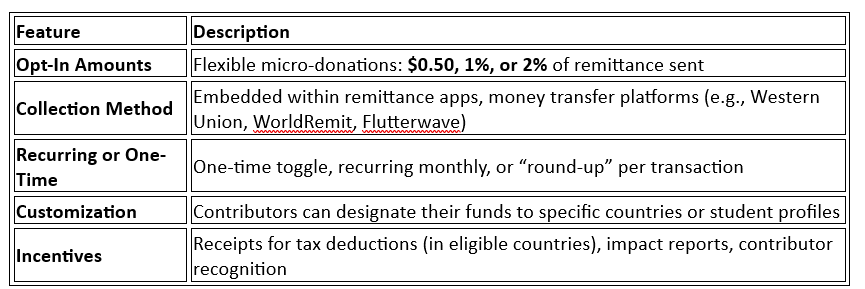
3. Revenue Potential
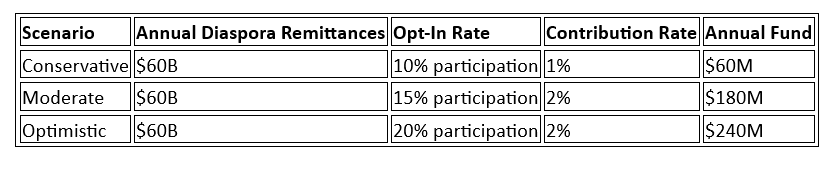
4. Operational Framework
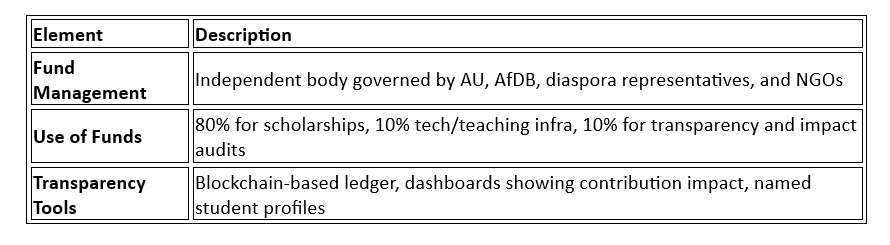
5. Strategic Advantages
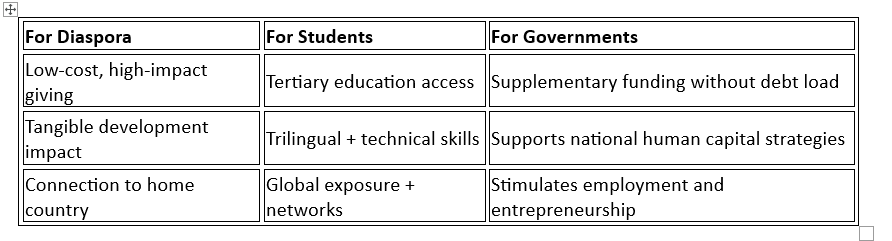
6. Implementation Plan (Phased Rollout)
Phase 1: Setup (Year 1)
- Establish governing trust
- Partner with 2–3 fintech/remittance platforms
- Launch pilot in 5 countries
- Soft launch DREF portal
Phase 2: Scale (Years 2–3)
- Expand to top 10 remittance platforms
- Enable diaspora geo-targeting
- Begin direct student sponsorships
- Launch annual “Diaspora Education Impact Report”
Phase 3: Maturity (Years 4–7)
- DREF becomes self-sustaining
- Integrated into remittance infrastructure continent-wide
- Real-time dashboards for donor-student matching
- AI-based impact forecasting
7. Sample Donor Journey
- Send Money via app
- Prompt appears: “Add $1 to support a student’s future?”
- Tap Yes → See a short profile of a student or classroom you’re supporting
- Receive monthly update → “Your $5 helped fund Amaka’s coding class in Tianjin”
8. Conclusion
This voluntary diaspora contribution model creates a dignified, democratic, and decentralized education finance stream. It aligns with the China-Africa Education Partnership’s ethos of South-South solidarity and bridges everyday financial flows with strategic continental impact.
Appendix C: China-Africa Education Partnership – This a summary for complete see Business Analysis
Summary
The China-Africa Education Partnership proposes using China’s excess real estate to host African students in trilingual, skills-based tertiary programs. It aims to address Africa’s massive education gap while supporting China’s soft power and economic goals.
Key Strengths
- Huge demand: Millions of underserved African students
- Smart use of China’s surplus infrastructure
- Trilingual, future-ready graduates
- Taps into $60B annual diaspora remittances
- Clear mutual benefits for China, Africa, and students
Main Challenges
- Complex operations across multiple countries and languages
- Quality assurance and cultural integration risks
- Reliance on evolving education technology
- Potential geopolitical tensions (e.g., US-China competition)
Opportunities
- First-mover in South-South education
- Exportable educational tech and models
- Corporate, research, and regional partnerships
- Green, low-cost development model
Financial Highlights
- Pilot (1,000 students): $50–100M
- Full scale (100,000 students): $2–3B
- Annual revenue potential: $900M–$3.6B
- ROI: 12–18% (China), 300–500% (Africa), 150–300% lifetime earnings boost (students)
Recommendation
High potential, moderate-high risk. Proceed with phased implementation, emphasizing quality, student welfare, and political alignment. This could be a transformative South-South development model.