Preamble
World Salvage Corp is a registry and exchange that finds stranded public and industrial assets, verifies their status, values them, and puts them back to work. The aim is simple, cut waste, speed projects, and stretch budgets through rigorous verification and trusted deal flow.
The problem is widespread. Governments and companies leave projects incomplete, plants sit idle, and equipment decays while new equipment gets procured at full cost. This creates avoidable expense and delays for operators who could redeploy existing capacity.
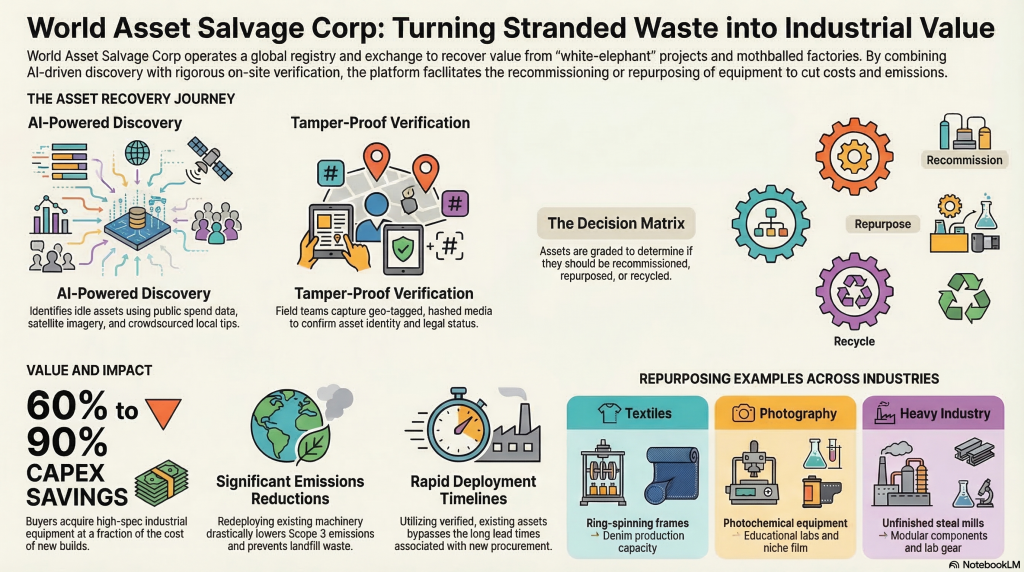
The solution combines ground truth and a structured marketplace. Discover assets through public spend data, audits, tenders, satellite review, and local tips. Verify on site with geo-tagged media and documents. Grade condition and legal clarity. Decide to recommission, repurpose, recycle, or decommission. Then match assets to buyers or redeployment programs using a secure exchange and escrow.
The concept is practical and example. Idle textile lines can become denim capacity. Photochemical equipment can serve education and niche film producers. Large unfinished steel sites can yield modular systems and high value components while civil works are resolved or recycled.
The operating model is modular. Core product areas include Discovery, Verification, Valuation, Exchange, Repurposing Studio, and a Deal Room. Each module writes to a common data model that tracks asset identity, location, ownership, condition, legal score, valuation, repurpose options, and ESG impact.
AI accelerates scale and trust. Document AI parses procurement and audit files. Vision models identify equipment and extract serials. Anomaly detection flags spend versus output gaps. Matching and outcome scores guide where to deploy field teams. Crowdsourcing adds tips, verified by reputation and bounties.
Governance, legal readiness, and risk controls are built in. A neutral registry standard, transparent grading rules, FOI playbooks by country, standardized contracts, four-eyes approvals, and a whistleblower channel reduce political heat and integrity risk.
Value is clear. Buyers can unlock material capex savings, shorter lead times, and measurable emissions reductions. Messaging centers on savings, speed, and climate impact, with pilots focused on a tight set of repeatable repurpose playbooks.
See apendices for alternate write up with some critique as a raw idea it lacks market analysis and competitor analysis . Hopefully someone might take this somewhere
Outline: World asset Salvage Corp, a global registry and exchange for stranded public and industrial assets.
Core problem: Governments and industries leave projects incomplete. Equipment sits idle. Factories are mothballed. Useful assets decay while new ones get procured at full price. You want to find these assets, verify them, value them, and redeploy them.
Solution: Build a trusted inventory and marketplace. Catalog white-elephant sites and equipment. Verify on the ground with video and documents. Negotiate with owners. Decide to recommission, decommission, recycle, relocate or repurpose. Then match assets to new uses or buyers.
Scope examples: Idle textile mills that can support denim production. Old film development equipment that can serve elsewhere. , Vinyl record manufacturing equipment , denim and textile manufacturing old equipment, Steel plants that were reported 80 percent complete on paper, or imported machinery that never got installed.
How it works, high level: Source candidate assets from public spend data, procurement records, and local tips. Validate with field checks and paperwork. Grade condition and legal status. Set an indicative valuation. Publish to the exchange. Run structured negotiations with the right holder. Close sales or redeployment agreements.
AI role: Parse procurement and audit documents at scale. Flag anomalies. Identify equipment types from images and serials. Score probability of successful recovery. Suggest repurposing options and comparable valuations. Crowdsourcing supports discovery, validation, and appraisal flows.
Positioning: This is not anti-capitalist. You cut waste by buying or releasing working assets for a fraction of new cost, then repair to spec. You save time, money, and materials.

Taxonomy and operating model
Asset taxonomy
- Sites, for example incomplete plants, abandoned public facilities.
- Equipment, for example production lines, stand-alone machines, spares, and tools.
- Documentation, for example purchase orders, certificates, warranties, and drawings.
- Legal, for example title, liens, encumbrances, concession terms, and court actions.
Lifecycle states
- Suspected, tip or data pattern indicates an idle asset.
- Verified, field evidence confirms location, identity, condition.
- Rated, technical grade, legal clarity score, and refurbishment plan.
- Marketed, listed to buyers or redeploy programs.
- Closed, sold, leased, redeployed, or recycled.
Decision tree
- Recommission, if refurbishment ROI beats replacement, and legal status is clear.
- Repurpose, if a different industry can use the core capability. Example, denim from idle textile assets.
- Recycle, if value sits mainly in materials.
- Decommission, if risks exceed value.
Entity structure
- Apolitical standards body for the registry and grading rules.
- For-profit operating company for origination, verification, brokerage, and refurbishment.
- Local affiliates for fieldwork and negotiations, because context and politics are local.
Product, data, and AI design
Core product modules
- Discovery, data ingestion from spend reports, audits, tenders, satellite imagery, and tip submissions. Freedom of Information workflows where allowed.
- Verification, mobile app for geo-tagged video, photos, serial scans, and witness statements. Tamper checks and chain of custody.
- Valuation, condition-based pricing, comparable sales, refurbishment bill of materials, and downtime cost avoided.
- Exchange, Listings with legal pack, inspection windows, offer flows, and escrow.
- Repurposing studio, templates for conversion use cases, for example mill to denim line.
- Deal room, stakeholder map, negotiation steps, and approvals.
Suggested database schema, starter fields
- Asset, ID, type, make, model, serial, year, specs, photos, video.
- Location, address, coordinates, access notes.
- Ownership, entity, proof docs, restrictions, disputes.
- Status, suspected, verified, rated, marketed, closed.
- Condition, mechanical, electrical, control systems, environment, score 0 to 100.
- Legal score, title clarity 0 to 100, FOI references.
- Valuation, as-is, refurbished, replacement cost, confidence.
- Repurpose options, candidates with feasibility scores.
- ESG, materials saved, CO2 avoided, landfill avoided.
AI components
- Document AI, extract vendors, quantities, and delivery evidence from procurement files.
- Vision AI, classify equipment from images, extract nameplates, match to OEM parts lists.
- Anomaly detection, flag projects with high spend, low output, or missing commissioning evidence.
- Matchmaking, recommend buyers or partner facilities by process capability.
- Outcome prediction, probability of successful recovery, cost to refurbish, time to deploy.
Crowdsourcing and incentives
- Roles, finder, verifier, appraiser.
- Payouts, fixed bounties for verifiable tips. Tiered bonuses for deals that close.
- Reputation, accuracy score improves fee share and job access.
- Safeguards, NDAs, anti-corruption attestations, and redaction for sensitive locations.
Governance, legal, and risk
Governance
- Independent rules for grading and conflicts. Publish the rating methodology.
- Audit trail, every data point has a source and timestamp.
- Ethics panel to review deals with political sensitivity.
Legal
- Run ownership and encumbrance checks early.
- Use standardized sale or lease templates with clear liability splits.
- Build an FOI request library, country by country, and track response times.
Risk controls
- Political, use local affiliates and neutral branding. Stakeholder mapping for each asset.
- Technical, third-party inspections before any binding offer.
- Market, run a two-sided auction to surface true demand.
- Integrity, whistleblower channel, plus four-eyes approvals for high-value deals.
Business model
Revenue
- Brokerage fee on sale or lease.
- Subscription for premium registry access and alerts.
- Refurbishment project margin.
- Data services, asset intelligence feeds for banks, insurers, and OEMs.
Costs
- Field verification network and QA.
- Legal and due diligence.
- Platform engineering and storage.
- Insurance and guarantees.
KPIs
- Verified assets per month.
- Recovery rate, percent of verified assets that reach closed state.
- Cost saving versus new procurement.
- Time to redeploy, median days from verification to close.
- CO2 avoided from reuse.
Examples to sharpen the model
- Textile line to denim conversion. Acquire idle ring-spinning frames, replace bearings and drives, add denim-ready finishing, and contract a buyer under take-or-pay. Your doc cites empty factories with salvageable textile equipment. Use that as one of the first playbooks.
- Photo equipment reuse. Old photochemical gear can serve teaching labs or niche analog film producers. You flagged idle photo factories as a source. Start with small lots to prove logistics and testing flows.
- Unfinished steel mill assets. Split the problem. Redeploy mobile or modular components first, for example cranes, compressors, and lab gear. Park heavy civil works as long-dated options or materials recycling. Your notes reference mills reported near completion on paper and imported machinery never implemented.
Naming and narrative
If you keep a single brand, use language that stresses savings, speed, and climate impact, not failure recovery. Options that test well in B2G and industry:
- Global Reuse Exchange
- Public Asset Recovery Exchange
- Industrial Recommissioning Network
If you split, use:
- Foundation, open registry and grading standard.
- Operations Co, deals, refurb, marketplace.
Messaging to repeat, buy once, use fully. Save 60 to 90 percent of replacement cost by repurposing correctly. Your draft already counters the anti-capitalist perception. Keep that line in the pitch.
90-day pilot plan
Week 1 to 2, set scope
- Choose one sector, textile or food processing.
- Choose one geography with helpful access rules and partners.
- Define three asset playbooks.
Week 3 to 4, data and sourcing
- Load 3 to 5 years of procurement and audit PDFs for that sector.
- Publish a tipline with bounties.
- Shortlist 50 suspected assets.
Week 5 to 6, verification
- Train five local verifiers.
- Capture geo-tagged video and serials for 20 assets.
- Produce inspection reports and draft valuations.
Week 7 to 8, market test
- List 10 assets to a closed buyer list.
- Run two auctions and one redeploy trial with a partner operator.
Week 9 to 10, close deals
- Target 3 closures. Include at least one repurpose deal.
- Document refurbishment plans and timelines.
Week 11 to 12, measure and publish
- Publish a short pilot report with KPIs and case studies.
- Lock the v1 grading standard and templates.
Practical templates you can use now
Field verification checklist
- Photos, front, nameplate, control panel, wear points.
- Video, walk-around with commentary and running test if possible.
- Paper, purchase order, delivery note, commissioning record, warranty, lien search.
- Legal, owner contact, possession status, disputes.
- Safety, hazmat, guarding, lockout points.
- Condition, score each subsystem 0 to 100.
Deal memo, one page
- Asset ID and summary.
- Owner and right to sell or lease.
- As-is value, refurb cost, replacement cost, net benefit.
- Proposed path, recommission, repurpose, recycle, or decommission.
- Risks and mitigations.
- Next actions and owners.
Repurpose playbook, starter
- Input capability, what the asset can do today.
- Target process, what the new user needs.
- Gap analysis, mechanical, electrical, controls, utilities.
- Mod kit, parts, labour, timeline.
- Pilot run plan and acceptance tests.
- Training and spares.
Suggestions to strengthen the idea
- Make verification tamper-proof. Require app-captured media with device attestation and location locks. Store hashes on an immutable log. Your concept already calls for video, audio, and legal checks. Make them auditable.
- Publish a transparent grading standard. Keep it simple at first. Condition, legal clarity, and redeployability. Buyers will trust the exchange if grades are consistent.
- Focus on three repeatable playbooks. Textile to denim, grain mill to feed mill, beverage bottling line to water bottling. Depth beats breadth. Your notes give textile and photo as early lanes.
- Use a two-tier brand. Neutral registry for data and ratings. Commercial arm for deals. This lowers political heat and attracts partners.
- Stand up a buyer council. Five credible operators who will preview listings and set practical acceptance criteria.
- Secure refurbishment partners early. Line up OEM-trained shops and ISO maintenance firms. Publish SLAs.
- Create a legal fast lane. Pre-approved templates and a short path to resolve disputes or missing papers.
- Measure climate value. Publish CO2 and materials saved per deal. This opens development bank funding and corporate scope 3 buyers.
- De-risk politics. Map stakeholders on every deal. Avoid assets with high public sensitivity in early pilots. Your draft flags political and social drivers, so bake this into screening.
- Monetize data exhaust. Offer asset intelligence to insurers and lenders. Idle equipment is a loss driver. Your registry can change risk pricing.
Conclusion
This blueprint turns waste into productive capacity by pairing verifiable ground truth with a trusted market. The immediate path is focused, one sector, one geography, and three repeatable playbooks supported by a small verifier network and two refurbishment partners.
Run the 90-day pilot with clear gates. Load three to five years of sector procurement and audit PDFs. Launch the tipline and shortlist assets. Complete inspections with geo-tagged media and draft valuations. List a limited set to a closed buyer council, run auctions, close three deals including one repurpose, and publish results with the v1 grading standard and templates.
Lock the foundations early. Adopt the public grading standard, implement tamper-evident verification, stand up standardized legal packs with escrow, and set SLAs with refurbishment partners. Track KPIs across sourcing, quality, velocity, economics, and impact to drive iterative improvement and bankability.
When the pilot hits its targets, scale by adding adjacent playbooks and regions, and monetize the registry and intelligence services alongside brokerage and refurb projects. Keep the narrative consistent, buy once, use fully, and prove it with auditable data and closed-loop outcomes.
Appendices
World Salvage Corp Snap analysis and critique
Your draft proposes a global way to find stranded public and industrial assets, verify their status, value them, then recommission, repurpose, recycle, relocate or decommission , salvage through a trusted registry and exchange. You stress on-the-ground verification, legal clarity, and negotiation with owners. You illustrate with idle African factories, vinyl records production textile lines for denim, photo equipment, and paper-complete steel mills that never ran.
Stakeholders, incentives, and likely blockers
- Asset right holders. Government ministries, SOEs, liquidators, landlords, special purpose vehicles. Incentive, recover value and clear liabilities. Blockers, reputational risk, political exposure, missing paperwork.
- Buyers and operators. Industrial SMEs, OEM refurb partners, circular economy manufacturers, training labs. Incentive, 60 to 90 percent capex savings versus new builds if refurbished to spec. Blockers, trust in condition and title.
- Verification network. Local surveyors, engineers, accredited inspectors, community tipsters. Incentive, bounties and fees. Blockers, safety, tamper risk, and retaliation in sensitive cases.
- Finance and insurance. Asset-backed lenders, development banks, political risk insurers, warranty providers. Incentive, new deployable collateral and green outcomes. Blockers, title defects, corruption exposure.
- Oversight and civil society. Auditors, FOI advocates, anti-corruption bodies, local communities. Incentive, transparency and service restoration. Blockers, data sensitivity and ongoing disputes.
People, process, technology map
People
- Origination lead, runs data hunts and stakeholder outreach.
- Verification lead, manages field inspections, safety, and QA.
- Legal lead, title checks, templates, FOI workflows.
- Deal manager, pricing, auctions, and escrow.
- Refurb PM, scopes BOM, timelines, acceptance tests.
Core processes
- Discover suspected assets from spend data, audits, tenders, tips.
- Verify on site with geo-tagged video, nameplate scans, and witness statements, store hashes for tamper checks.
- Rate condition, legal clarity, and redeployability, then decide path.
- List to a vetted buyer pool with a legal pack, run offers or auctions with escrow.
- Close, then execute refurb or repurpose playbook with SLAs.
Technology
- Document AI to parse procurement, delivery, and commissioning records.
- Vision AI for equipment ID and serial extraction.
- Anomaly detection on spend versus output.
- Exchange with role-based access, audit trails, and immutable media proofs.
- Mobile verifier app with device attestation and location locks.
Product and data model
- Modules. Discovery, Verification, Valuation, Exchange, Deal Room, Repurposing Studio.
- Key tables. Asset, Location, Ownership, Status, Condition, Legal score, Valuation, ESG impact, Repurpose options.
- Events. Tip submitted, inspection complete, rating issued, listing live, offer accepted, close, redeployed.
Market analysis
Segments by source
- Public works and SOE projects. Dams, plants, hospitals, rail kits that stalled.
- Private industrial closures. Food, beverage, textiles, chemicals, light manufacturing.
- Education and labs. Photographic and scientific gear for teaching or niche makers. Your dictation cites idle photo factories and textile mills.
Buyer personas and jobs
- Cost-sensitive operators. Job, expand capacity fast at low capex.
- OEM-aligned refurb shops. Job, source cores and assemblies for certified rebuilds.
- Development actors. Job, restore stalled public services with less spend and less time.
- Niche producers and labs. Job, acquire legacy equipment that is no longer made.
Demand drivers
- Capex inflation, supply chain lead times, ESG and Scope 3 pressure, and brownfield speed.
Competitive landscape
- Industrial auction platforms and liquidators, scrap traders, government surplus outlets, and informal brokers. Your edge is verified condition, legal clarity, repurpose playbooks, and a registry standard that builds trust.
Pricing logic
- Brokerage fee on sale or lease, premium data subscriptions, refurb margin, and intelligence feeds for banks and insurers. Track unit economics at deal level, fee revenue minus verification and legal costs.
Legal and risk playbook
- Early title and encumbrance checks, standardized sale or lease contracts, liability splits, FOI request templates by country, and response tracking.
- Political risk screening on each asset. Drop high-heat cases in early pilots.
- Integrity controls. Four-eyes approvals, whistleblower channel, and conflict disclosures.
KPIs and feedback loops
- Sourcing, suspected assets per month and conversion to verified.
- Quality, average condition and legal scores, dispute reversal rate.
- Velocity, median days from verify to close.
- Economics, recovery rate, fee per closed deal, refurb gross margin.
- Impact, CO2 and materials saved per deal, plus service restored where relevant.
90-day pilot, tightened
Your rewrite already sketches a 12-week pilot. Keep the cadence, and add crisp success gates.
- Weeks 1 to 2, pick one sector and one geography with clear access rules, define three repurpose playbooks, sign two refurbishment partners.
- Weeks 3 to 4, load three years of procurement and audit PDFs, launch bounties, shortlist 50 assets.
- Weeks 5 to 6, train five verifiers, complete 20 inspections with tamper-evident media and draft valuations.
- Weeks 7 to 8, list 10 assets privately, run two auctions, one redeploy trial with a partner operator.
- Weeks 9 to 10, close three deals including one repurpose, lock logistics and refurb work orders.
- Weeks 11 to 12, publish KPIs and case notes, finalize v1 grading standard and legal templates.
Speculative futures to extend the moat
- Digital twin passports for assets using serials, inspection hashes, and maintenance logs to allow instant diligence.
- Satellite and aerial change detection to spot mothballed sites and verify activity claims at scale.
- Verifier identity and reputation with signed attestations and accuracy-weighted payouts.
- Repurpose design library, configurable kits and acceptance tests for repeated conversions, for example textile to denim.
- Outcome prediction that scores probability of recovery and time to deploy to guide where you spend field effort.
- Climate-aligned finance, pre-approved lines tied to verified CO2 savings and materials reuse metrics.
- Public registry standard with a neutral brand plus a commercial operations arm to reduce political heat.
Concrete upgrades to your concept
- Make verification provable. Enforce device attestation, geo locks, and media hashing with an immutable audit log. Buyers and lenders will trust your grades.
- Publish a simple, public grading standard. Condition, legal clarity, and redeployability, each 0 to 100 with definitions.
- Focus on three repeatable playbooks for year one. Textile to denim, beverage to water bottling, grain mill to feed mill. Depth beats breadth. Your notes already highlight textile and photo, so start there.
- Set up a buyer council and refurbishment SLAs up front. De-risk acceptance and warranty debates.
- Build a legal fast lane. Pre-clear templates, define a short cure process for missing documents, and add escrow with conditions precedent.
- Monetize intelligence exhaust. Sell structured feeds on stranded asset risk to insurers and banks once you have scale.
Open questions to test quickly
- Which jurisdiction offers the best early FOI yield and least political heat. Your draft calls out FOI as a key enabler.
- Average refurb cost and time by asset class for your first three playbooks.
- Minimum viable legal pack buyers will accept to place a firm offer.
- Bounty pricing that brings quality tips without spam.
- Buyer willingness to pay for premium registry access before deal flow is large.