🌍 Vision & Purpose
The global food system stands at a crossroads. While climate change threatens agricultural stability and nutritional inequality persists worldwide, indigenous communities possess centuries of accumulated wisdom about nutrient-dense foods and herbal remedies. Yet this knowledge remains fragmented, undervalued, and vulnerable to exploitation.
The quinoa phenomenon exemplifies both the promise and peril of superfood commercialization. While global demand brought economic opportunities to Andean farmers, it also led to local displacement, price volatility, and environmental degradation. This pattern has repeated with teff in Ethiopia, where rising exports began pricing out local consumers from their traditional staple.
While elements of this knowledge already exist across multiple databases, research papers, and agricultural institutions particularly within the Global South the concept itself is not new. What’s novel is the effort to unify and elevate this scattered information into a single, crowd-sourced, searchable platform. This system will be built on a robust framework that includes ingredient identification, geographic origin, cultivation scale, usage analysis, and local storytelling. It will leverage AI for data synthesis and verification, and embed circular economy principles to ensure sustainability and equitable value distribution. In research, analysis and implementation the first step would be to see what already exists the following is a kick start (see appendices for start-off candidates).
My outline analysis
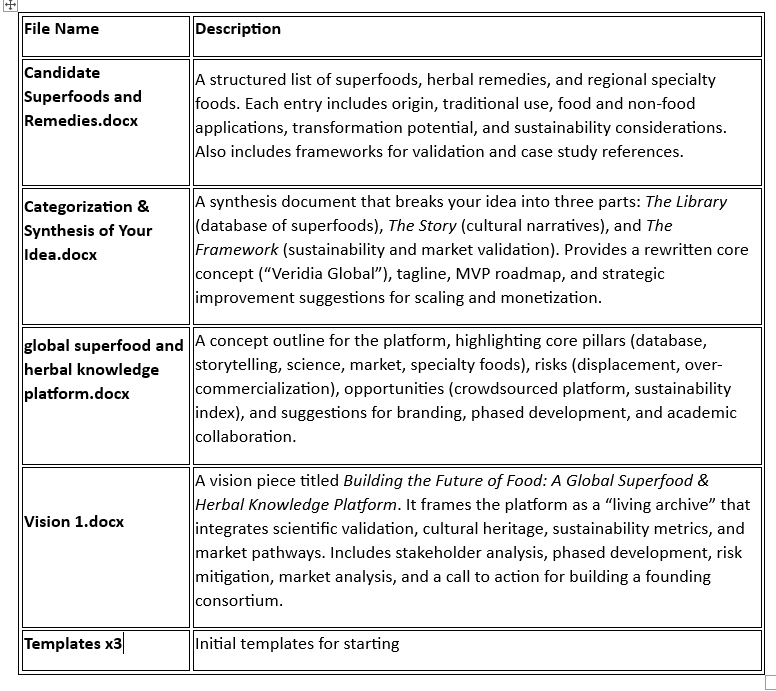
As usual: Superfood artefacts
The Platform’s Mission
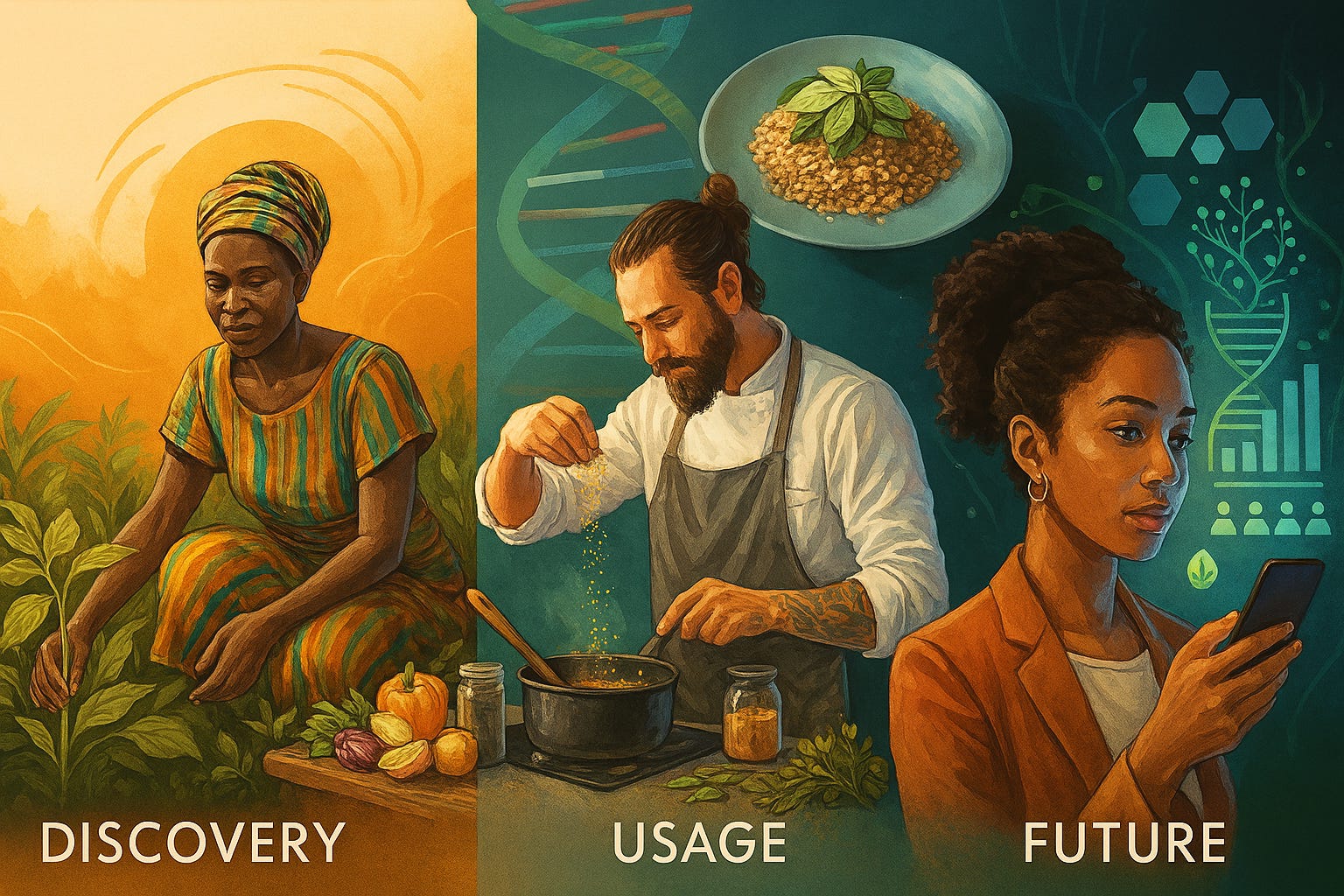
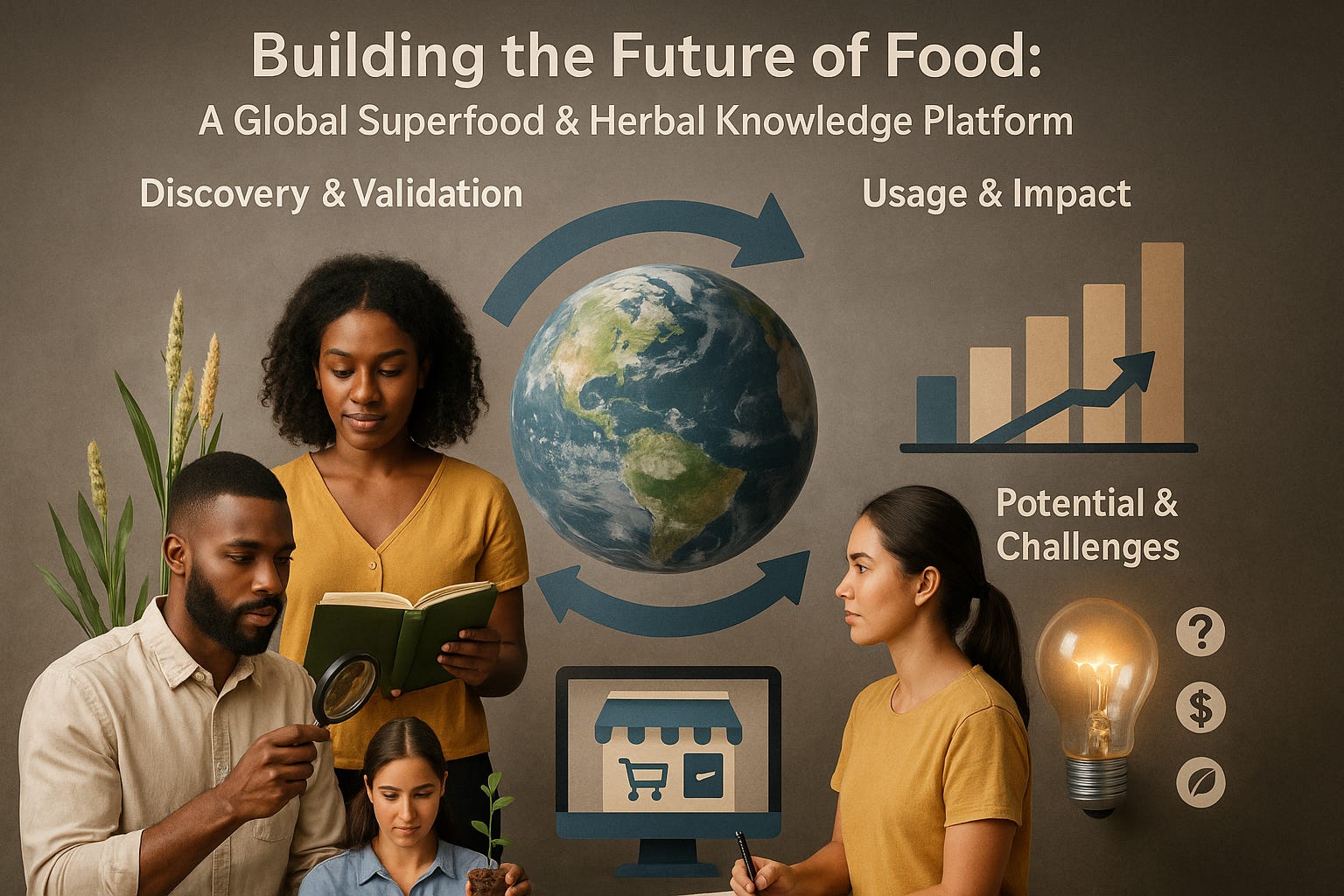
This platform seeks to create a verified, dynamic repository that bridges traditional food knowledge with modern science and ethical commercialization. Rather than another static database, this system will serve as a living ecosystem connecting farmers, researchers, chefs, investors, and consumers around shared values of sustainability, cultural respect, and equitable benefit-sharing.
The core architecture integrates four critical dimensions:
- Scientific validation: Rigorous nutritional, pharmacological, and ecological assessment
- Cultural heritage: Authentic documentation of origin stories, traditional uses, and preparation methods
- Sustainability metrics: Comprehensive scoring for carbon footprint, water usage, and regenerative potential
- Market pathways: Strategic analysis of demand trends, value-added applications, and commercialization opportunities
This represents a fundamental shift from extraction-based models toward regenerative systems that strengthen rather than exploit source communities.
🧩 Framework for Stakeholder Identification & Analysis
Primary Stakeholder Mapping
Local Producers & Cooperatives
- Interests: Sustainable income, market access, cultural preservation
- Influence: High (control supply and authenticity)
- Contributions: Traditional knowledge, sustainable cultivation practices, cultural narratives
- Risks: Exploitation, displacement, loss of food sovereignty
Ethnobotanists & Food Historians
- Interests: Academic recognition, preservation of knowledge, scientific validation
- Influence: Medium (credibility and research capacity)
- Contributions: Scientific rigor, documentation methodology, peer review
- Risks: Extractive research practices, inadequate community compensation
NGOs & Development Agencies
- Interests: Community upliftment, sustainable development, capacity building
- Influence: High (funding and policy connections)
- Contributions: Field networks, funding, policy advocacy
- Risks: Mission drift, bureaucratic inefficiency, paternalistic approaches
Ethical Food Brands & Impact Investors
- Interests: Market differentiation, ESG compliance, consumer trust
- Influence: High (capital and market access)
- Contributions: Funding, distribution channels, consumer education
- Risks: Greenwashing, profit prioritization over community benefit
Participatory Engagement Model
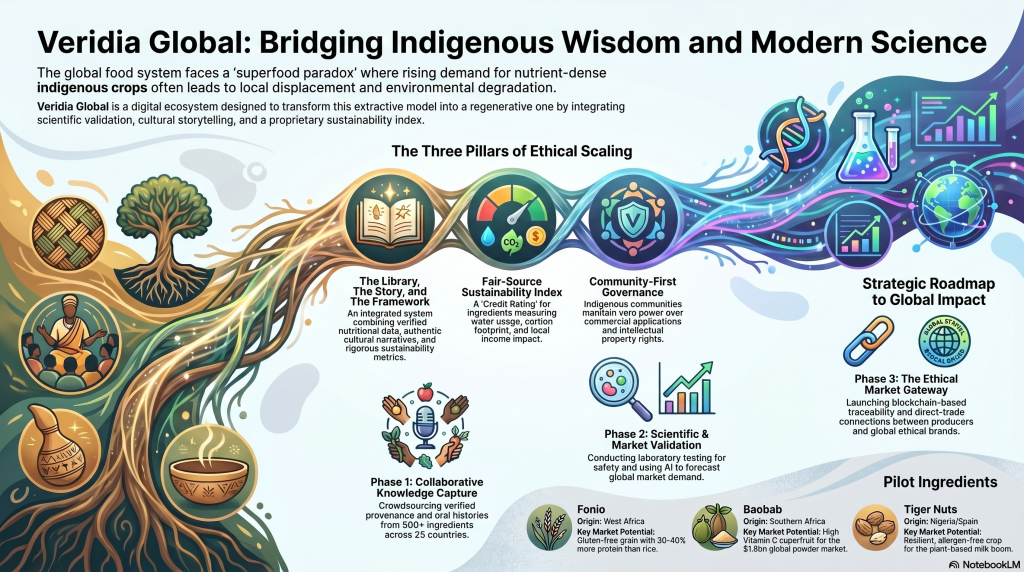
Knowledge Co-Creation Protocol Each ingredient profile will be developed through collaborative workshops involving:
- Community elders and traditional healers
- Local farmers and women’s cooperatives
- Academic researchers and nutritionists
- Sustainability experts and agronomists
Benefit-Sharing Framework
- Intellectual property rights recognition for traditional knowledge holders
- Revenue-sharing agreements with transparent distribution mechanisms
- Community funds for education, healthcare, and agricultural development
- Veto power for communities over commercial applications
Advisory Council Structure
- Regional advisory boards with 60% indigenous/local representation
- Scientific advisory panel for validation protocols
- Ethics committee for benefit-sharing oversight
- Youth council for intergenerational knowledge transfer
📊 Strategic Outlook
Phased Development Strategy
Phase 1: Knowledge Capture (Months 1-18) Foundation Building
The initial phase focuses on creating a robust, community-driven knowledge base through:
- Crowdsourced ingredient submissions with verified provenance
- Oral history collection through trained community facilitators
- Preliminary sustainability scoring based on established metrics
- Partnership development with universities and research institutions
Success metrics include 500+ documented ingredients across 25+ countries with verified community consent.
Phase 2: Scientific & Market Validation (Months 12-36) Credibility & Commercial Readiness
This phase transforms raw knowledge into market-ready intelligence:
- Laboratory testing for nutritional profiling and safety assessment
- Peer-reviewed publication of findings in food science journals
- Demand forecasting using AI-driven market analysis
- Pilot partnerships with 10-15 ethical food brands
The sustainability index algorithm will be refined through field testing and stakeholder feedback.
Phase 3: Commercial Gateway (Months 24-60) Scaling & Impact
The final phase activates the platform’s matchmaking and certification functions:
- Direct trade connections between producers and buyers
- Blockchain-based traceability and certification systems
- Impact dashboards showing community benefit distribution
- Expansion into secondary markets (cosmetics, nutraceuticals, beverages)
Risk Mitigation Strategies
Cultural Safeguards
- Mandatory consent protocols before any knowledge documentation
- Community veto rights over commercial applications
- Regular benefit-sharing audits with public reporting
- Cultural sensitivity training for all platform participants
Ecological Protection
- Satellite monitoring of harvesting areas to prevent overexploitation
- Regenerative agriculture incentives and technical support
- Biodiversity impact assessments for all scaled ingredients
- Climate adaptation support for vulnerable growing regions
Market Stability Measures
- Diversified crop portfolios to reduce monoculture risk
- Price floor guarantees during market development phases
- Storage and processing infrastructure development
- Alternative livelihood training for producing communities
Fair Trade 2.0 Positioning
This platform evolves beyond traditional fair trade models by:
- Integrating real-time sustainability monitoring
- Providing transparent supply chain visibility
- Enabling direct producer-consumer relationships
- Offering comprehensive community development support
📈 Market Analysis
High-Potential Ingredient Categories
Gluten-Free Ancient Grains Fonio (West Africa): Exceptional amino acid profile with 30-40% higher protein than rice. Traditional ceremonial significance in Mali provides authentic storytelling foundation. Market opportunity in $7.5 billion gluten-free market.
Teff (Ethiopia): Already established in international markets but suffering from local displacement issues. Model case for ethical scaling with benefit-sharing agreements.
Functional Superfruits Baobab (Southern/West Africa): Six times more vitamin C than oranges, established EU novel food status. Growing superfruit powder market ($1.8 billion globally) with premium positioning potential.
Moringa (India/Africa): Multi-use applications across food, cosmetics, and pharmaceuticals. Strong scientific backing with over 1,000 published studies.
Adaptogenic Herbs Tiger Nuts (Nigeria/Spain): Successful European market penetration (horchata) demonstrates global potential. High fiber content and nut-free positioning for allergen-conscious consumers.
Secondary Market Opportunities
Cosmetics Integration
- Shea butter expansion into food-grade applications
- Hibiscus extract for natural coloring and antioxidants
- Tamanu oil for premium skincare lines
- Estimated market value: $2.3 billion in natural cosmetics ingredients
Functional Beverages
- Fermented palm wine refined for craft spirits market
- Gogoro positioning as premium African spirit
- Hibiscus-based beverages (current $180 million market growing 8% annually)
- Adaptogenic drink mixes with traditional herbs
Circular Economy Applications
- Palm by-products for industrial cleaning applications
- Shea waste valorization for biomass energy
- Hibiscus seed protein extraction for food fortification
- Estimated waste stream value: $850 million annually
Case Study Analysis
Quinoa Lessons (2000-2020)
- Price increases of 300-400% led to local food insecurity
- Export focus created monoculture vulnerability
- Limited value addition kept most profits offshore
- Platform application: Price stabilization mechanisms and diversified crop development
Teff Export Dynamics (2005-2015)
- Ethiopian government restricted exports to protect local supply
- Illegal seed smuggling led to competition from Dutch/US production
- Traditional farmers saw minimal benefit from global demand
- Platform application: IP protection and benefit-sharing agreements
🛠 Implementation Blueprint
Technology Architecture
Core Database Features
- Multi-dimensional filtering: region, nutritional profile, sustainability score, cultural significance
- Interactive mapping with origin visualization and supply chain tracking
- Multi-language support with indigenous language integration
- Mobile-first design for field data collection
AI-Powered Knowledge Extraction
- Natural language processing for traditional recipe documentation
- Pattern recognition for identifying medicinal applications across cultures
- Automated literature review synthesis from scientific publications
- Image recognition for plant identification and quality assessment
Blockchain Integration
- Immutable provenance tracking from farm to consumer
- Smart contracts for automated benefit-sharing distribution
- Digital certificates for sustainability and authenticity verification
- Transparent impact reporting with real-time data updates
Impact Visualization Tools
- Carbon footprint calculators with comparison baselines
- Community benefit dashboards showing fund distribution
- Biodiversity impact maps with conservation status indicators
- Supply chain risk assessment with climate adaptation planning
Strategic Partnership Framework
Academic Collaborations
- Research agreements with leading ethnobotany programs
- Student exchange programs with indigenous knowledge holders
- Peer-review network for validation protocols
- Joint grant applications for field research funding
Certification Partnerships
- Integration with existing fair trade and organic certifiers
- Development of indigenous knowledge protection standards
- Sustainability verification through third-party auditing
- Consumer education through certification body networks
Industry Anchor Clients
- Pilot programs with 5-10 committed ethical food brands
- Co-development agreements for new product categories
- Volume commitments to provide market stability for producers
- Marketing partnerships for consumer education campaigns
Financial Sustainability Model
Revenue Streams
- B2B database licensing to food companies and researchers ($50-200K annually per enterprise client)
- Transaction fees on direct trade connections (2-3% of transaction value)
- Certification and verification services ($500-2000 per ingredient assessment)
- Consulting services for product development and market entry ($100-300K per engagement)
Impact Investment Integration
- Patient capital for producer infrastructure development
- Blended finance structures combining grants and commercial investment
- Carbon credit development for regenerative agriculture practices
- Social impact bonds tied to community development outcomes
💡 Call to Action
Building the Founding Consortium
This platform requires unprecedented collaboration across disciplines, cultures, and continents. We invite participation from:
Research Community Join as validation partners to ensure scientific rigor while respecting traditional knowledge. Contribute ethnobotanical expertise, nutritional analysis, and peer review capacity.
Producer Cooperatives
Become founding community partners to co-create the knowledge base and benefit-sharing frameworks. Share traditional wisdom while maintaining sovereignty over cultural heritage.
Ethical Enterprises Commit as anchor clients to provide market stability during development phases. Pioneer transparent supply chains that benefit origin communities.
Development Organizations Partner to provide field networks, funding, and policy advocacy. Bridge grassroots knowledge with institutional resources.
Pilot Program Launch
We propose launching with 3-5 carefully selected ingredients to demonstrate the model:
- Fonio (Mali/Nigeria): Strong traditional significance with clear market potential
- Tiger Nuts (Nigeria): Successful Spanish market model provides scaling blueprint
- Baobab (Senegal/Ghana): Established regulatory approval with expanding applications
- Hibiscus (Sudan/Nigeria): Traditional beverages with global tea market opportunities
- Moringa (India/Philippines): Scientific validation with multi-sector applications
Each pilot will include:
- Community consultation and consent processes
- Scientific validation and safety assessment
- Sustainability baseline establishment
- Market development with committed buyers
- Impact measurement and benefit distribution
Timeline for Engagement
Immediate (0-6 months)
- Form founding consortium with key stakeholders
- Develop governance structure and ethical guidelines
- Launch pilot ingredient selection and community outreach
- Secure initial funding from impact investors and grants
Short-term (6-18 months)
- Complete pilot ingredient documentation and validation
- Build core platform functionality and user interface
- Establish benefit-sharing mechanisms and community funds
- Launch limited beta testing with anchor clients
Medium-term (18-36 months)
- Scale to 25+ ingredients across multiple regions
- Demonstrate measurable community impact and market success
- Expand to secondary market applications
- Achieve financial sustainability through revenue diversification
The future of food lies not in extracting value from traditional knowledge, but in creating regenerative systems that honor the wisdom of indigenous communities while meeting global nutritional needs. This platform provides the framework to transform how the world discovers, validates, and commercializes the rich heritage of human food wisdom.
Together, we can ensure that the next superfood trend becomes a story of empowerment rather than exploitation, regeneration rather than extraction, and shared prosperity rather than cultural appropriation.
Appendices
Candidate Superfoods and Remedies
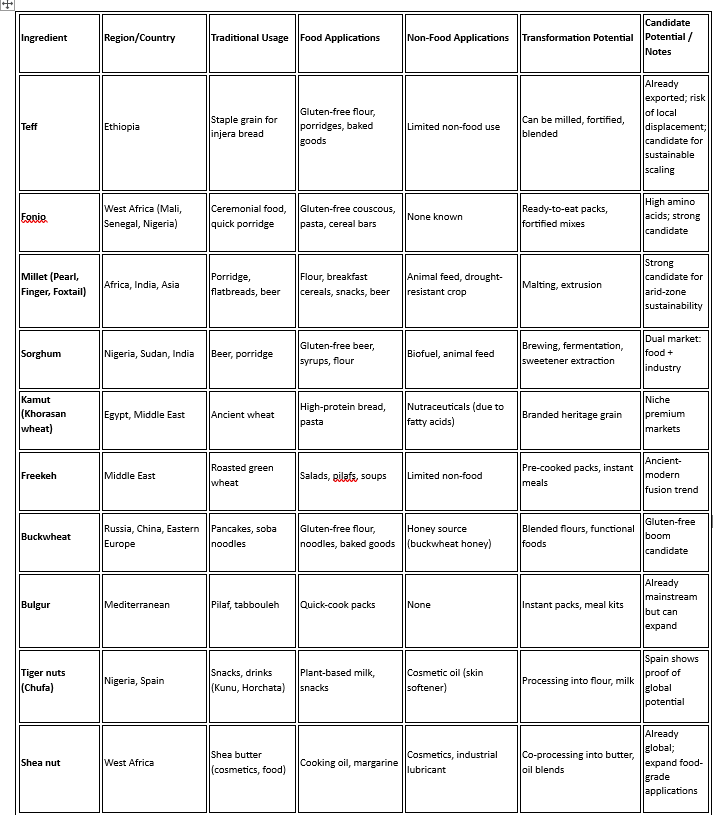
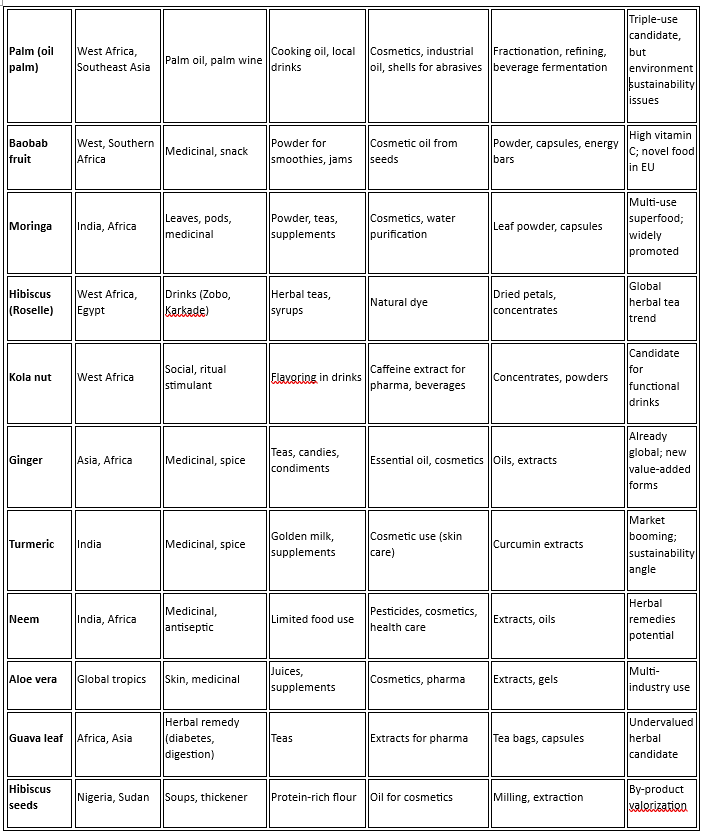
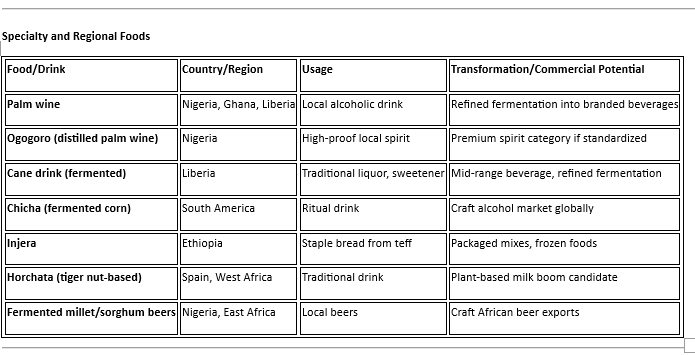
Herbal Remedies & Frameworks
- African herbal mixes: anti-malarial, digestion, fertility remedies. Require dosage validation.
- Chinese TCM herbs: model for systematic validation.
- Ayurvedic herbs: turmeric, ashwagandha, neem.
- Pan-African exploration: guava leaf, bitter leaf, pawpaw leaf, hibiscus calyx.
References for Development
- Case studies: Quinoa (Andes), Teff (Ethiopia), Cocoa (Ghana), Coffee (Ethiopia, Latin America).
- Sustainability models: Fairtrade, Rainforest Alliance.
- Circularity models: Palm by-products, shea waste, hibiscus seed valorization.
- Market entry: Specialty food markets, craft beverage markets, nutraceuticals, cosmetics.