Preamble
This white paper addresses the urgent need to preserve endangered languages and proposes a forward-looking framework that combines community action with the help of Artificial Intelligence (AI). Endangered languages are more than communication systems; they are vessels of ecological knowledge, cultural memory, and alternative worldviews that enrich our collective human intelligence. As globalization accelerates linguistic loss, AI offers both risk and opportunity. Left unchecked, dominant-language AI models may hasten erasure, yet when guided by communities, AI can become a powerful instrument for preservation, revitalization, and innovation.
The importance of this work extends far beyond cultural heritage. Endangered languages encode ecological classifications that can inform climate resilience, unique cognitive frameworks that can inspire new models in psychology and AI reasoning, and ancestral knowledge systems that can support sustainable development. Future applications may include AI models trained on endangered language structures to improve natural language processing, the integration of indigenous ecological terms into environmental monitoring systems, or immersive educational tools that use endangered languages to teach not only words but entire ways of seeing the world.
This paper introduces a Community Crowdsourced Framework (Community crowd sourced Framework) designed to equip local groups with practical tools, technical pathways, and participatory processes for language preservation. The framework prioritizes community control, cultural sovereignty, and sustainability, ensuring that technology amplifies human agency rather than replaces it. By investing in endangered languages today, we safeguard irreplaceable knowledge while unlocking new pathways for scientific, educational, and technological innovation that can benefit future generations.
Preserving Endangered Languages in the Age of AI: An outline White Paper

Abstract
This white paper examines the critical importance of preserving endangered languages and presents a transformative framework for leveraging Artificial Intelligence (AI) in preservation and revitalization efforts. As linguistic diversity faces unprecedented threats from globalization, AI emerges as both a challenge and an opportunity—offering powerful tools for documentation, analysis, and community-led revitalization while requiring careful ethical consideration to avoid digital colonialism.
1. Introduction: The Silent Crisis
Every two weeks, a language dies. With it disappears a unique way of understanding the world—a framework for perceiving time, space, relationships, and the environment that has evolved over millennia. This linguistic extinction represents one of the most profound yet overlooked crises of our time, silently erasing irreplaceable repositories of human knowledge, cultural wisdom, and cognitive diversity.
Currently, over 3,000 of the world’s approximately 7,000 languages are critically endangered, with many having fewer than 100 fluent speakers remaining. UNESCO’s Atlas of the World’s Languages in Danger documents this accelerating loss, revealing that 40% of the world’s languages face extinction within the next century. Unlike species extinction, which garners global attention and conservation efforts, language death occurs largely unnoticed beyond the affected communities.
The drivers of this crisis are well-documented: economic globalization that favors dominant languages in commerce and education, urbanization that separates younger generations from their linguistic heritage, digital divides that exclude minority languages from online spaces, and educational policies that prioritize national or international languages over local ones. Yet within this crisis lies an unprecedented opportunity.
Thesis: While globalization and cultural assimilation accelerate language loss, Artificial Intelligence presents a dual role—simultaneously threatening linguistic diversity through the dominance of major-language models while offering transformative tools for preservation, documentation, and community-driven revitalization efforts that can democratize language maintenance in ways previously impossible.
2. The Incalculable Value of Endangered Languages
2.1 Cultural and Anthropological Treasures
Endangered languages are living libraries of human intellectual achievement, encoding millennia of accumulated knowledge, cultural practices, and unique worldviews. Each language represents a distinct solution to the fundamental human challenge of organizing and expressing experience.
The Guugu Yimithirr language of Australia exemplifies this profound cultural encoding. Unlike English speakers who use relative directions (“turn left at the store”), Guugu Yimithirr speakers must use absolute cardinal directions in all spatial references (“there’s an ant on your south leg”). This linguistic requirement forces speakers to maintain constant spatial awareness, fundamentally shaping their cognitive mapping abilities and relationship with landscape—insights invaluable for understanding human spatial cognition and navigation.
The Aymara language of the Andes demonstrates how languages can encode radically different philosophical concepts. Aymara speakers conceptualize the past as being “in front” of them (because it can be “seen” or known) and the future as “behind” them (because it cannot be seen). This reversal of the typical Western temporal metaphor offers alternative frameworks for understanding time, knowledge, and causality that could inform fields from philosophy to cognitive science.
In the realm of ecological knowledge, the Seri people of Mexico possess a vast vocabulary related to the marine life of the Gulf of California, with detailed classifications of sea turtle behavior, seasonal fish patterns, and sustainable harvesting practices. This knowledge, encoded in their language, represents a sophisticated database of marine ecology accumulated over thousands of years—information of immense value to modern conservation biology and fisheries management.
2.2 Linguistic and Cognitive Revelations
From a linguistic perspective, endangered languages provide crucial data for understanding the full range of human linguistic capacity. Many contain grammatical features absent from major world languages, challenging and refining linguistic theory.
Languages with evidentiality systems require speakers to grammatically mark how they acquired information—whether through direct observation, hearsay, inference, or assumption. The Tariana language of Brazil has five distinct evidential markers, forcing speakers to constantly evaluate and communicate their epistemic stance. Studying such systems reveals how language can shape patterns of reasoning, evidence evaluation, and knowledge transmission.
The switch-reference systems found in many Native American languages require speakers to track whether the subject of a subordinate clause is the same as or different from the subject of the main clause. This grammatical feature provides insights into how humans cognitively manage complex narrative structures and maintain coherence across extended discourse.
2.3 Scientific and Ecological Goldmines
Indigenous languages often serve as taxonomic systems for local ecosystems, containing precise classification schemes developed through intimate, multigenerational observation of natural phenomena. The Kallawaya healers of Bolivia maintain a secret language largely based on medicinal plants, essentially functioning as an encrypted pharmacological database. Their linguistic knowledge has already contributed to the discovery of several compounds of medical interest.
The Kayah people of Myanmar have developed complex soil classification systems embedded in their language, with distinct terms for soil types based on color, texture, drainage, and suitability for specific crops. This knowledge directly informs sustainable agricultural practices and soil conservation strategies relevant to modern farming challenges.
Australian Aboriginal languages contain sophisticated systems for describing weather patterns, seasonal indicators, and ecological relationships. The Gunditjmara people’s language includes detailed descriptions of ancient aquaculture systems that guided archaeologists to the rediscovery of sophisticated fish trap networks dating back thousands of years.
3. AI as a Preservation and Revitalization Tool: Methods and Applications
3.1 Data Collection and Curation
Modern AI technologies offer unprecedented capabilities for processing and organizing linguistic data. Automatic Speech Recognition (ASR) systems, while originally developed for major languages, can be adapted for low-resource endangered languages with remarkably small datasets.
Te Hiku Media’s pioneering work with Māori (te reo Māori) demonstrates this potential. They developed an ASR system achieving 92% accuracy with community-owned data governance protocols, ensuring that the technology serves Māori educational and broadcasting needs while maintaining cultural sovereignty over linguistic data. Their “data is like land” framework establishes community ownership of linguistic data with clear protocols for access, revenue sharing, and cultural sensitivity.
AI-powered tools can process thousands of hours of legacy recordings—from aging magnetic tapes to digital files—automatically generating initial transcriptions that human speakers can then verify and correct. This dramatically reduces the time required for corpus development from decades to months.
3.2 Transcription and Translation
Machine learning algorithms excel at pattern recognition, making them ideal for developing orthographies for previously unwritten languages and creating translation models even with limited parallel texts. However, this process must always maintain human-in-the-loop collaboration with native speakers and community linguists.
Mozilla’s Common Voice project has demonstrated scalable approaches to building open speech datasets, now covering over 100 languages with continuing expansion into Indigenous languages. Their open-source methodology provides communities with tools to collect, validate, and share linguistic data while maintaining control over its use.
The No Language Left Behind project by Meta AI created translation models for 200 languages, including many low-resource languages. While not specifically focused on endangered languages, the technical approaches—using multilingual transfer learning and data augmentation techniques—provide valuable methodologies for working with limited data.
3.3 Interactive Learning Tools
AI enables the creation of personalized, adaptive learning experiences that can support language acquisition and maintenance within communities. These applications must be designed with and for communities, respecting cultural protocols around language use and transmission.
Pronunciation coaching systems can provide real-time feedback to heritage language learners, using ASR technology to identify pronunciation differences and guide improvement. The Māori ASR project has spawned tutoring applications that help students improve their pronunciation in real-time—crucial for tonal or phonetically complex languages where traditional written materials fall short.
Chatbots and conversational AI can provide practice opportunities for learners when native speakers are unavailable. These systems can be trained on cultural narratives, traditional stories, and domain-specific vocabularies, offering contextually appropriate conversation practice.
Gamified learning platforms can make language acquisition engaging for younger community members, incorporating traditional stories, cultural knowledge, and community-specific content into interactive experiences.
3.4 Synthetic Media for Revival
Advanced AI can generate synthetic speech from limited recordings of last fluent speakers, potentially allowing new learners to hear and practice with the language even after native speakers have passed away. This application requires careful ethical consideration and community consent, as it involves creating “digital voices” of community members.
Voice synthesis technology can be trained on as little as 10-15 minutes of clean audio to create synthetic voices that maintain the phonetic characteristics of the original speaker. This technology could enable the creation of audiobooks, educational materials, and interactive content in endangered languages.
Text-to-speech systems specifically tuned for endangered languages can convert written materials into audio, supporting literacy efforts and making written resources accessible to community members with varying levels of reading proficiency.
4. Funding and Sustainable Project Architecture
4.1 Multi-Stakeholder Funding Models
Sustainable endangered language preservation requires diversified funding approaches that recognize both the cultural importance and practical applications of this work.
Public Funding Sources:
- National Science Foundation (NSF) Documenting Endangered Languages (DEL) program
- National Endowment for the Humanities (NEH) Preservation and Access grants
- UNESCO Intangible Cultural Heritage funds
- National and regional cultural heritage agencies
- Indigenous affairs departments and tribal government funding
Philanthropic Foundations:
- The Endangered Languages Fund provides direct support to community-led documentation projects
- Wikimedia Foundation supports open-access linguistic resources and tools
- Private foundations focused on cultural preservation and education
- Family foundations with interests in anthropology, linguistics, or specific cultural regions
Corporate Social Responsibility Programs: Technology companies increasingly recognize their role in supporting linguistic diversity:
- Google’s AI for Social Good initiative supports the Endangered Languages Project
- Microsoft’s AI for Accessibility program includes language preservation components
- Meta’s commitment to multilingual AI development creates opportunities for partnership
- Mozilla’s Common Voice project demonstrates sustainable open-source approaches
Community-Led and Crowdfunding Initiatives:
- Platforms like GoFundMe and Kickstarter enable diaspora communities to support preservation efforts
- Patreon allows ongoing support for language activists and educators
- Local fundraising within communities builds ownership and sustainability
- Cultural events and traditional crafts sales can support language programs
4.2 Project Proposal Blueprint
Successful funding proposals for AI-enhanced language preservation should include:
Community Partnership Framework:
- Clear agreements with community stakeholders about data ownership and usage rights
- Cultural protocols for handling sensitive materials (sacred songs, ceremonial language)
- Training plans for community members to maintain and extend the work
- Revenue-sharing agreements for any commercial applications
Technical Deliverables:
- Searchable digital corpus with metadata standards
- Mobile applications for learning and practice
- ASR and text-to-speech systems tuned for the specific language
- Online dictionaries with audio pronunciation guides
- Documentation of linguistic features and cultural context
Long-term Sustainability Plans:
- Community training programs for maintaining digital resources
- Integration with existing educational institutions (schools, community centers)
- Plans for ongoing data collection and corpus expansion
- Partnerships with academic institutions for continued research support
5. Novel Value Adds and Cross-Disciplinary Applications
5.1 AI Model Improvement and Robustness
Working with endangered languages creates technical challenges that drive innovations benefiting all AI applications. Low-resource language processing requires more efficient algorithms, better transfer learning techniques, and more robust models that can handle linguistic diversity.
Masakhane, a grassroots African NLP collective, demonstrates how community-driven approaches to language technology can advance both preservation goals and technical capabilities. Their work on African languages has contributed to better multilingual models and transfer learning techniques that benefit the broader AI community.
The complex grammatical features of endangered languages—such as evidentiality systems, rich morphology, and unique syntactic structures—serve as challenging test cases for natural language processing systems, forcing improvements in model architecture and training techniques.
5.2 Cognitive Science and Psychology Applications
Preserved endangered languages provide unique datasets for investigating the relationship between language structure and cognition. The documentation of languages with absolute spatial reference systems (like Guugu Yimithirr) has contributed to understanding of spatial cognition and navigation abilities.
Languages with complex evidentiality systems offer insights into how grammatical structures might influence reasoning patterns and evidence evaluation. This research has applications in developing better AI systems for fact-checking, source evaluation, and knowledge representation.
5.3 Educational Innovation
Endangered language preservation projects pioneer innovative pedagogical approaches that can benefit all language education:
- Immersive digital environments for language learning
- Community-based teaching methodologies that integrate cultural knowledge
- Intergenerational learning programs that leverage both elder knowledge and youth technical skills
- Assessment tools that respect cultural values around language competence
Māori language revitalization in New Zealand demonstrates how community-controlled language education can transform not just linguistic outcomes but broader social and economic development within communities.
5.4 Media and Cultural Production
Preserved languages enable authentic representation in media and entertainment, supporting cultural tourism and creative industries. The success of films and television programs featuring indigenous languages (such as the recent popularity of content in Māori, Welsh, and various Native American languages) demonstrates commercial viability.
Video games and interactive media can incorporate endangered languages, creating engaging ways for younger generations to encounter their linguistic heritage while building digital literacy skills.
5.5 Commerce and Economic Development
Language preservation supports economic development within communities through:
- Cultural tourism programs that showcase linguistic diversity
- Artisan and craft industries that incorporate traditional language elements
- Local media production (radio, podcasts, social media content)
- Translation and interpretation services for government and healthcare systems
- Educational consulting for multicultural programs
6. Ethical Considerations and Challenges
6.1 Data Sovereignty and Digital Colonialism
The most critical ethical consideration in AI-enhanced language preservation is ensuring that communities maintain control over their linguistic and cultural heritage. The history of anthropological and linguistic research includes numerous examples of extractive practices where outside researchers collected cultural materials without meaningful community benefit or control.
Community-Owned Data Governance models, exemplified by Te Hiku Media’s approach, establish clear protocols for:
- Who can access linguistic data and under what conditions
- How any commercial benefits from AI applications should be shared
- Cultural protocols around sensitive or sacred language materials
- Training and employment opportunities for community members in technical roles
Digital Colonialism concerns arise when technology companies or academic institutions develop AI tools for endangered languages without meaningful community partnership, potentially replicating colonial patterns of extraction and control.
6.2 The Limitations of AI
AI is a powerful tool for language preservation but cannot replace human speakers and community-led revitalization efforts. Technology should augment and support human relationships with language, not substitute for them.
The “Digital Graveyard” Risk occurs when languages are extensively documented and digitally preserved but not actively revitalized within living communities. Documentation alone does not constitute preservation—languages must continue to evolve and adapt through active use.
Quality and Accuracy Concerns require ongoing human oversight, especially for culturally sensitive materials. AI-generated content must be reviewed by native speakers and cultural authorities to ensure accuracy and appropriateness.
6.3 Cultural Sensitivity and Sacred Knowledge
Many languages contain elements that communities consider sacred, restricted, or inappropriate for certain audiences. AI systems must be designed with cultural protocols that respect these boundaries:
- Gender-specific language materials that should only be accessed by appropriate community members
- Sacred songs or ceremonial language that should not be used in secular applications
- Traditional ecological knowledge that communities wish to keep within specific contexts
7. Implementation Framework: A Practical Roadmap
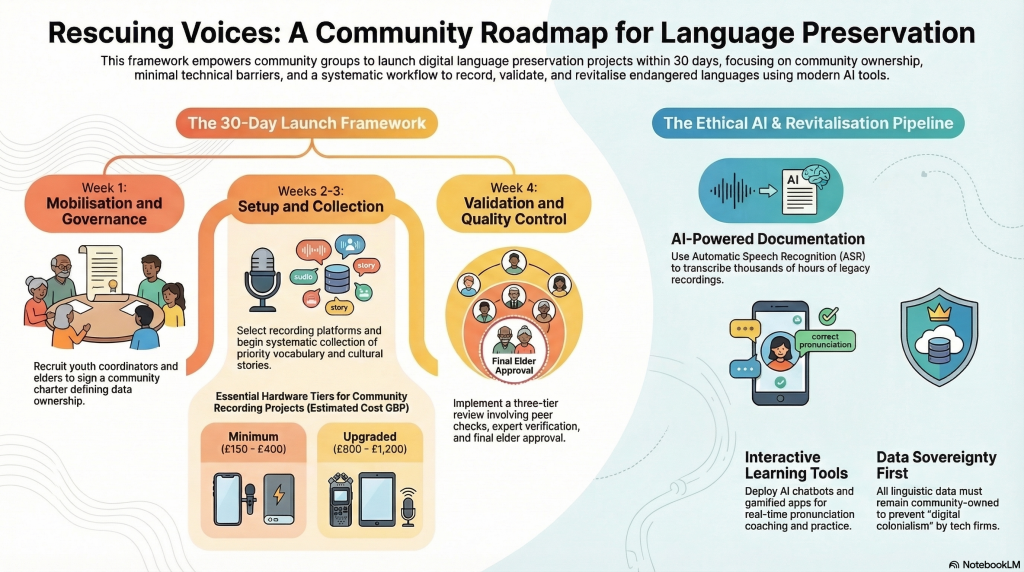
7.1 Phase 1: Community Engagement and Planning (Months 1-3)
Community Partnership Development:
- Identify and engage community stakeholders, elders, and language advocates
- Establish cultural protocols and data governance agreements
- Conduct linguistic assessment to determine documentation status and revitalization priorities
- Develop community-controlled research agreements with clear benefit-sharing provisions
Technical Assessment:
- Evaluate existing linguistic materials (audio recordings, texts, dictionaries)
- Assess community technology capacity and training needs
- Identify appropriate AI tools and platforms for the specific language context
- Plan for sustainable technical infrastructure
7.2 Phase 2: Data Collection and Initial Processing (Months 4-9)
Corpus Development:
- Collect new audio and text materials using community-appropriate methodologies
- Digitize and process legacy materials with appropriate cultural protocols
- Train initial ASR models using transfer learning from related languages
- Develop preliminary orthographies and transcription standards with community linguists
Community Training:
- Train community members in data collection and digital archiving techniques
- Provide technical literacy training for ongoing project maintenance
- Establish local capacity for quality control and cultural review processes
7.3 Phase 3: Application Development and Testing (Months 10-15)
Core Applications:
- Develop pronunciation coaching tools and basic learning applications
- Create searchable digital dictionaries with audio components
- Build text-to-speech systems for educational material production
- Test and refine applications with community feedback
Educational Integration:
- Partner with local schools, community centers, and cultural programs
- Develop age-appropriate learning materials and curricula
- Train educators in using AI-enhanced language learning tools
7.4 Phase 4: Scaling and Sustainability (Months 16+)
Broader Implementation:
- Expand applications based on community feedback and priorities
- Develop advanced features like conversational AI and cultural content generation
- Create partnerships with other communities working on related languages
- Establish ongoing funding and maintenance frameworks
Knowledge Transfer:
- Document methodologies and lessons learned for other communities
- Contribute to open-source tools and platforms for endangered language preservation
- Participate in academic and policy discussions about language preservation technology
8. Case Studies and Success Stories
8.1 Te Hiku Media: Māori Language AI
Te Hiku Media’s development of Māori ASR technology demonstrates the potential of community-controlled language AI. Their project achieved:
- 92% accuracy in Māori speech recognition
- Community ownership of all linguistic data and AI models
- Integration with Māori educational institutions and broadcasting
- Employment and training opportunities for Māori community members
- Clear protocols for data sovereignty and cultural sensitivity
8.2 Mozilla Common Voice: Global Participation
Mozilla’s Common Voice project has successfully engaged communities worldwide in building open speech datasets:
- Over 100 languages represented with continuing expansion
- Community-driven data collection and validation processes
- Open-source tools and methodologies available to all communities
- Integration with educational and commercial applications
8.3 Masakhane: African Language Technology
The Masakhane collective demonstrates grassroots approaches to language technology development:
- Community-led research and development by Africans for African languages
- Open sharing of resources and methodologies
- Focus on practical applications that benefit participating communities
- Integration of linguistic diversity considerations into AI development
9. Policy Recommendations
9.1 Government Support
National Language Policy:
- Recognize endangered languages as national cultural heritage requiring protection
- Provide dedicated funding streams for community-led preservation efforts
- Support integration of endangered languages into educational curricula
- Ensure indigenous and minority language rights in digital services
Research and Development:
- Fund interdisciplinary research connecting linguistics, AI, and community development
- Support university-community partnerships with equitable benefit sharing
- Provide technical infrastructure and training for community-led projects
9.2 Industry Engagement
Technology Company Responsibilities:
- Include endangered languages in AI ethics and accessibility initiatives
- Provide technical support and infrastructure for community-led projects
- Ensure that AI development does not further marginalize minority languages
- Support open-source tools and platforms for language preservation
Professional Standards:
- Develop industry standards for ethical AI development in cultural contexts
- Provide training for technologists working with endangered languages
- Establish best practices for community partnership and data sovereignty
9.3 International Cooperation
UNESCO and International Bodies:
- Expand support for endangered language preservation as part of cultural heritage protection
- Facilitate international sharing of preservation methodologies and technologies
- Support capacity building in communities and regions with high linguistic diversity
- Integrate language preservation into sustainable development goals
10. Conclusion: A Call to Collaborative Action
The preservation of endangered languages represents one of the most pressing cultural and intellectual challenges of our time. As we stand at the intersection of unprecedented language loss and revolutionary technological capability, we face a unique historical moment that demands coordinated, ethical, and community-centered action.
AI technologies offer transformative possibilities for language preservation, but only when deployed in partnership with communities and guided by principles of cultural sovereignty and benefit-sharing. The examples of Te Hiku Media, Mozilla Common Voice, and Masakhane demonstrate that community-controlled technology development can achieve both preservation goals and technical innovation.
The Path Forward requires:
For Communities: Engagement with technology as a tool for cultural sovereignty, not cultural replacement. The most successful preservation efforts combine traditional knowledge transmission methods with strategic use of digital tools.
For Technologists: Recognition that endangered language preservation is not just a technical challenge but a cultural and ethical one requiring deep community partnership and ongoing relationship-building.
For Policymakers: Understanding that linguistic diversity is a form of biodiversity requiring active protection and support, with clear policy frameworks that support community-led efforts.
For Academics: Commitment to decolonized research practices that prioritize community benefit and control over extractive data collection.
For Funders: Support for long-term, community-controlled projects that build local capacity and sustainable preservation infrastructure.
The Vision: A world where technology amplifies rather than erases cultural diversity, where AI serves as a bridge between generations and cultures rather than a force for homogenization, and where the full spectrum of human linguistic creativity continues to evolve and inspire future generations.
The languages we save today carry within them solutions to challenges we have not yet imagined, ways of thinking we have not yet explored, and knowledge systems we have not yet understood. In preserving endangered languages through ethical AI development, we preserve not just communication tools but entire ways of being human in the world.
The work is urgent, the opportunities are unprecedented, and the responsibility is collective. The question is not whether we can afford to preserve endangered languages in the age of AI, but whether we can afford not to.
References and Resources
Key Organizations:
- Endangered Languages Project (endangeredlanguages.com)
- Te Hiku Media (tehiku.nz)
- Mozilla Common Voice (commonvoice.mozilla.org)
- Masakhane (masakhane.io)
- Living Tongues Institute (livingtongues.org)
- UNESCO Atlas of the World’s Languages in Danger
Technical Resources:
- ELAR: Endangered Languages Archive (elar.soas.ac.uk)
- OLAC: Open Language Archives Community (language-archives.org)
- SIL International Linguistic Resources
- Wikidata Lexemes for morphological data
Funding Sources:
- NSF Documenting Endangered Languages Program
- NEH Preservation and Access Grants
- Endangered Languages Fund
- Indigenous Language Technology funds