The Case for a Second Mobile Device
Why AI-Augmented, Rugged, and Modular Devices Could Outgrow the Smartphone
Preamble
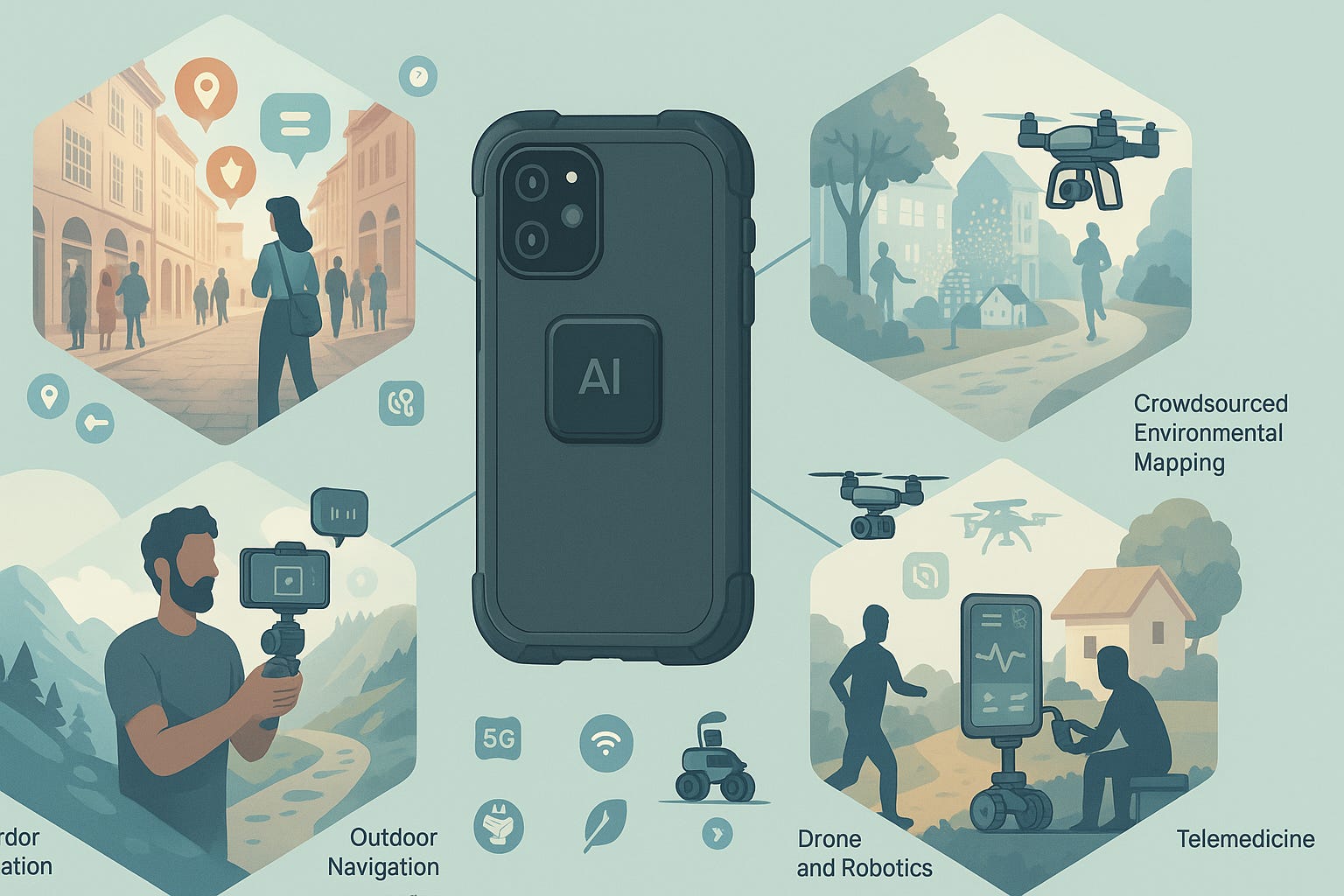
Smartphones dominate daily life, yet growth in developed markets has stalled. To unlock new demand, build a rugged, AI-augmented secondary device and platform that turns real places into interactive layers. With it, you can leave or discover virtual notes, treasures, and challenges; film on the move with a modular studio; navigate trails more safely; crowdsource high value environmental data; run drones or small robots as camera crews; and add telemedicine modules for remote care. This is a path to new revenue and defensible IP, not a novelty.
General-purpose phones optimize for the average case. They excel at cameras, performance, and apps, but they under serve specific jobs such as rugged outdoor use, immersive AR gaming, extended battery workflows, and mobile content creation. The answer is a new category, a rugged, AI-ready companion device with modular attachments that turns into specialized tools when you need them.
A Contrarian View: Why One Phone Is Not Enough
The prevailing assumption is that people don’t want a second device. Minimalism and convergence seem like the endgame. But this view ignores two realities. First, smartphones are optimized for mass-market averages, not niche needs. Second, specialized tasks often demand dedicated tools. We already accept this in other domains: laptops coexist with tablets, cameras with phones, and smartwatches with both. Why should mobile computing be different?
The contrarian argument is that the “one-device-for-all” model is outdated. Just as adventurers carry rugged GPS units, creators travel with gimbals, and gamers invest in consoles, secondary devices will emerge for tasks that smartphones cannot fully support.
The Role of AI: Turning Hardware Into Companions
AI transforms this device from an accessory into a proactive partner. Edge AI processing enables real-time environmental mapping, object recognition, and gameplay responsiveness. AI companions learn your patterns, adapt difficulty in games, optimize battery usage, and personalize creative workflows.
Examples:
- In AR gaming, AI anticipates user strategy and dynamically alters missions.
- For content creators, AI suggests framing, edits clips, and even generates highlight reels.
- Outdoor adventurers benefit from AI-driven hazard alerts and adaptive navigation.
The device becomes more than a tool. It becomes a context-aware co-pilot.
As usual my stuff: Artifacts
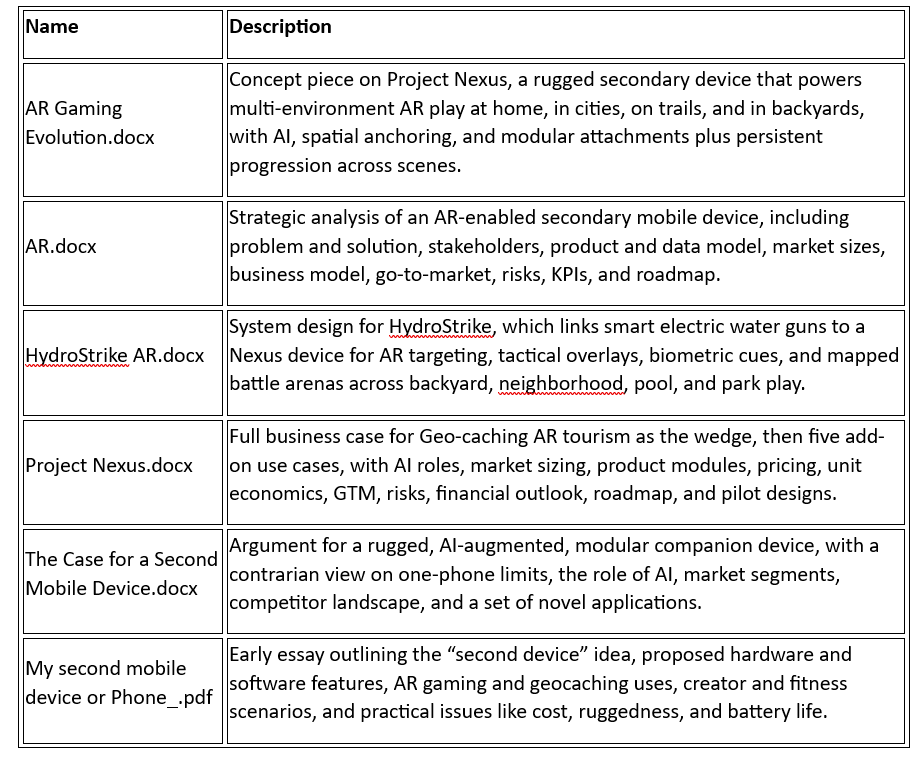
Project Nexus: A Business Case for Geo-caching AR Tourism and a Family of AI-Augmented Outdoor Experiences
Building a profitable platform for place-based play, creation, safety, and field work
Executive summary
Opportunity. Launch a place-based AR platform anchored by a rugged AI companion device and phone apps. Start with Gaming Geo-caching and AR Layered Tourism as the wedge. Expand into five adjacent use cases that share the same hardware, maps, and AI stack.
Why now. AR engines, on-device AI, and 5G are ready. Outdoor recreation and the creator economy are growing. Consumers already pay for smart outdoor gear and premium play, as seen in connected water blasters and accessories.
Target users. AR gamers, outdoor enthusiasts, mobile creators, professional field workers, and fitness users. Segment sizes range from 2 million AR early adopters to 50 million fitness gamers globally.
Business model. Hardware margin plus subscriptions, marketplace take on content and attachments, and enterprise licensing. Expected gross margin 40 to 50 percent with 8 to 12 month payback if CAC stays near 150 to 250 dollars and LTV reaches 1,200 to 2,000 dollars per user.
Problem and contrarian thesis
Smartphones serve the average use case. They are not optimized for rugged gameplay, day-long filming, glove-friendly inputs, or safe off-grid navigation. The contrarian bet is that users will add a second device or a dedicated mode when the experience is meaningfully better, safer, or more fun. We already do this with action cameras, drones, and consoles. The same logic will hold for AI-augmented, outdoor-safe AR.
Solution overview
A cross-use-case platform built on the same stack.
- Gaming Geo-caching and AR Layered Tourism
Users drop puzzles, notes, and treasure at physical spots. Visitors unlock them in AR, follow story trails, and earn creator rewards. Safety filters hide non-participants, and dynamic difficulty reacts to weather and crowding. City tours, museums, festivals, and heritage sites can run seasonal hunts and sponsor routes. - AI-Powered Creative Studios
A modular rig turns the device into a pocket studio. AI suggests framing, stabilizes footage, edits highlights, and adds AR graphics. Drones or small ground robots act as roaming camera operators controlled by the same device. This raises production value for solo creators. - Outdoor Navigation and Safety
The app generates difficulty-rated virtual trails from satellite and local data. It adjusts for weather and fatigue, warns of hazards, and supports group coordination. AR guides overlay cairns, runestones, or waypoints without distracting from the path. - Crowdsourced Environmental Mapping
Users capture trails, trees, wildlife, street furniture, and building facades to feed privacy-safe digital twins. This supports conservation tasks, local planning, and immersive tourism layers. The same data powers future game content. - Drone and Robotics Integration
Use the device as brain and controller. Scripts switch among angles, track subjects, and keep safe standoff distances. Great for interviews, sports, property tours, and events without a full crew. - Telemedicine Extensions
Clip-on health modules capture vitals. The AI performs triage, records case notes, and forwards a summary to clinicians when signal returns. This adds value for outfitters, tours, and rural clinics.
The role of AI
The platform uses edge AI for perception, personalization, safety, and creation.
- Perception. Environmental mapping, object detection, and lane or trail recognition.
- Personalization. Adaptive missions, fatigue-aware pacing, creator presets.
- Safety. Non-player filtering, boundary alerts, weather and crowd checks.
- Creation. Auto edit, highlight reels, and AR overlays in context.
- Performance. Smart preloading and battery management so long sessions stay smooth.
Market size and competition
Top segments.
AR gaming early adopters 2 million. Outdoor adventure 15 million. Mobile creators 8 million. Professional field workers 25 million. Fitness gamification 50 million. These segments accept gear purchases and subscriptions.
Competitors.
Direct options include head-mounted AR and handheld gaming. Indirect options include action cameras, rugged phones, and wearables. Apple and Meta ecosystems will pressure content and attention. Your advantage is place-based play plus safety and creator value in one stack.
Parallel signal.
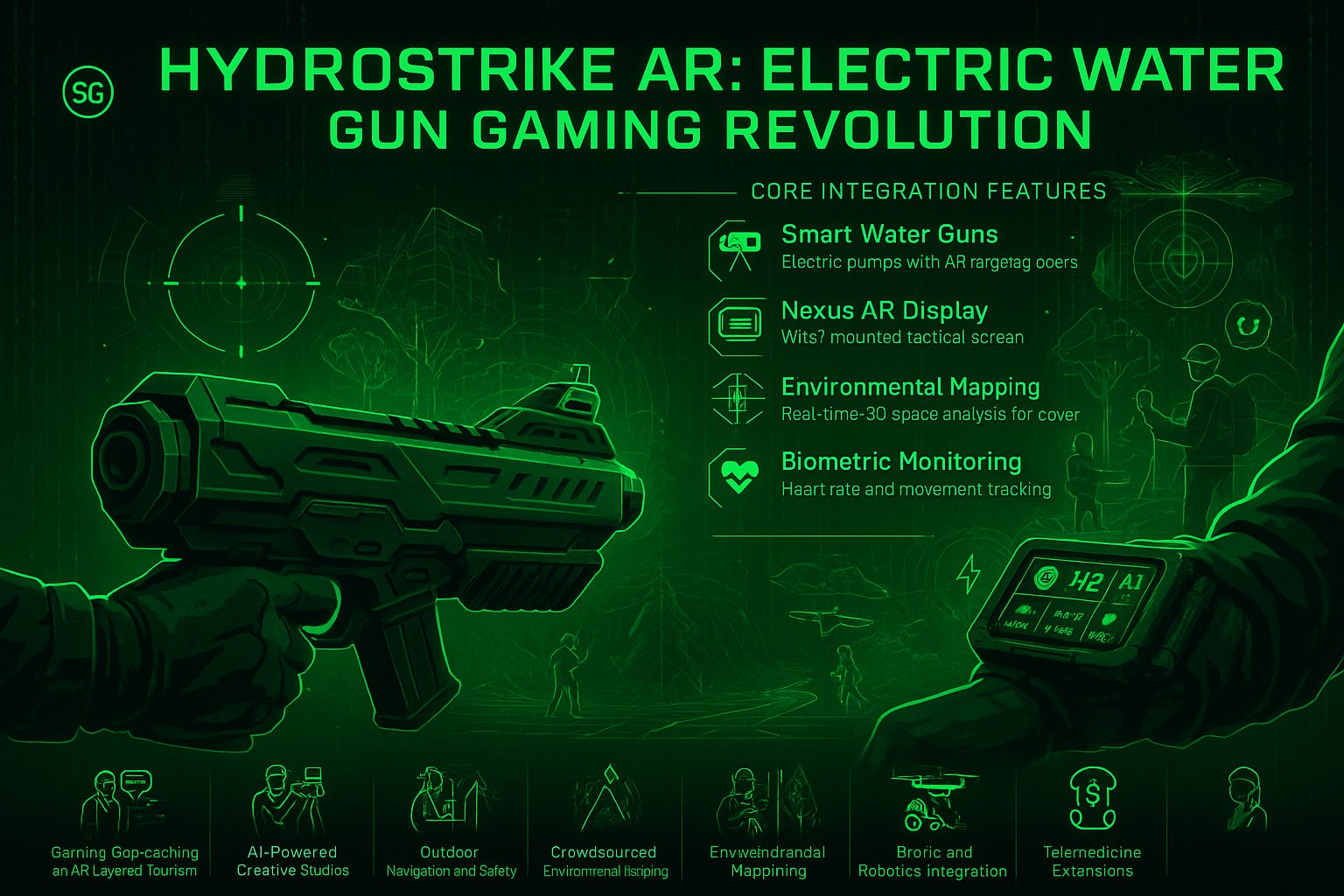
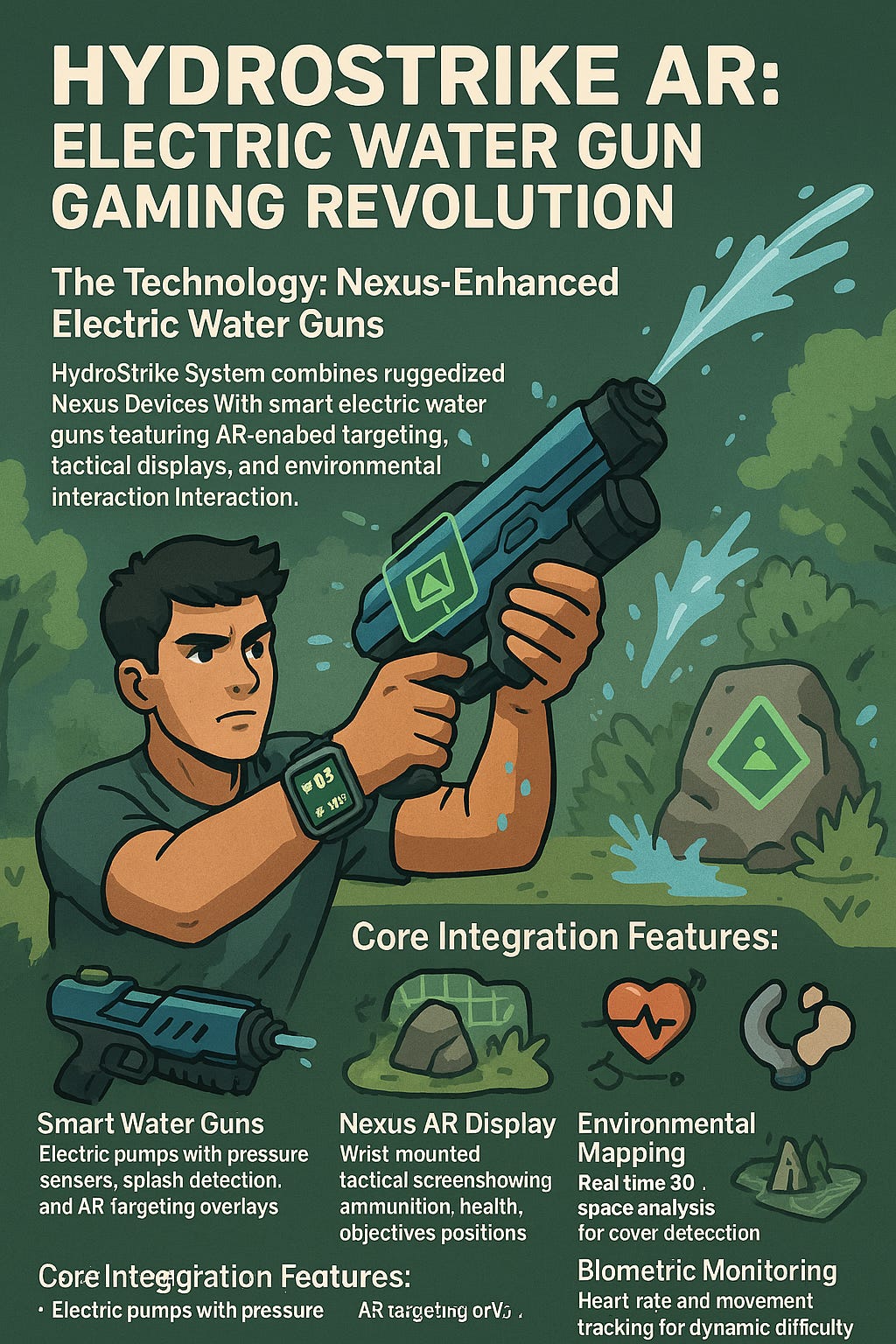
Connected water blasters show demand for smart outdoor play and tournament formats. Partnerships here provide an on-ramp to families and communities.
Product and data model
Core modules. Reality Engine for AR mapping, AI Companion, Social Hub, Creator Suite, Fitness and Safety, and Storage Vault for offline content. Key datasets include spatial maps, user behavior, community activity, content libraries, and device performance.
Attachment ecosystem. Water play, camera rigs, gimbals, health sensors, and drone docks. The same SDK supports game studios, tour operators, and outdoor brands.
Business model and pricing
- Hardware. Device at 400 to 800 dollars. Attachments with 30 percent margins.
- Subscriptions. 9.99 dollars per month for premium AI features, cloud sync, creator packs, and safety services.
- Marketplace. 70 to 30 split on paid routes, tours, and quest lines. Same split for creator LUTs, templates, and effect packs.
- Enterprise. Licenses for tourism boards, outdoor retailers, event operators, field services, and clinics.
Unit economics target. CAC 150 to 250 dollars through creators, outfitters, and events. LTV 1,200 to 2,000 dollars from hardware, 24 months of subscription, and add-ons. Payback in 8 to 12 months. Gross margin 40 to 50 percent.
Go-to-market
Wedge. Launch city-scale AR Geo-caching Tourism and neighborhood games. Add outdoor navigation and creator studio packs in months 4 to 9.
Channels.
Direct online with try-before-buy AR previews. Outdoor stores and tourism partners. Gaming and maker events. Carrier bundles in year two.
Lighthouse partners.
A water-play brand for family events. Two tourism boards for seasonal city hunts. An outdoor retailer for trail challenges. Three creator teams for flagship shorts.
Technology and operations
- Edge AI and CV. Low latency on device. Stable in sun, rain, and low light.
- Connectivity. 5G and Wi-Fi 6 with offline fallbacks and safe store-and-forward.
- Safety by design. Civilians filtered from overlays. Automatic pause near roads and during pool swim sessions. Privacy-first defaults and clear consent for shared routes.
- Creator pipeline. One-tap capture, auto cut, and branded templates.
Risks and mitigations
- Battery and heat. Optimize on-device AI and give users power-save presets. Field test on long routes.
- Content velocity. Seed 50 plus launch routes and quests through partner studios. Run monthly creator bounties.
- Regulation and liability. Build to GDPR and safety standards. Add geofences and dynamic de-risking rules.
- Platform responses from big tech. Lean into open maps, modular hardware, and local partners. Secure IP on AR interactions and mounts.
Financial outlook, year 1 to year 2
Assumptions. 10,000 devices shipped, 25 percent attach rate on camera and water-play modules, 40 percent take-up on subscription at month 3. CAC 180 dollars. Hardware gross margin 40 percent.
Outcomes.
- Hardware gross profit: about 1.6 to 2.4 million dollars.
- Subscriptions: about 480,000 dollars ARR by month 12.
- Marketplace and events: 300,000 to 500,000 dollars.
This mix supports break-even near month 12 if returns and warranty stay within plan. Numbers align with the unit economics envelope above.
Roadmap and proof milestones
0 to 90 days. Ship Geo-caching MVP, safety filters, and two city pilots. Recruit 100 active testers with 4 hours weekly use.
3 to 6 months. Launch creator studio pack, trail safety, and family water-play events. Reach 1,000 beta users with 80 percent satisfaction.
6 to 12 months. Developer tools, marketplace, and first enterprise licenses. 10,000 preorders and 50 plus experiences live.
KPIs. Monthly active AR sessions as North Star. Track session duration, retention, attachment rate, paid route purchases, and incident-free miles on trails.
Pilot designs
- City Heritage Hunt. Three themed routes with local merchants funding prizes. Measure dwell time and coupon redemption.
- Trail Safety Challenge. Difficulty-rated loops with fatigue-aware pacing and weather-smart alerts. Measure incident reduction.
- Creator Weekend. Mobile studio kits plus roaming drone scripts for a festival recap. Deliver finished reels by Sunday night.
- Family Water-Play Cup. Backyard and park tournaments with safe boundaries and auto highlights. Measure repeat sessions.
Conclusion
Start with Gaming Geo-caching and AR Layered Tourism because it is fun, easy to explain, and sponsor friendly. Use the same AI, maps, and device to expand into creation, safety, mapping, drones, and care. The platform earns across hardware, subscriptions, content, and partnerships. The work is not to convince people to buy another screen. The work is to make place-based experiences safer, richer, and more creative than a phone alone can offer.