Preamble
What happens when you take a freshly minted design framework and stress-test it against a real business concept? This analysis applies The New New Design methodology a four-part framework for creating meaning in an age where quality is ubiquitous to “Around the World in 360 Snacks” a cultural discovery platform that transforms passive snacking into active global citizenship.
The results reveal something unexpected: the framework does not just evaluate the business it elevates it. What began as a subscription box concept evolves into cultural infrastructure, complete with diplomatic partnerships, algorithmic personalization, and stakeholder governance models. Along the way, we uncover critical gaps the original concept missed: accessibility barriers, cultural appropriation risks, supply chain vulnerabilities, and the tension between scaling and authenticity.
This is not just a case study. It is a demonstration of how design thinking in the post-quality-parity era must wrestle with questions far beyond aesthetics and functionality questions of power, legacy, and whose stories get told.
The New New design references:
The New New Design Part 1: Closing the Branding Gap in a World Where Quality is Ubiquitous , The New New Design Part 2: The Architecture of Meaning in the Age of Quality Parity , The New New Design Part 3: Turning Stakeholder Desire into Products and Services The New New Design Part 4: Beyond existing Standards of Excellence in the Post-Parity Era
Executive Summary: Positioning in the Post-Quality-Parity Era
Around the World in 360 Snacks operates at the intersection of three paradigm shifts identified in The New New Design methodology: quality democratization (where curation and meaning remain scarce), narrative as currency (where cultural authenticity creates value independent of material scarcity), and participation economics (where consumers seek co-creation, not just consumption).
The analysis elevates the concept beyond “subscription box with app” to a cultural infrastructure platform that transforms passive snacking into active cultural participation. The framework exposes both the concept’s potential and its vulnerabilities, from operational complexity to the ethical minefields of cultural commerce.
If you want a deep dive read the longform article : Applying The New New Design framework to Around the world in 360
Market Niche Relevance: Finding the Underserved
The Stakeholder Landscape
The framework reveals five distinct stakeholder clusters, each with layered desires beyond simple product consumption:
Curious Cosmopolitans seek portable cultural literacy and conversation starters they are not buying snacks; they are buying social capital. Diaspora Communities need more than access to home-country flavors; they want validation of cultural identity and tools to bridge their heritage with their current home. Corporate Cultural Architects face pressure to demonstrate genuine DEI commitment through experiential tools, not lectures creating an opening for “Cultural Intelligence Workshops in a Box” priced at 3-5x consumer rates.
Tourism and Diplomatic Institutions struggle with expensive bespoke gifting that lacks engagement metrics, creating demand for white-label cultural passport programs with trackable conversion to tourism and trade. Educational Institutions need hands-on cultural education tools, opening opportunities in homeschooling families, language learning programs, and international student orientation.
The competitive analysis reveals that existing players like Bokksu (Japan-focused), Universal Yums (global but surface-level), and SnackCrate (kid-friendly) all share critical gaps: no algorithmic personalization, minimal app functionality, subscription-centric models, absent B2B strategies, and passive consumption without community co-creation.
Storytelling Architecture: Narrative as Infrastructure
Three-Layer Story System
The New New Design framework demands narrative depth at every scale. The macro narrative positions the platform as infrastructure for cultural curiosity, democratizing flavor exploration that once required wealth and travel privilege. But the framework pushes further: every brand story needs an identified antagonist here it is “generic globalization that homogenizes taste” or “exclusionary luxury that gatekeeps cultural access”.
At the product level, each box must tell a complete story with cultural context, flavor geography mapping regional traditions, maker connections that humanize the supply chain, and participation invitations beyond eating. A Diwali box, for example, does not just contain “traditional Indian sweets” but traces the festival’s flavor geography from Bengali sandesh to Gujarati mohanthal, with audio stories from the families who make them.
The micro narrative—individual item storytelling—transforms a simple rice cracker into a window on culture: “Third-generation cracker master Takeshi Nakamura still hand-brushes soy glaze using his grandmother’s recipe. These crackers are grilled over binchotan charcoal… In Osaka, senbei are less snack than ritual: they accompany tea ceremonies and signal hospitality”.
Visual Identity as Cultural Translation
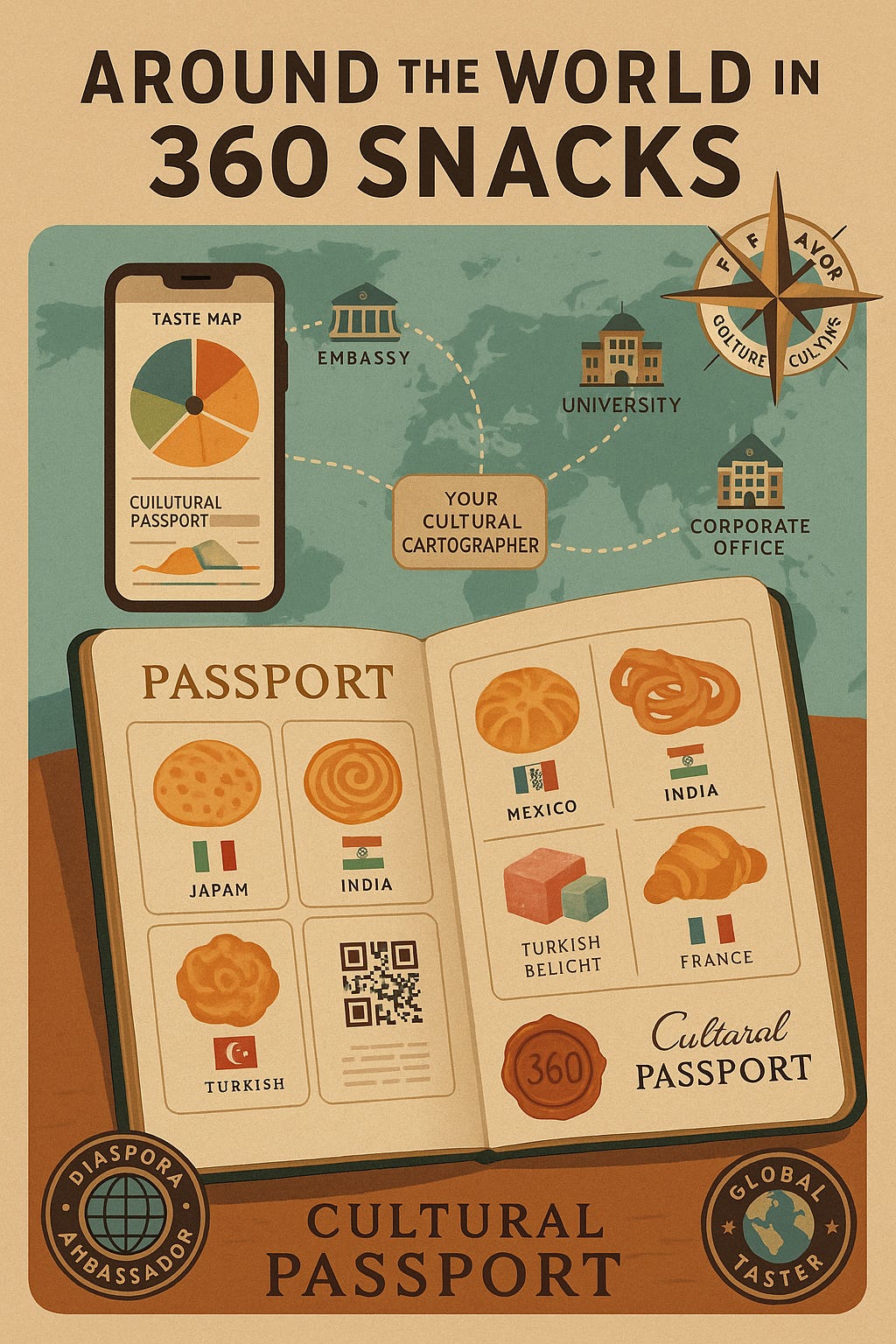
The passport aesthetic creates ritualized unboxing: collectible country stamps, app “visas” that fill with tasted destinations, wax seals with region-specific emblems, and layered packaging that mimics arrival at borders. The framework demands tactile materiality kraft paper with letterpress, rough textures evoking travel journals and a color psychology system using earth tones for authenticity with jewel accents per region.
Missing from the original concept: accessibility in visual design, ensuring colorblind-friendly palettes and high-contrast labels for low vision users, plus reusability where boxes transform into display cases for collected stamps.
Operational Moats: Building Defensibility
The New New Design framework reveals that operational excellence in the post-parity era requires mastery of unglamorous complexity. Importing food across borders is a regulatory minefield—UK FSA regulations, EU novel food rules, US FDA FSMA requirements all differ dramatically. Most new entrants underestimate this complexity, facing mislabeling recalls, customs seizures, allergen cross-contamination lawsuits, and import violations.
The competitive advantage lies in building compliance infrastructure: hiring food safety consultants (£40,000-60,000/year), developing market-specific checklists, creating supplier vetting protocols with full ingredient declarations and factory audits, implementing barcode tracking for batch traceability, and securing £2-5M product liability coverage. This creates a 6-12 month learning curve that new entrants must traverse, while larger platforms like Amazon lack specialized food knowledge.
The unexpected revenue opportunity: licensing the compliance framework to other small food importers as a £5,000-15,000/year SaaS model, or offering consulting services at £200-400/hour.
Cultural Partnership Networks
Building relationships with embassies, tourism boards, and cultural institutions is time-intensive—6-12-month sales cycles through bureaucratic procurement processes. But first-mover advantage compounds: the first embassy partnership provides the case study that makes the second easier, creating momentum and potential exclusivity agreements that lock out competitors for 1-3 years.
The build strategy requires identifying pilot champions (younger, digitally savvy cultural attachés), offering free 500-box pilots at cost (absorbing £2,000-3,000 as customer acquisition), documenting everything for case studies, and recruiting retired cultural attachés as advisors whose networks open doors. Once established, 5-10 institutional partnerships create an insurmountable credibility gap for competitors.
Data Flywheel as Personalization Engine
The framework identifies a compound advantage in first-party taste data. With 0-500 users, only basic rules-based recommendations work; at 500-5,000 users, collaborative filtering becomes viable; at 5,000-50,000 users, machine learning models predict ratings and enable hyper-personalization; beyond 50,000 users, the data informs cross-domain expansion and becomes licensable to brands for £50,000-250,000/year.
Late entrants start at stage one while established players operate at stage three or four their recommendations are inferior, retention suffers, and they never catch up. The ethical commitment required: transparent data policies, no selling personal data (aggregate insights only), easy export and deletion, and algorithm explainability.
Critical Design Gaps: What the Framework Exposes
The original concept mentioned “allergen-friendly lines” but lacked systematic approach. The framework demands comprehensive dietary pathway systems: allergen-free curated paths for top 8 allergens, religious observance paths with halal and kosher certification, lifestyle paths for vegan/keto/paleo, and medical restriction paths for diabetic-friendly and FODMAP-compliant options.
Beyond dietary access, the framework exposes sensory accessibility gaps: Braille labels on packaging, high-contrast color coding, tactile differentiation, audio description QR codes, accurate captions on all video content (not auto-generated), “Simple Mode” in the app for cognitive disabilities, plain language throughout, pictogram communication, easy-open packaging, large-print labels, and voice control integration.
The framework positions accessibility not as profit center but as ethical baseline and brand differentiation—the disability community represents 15-20% of global population, making inclusive design both right and smart.
Cultural Appropriation and Power Dynamics
The analysis reveals the minefield that cultural commerce must navigate. The framework demands six ethical principles: economic reciprocity (makers receive fair compensation and visibility), cultural authority (source communities consulted, not tokenized), contextual integrity (respecting sacred/ceremonial objects), attribution rigor (crediting specific origins, not homogenizing), representational plurality (multiple voices, not single representatives), and power dynamics acknowledgment (naming historical and current imbalances).
When accusations arise—and the framework assumes they will—the response protocol requires listening deeply without defensiveness, consulting expert advisory boards, deciding transparently whether criticism is valid or represents legitimate disagreement, and implementing systemic change that prevents recurrence. The framework provides real-world scenarios: “You’re profiting from our culture” demands published economic breakdowns and cultural funds; “This description is stereotypical” requires immediate correction and expanded reviewer panels; “You shouldn’t sell sacred items” means removal and apology; “Outsiders have no right to profit” has no perfect answer but demands honest acknowledgment.
Founder identity matters significantly if founders come from dominant/colonizer cultures, extra vigilance and power-sharing are essential; if from diaspora/marginalized cultures, vigilance remains necessary to avoid appropriating from other marginalized groups.
Supply Chain Resilience and Crisis Planning
The original concept lacked worst-case scenarios and response plans. The framework requires detailed crisis playbooks: for allergen contamination incidents (cease sales immediately, document symptoms, notify insurance and legal counsel, issue voluntary recall if necessary, commission third-party testing, communicate transparently); for negative press/social media crises (acknowledge without deleting, investigate facts, pause marketing, issue apologies if valid or respectful clarifications if unfounded, implement structural changes); and for supply chain disruptions (activate backup suppliers per multi-source policy, communicate delays transparently, offer compensation, support affected suppliers where possible).
The prevention investments include allergen management training, barcode traceability systems, adequate insurance coverage, cultural sensitivity training, external advisory boards, content review protocols, supply chain mapping with 2-3 backup suppliers per critical item, 60–90-day inventory buffers, and business interruption insurance.
Expansion Pathways: Cross-Domain Adaptation
The framework reveals five expansion domains that leverage the same cultural infrastructure:
Beauty and personal care (”Around the World in 360 Rituals”) would discover global beauty traditions through curated self-care items—Korean skincare deep dives, Moroccan hammam experiences with app-tracked skin profiles instead of taste profiles. The beauty market is 3x larger than snacks, justifying £40-60 boxes, though regulatory complexity is higher and shelf-life shorter.
Beverage discovery (”360 Sips”) would trace coffee, tea, spirits, and craft beverages from farm to cup, with coffee explorer tracks featuring single-origin samples, tea ceremony tracks focusing on preparation rituals, spirits tracks with age-verified miniatures and cocktail recipes, and craft beverage tracks exploring fermented drinks and functional beverages. Premium pricing is justified (£35-75/box) but freshness is critical—coffee oxidizes within seven days of roasting and alcohol shipping faces legal restrictions.
Craft and artisan materials (”Makers’ Passport”) would teach traditional crafts through authentic materials: textile traditions with natural dye kits, pottery with air-dry clay in regional styles, paper arts with specialty papers and calligraphy tools, jewelry making with culturally significant beads and findings. Unlike snacks requiring no equipment, crafts need tool investment and carry success anxiety the framework emphasizes process over perfection.
Children’s cultural education kits (”Little Explorers”) would integrate snacks, illustrated storybooks, activity workbooks, craft projects, music and movement, and parent guides all mapped to UK National Curriculum and US Common Core standards. The framework demands age segmentation (3-5, 6-8, 9-12), safety as paramount concern, educational rigor with advisor partnerships, cultural sensitivity avoiding stereotypes, and COPPA/GDPR-K compliant digital integration.
Wellness and functional foods (”Healing Traditions”) would explore adaptogenic, medicinal, and functional foods from global wellness practices Ayurvedic doshas, Traditional Chinese Medicine formulations, Mediterranean longevity foods, Indigenous superfoods, Latin American botanicals. The regulatory minefield is severe (health claims heavily restricted), requiring medical disclaimers, contraindication warnings, third-party purity testing, and expert advisory boards.
Governance and Legacy: Beyond Extraction
The framework exposes a gap in the original concept: community engagement without governance structure. The recommended progression moves from advisory community (Year 1: elected community council advising on curation), to decision influence (Year 2: community voting on major decisions, public deliberation forums, democratic legitimacy), to co-governance (Year 3: binding voting power in specific domains, economic participation through profit-sharing, board representation), and ultimately toward stakeholder ownership (Year 4+: considering cooperative structures, maker equity programs, or purpose trusts that prevent value extraction).
The framework acknowledges discomfort with stakeholder power founders must genuinely accept reduced control, economic redistribution means lower personal wealth, transparency creates vulnerability, and accountability is uncomfortable. But the tradeoff is resilience, legitimacy, and cultural legacy over quarterly earnings.
The New New Design Standards Applied
The framework assesses the concept across six dimensions: functional performance, aesthetic coherence, accessibility, ecological and ethical integrity, scalability and adaptability, and stakeholder engagement. Each dimension has five tiers—baseline (concepts and intentions), compliant (documented and verified), optimized (emergent properties), exceptional (systemic transformation), and transformative (paradigm-shifting).
The strategic recommendation: prioritize aesthetic coherence and stakeholder engagement for exceptional status (the cultural differentiation), maintain functional performance and scalability at optimized (necessary but not sufficient), and elevate accessibility and ecological/ethical practice to exceptional (values-alignment and market leadership). Resource allocation should be 40% on breakthrough dimensions, 35% on competitive parity to leadership, and 25% maintaining excellence.
Conclusion: Theory’s Fragility and Power
Applying The New New Design framework to “Around the World in 360 Snacks” reveals both the methodology’s robustness and its demands. The framework successfully identifies market opportunities competitors miss, elevates storytelling from marketing to infrastructure, exposes operational moats in unglamorous compliance work, reveals critical accessibility and ethical gaps, generates cross-domain expansion pathways, and pushes toward governance models that share power with stakeholders.
But the framework is unforgiving in its requirements. It demands cultural expertise the original concept lacked, operational sophistication beyond typical startups, capital investment for compliance and inventory, ethical vigilance against appropriation, willingness to redistribute power and profit, and long-term thinking that resists growth-at-all-costs pressures.
The question is not whether the framework is applicable clearly it transforms a decent concept into a potentially transformative platform. The question is whether founders are willing to do the harder work: building slower, sharing power, paying fairly, staying accountable, and creating legacy over exits.
The framework works. The question is whether we have the courage to follow where it leads. I still feel the analysis indicates users: adapt frameworks and adjust to situation. perform the analysis and choose applicable analysis there are no silver bullets in a changing landscape