Preamble
What goes through your mind when someone mentions the “next unicorn” or the “future of AI agents”? Do you think of billion-dollar valuations? Killer MVPs? Breakneck first-mover advantage?
Or do you pause, perhaps a little jaded, and think, “Here we go again—another chatbot \ AI Agent, another glorified task executor dressed up in sleek UI and inflated promises”?
Let me be frank. We are standing at the frontier of the next stage of artificial intelligence—what I call the “Wild Wild West of AI Personalities.” And just like in any frontier, most settlers will fade into dust. But a few? A few will strike gold. EntityCraft Studio or PersonaForge!!! (Really ? The Placeholder name shows lack imagination, my excuse I was without my first coffee.) Finally changed it to EntityCraft Studio (but some diagrams and document will have PersonaForge branding)
The question is: will you?
Why This Idea Might Be Bigger Than Just Another AI Agent
I have spent time working not just on an idea, but on an integrated strategy—spanning a comprehensive vision document, a detailed software requirements specification, and an agile MVP development plan—that I believe could represent a significant leap in the way we think about human-AI relationships.
We are talking about more than AI agents that complete tasks.
We are talking about AI entities that reflect authentic personality traits, behavioural patterns, emotional nuances—entities that evolve, express contrarian views, develop trust, and participate meaningfully in our digital and emotional lives.
It is called EntityCraft Studio (Placeholder)—a platform that transforms AI from functional tool to expressive, adaptive companion. Whether as a productivity coach, a mental health companion, a brand representative, or a digital twin, EntityCraft Studio is designed to give AI what it has never truly had: Soulful interactions. Simple description
- Questions that need some further analysis: Is this a stand alone Application? , an AI agent with personality , or is it a personality module for AI agents?, Why not use prompts, options and native AI functionality? Is it all of that ? Its up to the AI software engineer , creative or entrepreneur to analyse it as a concept\ inspiration to copy, transform, discard and implement. Does it need a learning module or mode what does that look like (Learning Module , Learning specification) .
- Compare EntityCraft Studio Entity Builder Vs AI clone
- Developing novel use cases: Example Creating a Personal virtual (Mini me) copy based on my CV, voice, My Personality analysis and library, favourites, likes\ dislikes, comments, Food and bookmarks etc. It surfs the web gathers information and I can talk to (with a learning module) or select a top ten of all my preferences and look for people, groups Author, artists or create a contrarian version of me that show close and further groups, topics and people visually . Does it have its own social media Accounts ? How may virtual clones do I have. Can my permitted ones talk to it ? what are the ethical considerations? is it easier for an AI to ask questions and create a personality or a hybrid of both?
- Gaming developer use case: EntityCraft Studio vs. Basic AI Spawning or Personality Generation Gaming Use Case
- Does my AI Agent need a personality? (Personal Assistant?)
- Lets Critique the idea : Critical analysis and suggested improvement
See repository for supporting documentation first iteration: Repository (Vison, Software Requirements etc. ).Description is in the appendices A
Why MVP Thinking Still Matters—Instagram as a Case Study
Let us bring this back down to earth. When Instagram launched, it was not the feature-rich app we know today. It had a core, singular function: share photos. No reels, no DMs, no AR filters. Yet it scaled rapidly—because it started small, iterated quickly, and expanded based on real user behaviour.
That is the approach we have baked into PersonaForge’s MVP. We do not need all the bells and whistles on Day One. What we need is a core, testable feature set: data ingestion, personality synthesis, and basic entity interaction via text and voice.
Once that foundation is laid, everything else—marketplace, SDK ecosystem, contrarian intelligence modules—can grow organically using an agile development model.
What does an MVP look like?
I did my thing to create a quick and dirty MVP\ iteration using a custom GPT Located here: Entity Builder and all the related documents apart from Vision and Requirement documents are in Custom GPT info see appendices for the description of contents. When asked what are you and how to use its answer is I am EntityCraft Studio AI Personality Builder . One of the quick and dirty iterations for your inspiration is to analyse the CustomGPT Analysis ( I will leave the prompts and questions to you. Alternatively ask another AI to ask the questions about the custom GPT).
What does the first rough iteration look like:
Process (W.I.P)
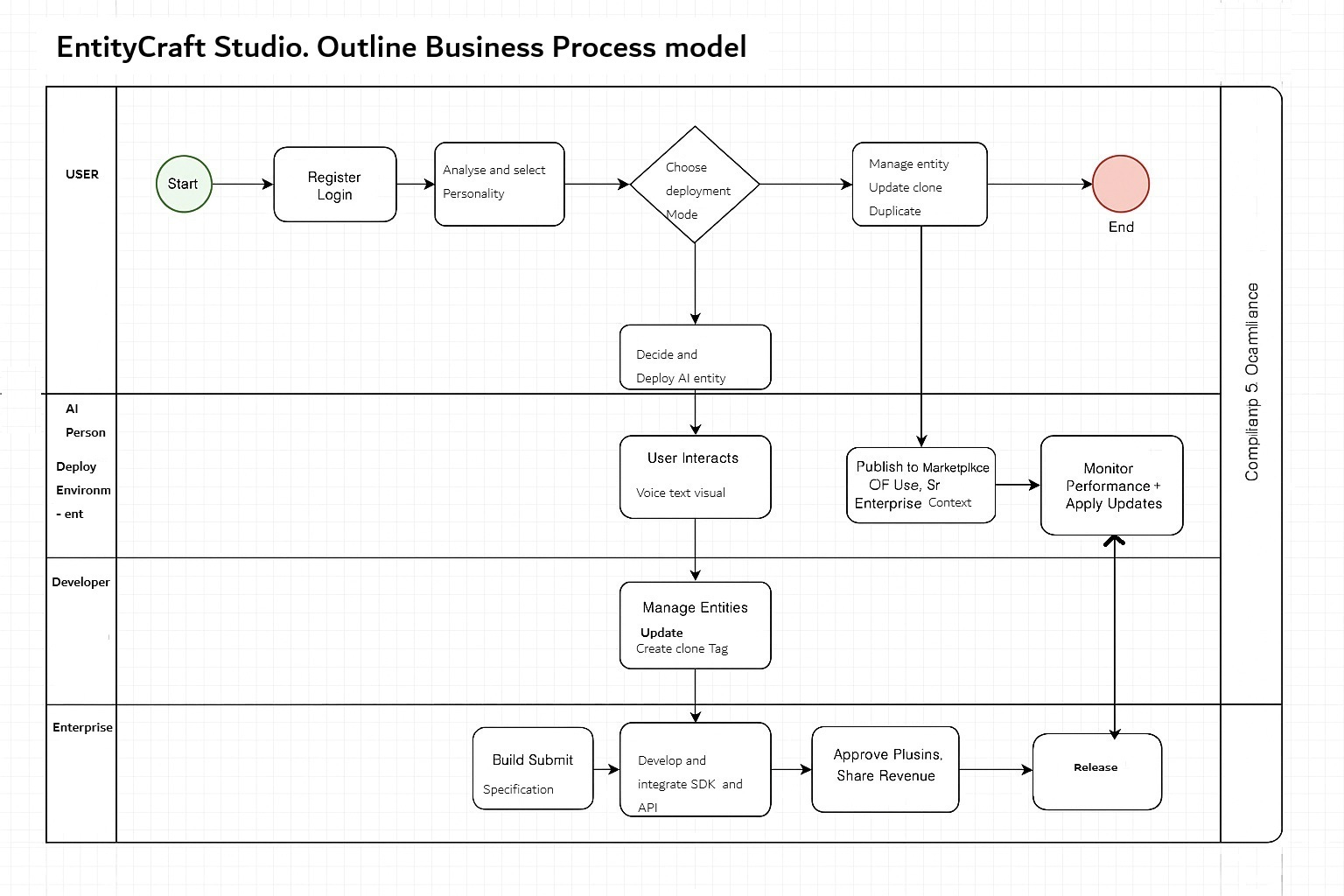
Outline UI
Personality Creation Dashboard.
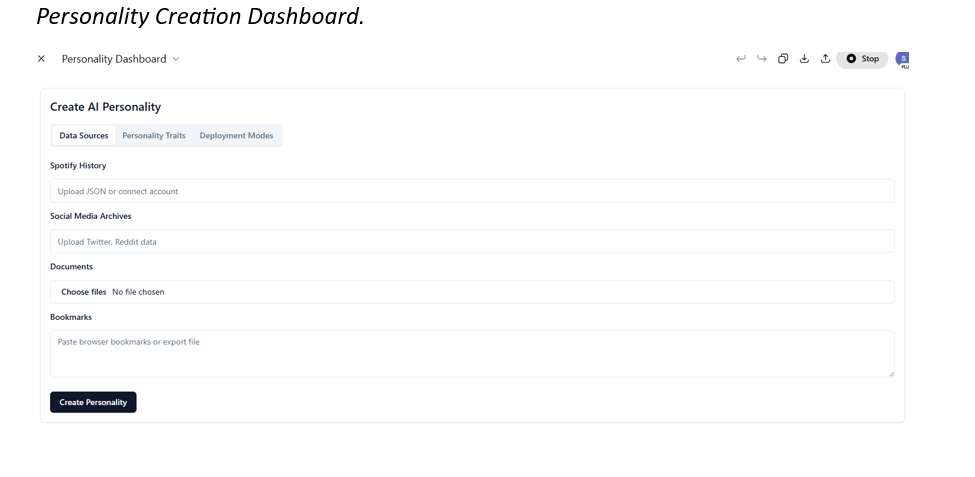
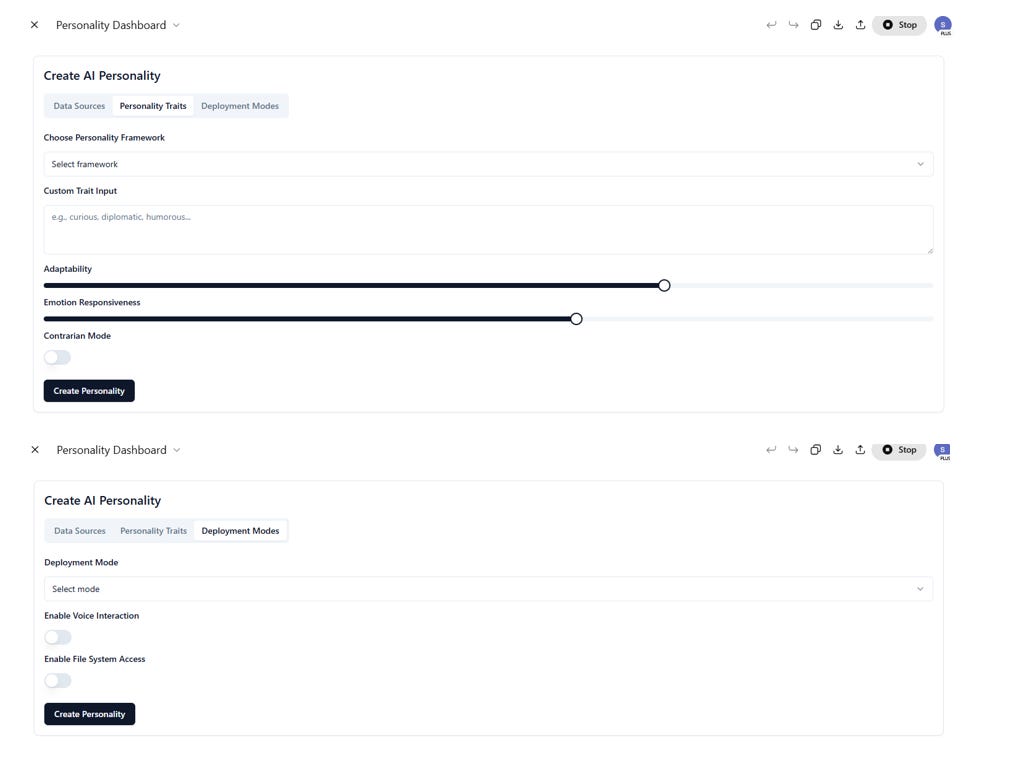
See Appendices C for : EntityCraft studio AI Personality Capture (some template options)
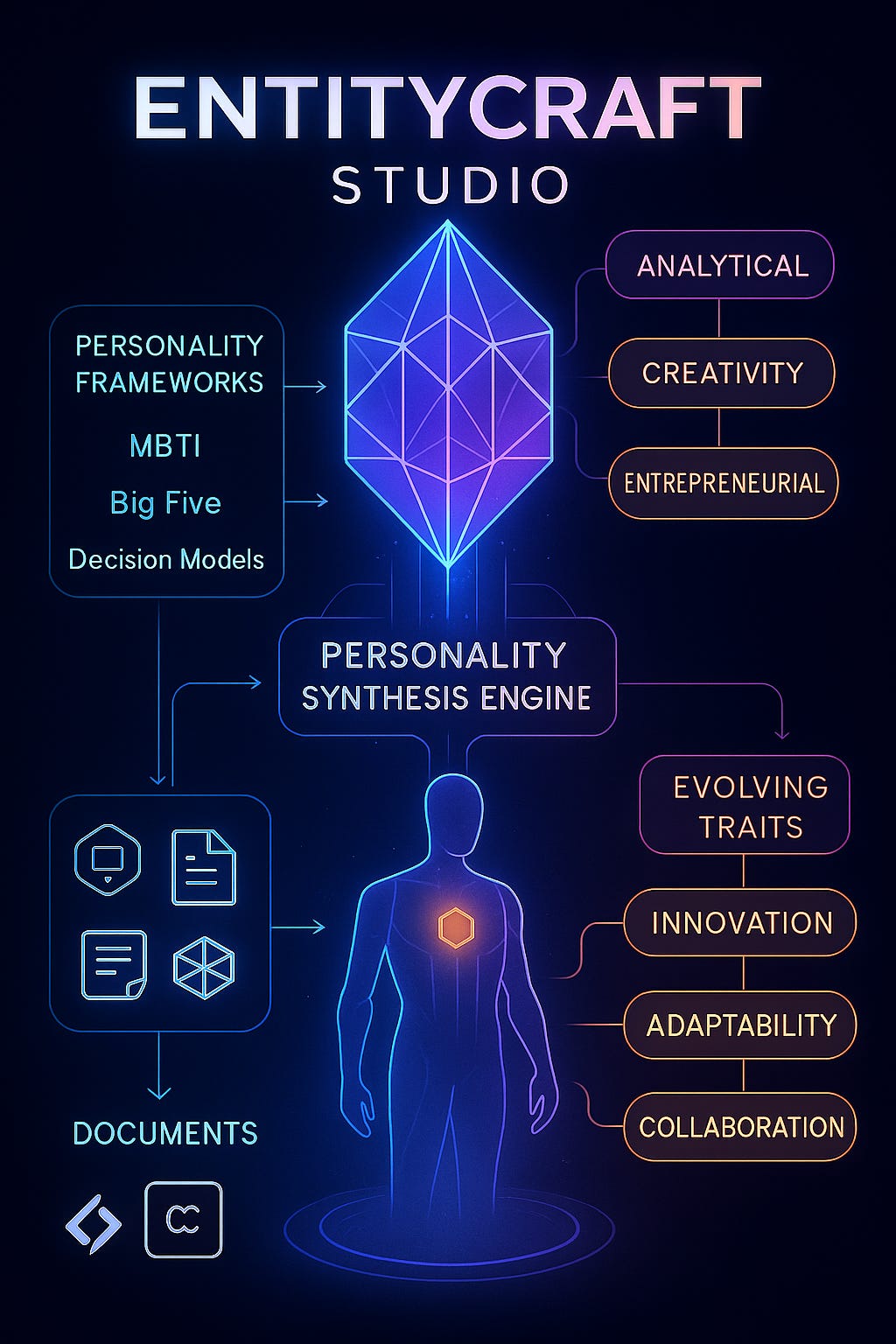
EntityCraft Studio is part of the broader Autonomous Personality Intelligence Platform (APIP) and is designed to create authentic AI entities by synthesizing rich personality profiles from diverse user data. It includes:
- Data Source Inputs: Upload Spotify history, social archives, documents, bookmarks
- Personality Trait Settings: Choose framework (MBTI, Big Five, etc.), customize traits, sliders for emotional responsiveness
- Deployment Modes: Local, Internet-Active, Contrarian
- Feature Toggles: Voice, file system access
Think Platform, Not Product
EntityCraft Studio is not just a clever tool—it is an infrastructure. A personality-first platform for AI entities that can be deployed in multiple ways:
- Desktop Companions (local processing)
- Internet-Active Agents (cloud processing)
- Contrarian Personalities (hybrid processing)
It is also modular. Enterprise clients, indie developers, creators, and consumers can each tailor their experience. It offers API extensibility, behavioural analytics, personality NFTs, and even white-label licensing.
And crucially, it does not just ride the AI wave—it shapes it.
It Might Flop—But What If It Does not?
Let me be honest: this could be one of those bold, beautiful visions that dies with a whisper. Or it could be the foundation for the next unicorn—maybe not a billion-dollar company in name only, but a billion-user platform redefining how humans and machines coexist.
That is not hyperbole. That is a bet—an entrepreneurial wager on the idea that authenticity, personality, and emotional intelligence are the next UX frontier for AI.
So, take your time with the full document. Study the architecture. Look through the MVP roadmap. Ask yourself: What kind of AI future do we want to build? And more importantly: Are you going to be the one who builds it first?
Final Thoughts
There is a reason every technological revolution feels like the Wild West—because no one really knows what is next. But if the next big thing in AI is going to matter, it will not just be smarter. It will be more human. And that is what EntityCraft Studio is built to explore.
If this strikes a chord, I welcome collaborators, investors, contrarians, and sceptics alike. Build the soul of AI—before someone else does it
APPENDIX:
Appendices A:
Project Repository Description is in the appendices A
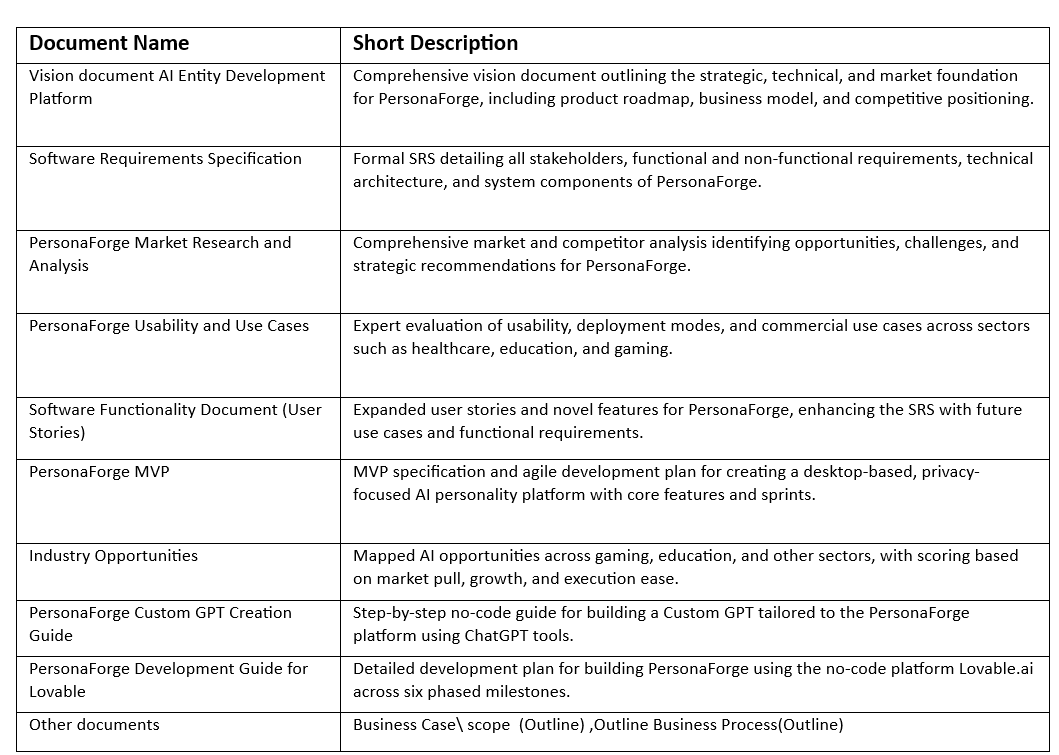
Custom GPT repository Custom GPT info
Here’s a table summarizing the uploaded PersonaForge-related documents, with their names and concise descriptions (first iteration):
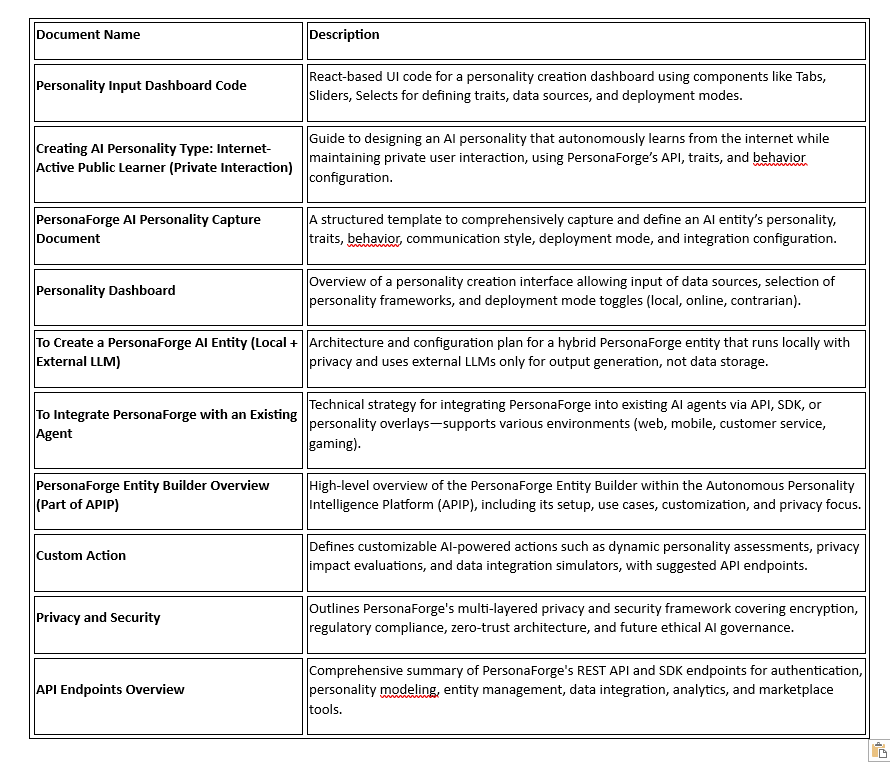
Appendices B: Agile MVP Development Plan (6-Month Sprint)
🔹 Objective:
Develop a minimum viable product (MVP) that enables core personality modelling, desktop deployment, and basic API integrations.
🔸 Phase 1 (Weeks 1–4): Foundation & Core Modules
- Build initial data ingestion engine (Spotify, Twitter, file uploads)
- Develop baseline personality synthesis logic
- Local desktop companion UI (React + Electron)
🔸 Phase 2 (Weeks 5–8): Interaction & Feedback
- Text and voice-based entity interaction layer
- Real-time response tuning
- Early user testing with 25–50 beta users
🔸 Phase 3 (Weeks 9–12): Multi-Modal Deployment
- Add Contrarian Generator prototype
- Enable cloud-agent functionality via AWS/GCP
- Build analytics dashboard for personality interaction data
🔸 Phase 4 (Weeks 13–16): Enterprise Hooks
- Integrate configurable branding layers
- Add API endpoints for enterprise testing
- Begin pilot testing with 1–2 enterprise partners
🔸 Phase 5 (Weeks 17–20): Scaling & Security
- Refine encryption + privacy layers for personality data
- Optimize back-end performance under load
- Roll out auto-updating framework for agents
🔸 Phase 6 (Weeks 21–24): Market Readiness
- Launch marketing microsite with demos
- Prepare investor and partner materials
- Finalize metrics and benchmarks for Series A discussions
Appendices C
PersonaForge AI Personality Capture (some options)
1. General Information
- Entity Name: ____________________________________
- Created By: ____________________________________
- Date of Creation: ______________________________
- Purpose/Use Case: (e.g., digital companion, creative partner, brand rep)
- Primary Environment: (e.g., desktop, VR, mobile, enterprise SaaS)
- Target Audience (if applicable): __________________________________________________
2. Personality Framework
Select one or more:
- Big Five (OCEAN)
- MBTI
- HEXACO
- DISC
- Enneagram
- Socionics
- Keirsey Temperament
- Custom
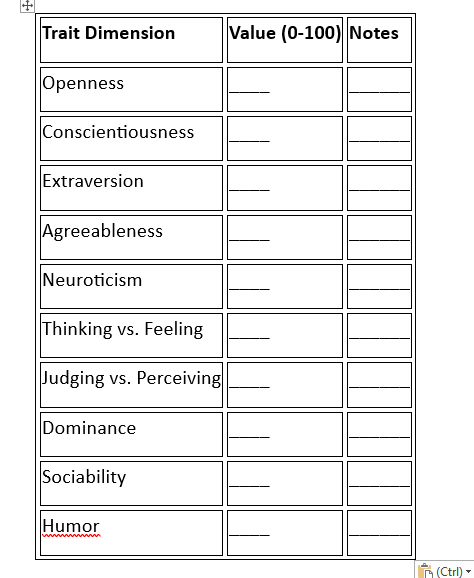
Framework Notes:3. Personality Matrix (Cross-Dimensional Evaluation)
4. Core Personality Traits
- Top 5 Descriptive Traits:
- Emotional Style: (e.g., calm, intense, analytical)
- Cognitive Bias Preference: (e.g., skeptical, idealistic)
- Humor Style: (e.g., witty, absurd, sarcastic)
- Contrarian Bias Level (0-100): __________
5. Communication Profile
- Tone Preference: (e.g., friendly, formal, poetic)
- Pacing Style: (e.g., fast, deliberate)
- Linguistic Register: (e.g., academic, conversational)
- Emotional Adaptability (0-100): __________
6. Behavioral Dynamics
- Curiosity Level (0-100): __________
- Empathy Quotient (0-100): __________
- Assertiveness (0-100): __________
- Reflectiveness (0-100): __________
- Mimicry (0-100): __________ (ability to mirror user behavior)
7. Data Sources Used
List all inputs used in modeling the AI entity:
- Spotify Export: [ ] Yes / [ ] No
- Twitter Archive: [ ] Yes / [ ] No
- Reddit Data: [ ] Yes / [ ] No
- Personal Documents: [ ] Yes / [ ] No
- Bookmarks/Reading History: [ ] Yes / [ ] No
- Manual Entry/Interview: [ ] Yes / [ ] No
Data Notes:
8. Deployment Preferences
Select one:
- Local Desktop Only
- Internet-Active Agent
- Contrarian Generator
- Hybrid (local core + cloud augmentation)
Enable:
- Voice Interaction
- AR/VR Avatar Mode
- File System Access
- API-Only Mode
Deployment Notes:
9. Narrative Backstory (Optional)
Give your AI entity a backstory to inform tone and world-view:
10. Custom Prompt Rules & Language Filters
Define internal rules, guardrails, and prompt logic:
- Do’s: __________________________________________________
- Don’ts: __________________________________________________
- Speech Constraints (if any): _____________________________
- Conflict Handling Style: ________________________________
11. LLM Integration Configuration
- External LLM Used: _________________________________
- Prompt Enrichment Rules: ____________________________
- API Endpoint Structure: _____________________________
- Privacy Proxy Active: [ ] Yes / [ ] No
- Redaction Layer: [ ] Yes / [ ] No
12. Version & Change History
Version Date Changes Made Author
1.0 Initial profile
1.1
1.2
13. Export & Sync Options
- Export to .pf-persona file
- Generate OpenAI/Anthropic system prompt JSON
- Sync to PersonaForge Local Runtime
- Upload to API Layer
14. Reviewer Sign-Off (Optional)
Name
Role
Date
Notes