Preamble
In 2019, Plastic Bagged Water, Anyone? examined the ubiquity of sachet water in West Africa, particularly Nigeria—a market where access to clean drinking water often comes packaged in cheap, single-use plastic pouches. While affordable, these sachets are environmentally catastrophic and clog drains, pollute waterways, and degrade into toxic microplastics.
This updated edition reframes the problem as an opportunity. It explores how emerging technologies, circular business models, and microfactory solutions—when powered by solar and scaled locally—can turn a major public health and climate challenge into a breakthrough in sustainable urban infrastructure.
The $12 Billion Opportunity
The global bottled water market is projected to reach $505 billion by 2030, with much of this growth concentrated in developing countries. Nigeria alone consumes an estimated 1 million plastic sachets per minute, creating a waste management crisis.
Yet scalable alternatives are already emerging—and they are proving both viable and profitable.
1. Plastic Sachets: A Dirty Legacy
Plastic sachets cost less than $0.01 per unit and are easy to distribute. But the environmental consequences are overwhelming:
- Drain blockages that cause urban flooding
- Microplastic ingestion through drinking and aquatic food chains
- Inadequate recycling infrastructure, with most sachets ending up in open dumps or waterways
Source: UNEP
2. Current Solutions—and Their Limitations
- Biodegradable sachets (PLA or bagasse-based) often require industrial composting—unrealistic in most low-income settings.
- Refill stations reduce plastic but face hygiene concerns, inconsistent regulation, and cultural resistance.
3. Tech-Powered Alternatives
A. Microfactories for Hyperlocal Production
Modular, container-sized microfactories can be deployed near urban centres to manufacture:
- Compostable sachets from cassava starch, seaweed, or PLA
- Edible water pods, like those developed by Ooho (Notpla), which biodegrade in 6 weeks
- Powered by off-grid solar, reducing dependence on unstable electricity grids
B. Smart Water ATMs
Inspired by Sarakasi’s model in Nairobi:
- NFC-enabled water bottles
- Solar-powered dispensers
- Real-time blockchain-based tracking for usage, hygiene, and pricing
- Case study: Pilot program in India reduced plastic waste by 70%
C. Incentivized Return Systems
- Use Plastic Bank-style models to reward container returns via blockchain tokens
- Returned compostables can be ground into fertilizer for local farming
- Adds value and creates a circular product lifecycle
4. Startup Case Studies
🧪 Notpla (UK) – Edible Water Pods
- Tech: Seaweed-based pods
- Used at 2024 London Marathon
- Revenue: B2B (events, hospitality)
- Cost reduced from $0.15 to $0.03/unit
💧 Sarakasi (Kenya) – Water ATMs
- Solar-powered refill stations
- RFID-linked reusable bottles
- Revenue: Pay-per-use, local ads
- Impact: 92% drop in plastic waste
🌿 GreenPod (India) – Compostable Sachets
- Cassava starch packaging
- Partnered with Unilever for distribution
- Revenue: Licensing to FMCG brands
- 30% lower carbon footprint than plastic
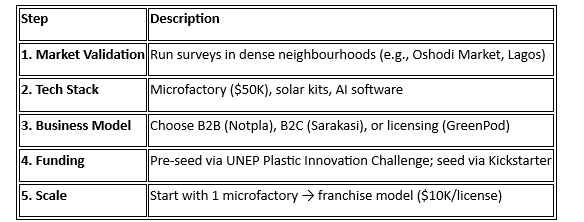
5. Start-up Playbook: 5 Steps to Launch
6. The Speculative Future: Beyond Water
- 3D-Printed Compostable Bottles at point of sale
- Solar-Powered Desalination Microplants for coastal cities
- Integrated Plastic-Free Retail Networks linked to water ATMs and compost hubs
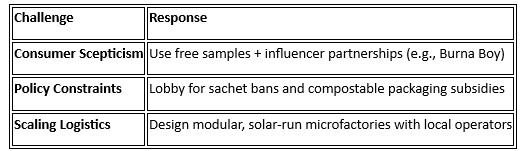
7. Challenges & Mitigation
Conclusion
Plastic-bagged water is not just an environmental disaster—it is a call to innovate. Combining local context with global tech offers a clear path toward clean, decentralized, plastic-free water systems. This is not charity. It is viable business, scalable design, and urgent climate action. The sachet economy is waiting for its disruption. The tools are already here.
Appendices
Appendix A: Lean Business Plan Summary
- Problem: 300B plastic sachets/year lack viable eco-alternatives
- Solution: Compostable pods + solar-powered ATMs
- USP: 100% biodegradable, 50% cheaper at scale
- Market: $12B TAM in Africa/Asia
- Financials: $150K setup, $500K projected revenue in Y1
1. Executive Summary
- Problem: 300B plastic sachets/year lack eco-friendly alternatives.
- Solution: Micro factory-produced compostable pods + water ATMs.
- USP: 50% cheaper than incumbents; 100% biodegradable.
2. Market Analysis
- Target: Urban Africa/Asia (e.g., Lagos, Dhaka).
- TAM: $12B (plastic sachet market).
3. Product Line
- Core: Edible pods ($0.03/unit).
- Premium: Smart bottles with hydration tracking (+$2 revenue/user/year).
4. Operations
- Supply Chain: Seaweed farmers → Micro factory → Distribution hubs.
- Tech Partners: SolarEdge (energy), TerraCycle (composting).
5. Financials
- Startup Costs: $150K (micro factory + 6-month runway).
- Projected Y1 Revenue: $500K (at $0.05/unit, 10M units sold).
6. Risks & Mitigation
- Risk: User scepticism.
- Fix: Free samples + celebrity endorsements (e.g., Burna Boy for Lagos pilot).
Appendix B: Infrastructure, Tech & Sustainability Considerations
1. Logistics in Low-Infrastructure Environments
- Motorbike delivery, ferry drop-off, or urban kiosk networks
- Microfactories positioned near markets minimize transport
2. The Role of Solar Power
- Reliable power alternative in areas with <10 hours/day grid supply
- Precedent: Solar ATMs, medical fridges in Uganda, DRC
- Power systems: Tesla Powerwall, modular solar grids, local providers like SolarEdge
3. Small-Scale Water Purifiers
- From basic filters (LifeStraw) to community RO & UV systems
- Recommended partners: Aqua Clara, Drinkwell Systems
4. Compostable Packaging Innovations
- Ooho, Notpla, GreenPod
- Bioplastics from cassava, corn starch, seaweed
- Designed to degrade in 6–8 weeks in real-world conditions
5. Cultural, Climate, and Hygiene Constraints
- Refill stations must use automated sensors to avoid contamination
- Durability needed for high humidity
- Community behaviour campaigns essential for acceptance
6. Strategic Localization
- Urban model: High-tech, smart dispensers, AI-linked tracking
- Rural model: Low-tech, solar-run refill hubs
- Partnerships with NGOs, FMCG brands, and artisans for scaling