Preamble
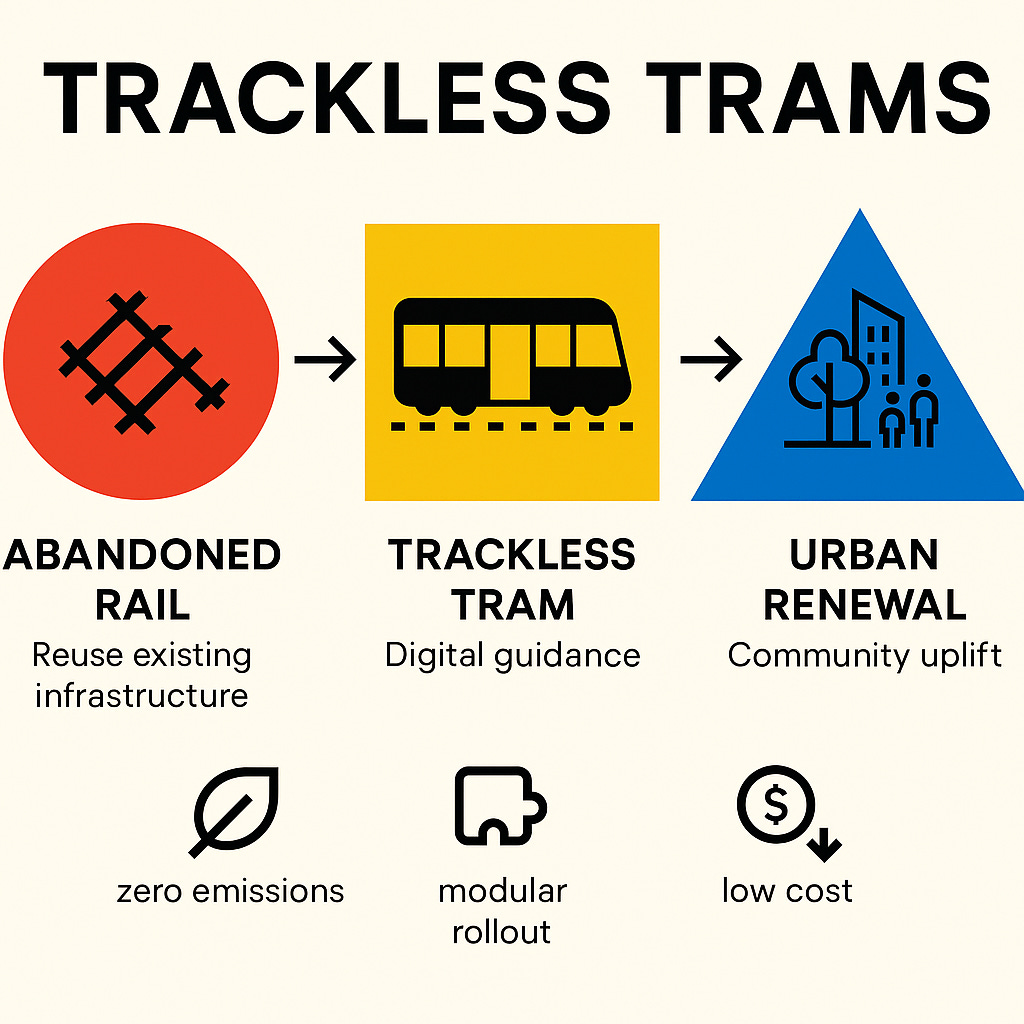
I live in London but, this post is applicable to all built up urban areas that have historical abandoned rail , walking pathways and abandoned or underutilised industrial corridors (see Candidate Cities). This post is London centric as London is rich in disused rail corridors and or abandoned paths and due to the industrial history of London there are industrial estates with abandoned tracks or underutilised roads \ minimal traffic that could act as corridors. These latent assets can become the backbone of a cleaner, faster transit network. They act as initiators and pilot track before large deployment. Trackless trams, also called Autonomous Rail Transit, pair the capacity of light rail with the flexibility of buses. They run on rubber tires, follow digital guidance markers, and draw power from onboard batteries. That mix avoids heavy rail construction, shortens build times, and slashes capital costs. By starting on existing alignments, the city can roll out service in months, not years, while testing demand and refining operations. Dedicated integrated lanes come later, layered where ridership and development potential are highest. This staged approach keeps disruption low, pushes carbon emissions down, and sparks investment in walkable, mixed-use neighbourhoods. I was invested enough to create an outline Case study that explores an area of London : Thamesmead–Belvedere detailed after the conclusion of this post. The larger document with the case study for Greater London is found here Case study Greater london . Please critique and consider adptations to towns and surburbs. The challenge is critical mass of users, extent of initial abandonded train tracks and unused pathways, integration with public infratructure and cost benefits.
Introduction
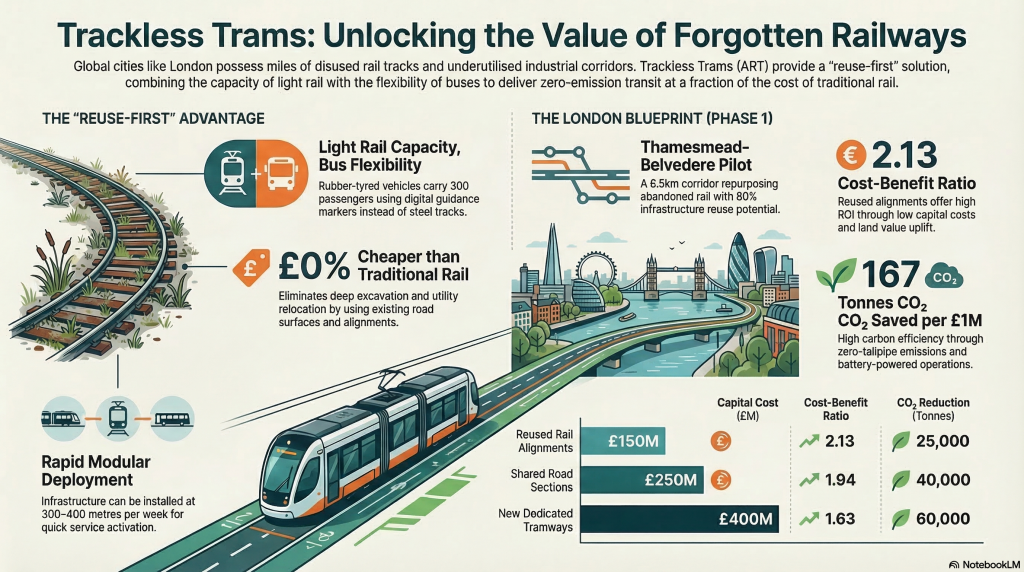
Reimagining Urban Mobility: Modular Implementation of Trackless Trams in London
London holds miles of disused rail tracks, overgrown footpaths, and redundant industrial roads. These hidden corridors can become new arteries for clean transport. Converting them to trackless tram routes lets you avoid expensive land purchases, deep excavation, and years of disruption.
These latent assets offer a compelling opportunity for implementing trackless tram systems without the prohibitive costs of land acquisition. With careful attention to planning permissions, health and safety standards, and environmental noise assessments, a modular rollout becomes not only feasible but strategically advantageous.
But are trackless trams merely glorified buses, or do they represent a transformative urban transit solution? The answer lies in their adaptability, scalability, and integration potential. Unlike traditional fixed-rail systems, trackless trams offer:
- Lower upfront infrastructure costs
- Rapid deployment on existing or reclaimed pathways
- Smart routing and energy-efficient operations
- Enhanced public engagement through visible, accessible transit corridors
🧩 Modular Implementation Pathways
Trackless trams thrive in a modular framework, allowing cities to tailor deployment based on existing conditions and urban priorities. Three core implementation strategies emerge:
- 🟢 Reclaimed Infrastructure Corridors Utilize abandoned rail tracks or disused pedestrian paths and due to the industrial history of London there are industrial estates with underutilised road\ traffic that could act as corridors with minimal intersections. This approach maximizes existing assets and minimizes disruption, ideal for pilot routes or low-cost viability studies.
- 🟡 Dedicated New Pathways Construct new corridors within urban environments, incorporating full road crossings and intersections. This model supports long-term transit planning and integration with broader mobility networks.
- 🔵 Shared Roadway Integration Embed trackless trams within existing or expanded roadways, using shared lanes and managed intersections. This hybrid approach balances cost-efficiency with accessibility, especially in dense urban zones.
My analysis
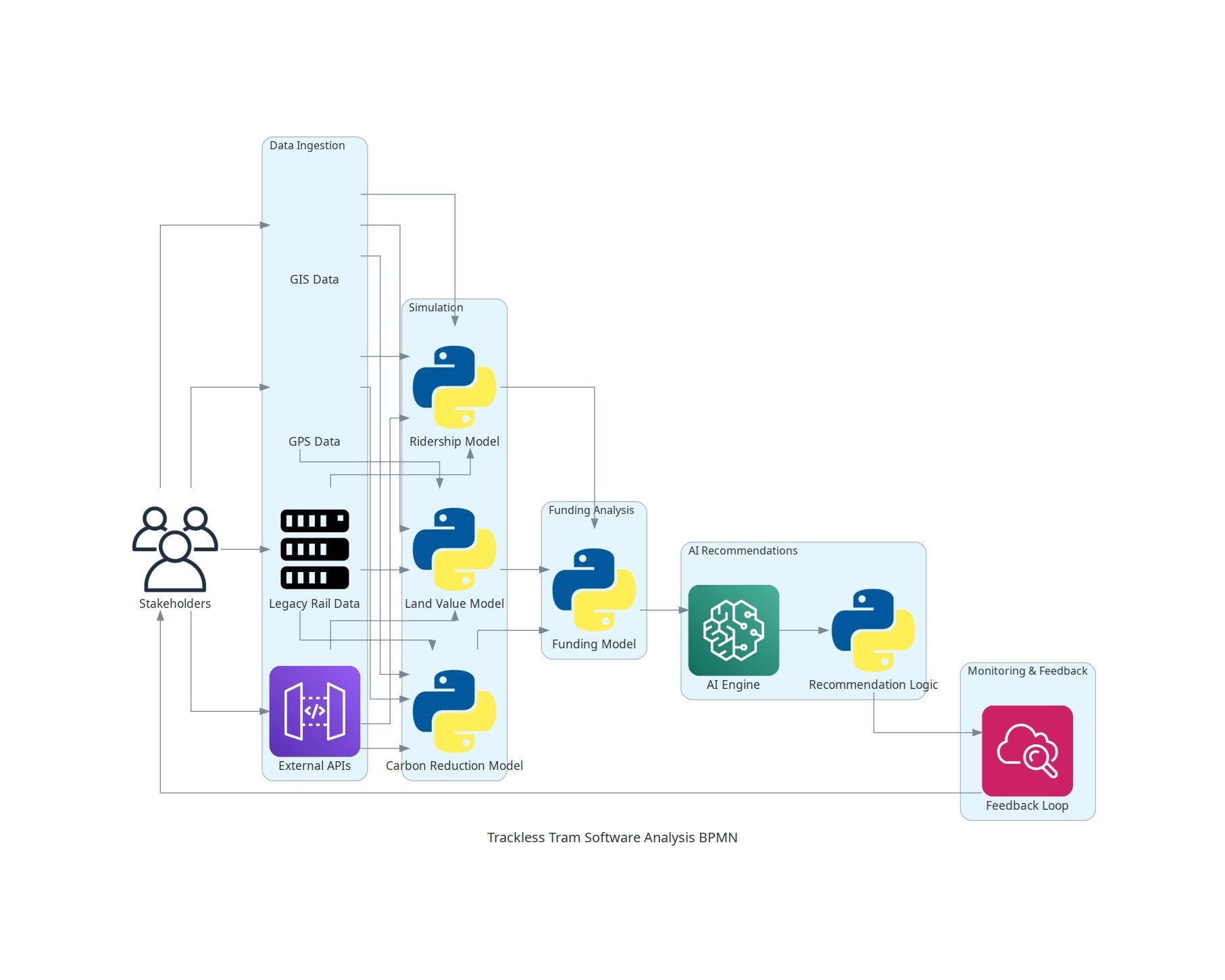
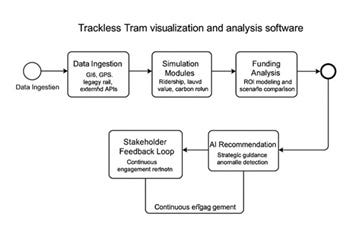
I did not perform any in-depth analysis as per my usual this is the W.I.P Artifacts but if you want an outline Software requirement analysis for building the software that support this idea see:Trackless Trams SRS
Trackless Trams: A New Era of Guided Electric Transit
Trackless trams, also called Autonomous Rail Transit, deliver the comfort of light rail while running on rubber tires. Digital guidance keeps each vehicle on a virtual track within centimetres, even at 70 km/h. Onboard batteries or hydrogen cells power the system, so tailpipe emissions drop to zero. A five-car set can carry as many as 300 passengers, matching light-rail capacity while using standard road surfaces. The system grows in modules. Start with corridors that have few road crossings and strong latent demand, such as the Abbey Wood to Belvedere alignment. Add new pathways or shared road segments only where you need them. This staged plan speeds delivery, builds public trust, and lets you refine the technology before expanding citywide. The Electric trams that operate without traditional rails are part of a growing innovation known as trackless trams or Autonomous Rail Transit (ART). These systems blend the benefits of light rail, buses, and autonomous vehicles to create flexible, sustainable urban mobility.
🔧 Key Features
- Rubber-Tired Vehicles: Instead of steel wheels on rails, these trams use rubber tires and follow painted or embedded guidance lines on standard road surfaces.
- Guidance Systems: Equipped with LiDAR, GPS, and camera-based sensors, they maintain precise alignment along their route—often within centimetres.
- Modular Design: Vehicles can be 3–5 carriages long, carrying up to 300 passengers, and are scalable based on demand.
- Battery-Powered: Most use lithium-titanate batteries, offering ranges of 25–40 km per charge. Regenerative braking helps recharge during operation.
🏙️ Infrastructure & Deployment
- No Rails or Overhead Wires: Eliminates the need for costly and disruptive rail installation or catenary systems, making them ideal for historic or dense urban areas.
- Rapid Installation: Systems like Coventry’s Very Light Rail (VLR) and TIG/m’s embedded track tech can be deployed at 300–400 meters per week, drastically reducing construction time.
- Surface-Level Tracks: Some use shallow embedded tracks (300 mm deep) for added stability without deep excavation.
🌍 Global Examples
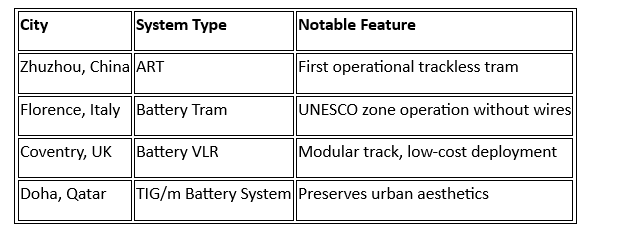
💡 Benefits
- Cost-Effective: Up to 80% cheaper than traditional light rail systems.
- Environmentally Friendly: Zero emissions and reduced energy consumption.
- Urban Integration: Minimal visual impact and disruption during installation.
These systems are gaining traction as cities seek cleaner, faster, and more adaptable transit solutions.
Critiques of Trackless Trams vs. Alternatives
Trackless trams while promising face several critiques when compared to traditional light rail and bus rapid transit (BRT). Here is a breakdown of the main concerns and potential solutions:
⚠️ Critique 1: Road Surface Degradation (Rutting)
- Issue: Repeated travel over the same path causes rutting in asphalt, especially with heavy vehicles following precise optical guidance.
- Impact: Degrades ride quality and disrupts guidance systems, as seen in Zhuzhou, China.
- Solution:
- Reinforce roadbeds with concrete or high-grade asphalt.
- Introduce slight path variation algorithms to distribute wear.
- Schedule regular surface maintenance and recalibration of guidance systems.
💰 Critique 2: Cost Misrepresentation
- Issue: Early claims suggested trackless trams cost 1/10th of light rail, but real-world projects (e.g. Melbourne’s Caulfield–Rowville) show costs nearing $74M/km.
- Impact: Misleads planners and delays proven alternatives.
- Solution:
- Conduct transparent feasibility studies with lifecycle cost analysis.
- Include infrastructure upgrades (e.g. power, drainage) in budgeting.
- Use modular deployment to phase investment and reduce upfront costs.
🧭 Critique 3: Technology Immaturity
- Issue: Optical guidance systems struggle in poor weather (fog, dust, leaves).
- Impact: Reduces reliability and accessibility, especially for disabled passengers.
- Solution:
- Combine optical guidance with LiDAR, radar, buried guideway and magnetic systems.
- Maintain manual override and onboard drivers for safety.
- Develop weather-resilient sensor housings and adaptive algorithms.
🏙️ Critique 4: Limited Urban Integration
- Issue: Lack of fixed infrastructure may reduce developer confidence in long-term viability.
- Impact: Weakens transit-oriented development (TOD) potential.
- Solution:
- Anchor systems with permanent stations and dedicated lanes.
- Use zoning incentives to encourage development around stops.
- Apply the Entrepreneur Rail Model to align private investment with public planning4.
🚌 Critique 5: Confusion with BRT or “Gadgetbahn”
- Issue: Critics argue trackless trams are glorified buses with proprietary tech.
- Impact: Undermines credibility and risks being sidelined like past failed innovations.
- Solution:
- Standardize vehicle specs and certification processes.
- Demonstrate superior ride quality and capacity through pilot programs.
- Avoid overhyping—focus on practical benefits and integration.
🌱 Environmental Impact of Trackless Trams
Trackless trams offer a compelling sustainability profile, but they are not without trade-offs:
✅ Positive Impacts
- Zero Emissions: Powered by electric batteries or hydrogen fuel cells, they eliminate tailpipe emissions and reduce urban air pollution.
- Reduced Noise Pollution: Rubber tires and electric motors produce quieter operations compared to diesel buses or steel-wheeled trams.
- Energy Efficiency: Regenerative braking and smart fleet management lower overall energy consumption.
- Urban Revitalization: Their ability to support transit-oriented development encourages denser, walkable communities, reducing car dependency.
⚠️ Environmental Concerns
- Battery Production: Lithium-titanate and hydrogen fuel cells require resource-intensive manufacturing, with environmental costs tied to mining and disposal.
- Road Surface Wear: Rubber tires cause rutting on asphalt, requiring frequent resurfacing and contributing to urban heat island effects.
- Lifecycle Emissions: While operational emissions are low, full lifecycle assessments (including manufacturing and infrastructure) may reveal higher carbon footprints than expected.
🚦 Operational Impact of Trackless Trams
These systems reshape how cities manage transit:
🚀 Advantages
- Rapid Deployment: No need for rail installation means faster rollout ideal for underserved suburbs or temporary corridors.
- Flexible Routing: Can be reprogrammed or rerouted more easily than fixed rail systems, adapting to changing urban needs.
- High Ride Quality: Stabilization tech from high-speed rail ensures smooth travel, even at speeds up to 70 km/h.
- Fleet Efficiency: Autonomous guidance and bi-directional design reduce turnaround times and improve scheduling.
🧩 Challenges
- Weather Sensitivity: Optical guidance systems may falter in fog, snow, or heavy rain, requiring backup systems.
- Maintenance Complexity: Advanced sensors and battery systems demand specialized upkeep and diagnostics.
- Street Space Competition: Without dedicated lanes, trams may compete with cars and bikes, affecting reliability in dense areas.
🚈 Impact of Dedicated Tramways & Light Rail Integration
Creating dedicated tramways and integrating them with light rail systems can profoundly reshape urban mobility, land use, and environmental outcomes. Here is a structured look at the key impacts:
🌍 Environmental Benefits
- Reduced Emissions: Electrified systems produce zero tailpipe emissions, improving air quality.
- Lower Noise Pollution: Steel wheels and electric motors are quieter than buses or cars.
- Energy Efficiency: Trams can use renewable electricity and regenerative braking, reducing overall energy use.
- Less Road Wear: Steel rails avoid rutting and microplastic pollution from rubber tires.
🚦 Operational Advantages
- Reliability: Dedicated tracks eliminate delays from traffic congestion, ensuring consistent travel times.
- High Capacity: Trams can carry 200–450 passengers per vehicle, reducing the need for multiple buses.
- Speed & Frequency: Systems like Green Wave Traffic Signal Pre-emption allow trams to glide through intersections without stopping.
- Longevity: Tram vehicles last 30–50 years, far longer than buses, lowering lifecycle costs.
🏙️ Urban Development & Integration
- Transit-Oriented Development (TOD): Fixed infrastructure encourages investment in housing, retail, and jobs near stations.
- Land Value Uplift: Property values often rise near tram corridors, attracting private investment.
- Improved Accessibility: Level boarding and wide doors enhance mobility for all users, including those with disabilities.
- City Image & Identity: Trams often become iconic, enhancing civic pride and tourism appeal.
💰 Economic Impacts
- Boosts Productivity: Reliable transit expands labour catchment areas and reduces commute times.
- Catalyst for Regeneration: Unlocks underused or hard-to-reach sites for redevelopment.
- Positive ROI: Projects like Edinburgh’s tram extension showed Benefit-Cost Ratios above 2.0, indicating strong economic returns.
⚠️ Considerations & Challenges
- Upfront Costs: Traditional deep-dig rail installation is expensive and disruptive.
- Utility Relocation: Requires careful planning to avoid delays and cost overruns.
- Political Will: Long-term commitment is needed to realize full benefits.
Impact of Dedicated Tramways for Trackless Trams
Creating dedicated tramways for trackless trams—rubber-tired, optically guided electric vehicles—can significantly enhance their performance, reliability, and urban integration. Here is a breakdown of the key impacts:
✅ Operational Enhancements
- Improved Reliability: Dedicated lanes eliminate interference from mixed traffic, ensuring consistent travel times and reducing delays.
- Higher Speeds: With fewer obstacles, trams can maintain optimal speeds (up to 70 km/h), improving service frequency and passenger throughput.
- Reduced Wear & Tear: Purpose-built surfaces (e.g. reinforced concrete) mitigate rutting and extend infrastructure lifespan compared to shared asphalt roads.
🌍 Environmental Benefits
- Lower Emissions: Dedicated corridors support electrified, zero-emission transit, reducing urban air pollution and greenhouse gases.
- Urban Cooling: Replacing heat-retaining asphalt with cooler materials (e.g. permeable concrete) can reduce urban heat island effects.
- Greening Opportunities: Tramways can incorporate green buffers, bioswales, and solar-powered infrastructure to enhance ecological value.
🏙️ Urban Development & Identity
- Transit-Oriented Development (TOD): Fixed, visible infrastructure boosts investor confidence and encourages mixed-use development near stations.
- Place-Making: Tramways can be designed as civic spaces with landscaping, public art, and pedestrian-friendly features.
- Civic Branding: Like traditional trams, trackless systems with dedicated corridors can become iconic elements of city identity.
💰 Economic Impacts
- Land Value Uplift: Properties near dedicated tramways often see increased value due to improved accessibility and reduced car dependency.
- Job Creation: Construction, maintenance, and operations generate employment across sectors.
- Cost Efficiency: While upfront costs are higher than shared lanes, lifecycle savings from reduced maintenance and increased ridership can offset investment.
⚠️ Challenges & Considerations
- Street Space Competition: Allocating exclusive lanes may face resistance from drivers, cyclists, and businesses.
- Utility Relocation: Even shallow embedded tracks or reinforced surfaces may require moving underground utilities.
- Political Commitment: Long-term success depends on sustained funding, stakeholder engagement, and clear governance models.
Dedicated tramways transform trackless trams from flexible bus-like systems into high-performance urban connectors.
Conclusion
Trackless trams are not a speculative gadget. They offer London a scalable solution that reuses what the city already owns, aligns with net-zero targets, and unlocks land for much-needed housing and jobs. The next step is clear. Map the strongest reuse corridors, set performance targets for speed and reliability, and launch a pilot that links an underserved district to the wider network. Quick wins will build public trust and attract private capital, paving the way for a citywide system that moves more people, cuts emissions, and drives inclusive growth.
Case studies
Case study 2 of Case study Greater london .
🚈 Modular Corridor Design: Thamesmead–Belvedere Trackless Tramway
Here is a conceptual sketch of a modular corridor using discarded rail alignments repurposed for dedicated trackless tramways in underserved Greater London zones—specifically the Thamesmead to Belvedere corridor, which has long lacked robust rail connectivity.
🧩 Corridor Overview
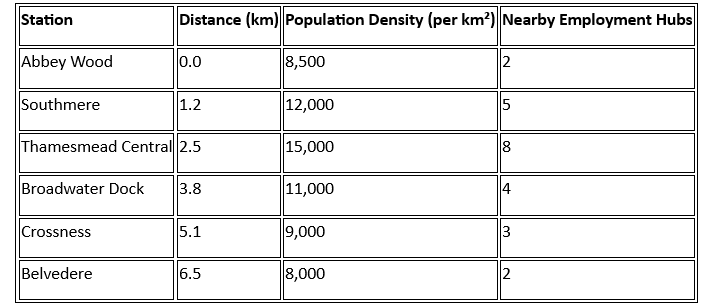
This corridor reuses underutilized rail paths and industrial access roads, transforming them into green-lined, optically guided tramways with modular stations every 1–1.5 km.
🏙️ TOD Scenario Highlights
- Thamesmead Central: Anchor TOD zone with mixed-use development, public plazas, and integrated cycling infrastructure.
- Southmere & Broadwater Dock: Mid-density housing clusters with co-working hubs and community gardens.
- Belvedere Terminus: Logistics and light industrial redevelopment with last-mile delivery integration.
📊 Simulation Insights
- Population Served: ~65,000 residents within 800m of corridor.
- Employment Access: ~24 major hubs connected.
- Travel Time Reduction: Up to 40% faster than current bus routes.
- Carbon Savings: Estimated 1,200 tonnes CO₂/year avoided.
📈 Visual Snapshot
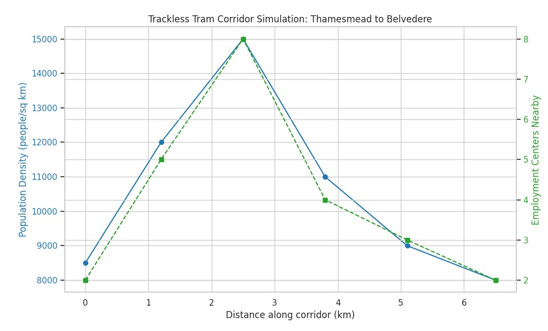
This dual-axis plot shows how population density and employment access vary along the corridor—ideal for prioritizing TOD investments and service frequency.