Preamble
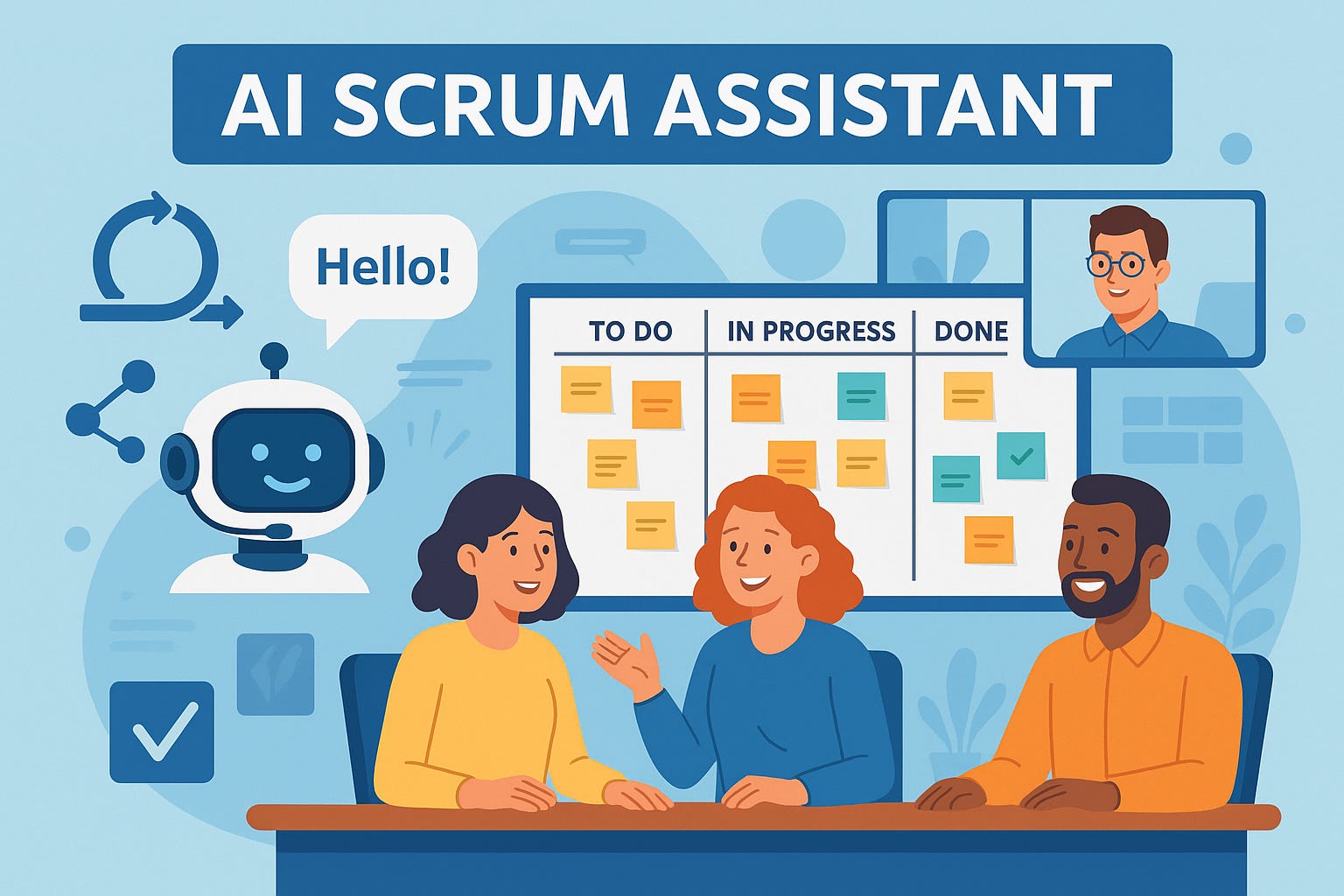
In the fast-evolving landscape of software development, balancing agility with scale remains a persistent challenge. Daily stand-ups, Kanban updates, and sprint reviews are foundational to agile teams—but they often become administrative burdens rather than value-generating rituals. Enter the AI Agile \ Scrum Assistant: an intelligent system designed to automate routine agile processes while preserving the human connection that fuels effective collaboration.
This post explores the vision, architecture, and potential strategic impact of TechFlow Solutions’ AI Agile \ Scrum Assistant—detailing how it integrates natural language processing, automated board management, and intelligent meeting facilitation to unlock productivity gains and scale agile practices for the future of work.
This was from the case study in First look: The AI Discovery Canvas That Cuts Through the Noise This is an example of output post full Discovery and sign-off. This is given to Alpha stage (Depending on what the agreed. Predetermined outputs in this case was a Vision document and Software requirements. In the real world priority \ time permitting it might include, Process maps (BPMN), Persona mapping, User journeys, UI or wireframes, Prototype e.g. a custom GPT or AI agent orchestration )
Idea trigger: “If you use the requirements in this document as a foundation and enhance them with a capable AI acting as a business analyst, software developer, and prompt, you can systematically review, refine, analyse, and improve the specifications. Incorporate your preferences and specify the AI builder you’re using (e.g., Lovable.ai or a Custom GPT) to generate a step-by-step guide. Leveraging an AI app builder or a custom GPT, you should be able to create a functional prototype for your AI Agile \ Scrum Assistant. remember include your implementation tech stack i.e digital Kanban board, product backlog or management system or spreadsheet and or Agile \ Scrum backlog setup.”.
AI Agile \ Scrum Assistant – Vision, Business Case & Software Requirements Specification
Project: AI Agile \ Scrum Assistant for Daily Stand-ups and Kanban Management
Organization: TechFlow Solutions Ltd
Document Version: 1.0
Date: June 17, 2025
Authors: Sarah Chen (Engineering Manager), Mike Thompson (AI Discovery Lead)
1. EXECUTIVE SUMMARY
The AI Agile \ Scrum Assistant is an intelligent system designed to revolutionize daily stand-up meetings and Kanban board management for TechFlow Solutions. By leveraging natural language processing and machine learning, the system will automatically capture, interpret, and act upon team updates, reducing administrative overhead by 40% while improving agile practice consistency across all development teams.
2. VISION STATEMENT
Vision: “To create the world’s most intuitive AI-powered agile assistant that transforms routine ceremonial overhead into strategic development insights, enabling teams to focus on innovation rather than administration.”
Mission: Accelerate TechFlow’s development velocity by intelligently automating stand-up facilitation, progress tracking, and board management while maintaining the human connection that makes agile methodologies effective.
3. BUSINESS CASE
3.1 Strategic Alignment
Company Mission: “Accelerating Innovation Through Intelligent Development”
Strategic Goals Supported:
- Increase developer productivity by 25% by 2026
- Reduce meeting overhead by 40% (Digital-First Development initiative)
- Scale agile practices from 12 to 30 developers by end of 2025
- Improve sprint predictability and delivery consistency
3.2 Problem Statement
Current State Pain Points:
- Time Waste: 10+ hours/week lost to administrative overhead across 4 teams
- Information Loss: Manual board updates miss 40% of nuanced details from verbal updates
- Inconsistency: Different team formats reduce cross-team visibility
- Scale Limitations: Current process unsustainable for planned 150% team growth
- Sprint Failures: 15-20% sprint commitment failures due to poor board accuracy
3.3 Financial Justification
Investment Required:
- Development: £150,000 (6 months)
- Infrastructure: £25,000 annually
- Maintenance: £30,000 annually
- Total 3-year TCO: £315,000
Expected ROI:
- Time Savings: 520 hours/year × £75/hour = £39,000/year
- Quality Improvements: Reduced rework from better tracking = £45,000/year
- Scalability: Avoid hiring additional Agile \ Scrum Masters = £90,000/year
- Total Annual Benefits: £174,000
- 3-Year ROI: 365% (Net benefit: £522,000 – £315,000 = £207,000)
3.4 Risk Analysis
High-Risk Factors:
- GDPR compliance complexity
- User adoption resistance
- NLP accuracy challenges
Mitigation Strategies:
- Early legal review and consent framework
- Comprehensive change management program
- Phased rollout with feedback loops
4. SYSTEM OVERVIEW
4.1 System Description
The AI Agile \ Scrum Assistant is a cloud-based intelligent system that integrates with existing development tools (Jira, Slack, meeting platforms) to provide:
- Automated Stand-up Facilitation – AI-guided meeting structure and timing
- Natural Language Processing – Intelligent interpretation of team updates
- Real-time Board Management – Automatic Kanban board updates
- Intelligent Insights – Blocker detection and progress analytics
- Cross-team Visibility – Unified dashboard for leadership oversight
4.2 Key Capabilities
- Speech-to-Text Processing with 95%+ accuracy
- Context-Aware NLP understanding ticket relationships and dependencies
- Sentiment Analysis for identifying team morale and blocker severity
- Automated Categorization of updates into progress, blockers, and plans
- Smart Notifications for critical issues requiring immediate attention
- Historical Analytics for sprint retrospectives and team performance insights
5. STAKEHOLDER ANALYSIS
5.1 Primary Users
- Software Developers (12) – Daily interaction with AI assistant
- Agile \ Scrum Masters (3) – Oversight and exception handling
- Product Owners (2) – Progress visibility and priority management
5.2 Secondary Users
- Engineering Leadership – Strategic insights and team performance
- HR Department – Employee data privacy oversight
- IT Security – System security and compliance monitoring
5.3 Success Metrics by Stakeholder
Developers:
- Stand-up time reduced from 25 minutes to 15 minutes
- Board update accuracy improved to 95%
- Developer satisfaction score > 4.5/5
Agile \ Scrum Masters:
- Administrative time reduced by 60%
- Cross-team visibility improved by 80%
- Blocker resolution time reduced by 30%
Leadership:
- Sprint predictability improved to 90%
- Team velocity increased by 20%
- Overall productivity metrics improved by 25%
6. FUNCTIONAL REQUIREMENTS
6.1 Core System Requirements
FR-01: Meeting Integration
Description: System must integrate with video conferencing platforms to capture audio Priority: High Acceptance Criteria:
- Support for Zoom, Teams, and Google Meet
- Real-time audio processing with <2 second latency
- Automatic meeting detection and recording initiation
FR-02: Natural Language Processing
Description: Process and interpret natural language updates from team members Priority: High Acceptance Criteria:
- Achieve 90%+ accuracy in intent classification
- Support for 5+ languages with English as primary
- Handle technical jargon and team-specific terminology
FR-03: Jira Integration
Description: Automatically update Jira boards based on processed updates Priority: High Acceptance Criteria:
- Real-time synchronization with Jira Cloud
- Support for custom fields and workflows
- Maintain audit trail of all automated changes
FR-04: Blocker Detection
Description: Identify and categorize blockers from team communications Priority: Medium Acceptance Criteria:
- Detect blockers with 85%+ accuracy
- Categorize by severity (Low, Medium, High, Critical)
- Generate automated alerts for critical blockers
FR-05: Progress Tracking
Description: Track and visualize team progress across sprints Priority: Medium Acceptance Criteria:
- Real-time burndown chart updates
- Velocity trend analysis
- Predictive sprint completion modeling
6.2 User Interface Requirements
FR-06: Dashboard Interface
Description: Provide web-based dashboard for team and leadership views Priority: High Acceptance Criteria:
- Responsive design supporting desktop and mobile
- Role-based access control
- Real-time data updates
FR-07: Meeting Facilitation Interface
Description: AI-powered meeting guidance and structure Priority: Medium Acceptance Criteria:
- Visual cues for meeting flow
- Automated time management
- Speaker identification and turn management
7. NON-FUNCTIONAL REQUIREMENTS
7.1 Performance Requirements
NFR-01: Response Time
- Requirement: System response time < 2 seconds for all user interactions
- Measurement: 95th percentile response time monitoring
- Rationale: Maintain meeting flow without interruption
NFR-02: Availability
- Requirement: 99.5% uptime during business hours (8 AM – 6 PM GMT)
- Measurement: Continuous uptime monitoring
- Rationale: Critical for daily stand-up dependency
NFR-03: Scalability
- Requirement: Support 50 concurrent users and 10 simultaneous meetings
- Measurement: Load testing and capacity monitoring
- Rationale: Account for company growth to 30 developers
7.2 Security Requirements
NFR-04: Data Encryption
- Requirement: All data encrypted in transit (TLS 1.3) and at rest (AES-256)
- Measurement: Security audit compliance
- Rationale: Protect sensitive development information
NFR-05: Access Control
- Requirement: Role-based access with multi-factor authentication
- Measurement: Access review and audit logs
- Rationale: Ensure appropriate data access levels
7.3 Compliance Requirements
NFR-06: GDPR Compliance
- Requirement: Full GDPR compliance for EU employee data processing
- Measurement: Data Protection Impact Assessment completion
- Rationale: Legal requirement for employee voice data
NFR-07: Data Retention
- Requirement: Automatic data deletion after 12 months unless legally required
- Measurement: Automated deletion job monitoring
- Rationale: Privacy by design and storage optimization
8. USER STORIES AND ACCEPTANCE CRITERIA
8.1 Developer User Stories
US-001: Automated Stand-up Participation
As a software developer
I want the AI to automatically capture and process my daily updates
So that I can focus on sharing meaningful information rather than manual board updates
Acceptance Criteria:
- [ ] AI accurately transcribes my verbal updates with 95% accuracy
- [ ] System identifies ticket numbers and updates mentioned
- [ ] I can review and approve automated board changes before they’re applied
- [ ] Updates are processed within 30 seconds of meeting completion
- [ ] I receive confirmation of all automated actions taken
US-002: Blocker Identification and Escalation
As a software developer
I want the AI to automatically detect when I mention blockers
So that critical issues are escalated appropriately without manual intervention
Acceptance Criteria:
- [ ] AI detects blocker keywords and context with 90% accuracy
- [ ] System categorizes blocker severity automatically
- [ ] Critical blockers generate immediate notifications to Agile \ Scrum Master
- [ ] I can manually override AI blocker categorization
- [ ] Historical blocker trends are available for retrospectives
US-003: Cross-team Visibility
As a software developer
I want to see relevant updates from other teams
So that I can identify dependencies and coordination opportunities
Acceptance Criteria:
- [ ] Dashboard shows updates from related teams and projects
- [ ] AI identifies and highlights cross-team dependencies
- [ ] I can subscribe to specific topics or team updates
- [ ] Updates are filtered by relevance to my current work
- [ ] Privacy controls allow me to control what I share across teams
8.2 Agile \ Scrum Master User Stories
US-004: Meeting Facilitation Support
As a Agile \ Scrum Master
I want AI assistance during stand-up meetings
So that I can focus on team dynamics and impediment removal
Acceptance Criteria:
- [ ] AI provides meeting structure and timing guidance
- [ ] System tracks speaking time and ensures equal participation
- [ ] Automated follow-up task creation for identified action items
- [ ] Real-time sentiment analysis alerts for team morale issues
- [ ] Meeting summary generated automatically within 5 minutes
US-005: Board Management Automation
As a Agile \ Scrum Master
I want boards to be updated automatically based on stand-up discussions
So that I can eliminate manual administrative work
Acceptance Criteria:
- [ ] Board updates happen automatically within 15 minutes of meeting end
- [ ] I receive summary of all automated changes for review
- [ ] Ability to bulk approve or reject automated updates
- [ ] Exception handling for updates that require manual intervention
- [ ] Audit trail of all automated changes with rollback capability
US-006: Team Performance Analytics
As a Agile \ Scrum Master
I want intelligent insights about team performance and trends
So that I can make data-driven decisions for team improvement
Acceptance Criteria:
- [ ] Weekly team performance reports generated automatically
- [ ] Trend analysis for velocity, blocker patterns, and team sentiment
- [ ] Predictive analytics for sprint completion probability
- [ ] Comparative analysis across teams and sprints
- [ ] Exportable reports for leadership review
8.3 Product Owner User Stories
US-007: Priority Impact Visibility
As a Product Owner
I want to understand how current development aligns with priorities
So that I can make informed decisions about scope and timeline adjustments
Acceptance Criteria:
- [ ] Dashboard shows progress on priority features and user stories
- [ ] AI identifies when work deviates from stated priorities
- [ ] Impact analysis for proposed priority changes
- [ ] Timeline predictions based on current velocity and blockers
- [ ] Stakeholder communication templates generated automatically
US-008: Stakeholder Communication
As a Product Owner
I want automated status updates for stakeholders
So that I can maintain transparency without manual reporting overhead
Acceptance Criteria:
- [ ] Weekly stakeholder reports generated from team updates
- [ ] Customizable report templates for different audiences
- [ ] Automated distribution to stakeholder groups
- [ ] Exception alerts for significant delays or scope changes
- [ ] Integration with existing communication tools (email, Slack)
8.4 Leadership User Stories
US-009: Portfolio-Level Insights
As an Engineering Manager
I want consolidated visibility across all development teams
So that I can identify trends, risks, and opportunities for improvement
Acceptance Criteria:
- [ ] Executive dashboard with key metrics across all teams
- [ ] Cross-team dependency mapping and risk analysis
- [ ] Resource allocation recommendations based on team capacity
- [ ] Early warning system for at-risk deliverables
- [ ] ROI tracking for development initiatives
US-010: Compliance and Audit Support
As an Engineering Manager
I want comprehensive audit trails and compliance reporting
So that I can demonstrate process adherence and data governance
Acceptance Criteria:
- [ ] Complete audit log of all AI actions and decisions
- [ ] GDPR compliance dashboard with consent status
- [ ] Data retention and deletion tracking
- [ ] Security incident reporting and response tracking
- [ ] Regulatory reporting templates and automated generation
9. SYSTEM ARCHITECTURE
9.1 High-Level Architecture
Microservices Architecture with the following core services:
- Audio Processing Service – Speech-to-text and audio analysis
- NLP Service – Natural language understanding and intent classification
- Integration Service – Jira, Slack, and meeting platform connectors
- Analytics Service – Data processing and insight generation
- Notification Service – Alert and communication management
- User Interface Service – Web dashboard and API gateway
9.2 Data Flow
- Audio Capture → Real-time processing during meetings
- Speech Recognition → Convert audio to text with speaker identification
- NLP Processing → Extract intents, entities, and sentiment
- Context Enrichment → Link to existing tickets and project data
- Action Generation → Create board updates and notifications
- User Approval → Present proposed actions for confirmation
- System Updates → Execute approved actions across integrated systems
- Analytics Processing → Generate insights and trends
9.3 Integration Points
Primary Integrations:
- Jira Cloud API – Ticket and board management
- Slack API – Team communication and notifications
- Zoom/Teams/Google Meet APIs – Meeting audio capture
- Azure Active Directory – Authentication and user management
Data Storage:
- Transactional Data – PostgreSQL for structured data
- Document Storage – MongoDB for meeting transcripts and unstructured data
- Analytics Data – Apache Spark for large-scale data processing
- Caching Layer – Redis for real-time performance optimization
10. IMPLEMENTATION TIMELINE
Phase 1: Foundation (Months 1-2)
- [ ] Core infrastructure setup and security framework
- [ ] Basic audio processing and speech-to-text capability
- [ ] Jira integration for read/write operations
- [ ] User authentication and authorization system
Phase 2: Core AI Capabilities (Months 2-4)
- [ ] NLP model training and fine-tuning
- [ ] Intent classification and entity extraction
- [ ] Basic board update automation
- [ ] Simple meeting facilitation features
Phase 3: Advanced Features (Months 4-5)
- [ ] Blocker detection and categorization
- [ ] Cross-team dependency identification
- [ ] Advanced analytics and reporting
- [ ] Mobile app and advanced UI features
Phase 4: Optimization and Rollout (Months 5-6)
- [ ] Performance optimization and scalability testing
- [ ] Comprehensive user training and change management
- [ ] Production deployment and monitoring
- [ ] Feedback collection and iteration planning
11. SUCCESS CRITERIA
11.1 Primary Success Metrics
Efficiency Metrics:
- Stand-up meeting duration reduced by 40% (from 25 to 15 minutes)
- Administrative overhead reduced by 60% for Agile \ Scrum Masters
- Board accuracy improved to 95% (from current 60%)
Quality Metrics:
- Sprint commitment success rate improved to 90% (from 80-85%)
- Blocker resolution time reduced by 30%
- Cross-team dependency identification improved by 80%
Adoption Metrics:
- User satisfaction score > 4.5/5 within 3 months
- 90% daily active usage within 6 months
- Zero critical security or privacy incidents
11.2 Business Impact Metrics
Productivity Metrics:
- Developer productivity increased by 25% (measured by story points delivered)
- Meeting overhead reduced by 40% (hours per sprint)
- Time to market improved by 15% for new features
Financial Metrics:
- ROI of 365% over 3 years
- Cost avoidance of £90,000 annually (additional Agile \ Scrum Master hiring)
- Revenue impact of £200,000 annually through faster delivery
12. RISK MANAGEMENT
12.1 Technical Risks
High-Priority Risks:
- NLP Accuracy Below Target – Mitigation: Extensive training data and model validation
- Integration Complexity – Mitigation: Phased integration approach with fallback options
- Performance Under Load – Mitigation: Comprehensive load testing and auto-scaling
12.2 Business Risks
High-Priority Risks:
- User Adoption Resistance – Mitigation: Comprehensive change management and training
- Privacy Concerns – Mitigation: Transparent data handling and strong consent management
- Competitive Disadvantage if Delayed – Mitigation: Agile development with rapid iteration
12.3 Compliance Risks
High-Priority Risks:
- GDPR Violations – Mitigation: Legal review and data protection by design
- Data Security Breaches – Mitigation: Security-first architecture and regular audits
- Audit Trail Gaps – Mitigation: Comprehensive logging and monitoring systems
13. APPENDICES
Appendix A: Detailed Technical Specifications
Appendix B: GDPR Compliance Framework
Appendix C: User Experience Wireframes
Appendix D: API Documentation
Appendix E: Security Architecture Diagrams
Document Control:
- Classification: Internal Use Only
- Review Cycle: Monthly during development, quarterly post-implementation
- Approval Required: CTO, Head of Engineering, Data Protection Officer
- Next Review Date: July 17, 2025