Preamble
Parts 1, 2, and 3 of The New New Design established a revolutionary premise and operational framework. We demonstrated how quality parity transforms luxury from material scarcity to meaning architecture. We explored how design intelligence, narrative coherence, and cultural participation create value independent of brand heritage. We provided the translation architecture for turning stakeholder desires into products that embody these principles.[1][2][3]
But a critical question remains: How do we systematically ensure our products don’t just participate in The New New Design paradigm but actually exceed the standards that define it?
Traditional design standards focused on material specifications and manufacturing tolerances. These remain necessary but insufficient. When a $300 bag matches the leather quality of a $3,000 luxury bag, material standards become table stakes. The differentiation and the integrity lies in a more complex, multidimensional understanding of design excellence.[2][3][1]
This is not about creating arbitrary criteria to justify premium pricing. This is about recognizing that products operating in the meaning economy must demonstrate excellence across functional performance, aesthetic coherence, accessibility, ecological impact, scalability, and stakeholder engagement simultaneously. And that these dimensions are not fixed they adapt across industries, evolve over time, and respond to cultural shifts.[4][5][6][7]
Part 4 provides the diagnostic and elevation framework for The New New Design. We move from product creation to product excellence, from market entry to category leadership, from closing the branding gap to redefining what excellence means.[1][2] . The definitions used in this post are within this context of a quality and production standards outline document.
Notes and commentary
It is worth noting that these posts are exploratory thought pieces suggestions and conceptual prompts intended to spark reflection across several dimensions: industrial application, design practice rigor, critical analysis, and potential fragmentation for usability across domains and sub-industries. They are not final positions, but evolving frameworks. In future iterations, I will critique these ideas more thoroughly, offering refinements were warranted and openly challenging or denouncing elements that prove inadequate or misaligned. This is part of a broader effort: I am currently developing a comprehensive e-book and or audiobook that will consolidate these insights. It will be released under a “free or pay-what-you-want” model or an otherwise affordable release process. (Details to be determined). A question for readers is : do you need some of the Proposed exploration for the New New design in the ebook and /or related Substack posts . For this post Part 4, the questions are: Should you exceed the existing Design , production quality standards and why? What are the considerations, value and the cost benefit of such and undertaking? What are the tangible and intangible benefits to your stakeholders? There are existing alternative options: follow the market, incremental or agile change, anticipatory changes based on enviromental analysis and feedback of PESTLE factors and new research etc. How do you adapt the following if you are a small or medium design entity?
Previous Parts
The New New Design Part 1: Closing the Branding Gap in a World Where Quality is Ubiquitous , The New New Design Part 2: The Architecture of Meaning in the Age of Quality Parity , The New New Design Part 3: Turning Stakeholder Desire into Products and Services
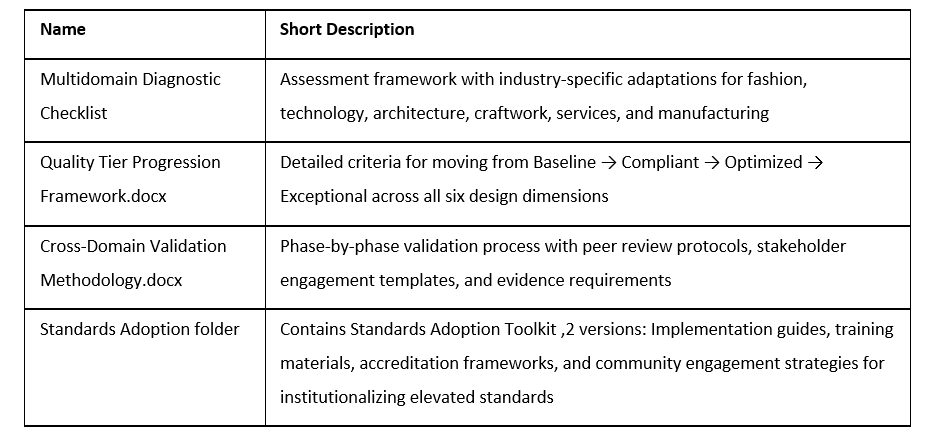
As usual, some outline artifacts Part 4 artifacts subject to review and improvement
The Inadequacy of Single-Dimension Excellence
When Quality Becomes the Problem
The democratization of quality created the problem The New New Design solves: when everyone can achieve material excellence, material excellence stops being meaningful. But the solution is not to abandon quality standards. It is to recognize that quality is one dimension among many, and that true design excellence requires simultaneous optimization across multiple, often contradictory dimensions.[3][5][8][2]
A watch with a perfect Swiss movement, housed in flawless titanium, priced accessibly, but produced through exploitative labor practices is not excellent. It is incomplete.[1]
A handbag with beautiful design language, transparent maker stories, and sustainable materials, but which falls apart after six months, is not excellent. It is dishonest.[2]
A service with revolutionary accessibility features and community co-governance, but which cannot scale beyond 100 users without collapsing, is not excellent. It is unsustainable.[9][10]
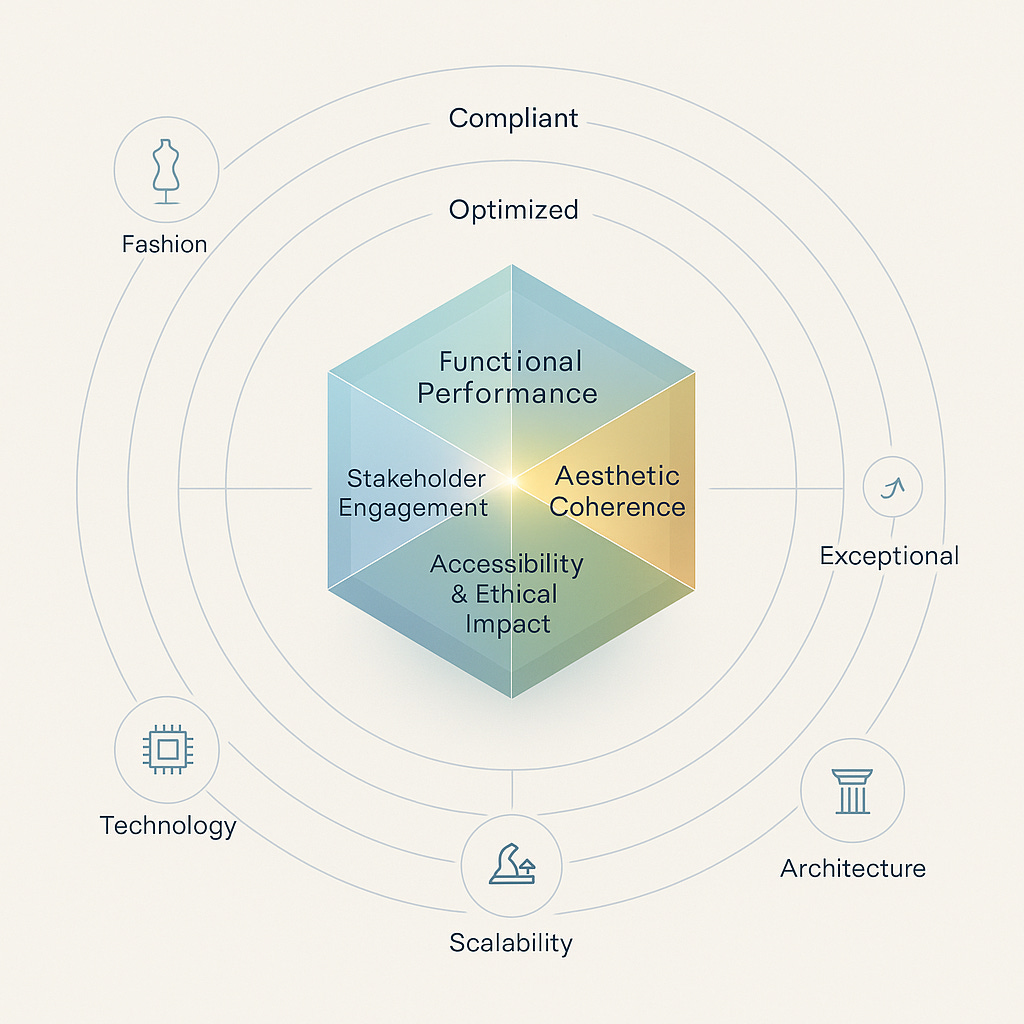
The Six Dimensions of New New Design Excellence
Products and services operating in the meaning economy must demonstrate integrity across six interdependent dimensions:[5][4]
Functional Performance: Does it work superbly? Not just adequately superbly.[3][2]
Aesthetic & Experiential Coherence: Does every element feel necessary and resolved? Does the design tell a coherent story ?[2][1]
Accessibility & Inclusivity: Can diverse users across ability, culture, and economic circumstance—access the value ?[5][9]
Ecological & Ethical Impact: Does this restore rather than extract? Does it honor rather than exploit ?[1][2]
Scalability & Adaptability: Can the core value proposition survive growth and context change ?[10][11]
Stakeholder Engagement & Legacy Potential: Do the people who make, use, and are affected by this have genuine agency? Will this matter in 20 years ?[3][1]
Traditional design evaluation asks: “Is this good?” The New New Design evaluation asks: “Is this good across every dimension that matters, in ways that are coherent, verifiable, and culturally defensible ?”[2][1]
The Quality Spectrum: From Baseline to Exceptional
Redefining Design Progression
Traditional design maturity models assume linear progression: prototype → production → refinement → mastery. But in the meaning economy, different products require different excellence profiles. A fashion accessory brand might prioritize aesthetic coherence and narrative while accepting moderate scalability constraints. A service design might prioritize accessibility and stakeholder engagement while operating at baseline aesthetic standards.[8][5][3][1]
The framework recognizes four progressive quality tiers, applied independently across each of the six dimensions:[8][5]
Baseline: Minimum viable excellence. The product works, doesn’t harm, and meets basic expectations. This is the quality parity level that democratized manufacturing has made accessible.[3][2]
Compliant: Industry-standard excellence. The product meets or exceeds recognized best practices, passes third-party validation, and aligns with sector benchmarks.[6][9]
Optimized: Category-leading excellence. The product exceeds benchmarks by measurable margins, demonstrates contextual adaptation, and shows evidence of systematic improvement.[11][5]
Exceptional: Paradigm-shifting excellence. The product establishes new benchmarks, generates replicable methodology, earns peer recognition, and influences category standards.[4][10]
The critical insight: You do not need Exceptional performance across all dimensions to close the branding gap. You need Compliant performance across most dimensions, Optimized performance in areas that align with your meaning architecture, and Exceptional performance in 1-2 breakthrough dimensions that define your cultural positioning.[1][2]
Horizon Watch Co. (from Part 3) might target: Exceptional narrative coherence and personalization architecture, Optimized functional performance and aesthetic coherence, Compliant accessibility and scalability, Baseline ecological impact (with transparent roadmap for improvement).[1]
This is not permission for selective mediocrity. It is strategic recognition that resources are finite and meaning is constructed through distinctive excellence, not uniform perfection.[2][3]
Dimension One: Functional Performance in the Age of Ubiquitous Quality
When “Works Perfectly” Is Table Stakes
Part 1 established that Swiss watch movements are available to any manufacturer. Italian leather is sourced by startups and legacy houses alike. Quality parity means functional excellence is accessible but that makes it more important, not less.[3][2]
The difference: In The New New Design, functional performance must be verifiable, transparent, and narratively coherent.[2][1]
Baseline Functional Performance:
The product completes its primary task without critical failures. A watch keeps time within acceptable tolerances. A bag carries objects without tearing. A service delivers promised outcomes most of the time.[3][1]
This is not enough to close the branding gap. Baseline performance is expected, not valued.[2]
Compliant Functional Performance:
The product meets industry standards with third-party verification. Performance metrics are documented and published. Testing protocols follow recognized methodologies.[6][9]
For Horizon Watch Co.: Swiss automatic movement with documented accuracy (-4/+6 seconds per day), 100m water resistance tested per ISO 22810, scratch-resistant sapphire crystal meeting ASTM D1044, with all specifications published and verifiable.[1]
This closes the quality gap. It does not yet close the branding gap.[3][2]
Optimized Functional Performance:
The product exceeds category benchmarks by meaningful margins. Performance adapts to diverse contexts. Reliability data shows systematic excellence over time.[11][5]
For a New New Design backpack: Exceeds military-grade durability standards (tested to 50,000 cycle zipper life vs. industry standard 10,000), modular attachment system adapts to urban commute, hiking, and travel contexts, 10-year warranty backed by sub-1% return rate.[1]
This begins to close the branding gap through verifiable superiority.[2]
Exceptional Functional Performance:
The product establishes new performance paradigms. Testing methodology is published and becomes industry reference. Patents or innovations enable capabilities previously unavailable.[10][6]
Example: Patagonia’s Capilene Cool Daily fabric that achieved moisture management without chemical treatments through fiber structure innovation alone, with methodology published for industry replication.[1][2]
The Narrative Integration Requirement:
Functional excellence only contributes to The New New Design value proposition when it is made visible, explicable, and culturally meaningful.[2][1]
This means: Publishing detailed specifications and testing results, documenting why certain performance targets were chosen, explaining how performance connects to user experience and values, providing comparison data that positions performance transparently.[3][1]
Horizon Watch Co. doesn’t just use a Swiss movement it publishes the movement’s provenance, explains what accuracy ratings mean in daily use, documents testing protocols, and makes clear: “This is the same movement used in watches costing $5,000-$15,000. We’re charging $495 because our margin funds community and transparency, not century-old advertising”.[1][2]
Functional performance becomes part of the meaning architecture when it is transparent, verifiable, and narratively coherent.[3][2][1]
Dimension Two: Aesthetic Coherence as Design Intelligence
Beyond Subjective Taste
Part 2 established that aesthetic intelligence has become a primary currency of value in post-quality-parity markets. But this is not about subjective beauty. It is about demonstrable design resolution the quality where every element feels necessary, coherent, and intentional.[2][3][1]
The Eames Lounge Chair example from Part 1: When it launched in 1956, it had no brand heritage to lean on. Its design was so resolved, so perfectly balanced between comfort and modernist aesthetic, between mass production and craft, that it created instant cultural legitimacy.[2]
That is the standard The New New Design pursues: designs so coherent they justify themselves.[1][2]
Baseline Aesthetic Coherence:
Visual and sensory elements are intentional, not accidental. The product has a recognizable design language. User touchpoints are navigable without training.[5]
This is functional design, not yet meaning-rich design.[2]
Compliant Aesthetic Coherence:
The design follows established principles (gestalt, color theory, material logic). Consistency is maintained across all touchpoints. Cultural appropriateness is validated for target contexts. Accessibility meets WCAG 2.2 or domain equivalent.[9][5]
For a New New Design furniture piece: Proportions follow golden ratio principles, material transitions are resolved (no visible fasteners unless they contribute to design language), finish quality matches luxury incumbents, cultural references are documented and defensible.[1][2]
This achieves design credibility but not yet distinction.[3][2]
Optimized Aesthetic Coherence:
The design creates distinctive, memorable experience while maintaining usability. Multi-sensory integration enhances rather than distracts. Emotional resonance is measurable through user research (Net Promoter Score >50, sentiment analysis >70%). Cross-cultural adaptation demonstrates nuanced understanding.[7][5]
This is where The New New Design brands begin to build cultural capital independent of heritage. The design itself becomes the story: “This references 1960s aerospace instrumentation—matte surfaces for glare reduction, high-contrast indices for instant readability, tool-like functionality. Every design decision has rationale rooted in that aesthetic philosophy”.[1][2]
Exceptional Aesthetic Coherence:
The design establishes new aesthetic paradigm or revives dormant traditions innovatively. Experience creates transformative impact (behavior change, perception shift, legacy value). Industry recognition for design contribution (awards, case studies, academic citation). Methodology is documented and transferable.[4][10]
Example: Dieter Rams’s work for Braun in the 1960s, which established principles of minimalist design that influence product design 60 years later. His “Ten Principles of Good Design” became industry reference.[2]
The New New Design Aesthetic Standard:
Coherence must be explicable and defensible. You can articulate why every design choice was made. Cultural references are authentic and researched, not appropriated. Design language remains consistent across product line. Evolution is intentional, not reactive to trends.[1][2]
And critically: Design intelligence must be made visible through narrative. Content that explains design philosophy, documents evolution, contextualizes cultural references. This transforms subjective aesthetic into shared cultural literacy.[3][2][1]
When someone asks “Why does this cost $645 when it looks similar to the $150 version?”, the answer is not “Better materials” (quality parity means that’s insufficient). The answer is: “Because every proportion, detail, and finish was resolved through 47 iterations over 11 months, referencing authentic design heritage, resulting in aesthetic coherence you’ll appreciate more deeply over years of ownership. Here’s the design story…”.[2][1]
Dimension Three: Accessibility as Cultural Imperative
Democratic Luxury Requires Democratic Access
The New New Design’s foundational premise closing the branding gap through meaning architecture rather than material scarcity only achieves cultural legitimacy if it is genuinely accessible.[3][1][2]
A $3,000 “affordable alternative” to a $15,000 luxury watch has not democratized luxury. It has created a mid-tier luxury brand. The New New Design ambition is more radical: exceptional quality and design intelligence accessible to significantly broader audiences.[3][1][2]
But accessibility is not just about price. It encompasses physical accessibility for diverse abilities, cultural accessibility across communities, cognitive accessibility for varied literacies, economic accessibility at multiple price points.[9][5]
Baseline Accessibility:
Primary functionality available to 80%+ of intended users without modification. Legal accessibility requirements met (ADA, EN 301 549). Documentation available in primary user language(s). Economic accessibility model defined for target segment.[9]
Compliant Accessibility:
Multi-modal access paths (visual, auditory, tactile, cognitive alternatives). Cultural accessibility tested with diverse user groups (minimum 3 demographic segments). Economic tiers enable 90%+ of target market access. Inclusive design principles embedded in development process, not retrofitted.[5][9]
For Horizon Watch Co.: Website meets WCAG 2.2 AA standards, product photography includes diverse wearers, configurator includes text descriptions for screen readers, pricing includes 3 tiers ($495 base / $645 customized / $795 limited edition) accessible to broad market.[1]
Optimized Accessibility:
Universal design approach: usable by diverse abilities without adaptation. Proactive accommodation: anticipates and removes barriers before users encounter them. Economic justice: pricing models include subsidized access for underserved populations. Co-design with historically excluded communities documented and integrated. Accessibility testing includes assistive technology users (minimum 20% of test group).[5][9]
This level begins to transform products into cultural movements. Not just selling to diverse audiences, but co-creating with them.[3][2][1]
Exceptional Accessibility:
Redefines accessibility standards in domain through innovative approaches. Creates economic access pathways previously unavailable (cooperative ownership, time-banking, pay-what-you-can models). Measurable impact on reducing disparities (employment, participation, outcomes data). Methodology shared openly; tools created for others to replicate. Third-party validation from disability rights, equity, or social justice organizations.[10][9]
Example: Warby Parker’s “Buy a Pair, Give a Pair” model that made quality eyewear economically accessible while creating distribution infrastructure for vision care in underserved communities globally. The model has been replicated across industries.[2][1]
The New New Design Accessibility Standard:
Accessibility is not a feature to be added or a market to be served. It is an ethical baseline and cultural positioning.[3][1][2]
Your meaning architecture must include genuine commitment to broad access. Your pricing strategy must serve this commitment (tiered models, transparent cost breakdowns, payment plans). Your design process must include diverse voices from inception. Your metrics must track equitable access and impact.[1][3]
And you must make this visible: “We offer three pricing tiers because we believe design excellence should be accessible. Our base model at cost + reasonable margin ensures anyone can participate. Customization and limited editions create premium tiers for those who want uniqueness. This structure sustains the business while serving broad audiences”.[2][1]
Dimension Four: Ecological and Ethical Integrity as Non-Negotiable
Sustainability as Baseline, Restoration as Aspiration
Part 2 identified ethical production and sustainability as non-negotiable baseline expectations among contemporary consumers, especially under 40. This creates both challenge and opportunity for The New New Design brands.[3][1][2]
The challenge: Ethical and ecological integrity often increase costs, constraining the accessibility that defines democratic luxury.[1][3]
The opportunity: Legacy luxury brands often have environmental debt (decades of wasteful production, opaque supply chains, resistance to circular models). New entrants can build ecological integrity from inception, making it part of their meaning architecture rather than retrofit.[2][3][1]
Baseline Ecological & Ethical Impact:
Environmental impact assessed (carbon footprint, material lifecycle, waste streams). Compliance with environmental regulations. Ethical sourcing verification for materials and labor (minimum Tier 1 suppliers). No use of prohibited substances or practices.[9]
This is legal compliance, not yet cultural differentiation.[2]
Compliant Ecological & Ethical Impact:
Lifecycle assessment (LCA) completed and documented. Environmental performance meets sector benchmarks (LEED Silver, EarthCheck certified). Supply chain transparency to Tier 2 suppliers. Fair labor practices verified through third-party audit. Data privacy/security meets GDPR or equivalent (for digital products).[9]
For a New New Design leather goods brand: Full LCA published showing embodied carbon, leather sourced from tanneries with environmental certifications (Leather Working Group Gold or higher), supply chain mapped to farm level, labor practices verified through independent audit, results published transparently.[1][2]
This begins to close the branding gap through verifiable ethics.[3][1]
Optimized Ecological & Ethical Impact:
Regenerative design principles applied: net-positive environmental impact. Circular economy model: 75%+ materials recoverable/recyclable. Full supply chain transparency and ethical verification. Community benefit agreements in place and monitored. Carbon neutrality achieved or pathway with timeline defined.[4][9]
This level transforms sustainability from compliance to cultural positioning. Your ecological commitment becomes inseparable from your brand story: “We chose vegetable-tanned leather because chrome tanning creates toxic waste. Yes, it costs 40% more and has longer lead times. We absorbed the cost difference because we believe leather goods shouldn’t poison rivers”.[1][2]
Exceptional Ecological & Ethical Impact:
Restores ecosystems or communities rather than merely avoiding harm. Creates new models for ethical production/distribution (cooperative ownership, commons-based approaches). Measurable biodiversity enhancement or social capital building. Open-source approach enables others to replicate ethical practices. Third-party validation (B-Corp, Cradle to Cradle Gold+). Industry leadership: standards influenced by this project’s methodology.[10][4][9]
Example: Patagonia’s decision to transfer ownership to environmental trusts, ensuring profits fund climate action in perpetuity. This moves beyond corporate sustainability to systemic redesign.[2][1]
The New New Design Ecological Standard:
Ecological and ethical integrity must be transparent, verifiable, and continually improving.[3][1][2]
This means: Publishing full environmental assessments and supply chain documentation, setting public improvement targets with accountability mechanisms, participating in industry coalitions working toward systemic change, making trade-offs visible (”We could reduce cost 15% by switching suppliers, but we won’t because current partners meet our labor standards”).[1][2]
The narrative integration: Your ecological commitment is not marketing it is foundational to your meaning architecture. Customers pay premiums not for greenwashing, but for demonstrated integrity.[3][2][1]
Dimension Five: Scalability Without Dilution
Growth That Preserves Meaning
The New New Design creates value through personalization, narrative, community, and scarcity all of which seem fundamentally unscalable. How do you grow from 100 customers to 10,000 to 100,000 without losing the intimacy, craft story, and exclusivity that created initial value?[2][3][1]
This tension killed many challenger brands. Initial success built on artisan small-batch production becomes impossible to maintain. Scaling requires manufacturing partnerships that compromise maker relationships. Growth demands capital that comes with pressure to maximize short-term profit over long-term meaning.[3][1]
The question is not whether to scale, but how to scale in ways that preserve meaning architecture.[1][2][3]
Baseline Scalability:
Documented processes enable replication by others. Core functionality maintained under 2x demand increase. Basic modular architecture allows component updates without system redesign.[11]
Compliant Scalability:
Handles 5-10x scale variation without performance degradation >20%. Adaptation pathway for 3+ adjacent contexts documented. Knowledge transfer system enables adoption by others (training, documentation, support). Technical debt quantified and sustainable.[11][10]
For Horizon Watch Co.: Manufacturing partnership can scale from 500 units/year to 5,000 units/year while maintaining quality standards, personalization system handles increased configuration volume, community management processes documented for hiring additional moderators, content production cadence sustainable at 5x current audience.[1]
Optimized Scalability:
Scales across magnitude orders (10-100x) with graceful performance curves. Successfully adapted to 5+ diverse contexts with 80%+ original functionality retained. Plug-in architecture enables community-driven extensions. Localization framework supports cultural/linguistic/regulatory adaptation. Fork-friendly: derivative works enhance rather than fragment ecosystem.[7][11][5]
This level enables category expansion while preserving meaning. Nike achieved this through modular platform: Air technology, Flyknit construction, NIKEiD customization scalable systems that enable both mass production and personalization.[2][1]
Exceptional Scalability:
Platform approach: enables entirely new use cases beyond original design. Cross-domain application demonstrated. Network effects: value increases with adoption. Open standards created; interoperability prioritized over lock-in. Governance model sustains evolution beyond original creators. Evidence of adaptation in low-resource contexts maintaining quality.[7][10]
The New New Design Scalability Standard:
Scalability must be architecturally designed from inception, not retrofitted under growth pressure.[3][1]
This means: Modular personalization systems that scale (configurators, not one-off custom work), manufacturing partnerships structured for growth (not single artisan dependencies), narrative systems that scale (content frameworks, not founder-only storytelling), community platforms that scale (moderators, ambassadors, not founder-only engagement).[3][1]
And critically: Transparency about scale transitions. When you move from made-to-order to small-batch production, when you add manufacturing partners, when you introduce automation—communicate changes openly. Your community will accept evolution if it’s explained honestly and values are maintained.[2][1][3]
“As we’ve grown from 500 to 5,000 customers, we’ve added two manufacturing partners. Here’s how we selected them, here’s their labor practices verification, here’s how quality control works across partners. Our commitment to ethical production and design excellence remains unchanged only the scale has evolved”.[1][3]
Dimension Six: Stakeholder Agency and Intergenerational Legacy
Co-Creation as Business Model
The New New Design’s most radical dimension: transforming stakeholders from consumers into co-creators. This is not community marketing. This is fundamental redistribution of agency in brand building.[2][3][1]
Part 3 detailed the expanded stakeholder universe: end users as meaning-seekers, makers whose craft becomes product value, community members who co-create narrative, cultural sources that inspire design language, future collectors who determine long-term value. Each holds stakes in product meaning that transcend transactional relationships.[3][1]
Baseline Stakeholder Engagement:
Key stakeholder groups identified and consulted (minimum: users, implementers, funders). Feedback mechanisms exist and are monitored. Basic governance structure defined.[8]
Compliant Stakeholder Engagement:
Multi-stakeholder engagement throughout design process (not just at endpoints). Power-mapping conducted; historically excluded voices have decision-making influence. Conflict resolution protocols established. Succession planning ensures continuity. Financial sustainability model viable for 5+ years.[8][5]
For a New New Design brand: User surveys inform design decisions, maker partners review product roadmaps, community input shapes limited edition designs, transparent financial modeling demonstrates long-term viability.[1][3]
Optimized Stakeholder Engagement:
Co-governance model: users/beneficiaries have structural power. Intergenerational design: considers 7-generation impact (Indigenous planning principle). Knowledge commons created: documentation, tools, methods freely accessible. Capacity-building embedded: stakeholders gain transferable skills. Economic multiplier: generates livelihoods and ecosystem development.[4]
This level transforms brands into cultural movements. Supreme achieved this through community-driven hype culture—the brand’s value is co-created by collectors, resellers, and cultural commentators as much as by Supreme itself.[2][1]
Exceptional Stakeholder Engagement:
Transforms power relations: shifts ownership/control to marginalized communities. Institutional permanence: integrated into policy, curriculum, or standards. Generative legacy: inspires derivative works across domains. Paradigm shift: changes how sector thinks about problem/solution space. Measurable systemic impact. Oral histories, case studies, academic research document impact.[10][4]
The New New Design Stakeholder Standard:
Stakeholder engagement must be authentic co-creation with structural power-sharing, not performative consultation.[3][1][2]
This means: Community input mechanisms that demonstrably influence decisions (not just feedback forms that disappear into void), transparent reporting on how input was incorporated or why not, economic participation opportunities (ambassador programs with compensation, affiliate structures, cooperative ownership models explored), maker recognition and attribution (not invisible supply chains), long-term thinking that values community health over quarterly growth.[1][3]
The narrative integration: Your community is not your audience they are co-authors of your brand story. When Horizon Watch Co. introduces a new limited edition based on community input, when customer configurations inspire standard colorways, when maker interviews become your most engaging content the stakeholder engagement becomes inseparable from brand value.[3][1]
“This limited edition design was proposed by community member Alex Chen in our Discord server, refined through 6 weeks of community discussion, and produced in a run of 100. Serial numbers 001-010 were reserved for most active community contributors. This is what co-creation means to us”.[1][3]
The Diagnostic Framework: Assessing Your Position
From Aspiration to Evidence
The six dimensions provide philosophical framework. The diagnostic process transforms philosophy into measurable position and actionable roadmap.[11][5]
Phase 1: Current State Assessment (2-3 Weeks)
Objective: Determine your current tier (Baseline/Compliant/Optimized/Exceptional) across all six dimensions.[5]
Process:
Dimension-by-Dimension Audit:
For each dimension, gather evidence: performance data, user research, environmental assessments, community metrics, scalability tests, stakeholder interviews.[8][5]
Map current state to tier criteria. Be brutally honest overstating current position undermines the entire framework.[5]
Document gaps: Where do you fall short of next tier? What evidence is missing? What capabilities need development ?[11][5]
Comparative Benchmarking:
Select 3-5 comparable brands (mix of legacy luxury, new luxury, and peer New New Design brands). Assess their position across the six dimensions using public information, product testing, community observation.[5]
Map competitive landscape: Where are you differentiated? Where are you at parity? Where are you behind ?[5]
Stakeholder Validation:
Interview 20-30 stakeholders across groups (customers, makers, community members, distribution partners). Ask: “What do we do exceptionally well? Where do we disappoint? What would make us world-class ?”[3][1]
Don’t just ask what they want observe what they value through behavior (what content gets engagement, what features get used, what products get recommended).[1][3]
Deliverable: Current State Report documenting tier position for each dimension, competitive positioning map, stakeholder insights, evidence gaps.[5]
Phase 2: Strategic Targeting (1 Week)
Objective: Determine which dimensions to prioritize for elevation based on meaning architecture and resource constraints.[2][1]
Process:
Meaning Architecture Alignment:
Review your core meaning architecture from Part 2: What dimensions are most critical to your value proposition ?[2][3]
If your brand is built on transparency and ethical production, Ecological/Ethical Impact and Stakeholder Engagement are non-negotiable Optimized+ targets.[2][1]
If your brand is built on design intelligence and aesthetic innovation, Aesthetic Coherence and Functional Performance are priority elevations.[1][2]
Resource Reality Check:
Map resource requirements (time, capital, expertise) for moving each dimension one tier.[11]
Prioritize: High-impact, moderate-resource improvements first; high-impact, high-resource improvements with phased plans; low-impact improvements deferred.[11]
Breakthrough Dimension Selection:
Choose 1-2 dimensions where you will pursue Exceptional performance. These become your cultural differentiation.[2][1]
Requirements: Alignment with founder/team passion, sustainable competitive advantage potential, cultural relevance to target community.[3][1][2]
Acceptable Minimums:
Identify dimensions where Compliant performance is sufficient given your positioning.[1]
Example: A fashion accessories brand might accept Baseline scalability initially (made-to-order, limited scale) while pursuing Exceptional aesthetic coherence and optimized stakeholder engagement.[1]
Be transparent about this: “We’re currently producing 500 pieces per year. As we scale, we’ll maintain design excellence and maker relationships—that’s non-negotiable. Scalability will increase gradually as we build sustainable infrastructure”.[3][1]
Deliverable: Strategic Targets Document defining tier goals for each dimension with rationale, breakthrough dimensions identified, resource allocation plan.[11]
Phase 3: Elevation Roadmap (1-2 Weeks)
Objective: Create actionable plans for moving each dimension toward target tier.[11]
Process:
Dimension-Specific Work Plans:
For each dimension requiring elevation, define: Current gap (what’s missing to reach next tier), capability requirements (skills, tools, partnerships needed), implementation steps (concrete actions with owners and timelines), validation criteria (how you’ll prove you’ve reached new tier), resource budget (time, money, expertise).[10][11]
Interdependency Mapping:
Identify where dimension improvements enable or constrain each other.[5]
Example: Improved scalability (Dimension 5) might require manufacturing partnerships that affect ecological impact (Dimension 4) and stakeholder engagement (Dimension 6). Plan holistically.[3][1]
Phased Timeline:
6-month sprint: Quick wins that demonstrate commitment and build momentum.[11]
18-month milestones: Major capability builds (new manufacturing partnerships, platform developments, comprehensive environmental assessments).[10][11]
3-5 year aspirations: Exceptional-tier breakthroughs and category leadership.[10]
Investment Requirements:
Quantify capital needs, expertise acquisition, tool/platform costs, certification/validation fees.[11]
Develop funding strategy aligned with growth model (bootstrapped, angel investment, community funding, revenue-funded).[1]
Deliverable: Elevation Roadmap with phased work plans, interdependency maps, timeline with milestones, investment requirements.[11]
Domain-Specific Adaptation: Making Standards Contextual
Why Universal Standards Fail
A fashion accessories brand and a software platform and an architecture practice all operate in The New New Design paradigm closing branding gaps through meaning architecture, building community, emphasizing narrative over legacy. But the specific dimensions most critical, the evidence required, and the tier progression differ fundamentally.[6][7][4][2][3][1]
The framework must be contextually adapted, not rigidly applied.[7][5]
Fashion & Accessories Adaptation
Priority Dimensions: Aesthetic Coherence (Exceptional target), Ecological/Ethical Impact (Optimized minimum), Stakeholder Engagement (Optimized target).[2][1]
Critical Evidence: Material provenance and environmental certifications, maker attribution and labor practice verification, design heritage documentation and cultural reference authenticity, community engagement metrics and user-generated content, secondary market health (resale values, collector activity).[3][1]
Dimension Modifications:
Functional Performance: Focus on durability, material aging, construction integrity.[1]
Scalability: Limited production may be strategic advantage rather than limitationcommunicate intentionally.[1]
Watches & Jewelry Adaptation
Priority Dimensions: Functional Performance (Optimized minimum precision matters), Aesthetic Coherence (Exceptional target), Scarcity/Legacy Architecture (Optimized target).[2][1]
Critical Evidence: Movement specifications and testing documentation, material sourcing and authenticity verification (precious metals, gemstones), provenance systems for secondary market validation, collector community health, design story coherence and cultural positioning.[1]
Technology & Software Adaptation
Priority Dimensions: Functional Performance (Optimized minimum users are unforgiving), Accessibility (Optimized minimum legal and ethical requirement), Scalability (Exceptional target fundamental to business model).[7][5][11]
Critical Evidence: Uptime/reliability metrics (99.9%+ target), accessibility compliance testing (WCAG 2.2 AAA), security audits and privacy compliance, API quality and developer experience, community/ecosystem health (if platform model).[7][5]
Dimension Modifications:
Aesthetic Coherence: Includes UI/UX design, interaction patterns, information architecture.[5]
Ecological Impact: Focus on energy consumption, data center footprint, algorithmic bias, data sovereignty.[9]
Architecture & Built Environment Adaptation
Priority Dimensions: Ecological Impact (Optimized minimum—embodied carbon is massive), Stakeholder Engagement (Optimized minimum—community impact unavoidable), Aesthetic Coherence (Optimized target).[4][8][9]
Critical Evidence: Lifecycle carbon assessment (embodied + operational), post-occupancy evaluation results, community design charrette documentation, historical/cultural context integration, LEED/WELL/Living Building Challenge certification.[8][4][9]
Dimension Modifications:
Functional Performance: Includes space utilization, environmental systems, user flow optimization.[8]
Legacy Potential: Includes intergenerational design considerations, adaptation capacity, cultural heritage contribution.[4]
Services & Social Programs Adaptation
Priority Dimensions: Accessibility (Exceptional target—core to mission), Stakeholder Engagement (Exceptional target—co-creation fundamental), Functional Performance (Optimized minimum—outcomes matter).[9][5]
Critical Evidence: Demographic reach and participation data disaggregated by marginalized groups, completion rates and outcome achievement, stakeholder governance documentation, cost-effectiveness ($ per outcome), sustainability planning (viability beyond initial funding).[9]
Dimension Modifications:
Aesthetic Coherence: Includes service journey design, emotional touchpoint quality, ritual/ceremony creation.[5]
Scalability: Includes franchise/replication potential, knowledge transfer systems, low-resource context adaptation.[10][11]
Craftwork & Artisanal Adaptation
Priority Dimensions: Aesthetic Coherence (Exceptional target), Stakeholder Engagement (Optimized target—maker visibility), Ecological/Ethical Impact (Optimized minimum).[2][1]
Critical Evidence: Skill documentation and transmission systems, material provenance and traditional knowledge, economic viability for practitioners, cultural authenticity balanced with innovation, intergenerational knowledge transfer.[2][1]
Dimension Modifications:
Functional Performance: Includes technical execution, material integrity, replicability.[1]
Scalability: May be appropriately constrained—communicate as strategic choice.[1]
Validation and Adoption: Making Standards Credible
From Internal Assessment to Cultural Recognition
The framework only closes the branding gap if it produces credible, verifiable claims about excellence. Self-assessed “Exceptional” performance without external validation is marketing—and contemporary consumers see through it immediately.[3][2][1]
Validation must be multidimensional, ongoing, and transparent.[10][5][11]
Peer Review Validation
Expert Panels: Assemble 5-7 domain experts (designers, material scientists, sustainability consultants, accessibility specialists) for formal review every 6-12 months.[10]
Provide evidence packages documenting performance claims. Request written assessments with improvement recommendations.[10]
Publish results (even critical feedback) as demonstration of commitment to excellence.[2][1]
Cross-Domain Review: Invite experts from adjacent fields to challenge assumptions. An industrial designer reviews your fashion accessories. A software accessibility specialist reviews your physical retail experience. Fresh perspectives reveal blind spots.[7][5]
User Validation
Co-Interpretation Sessions: Regular (quarterly) structured sessions where users review your dimension performance claims and provide evidence from their experience.[8][5]
Not “Do you like this?” but “We claim Optimized accessibility—do you agree? Where do we fall short?”.[5]
Behavioral Evidence: Track what users do, not just what they say. Accessibility claims validated by diverse user adoption. Scalability claims validated by performance under load. Community engagement claims validated by participation rates and user-generated content.[3][1]
Third-Party Certification
Industry Standards: Pursue recognized certifications where relevant: B-Corp for holistic social/environmental performance, LEED/WELL for built environment, EarthCheck for hospitality/tourism, ISO standards for manufacturing.[4][9]
These provide independent validation and cultural credibility.[9][10]
Custom Audits: For dimensions without standard certification, commission independent audits: supply chain transparency verification, accessibility testing by disability rights organizations, environmental impact assessment by specialized consultancies.[9][5]
Community Validation
Secondary Market Health: For physical products, resale values and collector activity provide unbiased validation of scarcity architecture and legacy potential.[3][1]
Healthy secondary market means your scarcity strategy works and value proposition is genuine.[1]
Organic Advocacy: Net Promoter Score, referral rates, user-generated content volume, community vitality all validate stakeholder engagement claims.[3][1]
You cannot fake passionate community—it either exists or it doesn’t.[3][1]
Transparent Reporting
Annual Standards Report: Publish comprehensive documentation: current tier for each dimension with evidence, year-over-year progress and setbacks, updated targets and roadmap, peer review findings and responses, investment in capability building.[10][5]
This transparency transforms assessment from marketing into credibility.[2][1]
Real-Time Documentation: Ongoing content that shows the work: design iteration documentation, maker partnership development, community feedback integration, supply chain audits, environmental impact tracking.[3][1]
The work itself becomes part of the story.[2][3][1]
Conclusion: Standards as Living Systems
Excellence as Process, Not Destination
The New New Design standards framework recognizes a fundamental truth: in the meaning economy, excellence is not a fixed state but a continuous elevation process.[2][3][1]
Quality parity means material excellence is accessible baseline. Design intelligence means aesthetic coherence must continually evolve. Cultural participation means stakeholder expectations rise over time. Ecological urgency means yesterday’s “sustainable” is tomorrow’s inadequate.[2][3][1]
The framework is not a checklist to complete. It is a diagnostic and elevation system to inhabit.[10][11][5]
From Closing Gaps to Setting Standards
Parts 1-3 established how to close the branding gap how challenger brands can create value comparable to luxury incumbents without century-old heritage. Part 4 establishes how to exceed the gap how New New Design brands can set new standards that legacy brands struggle to meet.[3][1][2]
Your advantages: No historical debt (extractive supply chains, opaque practices, resistance to change), meaning architecture built from inception (not retrofitted onto century-old business models), community as co-creators (not passive consumers), transparency as differentiation (not liability to hide), agility (can evolve faster than institutional incumbents).[1][2][3]
The Cultural Implications
As New New Design brands demonstrate excellence across six dimensions simultaneously functional performance with aesthetic coherence with accessibility with ecological integrity with scalability with stakeholder agency the cultural conversation shifts.[2][3][1]
Excellence becomes multidimensional. Consumers become design-literate across domains. Supply chains become visible. Makers receive recognition and economic benefit. Marginalized communities gain agency. Sustainability becomes baseline. Legacy becomes something built in years, not centuries.[3][1][2]
This is not disrupting luxury. This is redefining what luxury means.[1][2][3]
The Framework as Contribution
The diagnostic checklist, validation methodology, and domain adaptations are offered as open-source tools. The New New Design succeeds when the paradigm becomes widespread, not when any single brand dominates.[10][2][1]
Use the framework. Adapt it to your domain. Publish your findings. Share your elevation strategies. Create industry coalitions around multidimensional excellence. The rising tide lifts all ships except those anchored to obsolete definitions of value.[2][3][1]
A Call to Multidimensional Excellence
For The New New Design brands already operating: Assess your current position honestly. Identify breakthrough dimensions aligned with your meaning architecture. Build validation systems that make excellence visible. Publish transparently even weaknesses and aspirations.[3][1][2]
For legacy brands watching this shift: Your heritage is valuable but insufficient. Adopt multidimensional standards. Build genuine accessibility. Reveal your makers. Reduce ecological debt. Share power with stakeholders. Your century-old story is meaningful make the next chapter worthy of it.[1][2][3]
For consumers navigating this landscape: Demand evidence across all dimensions. Support brands doing the hard work of multidimensional excellence. Reject greenwashing, accessibility theater, and fake community. Use your purchasing power to elevate standards.[2][3][1]
For policymakers and standard-setters: The framework offers structure for recognizing and incentivizing multidimensional excellence. Consider certifications, procurement requirements, and regulatory frameworks that reward genuine elevation across dimensions.[9][10]
The Invitation
The New New Design is not a closed system. It is an invitation to reimagine value, democratize excellence, and build products that matter across every dimension that defines meaning in contemporary culture.[3][1][2]
The branding gap is not closing it is being redefined by those who understand that in the age of quality parity, story is product, community is currency, and multidimensional excellence is the only sustainable advantage.[1][2][3]
The framework is yours. The elevation is yours. The future of what excellence means is being written right now, by brands that refuse to accept that value requires centuries to build.[2][3][1]
Welcome to the next chapter of The New New Design. You are not just closing gaps. You are setting the standards others will aspire to meet.
References
1. The-New-New-Design-Part-3-article.docx
2. The-New-New-Design-Part-1.docx
3. The-New-New-Design-Part-2-rewrite.docx
4. https://www.aia.org/design-excellence/aia-framework-design-excellence
5. https://www.solutelabs.com/blog/how-to-conduct-a-design-audit
6. https://www.6sigma.us/manufacturing/design-for-excellence-dfx/
7. https://latitude-blog.ghost.io/blog/ultimate-guide-to-cross-domain-prompt-testing/
8. https://en.wikipedia.org/wiki/Design_quality_indicator
10. https://arxiv.org/html/2508.01430v1