Preamble: The Imperative of Universal, Non-Comparative Development Standards
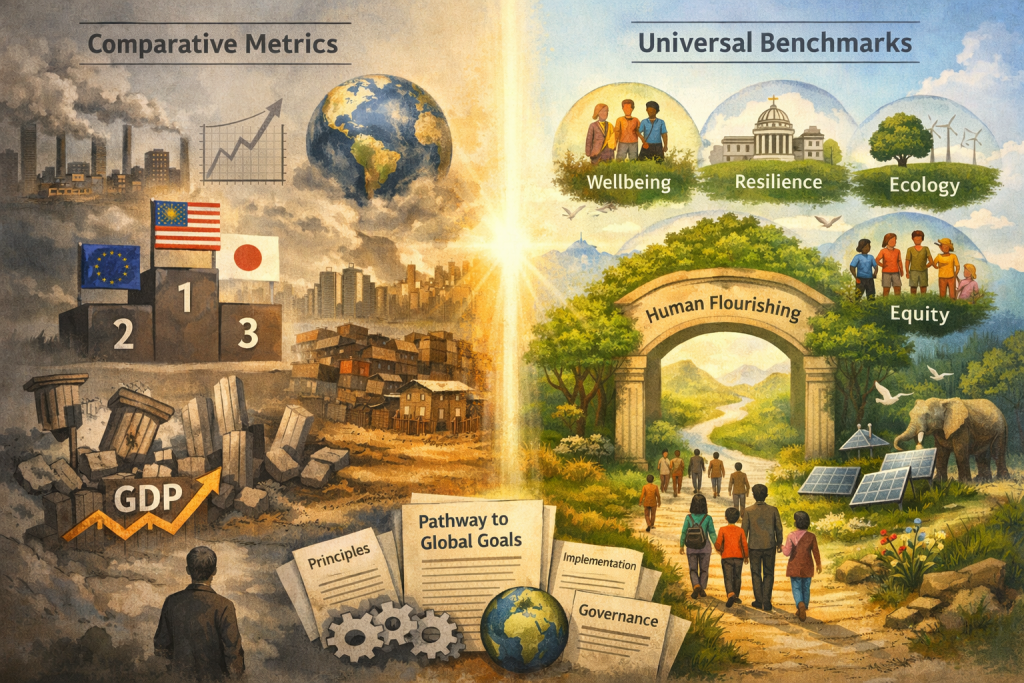
For over seven decades, the global development paradigm has been dominated by a hierarchical model that positions certain nations primarily the United States and Western European economies as the implicit standard against which all others are measured. This framework, embedded in indices like GDP per capita, the Human Development Index, and various competitiveness rankings, creates a zero-sum competition that fundamentally misunderstands both the nature of development and the requirements for civilizational maturation.
The referenced documents the Universal Societal Development Benchmark (USDB), the Pluralistic Framework for Civilizational Maturity Assessment, and their associated implementation specifications represent a radical departure from this paradigm. They propose something far more ambitious and necessary: universal benchmarks rooted not in the achievements of any particular nation or cultural model, but in the biophysical realities of planetary boundaries and the normative foundations of universal human dignity. Reference Files
| Referenced file name | Short description |
| Which data sources support measuring institutional.docx | Practical guidance on measuring institutional resilience (especially in local government), including data sources, planetary boundary threshold-setting, co-design with Indigenous communities, and mixing qualitative and quantitative indicators. |
| USDB Strategic Vision & BRD.docx | The Strategic Vision + Business Requirements Document (BRD) for the Universal Societal Development Benchmark (USDB), covering purpose, domains, stakeholder needs, pain points, and functional requirements. |
| USDB SRS with Epics & User Stories.docx | The Software Requirements Specification (SRS) for USDB, structured into epics, user stories, acceptance criteria, and delivery phases for implementation. |
| A Pluralistic Framework for Civilizational Maturity Assessment.docx | A conceptual paper proposing a pluralistic civilizational maturity framework, combining planetary boundaries, human dignity, cultural diversity, and meta-capacities (adaptation, foresight, governance). |
| The Universal Societal Development Benchmark.docx | A high-level overview of the USDB framework, including the 10 domains, the scoring system (tangible vs intangible), governance model, and use cases. |
Why Universal, Non-Comparative Standards Are Essential
The traditional comparative approach suffers from five fatal flaws:
1. The Arbitrary Reference Point Problem
When the “developed world” serves as the benchmark, we inadvertently canonize historical contingencies—patterns of industrialization that were often extractive, ecologically destructive, and built on colonial exploitation. Telling a nation in 2026 to “develop like the USA did” is both ecologically impossible (there aren’t enough planets) and ethically indefensible (the historical conditions that enabled that development path are unrepeatable and often unconscionable).
2. The Moving Target Fallacy
Comparative benchmarks create a treadmill where “catching up” is perpetually deferred. As high-income nations advance technologically, the goalpost shifts. A nation that achieves 1990s-USA standards in 2026 is told they’re still “developing” because the USA has moved ahead. This generates learned helplessness and ignores the fact that many “developing” nations now excel in areas where traditional “developed” nations struggle (mobile payment infrastructure, renewable energy adoption, community-based healthcare).
3. The Monoculture Trap
Ranking nations against a singular development model creates pressure toward homogenization. It suggests there’s one “correct” way to organize society—typically: industrialized, market-based, individualistic, technologically intensive, urban-centered. This erases legitimate alternatives: indigenous stewardship models, communitarian economic systems, different balances between efficiency and resilience, alternative conceptions of wellbeing. The presumption that the USA represents the apex of development is not a scientific claim but a cultural assertion dressed in quantitative clothing.
4. The Ecological Blindness
Traditional development metrics treat ecological destruction as an externality or, worse, as a necessary cost of “progress.” The USA’s historical development trajectory—and that of other early industrializers—was predicated on seemingly unlimited resource extraction and waste absorption. Presenting this as a model when we’ve already transgressed multiple planetary boundaries is not just outdated; it’s civilization-threatening.
5. The Perpetuation of Structural Inequalities
Comparative frameworks obscure the fact that “developed” and “developing” are not neutral descriptive categories but outcomes of historical power relations. The wealth concentration in certain nations is not solely—or even primarily—the result of superior policies or work ethic, but of structural advantages (colonial extraction, asymmetric trade relations, brain drain, patent regimes that privatize collective knowledge, currency reserve status). Measuring against these as standards normalizes and perpetuates these inequalities.
The Case for Universal, Intrinsic Benchmarks
A truly universal benchmark must be grounded in:
Biophysical Reality: The planetary boundaries framework (Rockström, Steffen) identifies nine Earth system processes with scientifically-determined thresholds beyond which we risk irreversible, catastrophic change. These are universal constraints—they apply equally to the USA, Singapore, Bhutan, and Nigeria. A society transgressing these boundaries is not “developed”; it’s temporarily successful in ways that guarantee future collapse.
Universal Human Dignity: The social foundation (expanded from Raworth’s doughnut economics) identifies minimum standards for human wellbeing—adequate food, health, education, shelter, voice, safety—that apply to every human regardless of their nation’s GDP. A society failing to provide these is not “developing”; it’s failing its fundamental purpose regardless of its technological sophistication or wealth concentration.
Adaptive Capacity Over Static Achievement: The meta-capacities framework (intergenerational coordination, complexity embrace, self-correction, pluralism, anticipatory risk management) measures not just current performance but the capability to maintain and evolve. A society scoring high on static metrics but low on adaptability is brittle, not mature. This reframes development from a destination to a continuous process of learning and adaptation.
Pathway Plurality Within Universal Constraints: The framework explicitly recognizes that there are multiple legitimate ways to achieve societal flourishing—Buen Vivir, Nordic social democracy, East Asian developmental states, Ubuntu communalism, Islamic stewardship models, liberal cosmopolitanism—provided they remain within ecological boundaries and above social floors. This is not relativism; it’s realism about cultural diversity combined with absolutism about universal constraints.
The USDB and Pluralistic Framework documents, spanning over 100,000 words of detailed specification, operationalize this vision. They are not perfect—no measurement system can be—but they represent the most comprehensive attempt to date to establish development standards that are:
- Universal (applicable to all societies)
- Non-comparative (measured against fixed ideals, not other nations)
- Ecologically grounded (respecting planetary boundaries as absolute constraints)
- Pluralistic (honoring diverse pathways within constraints)
- Participatory (co-governed with indigenous peoples, civil society, communities)
- Adaptive (designed to evolve as our understanding improves)
This article synthesizes these frameworks into a practical guide for implementing universal development benchmarks that transcend the limitations of comparative, hierarchy-based systems.
Vision for Universal Development Benchmarks: The Safe and Just Operating Space for Humanity
Core Conceptual Architecture
The vision articulated across the USDB and Pluralistic Framework documents can be synthesized as: measuring civilizational maturity by positioning societies within a “safe and just operating space”—the doughnut between ecological ceilings and social floors, assessed not by rank but by:
- Position relative to boundaries and floors
- Trajectory (direction and rate of change)
- Pathway quality (how development is pursued)
- Adaptive capacity (capability to navigate uncertainty)
This represents a shift from comparative development (how does Country X rank against Country Y?) to conditional development (is Country X operating sustainably within planetary limits while ensuring dignity for all, and does it possess the capabilities to maintain this?).
The Four-Layer Measurement Architecture
Layer A: Planetary Boundaries (Ecological Ceiling)
The nine planetary boundaries identified by Earth system science represent absolute, non-negotiable constraints:
- Climate change (atmospheric CO₂, radiative forcing)
- Biosphere integrity (biodiversity loss)
- Land-system change (habitat conversion)
- Freshwater use (consumptive water withdrawal)
- Biogeochemical flows (nitrogen/phosphorus cycles)
- Ocean acidification
- Atmospheric aerosol loading
- Stratospheric ozone depletion
- Novel entities (chemical pollution, plastics)
Key principle: A nation transgressing these boundaries—regardless of GDP, technological sophistication, or quality-of-life indicators—is not developed in any meaningful sense. It is operating unsustainably in ways that guarantee long-term decline. The USA, for instance, scores poorly on this layer despite high GDP, because its consumption patterns exceed allocated safe boundaries by 3-5x depending on the boundary and allocation principle.
Universal applicability: These boundaries are derived from Earth system science, not political negotiation. They apply identically to all nations. The only culturally/politically contingent aspect is allocation—how the total safe operating space is divided—but the total space itself is a biophysical fact.
Layer B: Social Foundation (Human Flourishing Floor)
Twelve core dimensions (adapted from doughnut economics) define minimum standards:
- Food security and nutrition
- Health and wellness (physical, mental, social)
- Education and lifelong learning
- Water and sanitation
- Energy access
- Housing and shelter
- Income and livelihood security
- Peace and safety
- Political voice and participation
- Social equity (non-discrimination, inclusion)
- Gender equality
- Networks and relationships (social capital)
Key principle: A nation failing to provide these foundations to all residents—regardless of its aggregate wealth or technological advancement—is not developed. Luxembourg’s high GDP is irrelevant if significant populations lack adequate housing or political voice.
Contextual adaptation: While the categories are universal (all humans need food, health, shelter), the thresholds can vary contextually. Arctic communities define adequate housing differently than tropical ones; nomadic societies measure housing through mobility infrastructure rather than fixed structures. The framework allows this adaptation through transparent, participatory processes while maintaining universal cores.
Layer C: Plural Pathways (Cultural & Institutional Diversity)
This layer acknowledges that there are multiple legitimate ways to organize society provided they remain within Layer A and above Layer B. The framework identifies reference pathway families:
- Buen Vivir / Indigenous Harmony: Reciprocity with nature, community cohesion, limited accumulation
- Social Democratic / Nordic: Equality, social solidarity, strong redistribution
- East Asian Developmental: Collective advancement, strategic planning, long-term investment
- Ubuntu / African Communalism: Extended kinship, community interdependence, elder wisdom
- Islamic Stewardship: Environmental khalifah, social justice, knowledge seeking
- Liberal Cosmopolitan: Individual rights, innovation, pluralism
Key principle: These pathways are assessed for coherence (do institutions align with stated values?) and performance within constraints (does the pathway deliver wellbeing within boundaries and above floors?). There is no ranking of pathways themselves—a Buen Vivir society that meets these criteria is as “developed” as a Nordic social democracy that does.
Critical insight: This refutes the monoculture trap. The USA’s liberal cosmopolitan pathway is one option, not the standard. In fact, several of these pathways outperform the USA on key metrics (Nordic on equality, East Asian on long-term planning, Indigenous on ecological sustainability, Ubuntu on community cohesion).
Layer D: Meta-Capacities (Maturity as Capability)
Five core meta-capacities distinguish mature civilizations (able to adapt and evolve) from merely successful ones (currently performing well but brittle):
- Intergenerational coordination: Ability to consider impacts 7+ generations forward
- Complexity embrace: Comfort with uncertainty, ambiguity, emergence
- Pluralism without tribalism: Maintaining diversity while cooperating across differences
- Self-correction: Recognizing errors, reversing course, learning from failures
- Anticipatory risk management: Foresight, early warning, preparedness
Key principle: A society scoring high on Layers A-C but low on Layer D is vulnerable. It may look developed today but lacks the adaptive capacity to navigate future challenges. Conversely, a society currently struggling but with high meta-capacities has better long-term prospects.
Application to major nations: The USA scores medium on most meta-capacities (strong on innovation/adaptation, weak on intergenerational coordination and self-correction due to political short-termism and polarization). Singapore scores high on anticipatory risk management but lower on pluralism. Indigenous societies often score high on intergenerational coordination and pluralism but may lack resources for technological anticipation.
What This Vision Means for “Development”
Under this framework, development is not about becoming like the USA or any other specific nation. It is about:
- Living sustainably within planetary boundaries (Layer A)
- Ensuring universal dignity through social foundations (Layer B)
- Pursuing a coherent pathway aligned with cultural values and context (Layer C)
- Building adaptive capacity to navigate complexity and uncertainty (Layer D)
A nation can be “developed” (mature) while being materially poorer than the USA if it operates within boundaries, ensures dignity for all, pursues a coherent pathway, and maintains adaptive capacity. Conversely, the USA in certain respects is underdeveloped despite its wealth—its transgression of ecological boundaries, failure to ensure universal healthcare/education, and low intergenerational coordination indicate developmental deficits.
Metrics That Transcend Geopolitical Hierarchies
The USDB proposes approximately 200 core indicators distributed across the four layers. Critically:
60% are quantitative objective metrics (emissions, literacy rates, life expectancy, energy access) that don’t depend on subjective judgment or cultural bias.
25% are qualitative indicators (governance quality, institutional capacity, community cohesion) requiring expert assessment but grounded in transparent rubrics.
15% are hybrid metrics (subjective wellbeing surveys, relational quality assessments) combining objective and perceptual data.
All indicators are assessed against universal benchmarks or scientifically-determined thresholds, not against other nations’ performance. For example:
- Renewable energy: Not “rank countries by renewable %”, but “is this society approaching 100% renewable (the universal technical potential and ecological necessity)?”
- Life expectancy: Not “compare to OECD average”, but “is this society providing conditions for full human lifespan potential (85+ years)?”
- Social cohesion: Not “rank trust levels”, but “does this society maintain sufficient cohesion to cooperate on collective challenges?”
Long-Term Resilience Over Short-Term Extraction
Traditional development metrics reward current consumption and production without accounting for sustainability. GDP growth can come from depleting aquifers, deforesting land, or burning through fossil fuels—all of which undermine long-term viability.
The universal benchmark framework explicitly penalizes unsustainable “development”:
- Regression penalties: Declining performance on key metrics (e.g., decreasing renewable energy share) triggers score reductions
- Overshoot flagging: Societies exceeding planetary boundaries are marked as unsustainable regardless of other achievements
- Trajectory weighting: Future projections matter more than static snapshots—a nation moving toward sustainability scores higher than one currently sustainable but regressing
- Meta-capacity bonus: Societies demonstrating learning, adaptation, and self-correction receive recognition even if current absolute performance is lower
The Role of Technology: Enabler, Not Determinant
Technology features prominently across all layers—renewable energy infrastructure, digital governance platforms, biotechnology for health, AI for optimization—but the framework rejects technological determinism (the idea that high-tech automatically equals developed).
Instead, technology is assessed instrumentally:
- Does it enable sustainability (Layer A)? Renewable energy and circular economy tech score highly; extractive technologies penalized.
- Does it support universal dignity (Layer B)? Digital access, healthcare tech, educational platforms valued; surveillance tech scrutinized.
- Is it aligned with chosen pathway (Layer C)? Different societies may deploy technology differently (Nordic emphasis on welfare tech, East Asian on infrastructure coordination, Indigenous on ecosystem monitoring).
- Does it enhance adaptability (Layer D)? Foresight tools, early warning systems, knowledge management platforms boost meta-capacities.
Critical distinction: Silicon Valley’s model of technology (rapid disruption, winner-take-all, surveillance capitalism) is one model, not the model. Alternative approaches—technology cooperatives, open-source development, community-controlled digital infrastructure, indigenous-led tech adaptation—may score higher on ethical and sustainability dimensions.
Framework for Achieving Universal Standards: Development Accelerators and Pathways
Moving from vision to implementation requires understanding what enables societies to meet universal benchmarks. The attached documents identify five categories of accelerators and multiple ease-of-development pathways.
Category 1: Governance and Institutional Accelerators
Adaptive Governance Structures
Societies with high meta-capacity scores universally demonstrate:
- Long-term planning bodies with mandates beyond electoral cycles (e.g., future generations commissioners, 7-generation councils)
- Participatory mechanisms that genuinely empower citizens (citizen assemblies with binding authority, not token consultation)
- Transparent accountability systems with independent oversight and rapid course-correction
- Multi-stakeholder decision-making that includes indigenous peoples, civil society, youth, and marginalized groups as co-governors, not stakeholders
Implementation pathway: Governance innovation doesn’t require waiting for economic development. Rwanda’s citizen-centered governance reforms, Taiwan’s digital democracy experiments, and indigenous self-governance structures demonstrate that institutional innovation can precede or parallel economic development.
Accelerator mechanism: The USDB’s governance framework itself (polycentric, participatory, with indigenous co-governance) models the governance structures that enable development. Nations adopting similar structures see faster progress because they:
- Make better decisions (incorporating diverse knowledge)
- Build legitimacy (reducing resistance to change)
- Adapt faster (learning loops built into structure)
- Reduce corruption (transparency and accountability)
Evidence: The Pluralistic Framework documents New Zealand’s wellbeing budget framework, Bhutan’s Gross National Happiness governance, and Ecuador’s constitutional rights for Pachamama as examples of governance innovation accelerating multidimensional development.
Policy Coherence and Integration
A major barrier to development is policy fragmentation—energy policy divorced from health policy, education separate from economic strategy. High-performing societies demonstrate:
- Cross-ministry coordination on USDB domains (energy-transport-urban planning integration)
- SDG integration (the USDB-SDG mapping eliminates duplicate reporting)
- Whole-of-government approaches to complex challenges
Accelerator mechanism: The USDB’s integrated dashboard enables this by making cross-domain connections visible. When policymakers see that renewable energy investments simultaneously improve air quality (health), reduce energy poverty (equity), and create jobs (economic), they’re more likely to pursue integrated strategies.
Category 2: Economic and Financial Accelerators
Capital Access and Investment Alignment
Development requires investment, but the framework rejects the notion that development = foreign direct investment in extractive industries. Instead:
Domestic resource mobilization: Tax reform, reducing illicit financial flows, sovereign wealth funds from resource extraction
Aligned international finance: Development banks and impact investors using USDB alignment as investment criteria creates virtuous cycle—funding flows to societies meeting universal benchmarks rather than those offering cheapest labor or weakest environmental regulations
Circular economy finance: Investment in material cycling, reuse infrastructure, renewable systems generates returns while meeting Layer A constraints
Accelerator mechanism: The USDB enables:
- Risk assessment: Investors can evaluate long-term stability (meta-capacities) and sustainability (planetary boundaries) rather than just short-term returns
- Impact verification: Clear metrics for ESG investing tied to actual universal benchmarks rather than arbitrary corporate claims
- Resource optimization: Gap analysis identifies highest-return interventions (where marginal investment has outsized impact)
Example application: A development bank can use USDB to identify that investing in Country X’s renewable energy infrastructure (closing a priority gap) simultaneously:
- Improves Layer A scores (climate boundary)
- Improves Layer B scores (energy access, health via air quality)
- Strengthens Layer D (energy security enhances resilience)
- Generates economic returns (job creation, reduced energy imports)
This is fundamentally different from investing in Country X’s fossil fuel extraction, which might show short-term GDP growth but worsens long-term viability.
Shift from GDP to Comprehensive Wealth
The framework’s rejection of GDP as primary metric enables redirection of resources:
What gets measured gets managed: When the USDB makes natural capital, social capital, and human capital visible alongside financial capital, policy and investment shift accordingly.
Decoupling growth from throughput: Circular economy, services economy, and knowledge economy can all generate economic value while reducing material/energy throughput. The USDB rewards this decoupling; GDP-based metrics penalize it.
Category 3: Knowledge, Education, and Capacity Accelerators
Universal Quality Education
Every high-scoring society on USDB domains prioritizes education, but critically:
Not just access: 100% primary enrollment with poor-quality teaching produces functional illiteracy. The framework measures learning outcomes, critical thinking, creativity, and systems thinking—capabilities required for navigating complexity (Layer D).
Lifelong learning: In rapidly changing contexts, initial education becomes obsolete. Adult participation in learning, reskilling programs, and knowledge-sharing networks become critical.
Diverse knowledge integration: The framework’s emphasis on indigenous knowledge, artistic knowledge, and experiential knowledge alongside scientific knowledge expands the knowledge base for problem-solving.
Accelerator mechanism: Education investment has multiplicative effects across all layers:
- Layer A: Environmental literacy enables sustainable behavior and innovation
- Layer B: Education is itself a social foundation component and enables others (health, livelihood)
- Layer C: Educational content can transmit pathway-specific values and capabilities
- Layer D: Education for systems thinking, uncertainty navigation, and collaborative problem-solving builds meta-capacities
Digital Infrastructure and Knowledge Commons
Unlike historical development that required expensive physical infrastructure first, digital infrastructure enables leapfrogging:
Mobile-first development: Countries can bypass landlines and desktop computing, going straight to mobile platforms for education, healthcare, financial inclusion, and governance participation.
Open-source development: Knowledge commons (open educational resources, open-source software, open data) dramatically reduce development costs. A society doesn’t need to reinvent every technological solution if it can adapt open-source versions.
Distributed manufacturing: 3D printing, local fabrication, and decentralized production reduce dependency on long supply chains.
Accelerator mechanism: The USDB’s open data platform and API ecosystem model this knowledge commons approach. Rather than proprietary measurement, the framework enables:
- Researchers anywhere to analyze and improve methodologies
- Local developers to build context-specific tools on the platform
- Communities to adapt frameworks to their needs
- Rapid diffusion of successful innovations
Category 4: Ecological and Resource Accelerators
Renewable Energy Transition
The energy transition is simultaneously:
- Required for Layer A (climate boundary compliance)
- Enabling for Layer B (universal energy access)
- Job-creating for Layer C (economic pathways)
- Risk-reducing for Layer D (energy security)
Accelerator mechanism: Unlike fossil fuel development which creates path dependence and stranded assets, renewable energy enables sustainable development without temporal limits.
Critical insight: Societies can leapfrog fossil fuel infrastructure entirely, going directly from energy poverty to renewable-powered development. This is already occurring in East Africa (mobile solar) and India (distributed renewables).
Ecosystem Restoration and Nature-Based Solutions
Traditional development treated nature as either:
- Resource to extract (mining, logging, industrial agriculture)
- Obstacle to remove (wetland draining, forest clearing for development)
The universal benchmark framework inverts this:
Ecosystems as infrastructure: Wetlands for flood control, forests for water cycling and climate regulation, mangroves for coastal protection, biodiversity for resilience.
Restoration as development: Investing in ecosystem restoration generates returns through ecosystem services while meeting Layer A boundaries. This is development, not “environmentalism delaying development.”
Accelerator mechanism: Nature-based solutions often cost less and perform better than engineered alternatives:
- Mangrove restoration vs. concrete seawalls: mangroves cost 1/5 as much, provide fisheries, sequester carbon, adapt to sea level rise
- Agroforestry vs. monoculture: produces diverse foods, builds soil, sequesters carbon, provides resilience
- Urban green infrastructure vs. grey infrastructure: reduces heat island effect, improves mental health, manages stormwater, enhances property values
Category 5: Social and Cultural Accelerators
Community Cohesion and Social Capital
Societies with strong social capital (trust, reciprocity, networks) develop faster and more sustainably than those with weak social ties but more financial capital. This is because:
Collective action capacity: Communities with high trust can organize for mutual benefit (credit cooperatives, community-managed resources, mutual aid)
Knowledge sharing: Strong networks accelerate learning and innovation diffusion
Resilience: Dense social networks buffer economic and environmental shocks
Accelerator mechanism: The USDB’s participatory mechanisms (citizen assemblies, community scorecards) build social capital while measuring progress. Participation itself strengthens the communities it aims to serve.
Cultural Continuity and Indigenous Knowledge
Rather than treating indigenous and traditional knowledge as “backward” and requiring abandonment for development, the framework recognizes:
Ecosystem management knowledge: Millennia of place-based observation produce insights scientific research is only now validating
Long-term thinking: Seven-generation frameworks embed intergenerational coordination (Layer D) into cultural practice
Alternative economic models: Gift economies, commons management, and reciprocity-based systems offer templates for sustainable organization
Accelerator mechanism: Societies that integrate indigenous knowledge often outperform on sustainability metrics. Examples:
- Indigenous-managed lands have higher biodiversity and carbon storage than protected areas or private holdings
- Traditional agricultural knowledge enables food security without industrial inputs
- Customary governance systems often show higher legitimacy and compliance than imposed legal systems
Critical implication: Development doesn’t require cultural erasure or Westernization. Societies can modernize in culturally-coherent ways—modernization ≠ Westernization.
Modular and Phased Implementation Pathways
A key innovation in the USDB framework is its modular design enabling phased implementation adapted to resource constraints:
Phase 1: Foundation (Years 1-2)
- Focus on easiest-to-measure tangible metrics
- Establish data infrastructure for priority domains
- Begin governance structure formation
- Pilot in limited geographies
Phase 2: Expansion (Years 3-5)
- Add intangible metrics with validation
- Expand geographic coverage
- Integrate with existing frameworks (SDG, Paris)
- Build stakeholder participation mechanisms
Phase 3: Maturity (Years 6-10)
- Full metric coverage across all domains
- Meta-capacity assessment operational
- Advanced analytics (AI-powered insights)
- Regional and global coordination
Phase 4: Evolution (Year 10+)
- Continuous refinement based on learning
- Type II civilization preparatory metrics
- Full integration into governance
Resource-appropriate entry points:
Low-resource contexts: Start with community scorecards, participatory gap analysis, and foundational metrics. Even without sophisticated technology, communities can assess where they stand on social foundations and ecological constraints.
Medium-resource contexts: Implement core digital infrastructure, integrate with existing statistical systems, participate in regional networks, adopt governance innovations.
High-resource contexts: Full implementation with advanced analytics, serve as regional hubs for data processing, invest in methodology innovation, support capacity building elsewhere.
Accelerator insight: Societies don’t need to wait for perfect conditions to begin. Starting measurement creates visibility, visibility enables prioritization, prioritization guides resource allocation, allocation generates improvement, improvement builds momentum.
Practical Implementation Strategy: From Vision to Operationalization
Strategic Entry Points for Different Stakeholders
National Governments
Immediate Actions (Months 1-6):
- Baseline assessment: Conduct initial USDB evaluation using existing data sources to identify current position across all four layers
- Gap analysis: Prioritize top 5-10 gaps by impact-feasibility ratio
- Governance establishment: Form national coordination committee with multi-stakeholder representation
- Policy integration: Begin mapping USDB domains to existing policy structures
Medium-term Actions (Months 7-18):
- Stakeholder mobilization: Launch citizen assemblies, integrate civil society reporting, establish indigenous co-governance
- Data infrastructure: Upgrade statistical systems for USDB compatibility, establish real-time data streams for critical indicators
- Pathway selection: Explicitly articulate chosen development pathway and assess coherence
- International alignment: Integrate USDB reporting with SDG, Paris Agreement, and regional commitments
Long-term Actions (Years 2+):
- Meta-capacity building: Invest in long-term planning institutions, foresight capabilities, adaptive governance structures
- Continuous improvement: Annual assessment cycles, responsive policy adjustments, transparency mechanisms
- Regional leadership: Support neighboring countries’ implementation, share lessons learned, participate in regional coordination
International Organizations (UN, Development Banks, Foundations)
Immediate Actions:
- Framework adoption: Integrate USDB into grant criteria, project evaluation, and country assistance strategies
- Capacity support: Fund data infrastructure, technical assistance, and governance capacity in implementing countries
- Coordination: Harmonize diverse measurement frameworks using USDB as unifying architecture
Medium-term Actions:
- Resource allocation: Shift funding toward USDB-aligned priorities (gap analysis informs investment)
- Knowledge platform: Build best practice repository, facilitate peer learning, support innovation diffusion
- Accountability: Use USDB for impact assessment and adaptive management of development programs
Long-term Actions:
- Global governance reform: Integrate USDB into multilateral decision-making, treaty compliance, and international coordination
- Innovation funding: Support research on methodology improvement, new measurement technologies, and frontier applications
Civil Society and NGOs
Immediate Actions:
- Shadow reporting: Conduct independent USDB assessments as accountability mechanism
- Community mobilization: Organize citizen assemblies and participatory budgeting using USDB framework
- Advocacy: Use USDB data to pressure governments on priority gaps and trajectory concerns
Medium-term Actions:
- Co-governance participation: Take seats on USDB governance bodies, shape metric refinement
- Service delivery: Align programs with USDB gap priorities, measure impact using framework
- Watchdog function: Monitor for gaming, bias, and governance failures
Long-term Actions:
- Institutional memory: Maintain long-term data on government promises vs. achievements
- Movement building: Use USDB as organizing framework for coordinated advocacy across domains
Private Sector (Corporations, Investors)
Immediate Actions:
- ESG integration: Map corporate sustainability reporting to USDB domains, identify alignment gaps
- Risk assessment: Use Layer A (planetary boundaries) and Layer D (meta-capacities) for long-term risk evaluation
- Market opportunity identification: Gap analysis reveals unmet needs and investment opportunities
Medium-term Actions:
- Supply chain evaluation: Assess suppliers and sourcing regions using USDB infrastructure, governance, and sustainability metrics
- Impact investing: Use USDB alignment as investment criteria, track portfolio impact using framework
- Innovation deployment: Develop products and services that enable USDB improvement (renewable energy tech, circular economy solutions, digital governance platforms)
Long-term Actions:
- Sector transformation: Industry-wide standards aligned with universal benchmarks
- Knowledge sharing: Contribute proprietary data and innovations to USDB knowledge commons
- Partnership: Co-invest with governments and development banks on USDB-prioritized infrastructure
Academic and Research Institutions
Immediate Actions:
- Methodology validation: Peer review of USDB metrics, indicators, and calculation methods
- Research prioritization: Use USDB gap analysis to identify high-impact research questions
- Curriculum development: Integrate universal benchmarks into sustainability, development, and governance courses
Medium-term Actions:
- Innovation research: Develop new measurement techniques, validate intangible metrics, improve cultural adaptation methods
- Evaluation: Conduct rigorous impact evaluations of USDB-guided interventions
- Interdisciplinary collaboration: Bridge silos across economics, ecology, sociology, engineering, ethics
Long-term Actions:
- Theory development: Build new development paradigms based on universal benchmarks insights
- Training pipelines: Produce researchers, practitioners, and policymakers fluent in multi-dimensional assessment
- Continuous refinement: Ongoing methodological improvement through research-practice feedback loops
Indigenous Peoples and Communities
Immediate Actions:
- Data sovereignty assertion: Claim ownership of community data, establish consent protocols
- Cultural adaptation: Co-design metrics reflecting indigenous values and priorities
- Traditional knowledge documentation: Systematize ecological and social knowledge using culturally-appropriate methods
Medium-term Actions:
- Co-governance participation: Exercise veto rights and decision-making authority in framework governance
- Indicator innovation: Develop and validate metrics for relational wellbeing, land health, cultural vitality
- Community-led assessment: Conduct self-assessments using adapted frameworks
Long-term Actions:
- Leadership: Model alternative development pathways that score highly on sustainability and wellbeing
- Knowledge sharing: Selectively share traditional ecological knowledge to inform global sustainability strategies
- Rights protection: Use USDB data sovereignty provisions as template for broader indigenous rights frameworks
Common Pitfalls and Mitigation Strategies
Pitfall 1: Political Resistance from Incumbent Power Structures
Manifestation: Governments resist transparency, fear accountability, or oppose co-governance requirements
Mitigation:
- Start with voluntary adoption: Make framework opt-in with clear benefits for early adopters
- Demonstrate value quickly: Ensure pilot countries see tangible benefits (better planning, increased funding access) within 12-18 months
- Build coalitions: Engage reform-minded leaders, civil society, youth movements, and international supporters
- Incremental implementation: Don’t require full transformation upfront; allow phased adoption that builds trust
- Positive framing: Emphasize opportunities (funding access, international prestige, improved governance) over threats
Pitfall 2: Resource Constraints (Financial, Technical, Human)
Manifestation: Lack of funding for data infrastructure, shortage of technical expertise, limited institutional capacity
Mitigation:
- Tiered implementation: Design framework to function at multiple resource levels (community scorecards for low-resource, full digital systems for high-resource)
- Capacity building investment: Front-load training, technical assistance, and infrastructure support from international partners
- Open-source technology: Leverage free tools, shared platforms, and knowledge commons to reduce costs
- South-South cooperation: Facilitate peer learning and technical assistance between similarly-resourced countries
- Blended finance: Combine public funding, philanthropy, and impact investment to distribute financial burden
Pitfall 3: Cultural Mismatch and Imposed Frameworks
Manifestation: Communities perceive metrics as Western-centric or culturally insensitive, leading to rejection or non-compliance
Mitigation:
- Participatory design: Mandatory community involvement in adapting thresholds and weightings
- Indigenous co-governance: Veto power over metrics affecting indigenous peoples ensures cultural resonance
- Multiple pathways: Explicit recognition that different cultural models can meet universal standards differently
- Flexibility within universalism: Allow threshold adaptation for contextual factors while maintaining universal cores (planetary boundaries, human dignity floors)
- Language and communication: Translate all materials, use culturally-appropriate communication methods, respect oral traditions
Pitfall 4: Measurement Becoming the Goal (Goodhart’s Law)
Manifestation: Focus shifts from genuine improvement to optimizing scores, leading to gaming, manipulation, or misallocated effort
Mitigation:
- Shadow reporting: Civil society conducts independent assessments to verify government claims
- Audit trails: Complete transparency about data sources, transformations, and calculations
- Quality scoring: Every metric comes with data quality assessment, flagging unreliable data
- Holistic assessment: Composite scores across 200+ indicators make gaming expensive and detectable
- Penalty systems: Score penalties for data manipulation, regression, or inconsistency
- Emphasis on trajectory: Direction of change matters more than absolute position, reducing incentive to falsify baselines
Pitfall 5: Maintaining Relevance as Context Changes
Manifestation: Framework becomes outdated as technology advances, new challenges emerge, or scientific understanding improves
Mitigation:
- Built-in review cycles: Triennial methodology reviews, decadal strategic reassessments
- Adaptive governance: Learning loops integrate stakeholder feedback and research findings
- Modular architecture: Components can be updated independently without overhauling entire system
- Continuous research: Academic partnerships ensure cutting-edge knowledge informs metrics
- Scenario planning: Regular horizon scanning identifies emerging issues requiring new metrics
- Versioning: Methodology versions tracked, allowing historical comparisons while incorporating improvements
Pitfall 6: Insufficient Stakeholder Buy-In
Manifestation: Low adoption rates, limited engagement, framework ignored by decision-makers
Mitigation:
- Demonstrate utility: Ensure framework generates actionable insights that actually improve decision-making
- Multi-audience dashboards: Tailor information presentation to different user needs (policymakers get different views than researchers)
- Integration with existing processes: Embed USDB into SDG reporting, climate commitments, budget processes rather than requiring parallel systems
- Success storytelling: Publicize cases where USDB-guided policies generated measurable improvements
- Network effects: As more countries/organizations adopt, value increases for all participants (data becomes comparable, best practices accumulate, coordination improves)
Methods for Maintaining and Refreshing the Benchmark
Governance for Evolution
The USDB framework proposes a three-tier governance architecture designed specifically for adaptive management:
Global USDB Council: Sets strategic direction, approves major methodology changes, mediates disputes. Composed of diverse stakeholders with rotating membership to prevent capture.
Technical Committees: Subject-matter experts continuously review metrics in each domain, propose refinements based on new research, validate new measurement technologies.
Community Councils: Indigenous peoples, civil society, and affected communities provide ongoing input on relevance, cultural appropriateness, and unintended consequences.
Annual Review Cycle:
- Data collection and validation (Q1-Q2)
- Stakeholder feedback aggregation (Q3)
- Proposed methodology refinements (Q4)
- Public consultation on changes (Year-end)
- Implementation of approved changes (Following year)
Triennial Deep Review:
- Comprehensive evaluation of all 200+ indicators
- Validation studies (are metrics measuring what they claim?)
- Bias audits (are results systematically skewed by demographic, geographic, or cultural factors?)
- Comparative analysis (how do USDB findings compare to other measurement systems?)
- Major methodology updates if warranted
Decadal Strategic Reassessment:
- Fundamental review of four-layer architecture
- Assessment of whether universal benchmarks remain appropriate
- Type II civilization metric development
- Integration of breakthrough measurement technologies
- Alignment with evolving scientific understanding of Earth systems and human development
Research and Innovation Pipeline
Continuous Research Program:
- Annual call for proposals on methodology improvement
- Funding for validation studies, cultural adaptation research, new indicator development
- Partnerships with universities and research institutions
- Publication of findings in open-access journals
Innovation Sandbox:
- Experimental space for testing new metrics before formal adoption
- Pilot programs in volunteer countries
- Rapid iteration based on results
- Clear criteria for promotion from sandbox to official framework
Technology Integration:
- AI and machine learning for pattern detection and predictive modeling
- Satellite and sensor networks for real-time environmental monitoring
- Blockchain for audit trail integrity
- Natural language processing for qualitative data analysis
- Continuous evaluation of emerging technologies for measurement potential
Ensuring Usability and Relevance
Multi-Format Outputs:
- Policymaker dashboards: Executive summaries, priority gap lists, policy recommendations
- Researcher interfaces: Full datasets, methodology documentation, API access
- Citizen portals: Simplified visualizations, plain language explanations, participatory features
- Practitioner tools: Implementation guides, best practice libraries, case studies
Accessibility Standards:
- WCAG 2.1 AA compliance for digital interfaces
- Mobile-first design for low-bandwidth contexts
- Offline functionality for remote areas
- 50+ language translations
- Multiple literacy-level versions (technical reports, policy briefs, infographics, videos)
Integration with Decision Processes:
- Template integration with national budget processes
- Automated SDG and Paris Agreement reporting
- Risk assessment tools for investors
- Grant application evaluation for donors
- Strategic planning frameworks for NGOs
Feedback Mechanisms:
- User surveys measuring satisfaction, usability, perceived value
- Usage analytics identifying which features are adopted vs. ignored
- Complaint and redress systems for errors or grievances
- Open forums for suggestions and discussions
- Regular “user conferences” bringing together diverse implementers
Sunset Provisions:
- Automatic review of any metric not used by >30% of implementations after 3 years
- Removal of redundant or low-value indicators to maintain lean framework
- Graduation criteria (metrics that become universal norms can be retired from active monitoring)
Conclusion: The Path Forward
The establishment of universal, non-comparative development benchmarks represents one of humanity’s most critical undertakings. As we face unprecedented challenges—climate disruption, biodiversity collapse, rising inequality, democratic backsliding, pandemic vulnerability—we cannot afford to continue measuring progress using frameworks designed for a different era and premised on unsustainable extraction.
The Paradigm Shift Required
Moving from comparative rankings to universal benchmarks demands more than technical recalibration. It requires fundamentally reconceiving what development means:
From competition to coordination: Development as collective endeavor to ensure all societies operate within planetary boundaries while ensuring universal dignity, rather than zero-sum competition for relative advantage.
From monoculture to pluralism: Recognition that there are multiple legitimate pathways to flourishing, each with different strengths, weaknesses, and appropriateness to context.
From static achievement to adaptive capacity: Prioritizing societies’ ability to learn, evolve, and respond to change over their current position on any particular metric.
From imposed standards to co-created frameworks: Measurement systems developed with communities, indigenous peoples, and civil society rather than for them by distant technocrats.
From extraction to regeneration: Development measured not by resource depletion rates but by ecosystem restoration, material cycling, and renewable system building.
Why This Framework Can Succeed Where Others Have Failed
The USDB and Pluralistic Framework documents represent a decade of synthesis across Earth system science, development economics, indigenous knowledge systems, complexity theory, and participatory governance. They succeed where earlier attempts fell short by:
- Grounding universalism in science and ethics, not cultural preferences
- Honoring pluralism within constraints, not imposing a singular model
- Building participatory governance from inception, not bolting it on afterward
- Integrating rather than fragmenting, connecting economic, social, environmental, and governance dimensions
- Enabling action, not just description—every measurement linked to acceleration pathways
- Designing for evolution, with adaptive governance and continuous learning built into the architecture
The Urgency of Now
We are in what the attached documents call a “civilizational transition”—a period of rapid, potentially catastrophic change where old systems break down and new ones emerge. The 2020s and 2030s will determine whether humanity successfully navigates to a sustainable, equitable Type I Civilization or fragments into collapse.
Universal benchmarks matter because what we measure shapes what we prioritize. If we continue measuring development primarily through GDP, we will continue pursuing GDP growth even as it drives us through planetary boundaries. If we measure progress through comparison (Country X vs. Country Y), we will continue zero-sum competition rather than cooperative advancement.
But if we measure development as positioning within safe and just operating space, assessing trajectory toward sustainability, honoring diverse pathways within universal constraints, and building adaptive capacity—we create the conditions for coordinated global action while respecting legitimate diversity.
A Call to Action
To national governments: You have an opportunity to lead humanity toward viable futures. Adopt these universal benchmarks not because international institutions demand it, but because they provide you with better tools for understanding your societies, setting priorities, and making decisions that serve your people’s long-term flourishing.
To international organizations: Realign your frameworks, funding, and programs around these universal benchmarks. Stop perpetuating the competitive, hierarchical model that has brought us to the brink of civilizational crisis. Enable cooperation.
To civil society: Hold power accountable to universal standards, not arbitrary rankings. Use these frameworks to make visible the failures of current systems and the possibilities of alternatives.
To indigenous peoples: Claim your seat as co-governors of these measurement systems. Your knowledge, values, and governance models are not artifacts of a pre-modern past but crucial resources for humanity’s future.
To researchers: Validate, critique, improve these frameworks. Make them rigorous. But don’t let the perfect be the enemy of the good—we need actionable tools now, not perfect theories later.
To investors and business leaders: Redirect capital toward universal benchmark alignment. The era of profit from planetary destruction is ending—the only viable long-term investments are those compatible with safe and just operating space.
To citizens everywhere: Demand that your societies adopt these universal standards. Participate in the citizen assemblies, community scorecards, and participatory budgeting processes they enable. Make visible what your governments would prefer to hide.
The Alternative to Universal Benchmarks
If we do not establish universal, non-comparative development standards, the default is continuation of the current paradigm:
- Continued zero-sum competition driving ecological overshoot and rising inequality
- Fragmentation as societies pursue incompatible paths without coordination
- Greenwashing and SDG-washing as metrics are gamed without genuine transformation
- Colonial patterns perpetuated through imposed standards that serve powerful nations
- Missed early warnings as systemic risks remain invisible to fragmented measurement
- Squandered opportunities for cooperation and mutual learning
- Accelerating civilizational crisis as our measurement systems fail to reveal the depth of our challenges or the possibilities of our solutions
The Promise of Universal Benchmarks
With universal, non-comparative development standards, we create:
- Clarity about constraints and requirements: Planetary boundaries and human dignity floors are non-negotiable
- Space for diversity: Multiple pathways to flourishing within universal constraints
- Foundation for cooperation: Shared measurement enables coordinated action on shared challenges
- Accountability mechanisms: Transparent assessment of whether societies meet commitments
- Learning infrastructure: Systematic capture and diffusion of successful innovations
- Early warning systems: Detection of approaching tipping points and emerging risks
- Vision of viable futures: Demonstration that sustainable, equitable development is possible
The Journey Begins with Measurement
The attached documents—over 100,000 words of detailed specifications—provide the roadmap. The USDB is not a theoretical exercise but an actionable framework ready for implementation. The Software Requirements Specification breaks down the vision into 230+ user stories with acceptance criteria. The Strategic Vision and Business Requirements Document maps stakeholder needs to features. The Pluralistic Framework for Civilizational Maturity Assessment provides the intellectual foundation.
The tools exist. The knowledge exists. The urgency is undeniable.
What remains is the political will to move from a development paradigm based on hierarchy and extraction to one based on universalism and sustainability. That shift begins with changing how we measure progress—from comparing ourselves to the USA or other nations, to assessing ourselves against the requirements of planetary viability and universal human dignity.
The benchmarks are set not by human preference but by biophysical reality and ethical necessity. Meeting them is not optional; it is the price of civilizational continuity. The only question is whether we will pay that price willingly through coordinated transformation, or unwillingly through crisis and collapse.
The framework is ready. The future is waiting. The choice is ours.