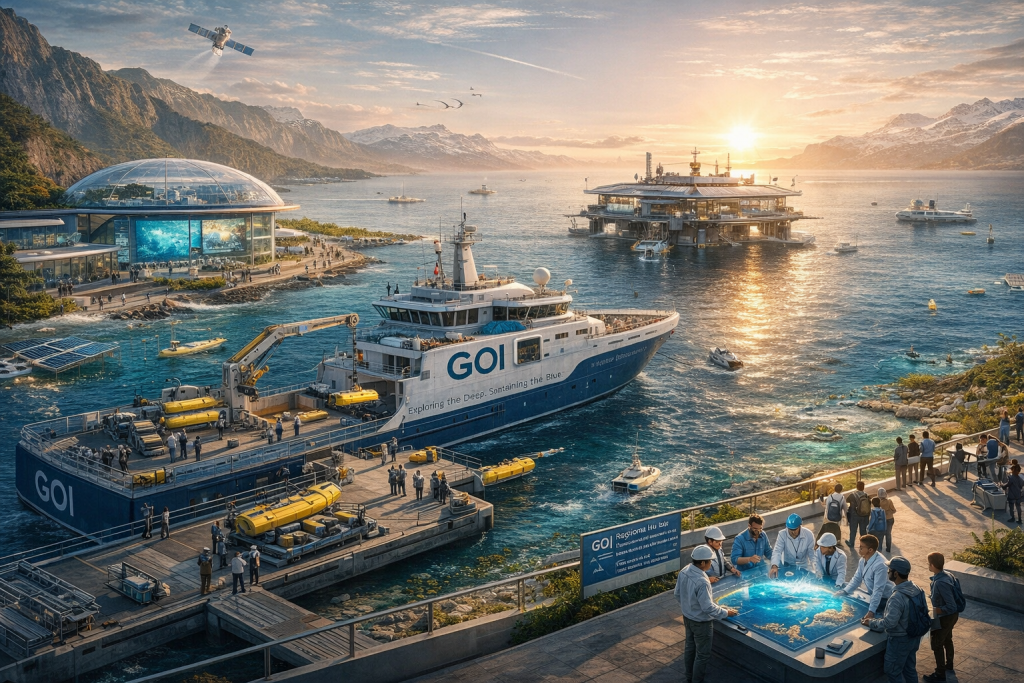
Preamble
We’ve sent rovers to Mars. We’ve photographed distant galaxies. We’ve invested hundreds of billions in exploring space a frontier that, however fascinating, offers no immediate solutions to the existential crises we face on Earth.
Meanwhile, the ocean covering 70% of our planet, regulating our climate, producing half our oxygen, and feeding billions remains largely unexplored, poorly understood, and catastrophically underfunded. We’ve mapped more of Mars’s surface than our own seafloor. The mismatch is inexcusable.
What follows is a comprehensive blueprint for correcting this imbalance: The Global Ocean Institute (GOI), an ambitious proposal for a NASA-scale international organization dedicated to ocean exploration, science, conservation, and sustainable stewardship. With an annual budget of $35 billion, innovative governance structures, and a mission spanning discovery to climate solutions, GOI represents what humanity could achieve if we treated the ocean with the seriousness it deserves.
This isn’t fantasy. The technology exists. The need is undeniable. What’s required is vision, political will, and a recognition that our survival depends on understanding and protecting the planetary system we’ve taken for granted for too long. How a $35 Billion Global Ocean Institute Could Transform Humanity’s Relationship with the Blue Planet
As usual Detailed supporting documents worth considering: The Global Ocean Institute
| Document Name | Short Description |
| Executive Summary option 1.docx | This Proposes the creation of GOESA (Global Ocean Exploration & Stewardship Agency), a NASA-scale international agency for ocean exploration, climate resilience, and stewardship. Outlines mission, structure, funding model, and moonshot programs. |
| The Global Ocean Institute.docx | This is option 2 similar but a different take Expands the GOESA concept into GOI (Global Ocean Institute), a comprehensive blueprint for a treaty-based international ocean agency. Covers governance, directorates, technology, funding, equity mechanisms, and a phased implementation roadmap from 2026 onward. |
| Implementation Model and Business Architecture.docx | Details the modular growth plan, business architecture, technology stack, cost-benefit analysis, and risk mitigation strategies for implementing GOESA. Includes maturity stages and core vs. scalable modules. |
| Ocean Frontier Futures.docx | Presents a speculative 50+ year visionary roadmap for converting decommissioned offshore oil and gas rigs into ocean research platforms, monitoring networks, and eventually sustainable oceanic research cities. Organized in phased timelines from 2025 to 2080+. |
Part I: The Case for Transformation
The Ocean Crisis We’re Ignoring
The numbers are staggering and terrifying:
- We’ve explored less than 5% of the ocean
- 90% of large fish populations have been depleted
- Coral reefs could be functionally extinct by 2050
- Ocean warming is accelerating, with consequences we barely understand
- Climate tipping points in ocean circulation could trigger catastrophic shifts
Yet global ocean research funding hovers around $5-10 billion annually—10 to 20 times less than space exploration—despite the ocean’s infinitely greater relevance to human survival.
Why Current Approaches Are Failing
Fragmentation: Ocean research is scattered across 100+ national agencies, 1,000+ universities, and numerous UN bodies with no central coordination. This creates duplicated efforts, incompatible data standards, gaps in coverage, and inability to tackle planetary-scale challenges.
Scale Mismatch: Ocean processes operate globally—circulation patterns, climate interactions, biodiversity—but governance and research remain predominantly national or regional. You cannot address a planetary system with fragmented national efforts.
Funding Instability: What ocean research exists is often short-term and politically vulnerable, preventing the long-term missions necessary for understanding complex systems.
Data Chaos: Ocean data sits siloed in incompatible databases with inconsistent standards and restricted access, preventing the synthesis necessary for predictive capability.
No Public Imagination: Unlike space exploration with its Apollo moments and Mars rovers, ocean science has never captured sustained public attention at the scale necessary to drive political investment.
Part II: The Vision—Global Ocean Institute
Mission Statement
The Global Ocean Institute advances humanity’s understanding of Earth’s ocean systems through ambitious exploration, rigorous science, and technological innovation, while ensuring the long-term health, sustainability, and equitable stewardship of marine environments for all nations and future generations.
Tagline: Exploring the Deep. Sustaining the Blue.
What GOI Would Accomplish
By 2035 (10 Years):
- 500,000+ new marine species described
- Complete ocean floor mapping at 100-meter resolution
- Zero illegal fishing in high seas through monitoring systems
- 30 million km² under effective marine protection
- 5,000+ autonomous underwater vehicles in continuous operation
- Ocean digital twin predicting conditions 30 days ahead
By 2050 (25 Years):
- Complete functional understanding of marine microbiome
- Ocean-based carbon removal contributing 2-3 gigatons CO2/year
- 50% of degraded coral reefs showing recovery
- Sustainable fisheries providing 20% more food with 30% less effort
- $2 trillion sustainable ocean economy
- Every coastal nation with ocean research capability
By 2075 (50 Years):
- Comprehensive inventory of marine life (95%+ species known)
- Ocean ecosystems resilient to warming
- Routine access to any ocean depth for research
- Permanent underwater research stations
- Ocean recognized as essential life-support system with legal protections
Part III: How It Would Work
Organizational Structure
GOI operates through a matrix organization combining specialized directorates with integrated mission programs and regional hubs:
Core Directorates:
- Ocean Science & Discovery – Fundamental research in marine biology, ecology, genomics
- Climate & Earth Systems – Ocean-atmosphere interactions, climate modeling, carbon cycles
- Exploration & Operations – Research fleet management, deep-sea expeditions, logistics
- Technology, Engineering & Robotics – AUV/ROV development, sensors, AI/ML applications
- Sustainability, Conservation & Policy – MPA design, restoration, regulatory science
- Data, AI & Open Knowledge – Global data platform, digital twin, open access
- Innovation & Blue Economy – Technology transfer, sustainable industries (firewalled)
- Education & Public Engagement – Ocean literacy, citizen science, media production
- International Partnerships – UN coordination, capacity building, benefit-sharing
- Safety, Ethics & Risk Management – Ethical oversight, environmental protection
Cross-Cutting Mission Programs:
- Ocean Shot Exploration Missions (e.g., Complete Hadal Zone Survey 2030)
- Climate Resilience Program
- Marine Biodiversity 2050
- Sustainable Blue Food Systems
- Coral Reef Restoration Megaproject
- Blue Carbon Acceleration Initiative
Regional Hub Network: 15-20 regional hubs across all ocean basins providing local presence, cultural relevance, and distributed capacity. Examples include Arctic Hub (Norway), Pacific Islands Hub (Fiji), Indo-Pacific Hub (Australia), Atlantic Hub (Portugal).
Part IV: The Technology Arsenal
Fleet & Infrastructure
200+ Vessels:
- 40 major research vessels (ice-capable, multi-disciplinary, global range)
- 10 icebreakers for polar operations
- 50 coastal research vessels
- 80+ autonomous surface vehicles
Underwater Capabilities:
- 15 human-occupied submersibles (11,000m capable)
- 500+ autonomous underwater vehicles (AUVs)
- 200+ remotely operated vehicles (ROVs)
- 50 long-range gliders for persistent monitoring
Observatories:
- 10,000+ smart sensor buoys
- 25 cabled seafloor observatories
- Seafloor sensor networks across geological hotspots
Facilities:
- 5 floating research stations (“Ocean Space Stations”)
- 3 permanent seafloor habitats (1000-3000m depth)
- 20 coastal research campuses
- Genomics centers and biotech labs
Digital Infrastructure
Global Ocean Monitoring Network: Real-time data streams from 50,000+ sensors continuously monitoring temperature, salinity, currents, chemistry, biology, and acoustics.
Digital Twin of the Ocean: High-resolution global circulation model coupled with biogeochemical and ecosystem models, featuring AI-enhanced data assimilation and scenario exploration capabilities. Think of it as Google Earth meets climate modeling meets real-time ocean prediction.
Computing Power: 500+ petaflops dedicated supercomputing capacity, exabyte-scale cloud storage, edge computing on vessels for real-time processing.
Open Data Platform: Universal open-access data with standardized formats, allowing any researcher globally to access GOI datasets within two years of collection.
Crossover Technologies with Space Exploration
GOI collaborates extensively with space agencies, recognizing deep parallels between ocean and space exploration:
| Technology | Space Application | Ocean Application | Synergies |
| Autonomous Robotics | Mars rovers | AUVs, seafloor exploration | AI navigation, fault tolerance |
| Life Support Systems | ISS, lunar habitats | Underwater habitats, submersibles | Closed-loop systems, pressure management |
| Remote Sensing | Earth observation satellites | Ocean color, altimetry, SAR | Sensor technology, data processing |
| Materials Science | Heat shields, pressure vessels | Corrosion resistance, pressure hulls | Extreme environment materials |
| Communications | Deep space networks | Underwater acoustic/optical | Low-bandwidth optimization |
Joint development programs accelerate innovation in both domains while reducing costs through shared R&D.
Part V: Governance—Preventing Capture and Ensuring Equity
Legal Foundation
GOI would be established through an Ocean Stewardship Treaty as an independent international organization (similar to CERN’s model):
- Not subordinate to any nation
- Answerable to member states collectively
- Operating under international law and UNCLOS principles
- Ratification by 30+ nations triggers establishment
Governing Bodies
1. Ocean Assembly (Legislative)
- All member states represented (one nation, one vote)
- Observer status for Small Island Developing States (SIDS), indigenous peoples, NGOs
- Meets annually to set strategic direction and approve budget
- Major decisions require 2/3 majority
2. Governance Council (Executive)
- 25 elected members serving 4-year rotating terms
- Representation formula balances geography, financial contribution, and SIDS interests
- Consensus-seeking culture with majority vote fallback
3. Scientific Advisory Board (Technical)
- 50 leading scientists across disciplines
- Nominated by scientific societies, appointed by Assembly
- Provides independent scientific advice
- Cannot be overruled on scientific matters (protects from political interference)
4. Ethics & Accountability Council
- 15 members: ethicists, indigenous representatives, legal experts
- Authority to pause activities raising ethical concerns
- Investigates conflicts of interest
- Public annual transparency report
5. Citizen Advisory Panel
- 100 members selected by lottery from Ocean Guardian App users globally
- Represents public interest beyond scientific and political elites
Preventing Institutional Capture
Governance Firewalls:
- Separate Innovation Board for commercialization (no overlap with Science Council)
- Mandatory conflict of interest disclosure and cooling-off periods
- No single nation hosts >20% of facilities or receives >25% of contracts
- All commercial partnerships reviewed every 5 years with public reporting
IP & Commercialization Framework:
- Default open source for publicly funded research
- Commercialization only for technologies with clear societal benefit
- Revenue allocation: 50% reinvested in research, 30% to developing nations, 20% to public engagement
- Legally separate GOI Ventures entity prevents parent organization influence
Transparency Requirements:
- Annual public reports detailing all funding sources and allocations
- Real-time dashboard of major contracts and partnerships
- Independent external audits
- Whistleblower protections
Equity and Indigenous Rights
Constitutional Principles:
- Ocean as common heritage of humankind
- Intergenerational responsibility
- Precautionary approach
- Free, prior, and informed consent for research affecting indigenous territories
Indigenous Integration:
- Indigenous Ocean Knowledge Council with formal advisory voice
- Co-design of research programs in traditional territories
- Benefit-sharing from discoveries in indigenous waters
- Employment and training priorities for indigenous scientists
Equity Mechanisms:
- $2B+ annual Capacity Building Fund for developing nations
- Technology Transfer Office ensuring access to innovations
- 10,000+ scholarships for students from developing nations
- Regional hubs co-located in Africa, Pacific Islands, Latin America, Southeast Asia
- Weighted voting on budget allocation favoring SIDS and least developed countries
Part VI: The Money—$35 Billion Annual Budget
Why This Scale?
NASA’s budget is approximately $25 billion annually. The ocean is infinitely more relevant to human survival than space exploration. A $35 billion annual investment is not only justified but conservative given:
- Global coastal damage and adaptation costs measure in hundreds of billions per year
- Ocean provides 15-20% of animal protein for 3+ billion people
- Ocean regulates climate, produces oxygen, drives weather systems
- Even a 5-10% improvement in coastal risk planning effectiveness justifies the investment
Diversified Funding Model (Preventing Capture)
Member State Contributions (55% – $19.25B)
- Assessed contributions based on GDP and coastline
- 50 founding member nations with tiered contribution levels
- Minimum commitments locked for 10-year periods ensuring stability
Ocean Impact Levy (20% – $7B)
- Small levy (0.1-0.5%) on international shipping, offshore oil/gas, deep-sea mining, industrial fishing in high seas
- Polluter-pays principle: activities with ocean impact fund ocean stewardship
- Collected through International Maritime Organization
Blue Bonds & Climate Finance (10% – $3.5B)
- Ocean-focused green bonds
- Access to climate finance mechanisms (Green Climate Fund, Adaptation Fund)
- Performance-based funding tied to conservation outcomes
Philanthropic & Private Partnerships (10% – $3.5B)
- Major foundations and ocean-focused philanthropy
- Corporate partnerships with strict ethical firewalls
- Ultra-high-net-worth individual commitments
Innovative Public Engagement (5% – $1.75B)
- Ocean Guardian App: Global micro-donation platform ($1-10/month subscriptions)
- Gamified citizen science with premium features
- “Adopt a square kilometer of ocean” sponsorship program
- Documentary and media revenue sharing
IP Licensing & Spin-offs (5% – $1.75B)
- Licensing revenue from technologies developed by GOI
- Equity stakes in spin-off companies (via firewalled structure)
- Capped at 5% of budget to prevent mission drift
Budget Allocation
| Category | % | Amount | Purpose |
| Science & Discovery | 30% | $10.5B | Research missions, expeditions, scientific programs |
| Technology & Infrastructure | 25% | $8.75B | Fleet, vehicles, sensors, computing, facilities |
| Data & Digital Systems | 10% | $3.5B | Data platforms, AI/ML, digital twin, open access |
| Conservation & Restoration | 15% | $5.25B | MPA management, restoration, sustainability programs |
| Education & Engagement | 8% | $2.8B | Ocean literacy, citizen science, media, outreach |
| Capacity Building | 7% | $2.45B | Support for developing nations, training, partnerships |
| Operations & Administration | 5% | $1.75B | Governance, administration, safety, logistics |
Part VII: Ensuring Equitable Participation
Tiered Membership Structure
Tier A (High-Income Maritime Nations): Full contributions, proportional voting power, compete openly for contracts
- Examples: USA, Japan, Germany, UK, France, Canada, Australia, China, India, Russia, Nordic countries
Tier B (Middle-Income Coastal Nations): Reduced contributions (50%), equal voting power, preferential capacity building
- Examples: Chile, South Africa, Nigeria ,Malaysia, Thailand, Mexico, Turkey
Tier C (SIDS & Least Developed Coastal): Nominal contributions, enhanced voting power (1.5x), guaranteed benefits
- Examples: Pacific Islands, Caribbean states, Maldives, Bangladesh, Madagascar
Special Provisions for SIDS
- Guaranteed Representation: 20% of Council seats reserved
- Capacity Building Priority: 50% of capacity funds directed to SIDS
- Employment Quotas: 25% of GOI positions reserved for SIDS nationals
- Research Vessel Access: Guaranteed ship-time for SIDS scientists
- Benefit Sharing: 40% of IP revenue distributed to SIDS development fund
- Regional Hubs: Pacific Islands hub (Fiji) and Caribbean hub (Jamaica) among first established
Benefit Distribution Mechanisms
Direct Capacity Building:
- Training programs bringing 1,000+ scientists/year from developing nations to GOI facilities
- Visiting fellowships at GOI labs (6-24 month placements)
- Equipment donations to developing nation institutes
- Technical assistance establishing national ocean monitoring programs
Economic Opportunities:
- 30% of contracts reserved for companies from developing nations
- Preferential licensing terms for developing nation companies
- Blue economy incubators funded by GOI in developing nations
- Free access to sustainable aquaculture innovations for food security
Knowledge Access:
- All GOI data, publications, and educational materials free and open
- Translation of key materials into 50+ languages
- Satellite internet access for remote coastal communities
- Curriculum development support for national education systems
Conservation Support:
- Funding for developing nations to establish/manage marine protected areas
- Restoration programs (mangroves, coral reefs, seagrass) with local communities
- Alternative livelihood support for fishing communities
Climate Resilience:
- Early warning systems provided free to all coastal nations
- Coastal engineering support (nature-based protection design)
- Climate adaptation grants for vulnerable nations
- Insurance mechanisms for climate damages
Part VIII: Implementation Roadmap
Phase 1: Foundation (2026-2030)
Year 1-2 (2026-2027): Treaty Negotiation & Design
- Diplomatic campaign building coalition of 30+ founding nations
- Technical working groups developing organizational structure
- Pilot programs demonstrating value
- Initial funding commitments secured
Year 3-4 (2028-2029): Treaty Ratification & Establishment
- Ocean Stewardship Treaty signed and ratified
- Headquarters selection (Bergen, Norway or Lisbon, Portugal recommended)
- Recruitment of leadership and first 500 staff
- Acquisition of initial fleet and facilities
- Launch of Global Ocean Data Platform
Year 5 (2030): Operational Launch
- Official inauguration with global ceremony
- First major research expeditions deployed
- Ocean Guardian App launched publicly
- Initial monitoring networks activated
- 50 member nations, 5 regional hubs operational
- Annual budget reaching $10B (scaling toward $35B by 2035)
Phase 2: Acceleration (2031-2040)
Scientific Achievements:
- 100,000+ new species described
- Complete ocean floor mapping at 100m resolution
- Digital ocean twin operational at 10km resolution
- Major deep-sea exploration achievements
- 20+ major research vessels in continuous operation
Conservation Milestones:
- 20 million km² under effective marine protection
- 10,000 km² of coral reef under restoration
- Sustainable fisheries frameworks in 20+ nations
- Ocean plastic inputs reduced 30%
Capacity & Reach:
- 100 member nations
- 15 regional hubs covering all ocean basins
- 20,000 staff globally
- 5,000+ partner institutions
- 200 million Ocean Guardian App users
Budget: $35B annual (fully scaled)
Phase 3: Maturity (2041-2050)
Transformative Impact:
- Ocean systems predictively understood and monitored globally
- Climate early warning systems preventing major disasters
- Sustainable blue economy generating $2T annually
- Marine biodiversity stabilized and recovering
- 30% of ocean under effective protection
Institutional Maturity:
- GOI recognized as authoritative voice on ocean science and policy
- Self-sustaining funding model with diversified sources
- 50+ ocean shots completed
- Model for other global commons governance
Phase 4: Stewardship (2051+)
Long-Term Vision:
- Permanent underwater habitats and persistent monitoring
- Routine deep-sea access comparable to near-Earth space
- Ocean health maintained through adaptive management
- Human-ocean relationship transformed from exploitation to partnership
Part IX: Example “Ocean Shot” Missions
GOI would organize around ambitious, time-bound missions that capture public imagination while driving scientific progress:
1. “Hadal Challenge” (2030) Human-occupied submersible descent to Challenger Deep with full scientific lab capability—the ocean equivalent of the moon landing.
2. “Ocean Genome Atlas” (2035) Complete genomic characterization of 100,000 marine species, revolutionizing our understanding of marine life and unlocking biotechnology potential.
3. “Digital Ocean Twin” (2032) Real-time, 1km resolution model of global ocean predicting conditions 30 days ahead—transforming weather forecasting, shipping, fisheries management.
4. “Zero Ghost Gear” (2033) Autonomous systems removing 90% of abandoned fishing equipment from high seas, protecting countless marine animals from entanglement deaths.
5. “Coral Phoenix” (2040) Restoration of 10,000 km² of coral reef to climate-resilient states using assisted evolution, probiotics, 3D-printed structures, and restoration robotics.
6. “Complete Seamount Survey” (2035) Map and characterize every seamount on Earth—biodiversity hotspots that harbor unique species and critical spawning grounds.
7. “Marine Microbiome Initiative” (2038) Comprehensive characterization of ocean microbes, understanding their role in planetary systems and discovering novel biotechnologies.
Part X: Why This Can Succeed Where Other Efforts Haven’t
The Hybrid Coordination Model
GOI doesn’t replace existing institutions—NOAA, IFREMER, JAMSTEC, universities, and NGOs remain independent. Instead, GOI provides:
Coordination Layer: Ensuring complementary efforts and data sharing Funding Augmentation: For underfunded priorities like deep-sea exploration and developing nation capacity Global Infrastructure: Too expensive for single nations (fleets, computing, satellites) Flagship Missions: Requiring multi-national coordination Data Standards: And platforms for universal access Technology Development: And transfer mechanisms Policy Voice: For ocean in global governance
Operating Model:
- Global umbrella setting priorities and standards
- Strong national/regional nodes leveraging existing institutions through partnerships
- Federated research network where universities participate in GOI missions while maintaining independence
- Funding flows both ways: GOI funds national institutes for priority work; nations contribute to GOI core budget
Learning from Successful Models
CERN (European Organization for Nuclear Research):
- Multi-national scientific cooperation
- Shared expensive infrastructure
- Open science principles
- Talent attraction from global pool
International Space Station:
- Sustained long-term commitment despite political changes
- Technology sharing agreements
- Defined roles for different nations
- Public visibility maintaining political support
Human Genome Project:
- Clear, ambitious goal with defined timeline
- Open data principles accelerating research globally
- International coordination preventing duplication
- Broad societal benefits justifying investment
GOI combines the best elements: CERN’s governance structure, ISS’s sustained commitment model, and Human Genome Project’s open science approach, applied to the ocean domain.
The Political Moment
Several factors create unprecedented opportunity:
1. Climate Crisis Visibility: Ocean’s role in climate regulation increasingly recognized Coastal nations experiencing direct impacts (sea level rise, marine heatwaves) Growing constituency for ocean protection
2. BBNJ Treaty: Recently adopted UN treaty on high seas biodiversity Creates legal framework but lacks implementation capacity GOI could serve as scientific and operational arm
3. Technology Maturation: Autonomous systems, AI/ML, satellite Earth observation, genomic sequencing all reaching capabilities making ambitious ocean science feasible and affordable
4. SIDS Leadership: Small Island Developing States increasingly vocal on ocean issues Moral authority on climate and ocean degradation Coalition-building potential
5. Wealth Concentration: Ultra-high-net-worth individuals seeking legacy projects Growing ocean-focused philanthropy Potential for significant private co-funding
6. Public Consciousness: Documentaries like Blue Planet II reaching massive audiences Social media enabling ocean storytelling at scale Younger generations prioritizing environmental action
Part XI: Addressing the Skeptics
“We can’t afford it”
We can’t afford not to. Global coastal damage and adaptation costs already measure hundreds of billions annually. Ocean provides livelihoods for hundreds of millions and food for billions. Even marginal improvements in prediction, protection, and sustainable management generate returns vastly exceeding investment.
Consider: The world spends $2 trillion on military budgets annually. $35 billion for ocean stewardship is less than 2% of that. The question isn’t whether we can afford it—it’s whether we can afford not to invest in the planetary life-support system.
“It’s too ambitious / will never happen”
People said the same about:
- The United Nations
- CERN
- The International Space Station
- The Montreal Protocol (which successfully phased out ozone-depleting substances globally)
- The Human Genome Project
Ambitious international scientific cooperation has succeeded repeatedly when need was clear, technology was ready, and political will was mobilized. All three conditions now exist for ocean stewardship.
“National interests will prevent cooperation”
The ocean doesn’t respect borders. Climate change affects everyone. Overfishing depletes shared resources. Pollution spreads globally. National interests are increasingly aligned around ocean health because degradation harms everyone.
Moreover, GOI’s structure explicitly accommodates national interests through:
- Tiered membership allowing different contribution levels
- Regional hubs providing local benefits
- Technology transfer and capacity building
- Procurement spread across member nations
- Strong transparency preventing any single nation from dominating
“It will be captured by corporate interests”
GOI’s design specifically prevents capture through:
- Diversified funding (no single source exceeds 20%)
- Strict conflict of interest protocols
- Separate governance structures for science vs. commercialization
- Revenue caps on commercial activities (5% of budget max)
- Default open source for research outputs
- Independent ethics oversight with veto power
- Public transparency requirements
- Benefit-sharing mechanisms favoring public good
Compare this to current situation where ocean research is often directly funded by industries with vested interests in specific outcomes, with far less transparency.
“Existing UN bodies already do this”
Existing bodies are chronically underfunded, lack operational capacity, and have limited coordination. UNESCO-IOC’s budget is roughly $10 million annually—less than 0.03% of what GOI proposes. IMO focuses on shipping regulation. FAO on fisheries management. UNEP on environmental policy. Each plays important roles, but none have the scale, integration, or operational capacity for what’s needed.
GOI would operate under IOC umbrella but with the funding and authority to actually implement programs rather than just coordinate or advise.
“Technology isn’t ready”
Technology is more ready than political will. We already have:
- AUVs operating at 11,000m depths
- Satellite ocean observation systems
- Genomic sequencing at scale
- AI/ML for complex data analysis
- Advanced ocean modeling capabilities
- Underwater communication systems
- Persistent monitoring sensors
What we lack isn’t technology—it’s the organizational structure and funding to deploy these capabilities systematically at global scale.
Part XII: The Cultural Transformation
From Extraction to Partnership
For centuries, humanity has viewed the ocean as:
- Infinite dumping ground
- Limitless food source
- Transportation highway
- Military domain
- Resource to exploit
GOI represents a fundamental shift to viewing the ocean as:
- Planetary life-support system
- Climate regulator requiring protection
- Biodiversity reservoir to steward
- Partner in human survival
- Common heritage requiring collective care
This transformation parallels humanity’s evolving relationship with Earth itself—from viewing the planet as infinite resource to recognizing it as finite, interconnected system requiring stewardship.
The “Apollo Effect” for Oceans
The Apollo program didn’t just land humans on the moon—it:
- Inspired a generation to pursue science and engineering
- Generated technological spillovers benefiting society broadly
- Created iconic moments of human achievement
- Shifted perspective on Earth (the “blue marble” photograph)
- Demonstrated what coordinated effort could accomplish
GOI aims to create a sustained “Apollo effect” for oceans:
- Live-streamed deep-sea expeditions capturing public imagination
- Dramatic discoveries (new species, underwater volcanoes, ancient shipwrecks)
- Youth inspired to ocean careers
- Technological innovations improving daily life
- Cultural shift toward ocean consciousness
- Planetary perspective on interconnected ocean-atmosphere-ice systems
Unlike Apollo’s brief moment, GOI would sustain public engagement through:
- Ocean Guardian App connecting millions to real-time discoveries
- Documentary series partnerships
- Citizen science programs
- Educational integration
- Social media storytelling
- Museum collaborations
Ocean Literacy as Cultural Foundation
GOI’s success ultimately depends on societies valuing the ocean. The Education & Public Engagement Directorate would pursue global ocean literacy through:
Formal Education:
- Curriculum development for K-12 and university levels
- Teacher training programs
- Educational standards and credentialing
- Scholarships and fellowships
- Textbook and online resource creation
Informal Learning:
- Aquarium partnerships (traveling exhibits, virtual reality experiences)
- Documentary series (multi-platform distribution)
- Social media campaigns
- Podcast partnerships
- Interactive online platforms
Experiential Connection:
- Citizen science programs (local water quality monitoring, species observations)
- Virtual expeditions (live-streaming from research vessels)
- Adopt-an-ocean-square sponsorships connecting people to specific regions
- Community ocean festivals and events
Measurement: Baseline ocean literacy assessment in year 1, tracking improvements in:
- Basic ocean science knowledge
- Understanding of ocean-climate connections
- Awareness of conservation issues
- Attitudes toward ocean protection
- Behavior changes (sustainable seafood, plastic reduction, etc.)
Target: 50% improvement in global ocean literacy by 2036, 90% in coastal communities by 2051.
Conclusion: The Ocean’s Time Has Come
For too long, we’ve treated Earth’s ocean as background—an endless, unchanging expanse peripheral to human concerns. We’ve explored more of Mars than our own seafloor. We’ve invested more in studying distant planets than the planet-regulating system covering 70% of Earth.
The Global Ocean Institute represents a paradigm shift: recognizing the ocean as the life-support system it is, deserving flagship-level investment, public imagination, and long-term stewardship. It corrects the historical imbalance between space exploration (exciting, funded, coordinated) and ocean exploration (fragmented, underfunded, overlooked).
This is not about saving the ocean—the ocean doesn’t need saving. This is about saving ourselves by partnering with the ocean.
With $35 billion annual investment, NASA-scale ambition, interdisciplinary integration, ethical governance, and innovative funding preventing capture, GOI can deliver:
For science: Breakthrough discoveries rivaling the genomic revolution or space age
For climate: Critical understanding and solutions for planetary stability
For nature: Protection and restoration of marine ecosystems at scale
For humanity: Sustainable ocean economy, food security, resilience for billions
For culture: Reconnection with the ocean through inspiration and knowledge
For future generations: An ocean that thrives rather than merely survives
The technology exists. The need is undeniable. The political moment—with growing ocean consciousness, climate urgency, and international treaty progress—is arriving.
What’s required is vision, will, and commitment to treat the ocean with the seriousness it deserves.
As President Kennedy said: “We are tied to the ocean. And when we go back to the sea, whether it is to sail or to watch, we are going back from whence we came.”
The Global Ocean Institute answers Kennedy’s call not just to watch or sail, but to explore, understand, protect, and ensure the ocean thrives for all generations to come.
The question isn’t whether this is possible. The question is whether we have the courage to treat our planetary life-support system as if our lives depend on it.
Because they do.
Next Steps for Advancing This Vision
1. Build the Coalition: Scientists, environmental organizations, SIDS nations, and forward-thinking governments championing the Ocean Stewardship Treaty
2. Demonstrate the Model: 5-year, $500M pilot international ocean monitoring and exploration initiative proving feasibility
3. Mobilize Public Support: Documentary series, social media campaigns building public demand for ocean investment
4. Pursue Diplomatic Track: Working through IOC, UN Ocean Conference, bilateral channels to build political support
5. Complete Technical Blueprint: Detailed operational plans, budget models, organizational designs making GOI immediately implementable when political will emerges
The ocean is calling. It’s time we answered with the ambition, resources, and commitment it deserves.