Preamble
Although I am not a pickleball player, my background in squash piqued my analytical interest. The recent proliferation of pickleball content on platforms like YouTube over the last four years prompted me to apply my analytical framework to the sport. What follows is a market analysis investigating pickleball’s potential for growth, its associated risks, and possible mitigation strategies. This examination explores the growth and adoption cycles of a new sport, identifying its bottlenecks and the competitive landscape it may face in the future
Pickleball has exploded from niche pastime to global sensation, captivating players of all ages with its fast-paced play and social charm. Born from a blend of tennis, badminton, and ping-pong, its accessibility and low barrier to entry have fuelled a dramatic rise in participation, particularly among younger athletes and fitness enthusiasts. With dedicated courts springing up across urban centres and major leagues gaining traction, pickleball is not just a recreational craze but an emerging professional sport. Its potential lies in its adaptability: from casual local matches to televised tournaments, pickleball is carving out a lasting place in the sporting landscape.
Introduction
Market Overview & Future Projections. (See detailed breakdown: Pickleball Market Analysis )
- Market Size & Growth
– Global market reached USD 1.61 billion in 2024, with projections growing to approximately USD 3.52 billion by 2032 (CAGR ≈10.2%) (maximizemarketresearch.com, futuredatastats.com).
– Alternative forecasts suggest higher CAGRs (~15–16%), estimating USD 2.6 billion by 2025 and USD 9.6 billion by 2034 (linkedin.com).
– Varying estimates show CAGR range 10–22%, illustrating both conservative (~USD 2–3 billion in mid-2020s) and bullish growth scenarios toward mid-2030s. - Segment Trends
– Equipment market projected CAGR ~4.8–9% through 2034 (researchgate.net, globenewswire.com).
– Paddle market: USD 190 million in 2024 → USD 370 million by 2033 (CAGR 7.8%) (businessresearchinsights.com).
The global pickleball market is in a strong growth phase, currently at USD 1.6–2.2 billion, with a likely continuation at 10–16% CAGR to 2030+, shaping a multi‑billion-dollar industry by the mid-2030s.
Summary Insight
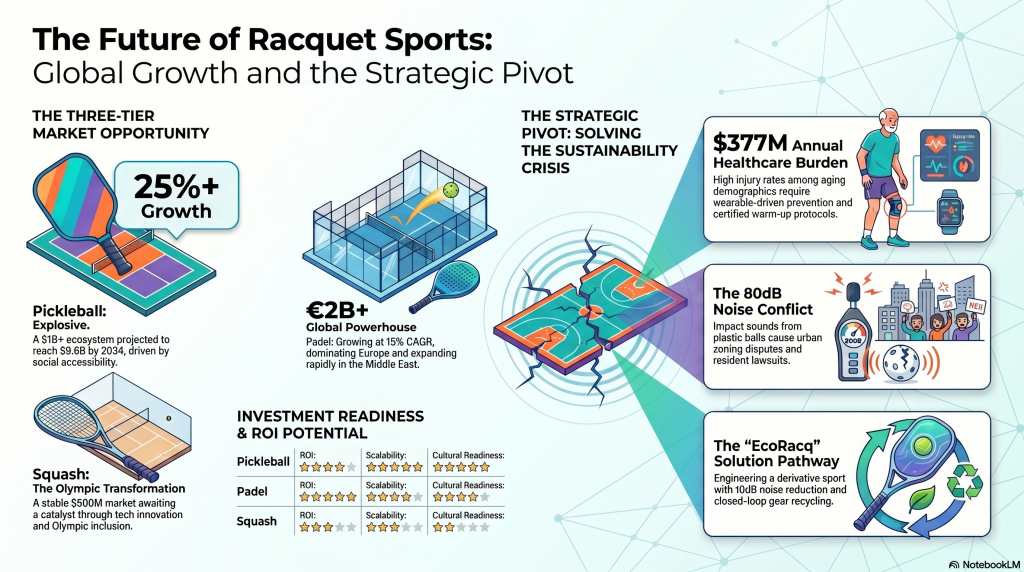
While pickleball excels in accessibility and community appeal, its noise, injury rates, cultural positioning, and fragmented leadership pose significant risks. Addressing these criticisms through governance reform, sustainability programs, and inclusive branding will be crucial for its long-term legitimacy and global expansion.
Issues
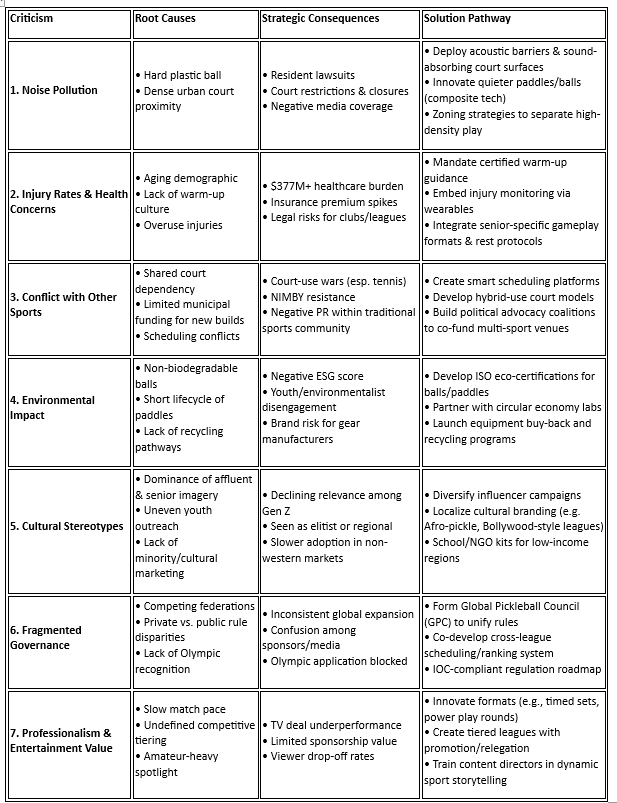
1. Noise Pollution
- Issue: The hard plastic ball on paddle creates a distinct “pop” sound, significantly louder than tennis.
- Impact: Homeowners near public parks and shared courts have filed complaints and lawsuits.
- Example: Cities like Arlington, VA and Denver have received formal grievances over constant noise.
2. Injury Rates & Health Concerns
- Issue: High incidence of falls, sprains, and joint injuries, particularly among older players.
- Cost: Estimated $377M+ in US healthcare costs annually, surpassing projections.
- Criticism: Seen as underregulated in terms of warm-up, training, or fitness requirements.
3. Conflict with Other Sports
- Tennis Turf War: Tennis players and clubs have opposed the conversion of courts to pickleball use.
- Court Availability: Tensions around scheduling, space, and exclusivity rights.
- NIMBY Pushback: Community backlash over multi-use conversions in shared urban areas.
4. Environmental Impact
- Plastic Waste: Single-use plastic balls degrade quickly, contributing to microplastic pollution.
- Disposable Equipment: Paddles have short lifespans, and carbon fiber recycling is minimal.
- Greenwashing Risk: Few regulations on eco-certification; sustainability claims vary widely by brand.
5. Cultural Stereotypes
- Perception: Labeled a “boomer sport” or “middle-class hobby” in media and some youth circles.
- Exclusivity: Barriers to entry in some regions due to club memberships, gear cost, or cultural fit.
6. Fragmented Governance
- Multiple Federations: UPA, PPA, PIC, IPF, WPF, PWR—confusing for players, sponsors, and media.
- Inconsistency: No unified global rankings or rulebook creates barriers to Olympic entry.
7. Professionalism & Entertainment Value
- Criticism: Some pro matches are viewed as slow-paced or less dynamic than tennis or padel.
- Monetization Limits: Without high viewer engagement, TV rights and sponsorships may underperform.
Addressing the Issues.
You need a clear choice that reduces neighbourhood noise, protects players, and scales globally. Most complaints track back to impact sound from the plastic ball and composite paddles, which often measures about 70 to 80 dB.
You also face real cost pressure from injuries in older players. Annual U.S. healthcare costs tied to play have been estimated at more than 377 million dollars.
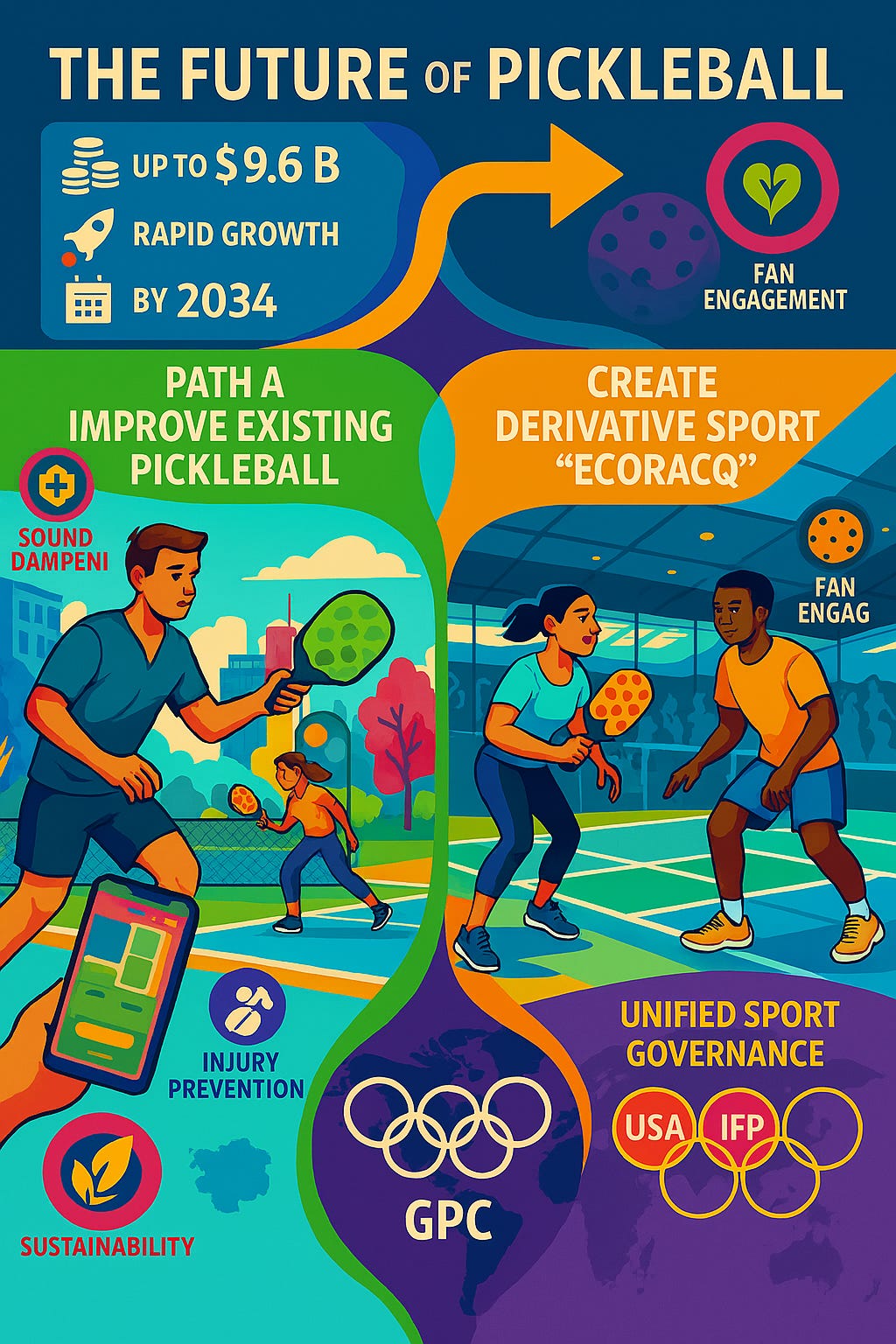
Start with two paths. Path A, improve pickleball through quieter paddles and balls, sound‑absorbing courts, and zoning or scheduling that separates dense residential areas from peak play. Path B, design a derivative low noise sport with new rules, modular courts, and eco gear, built for urban settings and inclusive growth.
Use decision criteria you can measure. Target a noise drop of at least 10 dB while keeping ball speed and bounce within 10 percent of today’s play, and aim for 80 percent player approval in blinded trials. If you can hit those marks, stay with improvement. If you cannot, progress a new format.
Build adoption the same way in either case. Pilot in three cities across the United States, India, and Europe. Validate decibels, gameplay quality, and community sentiment before you scale.
Extended Criticism Matrix: Root Cause → Strategic Consequence → Solution Pathway
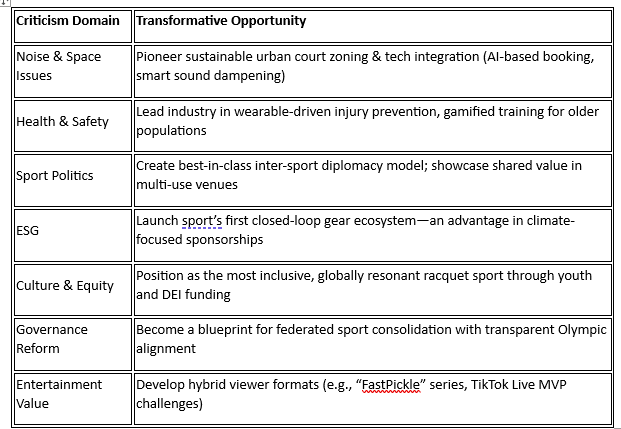
Strategic Summary: Turning Criticisms into Competitive Advantages
Alternative approach: Engineering a solution
As a sports engineer tasked with reducing the noise generated by pickleball (a common complaint due to the hard plastic ball and paddle impacts), I would follow a structured innovation and problem-solving process. Below is a step-by-step approach, including potential modifications, testing criteria, and whether the solution could lead to a new derivative sport.
1. Problem Definition & Noise Analysis
Goal: Reduce pickleball noise (average ~70–80 dB, similar to a vacuum cleaner) while maintaining gameplay integrity.
Primary Noise Sources:
- Ball-Paddle Impact (high-frequency “pop” from hard plastic ball + composite paddle).
- Ball-Bounce Impact (hard court surface).
- Player Movement (secondary issue).
Key Metrics to Measure:
- Decibel (dB) levels at impact.
- Frequency spectrum (high vs. low pitches).
- Player perception (subjective feedback).
2. Solution Pathways
A. Modify Equipment
- Paddle Design:
- Softer Core Materials: Replace carbon fiber/wood cores with dampening materials (e.g., foam, rubberized layers).
- Surface Texture: Add perforations or textured coatings to absorb impact vibrations.
- Shape & Size: Larger sweet spot to distribute impact force.
- Ball Design:
- Material: Softer polymer blends (e.g., TPU instead of hard polyethylene).
- Hole Pattern: Adjust hole size/number to reduce aerodynamic “whistle” and dampen sound.
- Pressureless Design: Eliminate the hollow “ping” of pressurized plastic balls.
B. Modify Court or Rules
- Court Surface: Use sound-absorbing materials (e.g., rubberized coatings).
- Rule Changes: Limit paddle hardness in competitions (similar to tennis string regulations).
3. Testing & Validation Process
Prototyping Phase:
- Lab Testing:
- Measure dB levels with high-speed cameras + sound meters.
- Compare materials (e.g., foam-core vs. traditional paddles).
- Player Trials:
- Blind tests for sound perception and playability.
- Evaluate changes in ball speed/bounce consistency.
Criteria for Success:
- Noise reduction of ≥10 dB (e.g., from 75 dB to 65 dB, akin to normal conversation).
- No significant loss of ball speed or bounce height (<10% deviation from standard).
- Player approval rating ≥80% in subjective feedback.
4. Potential Outcomes: Evolution or New Sport?
Scenario 1: Improved Pickleball
- If modifications are subtle (e.g., quieter ball + paddle), the game remains pickleball but with noise-reduced equipment (like “quiet” tennis balls).
Scenario 2: A New Derivative Sport (“Quietball” or “Foampadel”)
If changes drastically alter gameplay (e.g., slower ball, foam paddles), it could branch into a new sport with distinct rules:
- Example:
- Name: “Softpickle” or “Silent Paddle”
- Rules: Larger paddles, foam-core balls, no volleys near the net (to reduce loud smashes).
- Court: Smaller or soundproofed walls.
- Target Audience: Urban areas, indoor facilities, senior players.
5. Implementation & Commercialization
- Patents: File for proprietary material designs (e.g., noise-absorbing paddle layers).
- Partnerships: Work with USA Pickleball or WPF to certify “quiet” equipment.
- Marketing: Position as “eco-friendly” or “neighborhood-friendly” pickleball.
Expected Results
- Short-Term: Quieter paddles/balls adopted in noise-sensitive communities.
- Long-Term: Potential splintering into a new niche sport if gameplay changes are significant.
Would you prioritize improving existing pickleball or creating a new low-noise sport?
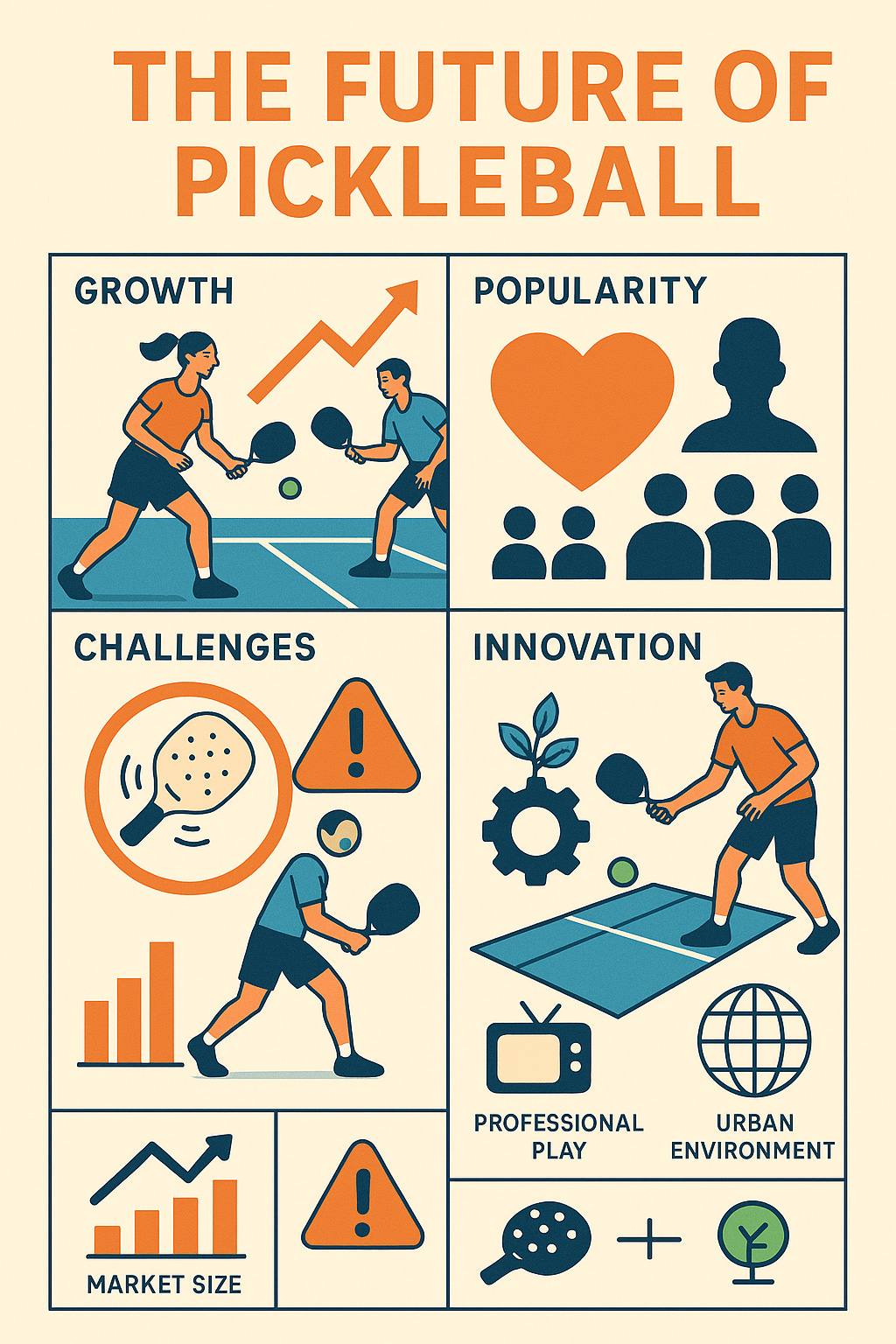
Vision Statement Design a globally scalable, inclusive, eco-friendly racquet sport that addresses all major criticisms of pickleball while preserving its social, accessible, and multigenerational appeal.
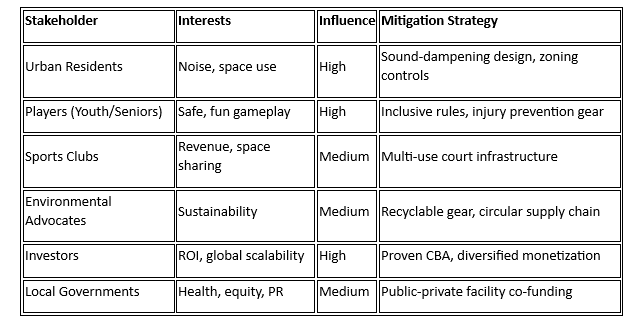
Stakeholder Analysis
PESTLE Analysis
- Political: Favorable due to health/sports funding; ensure compliance with zoning & Olympic standards
- Economic: Post-pandemic recreation boom; scalable modular courts reduce CapEx
- Social: High intergenerational potential; requires DEI-focused outreach
- Technological: Integrate AI officiating, gamified coaching, wearables
- Legal: Compliance with data privacy, IP for sport format, safety standards
- Environmental: Biodegradable balls, recycled paddles, ESG reporting
Porter’s Five Forces
- New Entrants: Low—new sport with IP protection and AI infrastructure
- Supplier Power: Low—standardized materials with diverse sources
- Buyer Power: Medium—community-based clubs vs high-end leagues
- Threat of Substitutes: Medium—badminton, table tennis, padel
- Competitive Rivalry: Low initially, increasing with success
SWOT Analysis
- Strengths: Quiet play, modular courts, eco gear, gamified learning
- Weaknesses: Initial unfamiliarity, equipment R&D costs
- Opportunities: Urban-friendly, school programs, Olympic potential
- Threats: Copycat sports, regulatory pushback, cultural mismatch
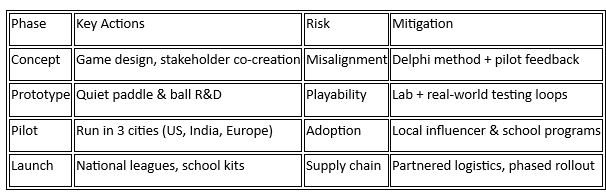
Development Process & Risk Mitigation
Cost-Benefit Analysis
- Costs: $2M R&D, $1M marketing, $3M infra pilots, $0.5M legal/IP
- Benefits: $10M 5-yr ROI from equipment, media, court licenses, AI tools
Development Timeline
- Year 1: Design, test, patent equipment; form federation
- Year 2: Pilot leagues, school outreach, soft media content
- Year 3: Official launch in 5 countries, major brand partnerships
- Year 4–5: Global franchising, Olympic bid, sustainability certification
Pathway to Success
- Focus on inclusivity, sustainability, and tech-driven user engagement
- Leverage AI for gameplay insights and officiating
- Co-develop with players, coaches, and urban planners
Game Design Proposal
- Name: “EcoRacq”
- Court: 18x8m modular court with quiet flooring
- Gear: Foam-polymer paddle, perforated TPU ball
- Rules: No-volley zone, time-bound rallies, point acceleration
- Scoring: 10-min rounds with skill-based bonus points
- Tech: App-based scheduling, AI coaching, injury analytics
Strategic Conclusion: From Crisis to Competitive Advantage
The Decision Framework
Pickleball faces a critical juncture that extends far beyond noise complaints. With a global market projected to reach $3.52-9.6 billion by the mid-2030s, the sport’s seven core criticisms—noise pollution, injury rates, inter-sport conflicts, environmental impact, cultural stereotypes, fragmented governance, and entertainment limitations—represent both existential threats and transformative opportunities.
Two-Path Strategy with Measurable Criteria
Path A: Enhanced Pickleball Execute targeted improvements while preserving the sport’s identity:
- Deploy acoustic barriers and sound-absorbing court surfaces
- Innovate quieter paddles and balls using composite technology
- Implement smart scheduling platforms to reduce court conflicts
- Launch equipment buy-back and recycling programs
- Establish unified Global Pickleball Council (GPC) for governance consolidation
Success Metrics: 10+ dB noise reduction, <10% performance deviation, 80% player approval in blind trials, measurable injury reduction via wearable integration.
Path B: Derivative Sport Creation (“EcoRacq”) If improvement thresholds aren’t met, launch a purpose-built alternative:
- 18x8m modular courts with quiet flooring
- Foam-polymer paddles with perforated TPU balls
- Time-bound rallies with skill-based bonus scoring
- AI-powered coaching and injury analytics integration
- Closed-loop sustainability ecosystem from day one
Implementation Roadmap
Phase 1 (Year 1): Simultaneous R&D on both paths with stakeholder co-creation using Delphi methodology. Patent quiet equipment designs and establish federation structure.
Phase 2 (Year 2): Three-city pilot program (US, India, Europe) validating decibel reduction, gameplay quality, and community sentiment. Launch school outreach and influencer campaigns addressing cultural stereotypes.
Phase 3 (Years 3-5): Scale successful path globally with focus on inclusivity, sustainability, and tech-driven engagement. Pursue Olympic recognition and major brand partnerships.
Financial Framework
Investment: $6.5M total ($2M R&D, $1M marketing, $3M infrastructure pilots, $0.5M legal/IP) Projected ROI: $10M+ over 5 years from equipment sales, media rights, court licenses, and AI tools Risk Mitigation: Phased rollout with local partnerships and diversified revenue streams
Transformative Vision
Rather than merely fixing pickleball’s problems, this framework positions either outcome as the blueprint for next-generation racquet sports. By addressing noise through acoustic innovation, injuries through wearable technology, governance through unified standards, and environmental impact through circular economy principles, we’re not just saving pickleball we’re pioneering sustainable sport development for urban, multigenerational communities.
The Competitive Advantage
Success in either path creates first-mover advantages in:
- Sustainable urban court zoning with AI integration
- Wearable-driven injury prevention for aging populations
- Inter-sport diplomacy models for shared venue optimization
- Closed-loop gear ecosystems attracting ESG-focused sponsors
- Inclusive global branding transcending cultural barriers
Final Recommendation
Begin immediate parallel development of both paths with quarterly assessment gates. The sport’s explosive growth trajectory demands urgent action, but the multi-billion-dollar market potential justifies comprehensive solutions. Whether through revolutionary improvement or purposeful reinvention, the winner will establish the template for how traditional sports evolve to meet 21st-century urban, environmental, and social challenges.
This isn’t just about making pickleball quieter it’s about engineering the future of accessible, sustainable, technology-enhanced community sport.