Preamble
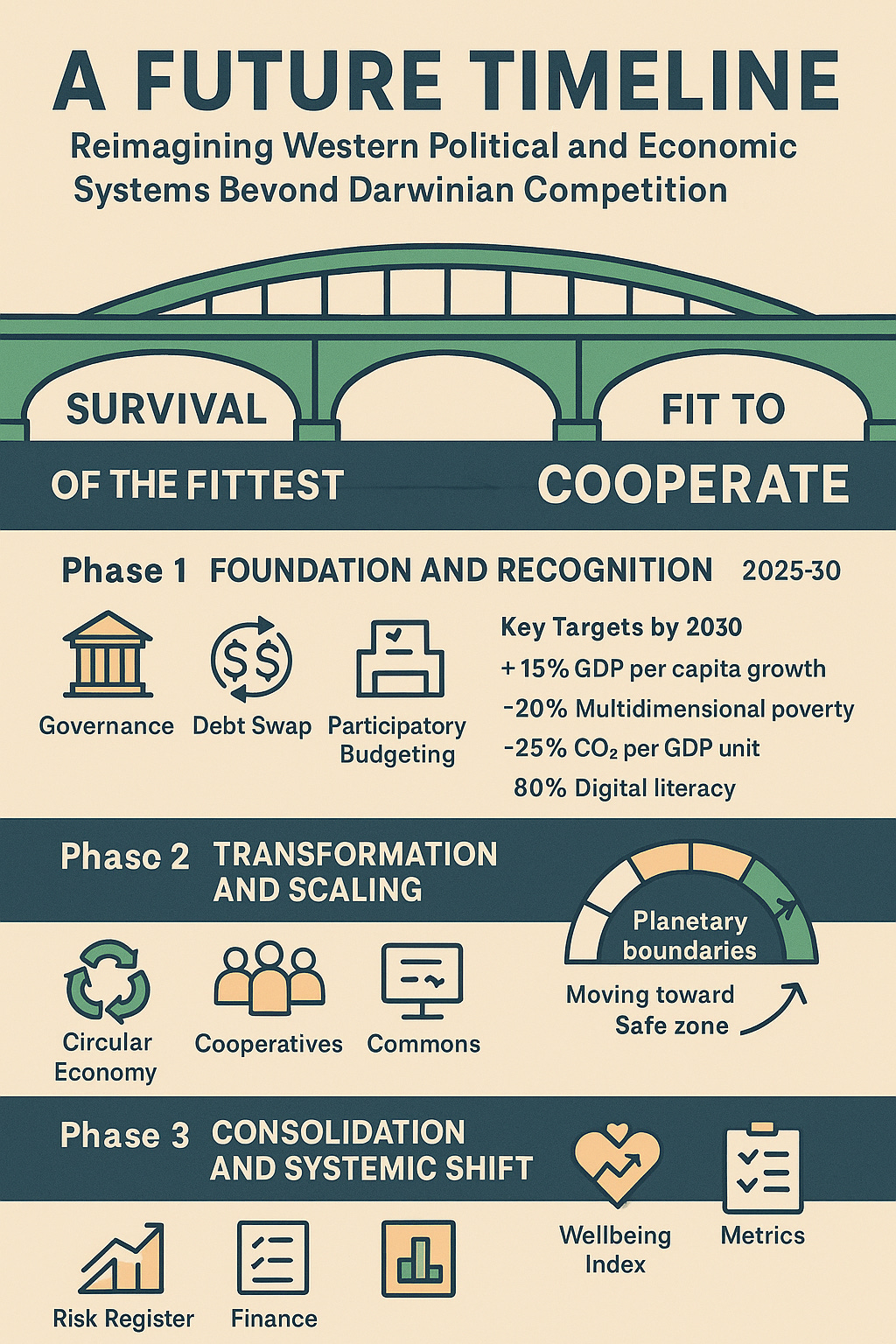
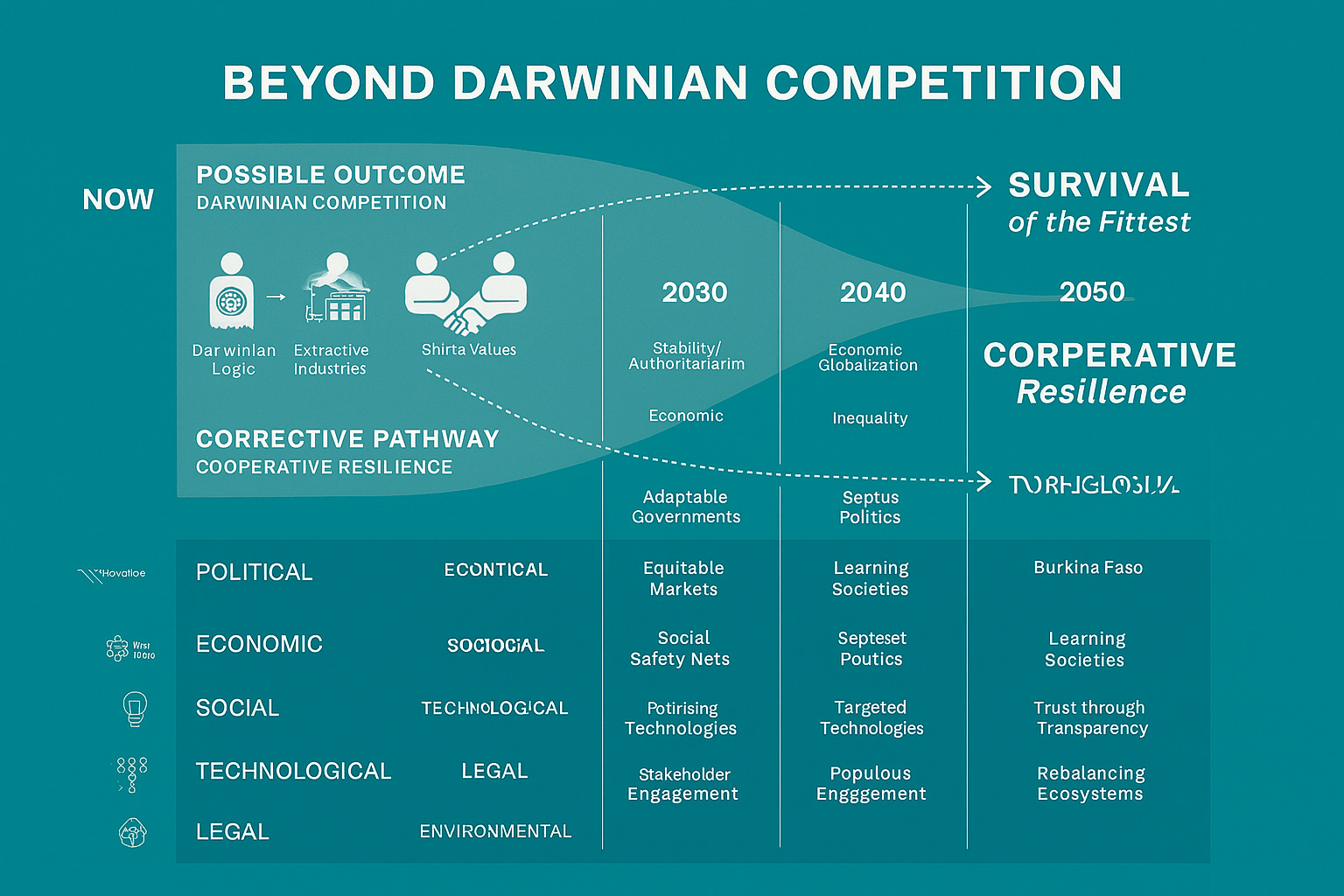
I’ve designed a comprehensive 25-year timeline (2025-2050) that reimagines Western political and economic systems by shifting from Darwinian “survival of the fittest” competition toward cooperative resilience, inclusive innovation, and ecological stewardship.
This is a continuation of
· Darwinian Philosophy in Western Politics and Economics: Part 1
· Darwinian Philosophy in Western Politics and Economics – Part 2
· Darwinian Philosophy in Western Politics and Economics Part 3
Philosophical Foundation: The Paradigm Shift
Previous posts discussed how Western systems have internalized Darwinian frameworks since the late 19th century, treating markets and politics as arenas where only the strongest survive. While this unleashed innovation, it generated spiraling costs: extreme inequality, environmental collapse (6 of 9 planetary boundaries already transgressed), political polarization, and geopolitical instability.-stockholmresilience+1
The proposed Accelerated Cooperative Development (ACD) framework shifts from “fit to survive” to “fit to cooperate” recognizing that in an era of climate crisis, digital interdependence, and planetary boundaries, zero-sum rivalry is self-defeating.
Three-Phase Transformation
Phase 1: Foundation and Recognition (2025-2030)
Priority Actions:
- Reform IMF/World Bank voting based on 2030 GDP PPP projections
- Launch Debt-for-Development Swap Facility pegged to SDG milestones
- Establish Global Anti-Corruption Escrow mechanism
- Create open-source innovation hubs pairing Northern and Southern economic entities
- Implement climate justice payments through automatic insurance pools
- Scale participatory budgeting to 10% of local government budgets local+1
Key Targets by 2030:
- GDP per capita growth: +15% in developing nations
- Multidimensional poverty: -20%
- CO₂ per GDP unit: -25%
- Digital literacy: 80%
- Domestic patent filings: +300% in Global South
- Gini coefficient: 0.42 (down from 0.48)[calculated]
Stakeholder Roles:
- Governments: Reform international institutions, implement transparency mechanisms, launch climate finance
- Private Sector: Adopt stakeholder capitalism principles, begin B-Corp certification (target: 10% of large enterprises) inclusivecapitalism+3
- Civil Society: Monitor accountability, mobilize movements, participate in citizen assemblies
- International Organizations: Create beyond-GDP metrics (HDI, GPI, LEI) oecd+2
- Academia: Develop post-Darwinian models, establish North-South partnerships
Phase 2: Transformation and Scaling (2030-2040)
Priority Actions:
- Deploy Global Virtual Governance Platform for participatory democracy across 12 dimensions
- Scale co-owned development funds to $500 billion
- Achieve 50% circular economy adoption in manufacturing
- Support 1 million solidarity economy cooperatives globally resilience+1
- Expand commons-based peer production to $5 trillion (5% of global GDP) antipodeonline+2
- Establish 500 open hardware manufacturing hubs
Key Targets by 2040:
- Planetary boundaries within safe zone: 6 of 9 stockholmresilience+1
- Democratic participation: 60% in virtual governance
- Circular material flow: 60%
- Commons-based production: 30% of GDP
- Wealth concentration (top 1%): 35% (down from 45%)
- Renewable energy: 70%
Transformation Focus:
- Political: Scale citizen assemblies to influence 30% of policy decisions, implement participatory budgeting for 30% of public budgets gov+2
- Economic: Transition to circular economy, scale cooperative enterprises, pilot universal basic services ukscs+3
- Technological: Expand commons-based peer production, democratize digital infrastructure boell+3
- Environmental: Restore 3 transgressed planetary boundaries through regenerative practices stockholmresilience+2
Phase 3: Consolidation and Systemic Shift (2040-2050)
Priority Actions:
- Implement steady-state economic policies within planetary boundaries annualreviews+2
- Replace GDP with wellbeing indices as primary metrics sciencedirect+3
- Achieve 60% of economic activity through cooperative/commons models thenextsystem+1
- Guarantee universal basic services (housing, healthcare, education, connectivity)
- Establish global commons governance for critical resources thenextsystem
- Restore 500 million hectares of degraded ecosystems
Key Targets by 2050:
- All 9 planetary boundaries: Within safe operating space stockholmresilience+1
- Gini coefficient: 0.25 (down from 0.48 in 2025)
- Democratic participation: 80%
- Regenerative economic practices: 90%
- Open-source patent share: 80%
- Net emissions: Net-negative with sequestration
Systemic Achievements:
- Political: Full stakeholder democracy, global commons governance, epistemic justice reforms
- Economic: Steady-state prosperity, cooperative enterprise dominance, wealth equity
- Social: Universal wellbeing, 90/100 social cohesion index, community resilience
- Technological: Democratic AI governance, 70% decentralized production, technology justice
- Legal: Universal commons frameworks, 100% indigenous rights recognition
- Environmental: All planetary boundaries respected, species recovery, regenerative practices
Cross-Cutting Implementation Elements
Risk Register and Mitigation
Political Backlash (High likelihood, High impact)
- Build broad coalitions, demonstrate benefits early, gradual transitions, inclusive representation
Economic Disruption (Medium-High likelihood, High impact)
- 25-year phasing, transition support, alternative livelihoods, resilience funds
Geopolitical Competition (High likelihood, Medium-High impact)
- Emphasize mutual benefits, triangular South-South-North partnerships, neutral standards bodies
Implementation Capacity (Medium likelihood, Medium impact)
- Capacity building, technical assistance, peer learning networks, dedicated funding
Climate Acceleration (Medium-High likelihood, High impact)
- Front-load climate action, automatic finance triggers, adaptation funds, accelerate renewables
Financing the Transition
Phase 1 (2025-2030): $2-3 trillion
- Redirect fossil fuel subsidies, financial transaction tax (0.1%), carbon pricing, debt-for-development swaps
Phase 2 (2030-2040): $4-5 trillion
- Cross-border data flow levy, progressive wealth taxation, commons revenue sharing, green bonds
Phase 3 (2040-2050): $3-4 trillion (declining as systems self-sustain)
- Steady-state surplus redistribution, commons dividends, regenerative economy returns
Measurable Indicators Across All Domains
Political: Transparency index, multi-stakeholder participation, voting reform completion, multilateral trust
Economic: Debt-to-SDG swaps, fair-trade adoption, circular economy rate, cooperative enterprise share, wealth distribution
Social: Digital literacy, inequality (Gini), social cohesion, universal services coverage, life satisfaction
Technological: Open-source patents, regional cloud hubs, green tech transfer, commons-based production value
Legal: Beneficial ownership registries, anti-corruption prosecution, contract transparency, indigenous rights
Environmental: CO₂ per GDP, planetary boundaries respected, biodiversity protection, circular material flow, restoration area
From Necessity to Possibility
This timeline demonstrates that the shift from Darwinian competition to cooperative resilience is not idealistic fantasy but strategic necessity. As previous posts conclude: abandoning “survival of the fittest” does not weaken societies it future-proofs them.-
The current trajectory 6 of 9 planetary boundaries transgressed, inequality at historic highs, political polarization escalating is unsustainable. This 25-year pathway offers a viable alternative, preserving innovation while embedding equity, resilience, and ecological stewardship._ stockholmresilience+1
The philosophical pivot from “fit to survive” to “fit to cooperate” channels humanity’s ingenuity toward collective flourishing. Markets remain dynamic, but structured for fairness within planetary boundaries. Competition continues, but within guardrails protecting the commons. Leadership is valued, but success is measured by how many are lifted, not left behind.communityeconomies+4
In an era of climate crisis and digital interdependence, cooperation is not altruism it is survival. The question is not whether we can afford this transition. We cannot afford to continue as we are. The question is whether we have the collective will to choose this path.-
Consequences of No Change: Business-as-Usual Trajectory
Previous posts paint a stark picture of what happens if Western systems continue on their current Darwinian path without reform. The analysis reveals cascading failures across multiple domains:
Political Consequences
Deepening Polarization and Authoritarianism
The posts identify zero-sum campaigning replacing cooperative policy-making, with “strong-man narratives legitimising authoritarian drift”. Electoral competition without cooperative frameworks erodes social cohesion in favor of hyper-individualism. With intra-Western trade nearing saturation, stagnant demand collides with rising migration and security pressures, creating fertile ground for populist backlash.-
Geopolitical Instability
The business-as-usual scenario leads to intensified interstate competition, trade wars, arms races, and decline in multilateral trust. As the documents warn, “collective challenges are left under-funded and under-co-ordinated”. Geopolitical tensions are already increasing carbon emissions through supply chain disruptions ships avoiding the Red Sea face increased transit times, costs and emissions, while Russia’s war against Ukraine has disrupted commercial flight patterns. weforum
Research confirms that geopolitical risks lead to “higher inflation, lower growth and significant welfare loss” through financial, trade, and commodity price channels. Climate change itself is becoming a geopolitical force: one study suggests 19% less global income by mid-century compared to a world unaffected by climate change, with billions potentially displaced from areas rendered unsuitable for human habitation. economicsobservatory+1
Economic Consequences
Extreme Wealth Concentration
The documents document how extreme wealth concentration is “rationalised as natural” under Darwinian frameworks. Current trends show the top 1% capturing nearly twice as much recent global GDP growth as the other 99%. By 2050, wealth concentration continues escalating—contemporary economists like Thomas Piketty and Joseph Stiglitz warn that increasing inequality could endanger our future.resilience+1_
The forecasts are sobering: under business-as-usual, “ecological deficit and inequality are set to rise dramatically”. One analysis predicts that by 2050, citizens of rich Western nations “will not be very much richer than today”, with disposable income stagnating or declining for decades. ey+1
Resource Depletion and Economic Stagnation
Humanity’s annual consumption of physical resources has grown more than threefold since 1972, with resource extraction now rising faster than the Human Development Index. The UN Environment Programme reports that high-income countries consume six times the mass of material resources per person as low-income ones, with a tenfold climate impact difference. resilience
Economic models from The Limits to Growth tradition show that in “business-as-usual” scenarios, “the level of human activity grew for decades, only to peak and eventually plummet”. Increasingly hot summers could trigger 30-60% increases in power use for air-conditioning, while indefinite economic expansion is “doomed to fail, but not before it’s crippled our ecological and social systems”. fpif+1
Job Displacement and Inequality
Automation analysis reveals that 20-25% of current jobs could be eliminated by the late 2020s equivalent to 40 million displaced US workers. Workers earning $30,000-$60,000 annually face the greatest disruption, with up to 30% displaced and many suffering depressed wage growth. The benefits flow primarily to the top 20% of highly compensated, skilled workers and capital owners. bain
Long-term unemployment from automation erodes future earnings: 20 years after losing a job, average earnings still lag by 27%. The coming phase could eventually eliminate up to 50% of all current jobs, with middle-to-low income workers hit hardest. bain
Social Consequences
Fragmentation and Inequality
The documents warn of “chronic stress, social isolation, inequality normalisation” as Darwinian frameworks penetrate deeper into social life. Societies with wide rich-poor divides have higher rates of homicide, imprisonment, infant mortality, obesity, drug abuse, and teenage pregnancy. Research shows that “greater equality will reduce unhealthy and excess consumption, and will increase the solidarity and cohesion needed to make societies more adaptable in the face of climate and other emergencies”. resilience
Loss of Human Flourishing
Contemporary analysis warns that 24/7 capitalism enabled by intrusive technologies is “eroding basic human needs such as sufficient sleep” and eliminating “the useless time of reflection and contemplation”. The cultural logic of late capitalism is characterized by “innovation for the sake of innovation, a superficial projected image of self via celebrities or ‘influencers’”, where societies “have lost their connection with history and are defined by a fascination with the present”. sydney
Environmental Consequences
Planetary Boundaries Collapse
Six of nine planetary boundaries have already been transgressed, and business-as-usual accelerates this trajectory. The documents warn of “environmental costs externalised”, with “extractive projects proceed[ing] with weak safeguards, shifting ecological costs southward”.+2
The IPCC confirms that “hard limits to adaptation have already been reached in some natural systems” no adaptive action or technology can prevent profound risks to these systems. We are locking in significant ecological damage: “deepening inequalities, competition for scarce goods, and the rise of status-driven consumerism generate social limits to growth as well as environmental ones”. dgap+1
Climate Crisis Acceleration
Financial stability analysis warns that “the manifestation of physical risks particularly that prompted by a self-reinforcing acceleration in climate change and its economic effects could lead to a sharp fall in asset prices and increase in uncertainty”. This could have “a destabilising effect on the financial system, including in the relatively short term”. fsb
Current fossil fuel projects are expected to exceed the remaining carbon budget for limiting warming to 1.5°C, yet “public and private finance flows for fossil fuels are still greater than those for climate adaptation and mitigation”. centreforfeministforeignpolicy
Global South Impacts
The documents detail how business-as-usual perpetuates extraction and dependency:
Resource Curse Intensification: Oil, mineral and timber wealth rarely translate into broad-based development
Democratic Undermining: Military coups, foreign interference and elite capture erode institutions
Environmental Degradation: Extractive projects proceed with weak safeguards
Migration Pressures: Economic precarity and conflict drive large-scale outward migration
As the documents conclude: “With intra-Western trade nearing saturation, stagnant demand collides with rising migration and security pressures”.
Evolution of Capitalist Economies: Historical Stages and Future Trajectory
Historical Phases of Capitalism
Capitalist economies have evolved through distinct stages, each characterized by different ruling coalitions and forms of coordination:
1. Mercantilism (1600-1839) bresserpereira
- Coalition: Monarch and merchants
- Characteristics: Active state intervention, formation of nation-states, long-distance trade systems, colonial expansion
- Economic logic: Protection of domestic industry, accumulation of gold/silver, monopolistic privileges
2. Liberal-Industrial Capitalism (1840s-1929) bresserpereira
- Coalition: Businessmen and aristocrats
- Characteristics: Free market ideology, rapid industrialization, minimal state intervention, laissez-faire policies
- Economic logic: Comparative advantage, free trade, competitive markets
- Peak innovation but also extreme labor exploitation and inequality
3. Capitalist-Managerial Phase (1940s-1980s) bresserpereira
- Coalition: Capitalists and professional managers/technocrats
- Characteristics: Social-democratic compromise, moderate state intervention, separation of ownership and control
- Economic logic: Keynesian demand management, welfare state, regulated capitalism
- Post-WWII “golden age” with strong growth and reduced inequality
4. Neoliberal-Rentier Capitalism (1980s-present) wikipedia+1
- Coalition: Financial capital and global corporations
- Characteristics: Deregulation, privatization, financialization, globalization, shareholder primacy
- Economic logic: Market fundamentalism, trickle-down economics, global supply chains
- Rising inequality, environmental degradation, financialization of everything
Contemporary “Late Capitalism” Characteristics
Academic and journalistic usage identifies late-stage capitalism by several markers: shortform+2
· Economic Concentration: Gigantic corporations and banks controlling massive assets and market shares internationally wikipedia
· Digital Dominance: Strong growth of digital, electronics and military industries and their societal influence wikipedia
· Post-Fordist Production: Transition from mass production in huge factories to automated, flexible manufacturing networks wikipedia
· Extreme Inequality: Increasing disparities in income, wealth and consumption wikipedia
· Debt-Driven Consumerism: Consumerism on credit and increasing population indebtedness wikipedia
· Commodification of Everything: Not just material resources but immaterial dimensions arts, lifestyle activities, relationships, sleep, attention become commodified and consumable sydney
· Innovation Without Purpose: “Innovation for the sake of innovation” rather than genuine social benefit sydney
· Temporal Compression: Loss of connection with history, fascination with present, erosion of time for reflection sydney
Future Evolution: Three Scenarios
Research and forecasting suggest three broad trajectories for capitalism’s evolution:
Scenario 1: Continued Neoliberalism (Business-as-Usual)
This is the path described above under “Consequences of No Change.” Key features by 2050:
- Economic power shifted decisively from West to East, with China and India as dominant economies futuretimeline+1
- US and European growth rates slow due to aging populations and reduced innovation momentum cisl.cam+1
- Wealth concentration reaches historic extremes with top 1% controlling 50%+ of assets
- 20-25% of jobs eliminated by automation, primarily affecting middle-income workers bain
- Planetary boundaries transgressed across 7-8 of 9 dimensions
- Social fragmentation, political polarization, and authoritarian tendencies intensifying
- Periodic financial crises becoming more frequent and severe sydney
- Global income 19% lower than climate-unaffected baseline dgap
As one forecaster notes: “I am afraid the poorest region…will continue to experience the same slow growth in the next 40 years as it did over the past 40, and therefore still be rather poor in 2052”.cisl.cam
Scenario 2: Reformed Capitalism (Stakeholder/Regenerative Model)
This trajectory involves adaptation without fundamental transformation:
- Universal Basic Income implemented in many nations by 2050 to address automation displacement futuretimeline
- Taxation systems targeting AI/automation-benefiting companies to fund social programs futuretimeline
- Blockchain and cryptocurrency gaining mainstream acceptance, diminishing traditional banking dominance futuretimeline
- B-Corp certification and stakeholder capitalism principles widely adopted
- Carbon pricing and circular economy policies implemented
- Some reduction in inequality (Gini falling to 0.35-0.40 range)
- Partial respect for planetary boundaries (5-6 of 9 within safe zone)
This represents the “cooperative resilience” pathway outlined in the documents and timeline previously provided.
Scenario 3: Post-Capitalist Transition
This involves systemic transformation beyond capitalist frameworks:
- Commons-based peer production becoming dominant economic mode antipodeonline+3
- Solidarity economy and cooperative enterprises representing 40%+ of economic activity
- Steady-state or degrowth economics within planetary boundaries steadystate+1
- Wellbeing indices replacing GDP as primary success metricsoecd+2
- Democratic governance of technology, especially AI
- Wealth distributed equitably (Gini coefficient below 0.30)
- All nine planetary boundaries respected
- Work reorganized around meaning and social contribution rather than profit
As scholars note, “in the face of the climate crisis, some are imagining everyday lives no longer guided by overconsumption and environmental degradation: a post-capitalist society”.sydney
Determining Factors
Which trajectory prevails depends on several critical variables:
Political Will: Whether societies can build coalitions for transformation despite elite resistance
Climate Timeline: How quickly climate impacts manifest and whether tipping points are triggered dgap
Technological Development: Whether AI/automation benefits are widely distributed or captured by elites bain
Social Movements: Strength of movements for economic democracy, climate justice, and systemic reform
Geopolitical Dynamics: Whether cooperation or competition dominates international relations weforum+1
Financial System Stability: Whether recurring crises create windows for fundamental reform fsb
Conclusion: The Stakes of Inaction
This posts make clear that continuing the current Darwinian trajectory is not a neutral “do nothing” option it is an active choice to accelerate toward multiple forms of collapse. As they conclude:
“Abandoning ‘survival of the fittest’ in global affairs does not weaken the West it future-proofs it“.
The business-as-usual scenario leads to:
- Economic stagnation for most, extreme wealth for few
- 20-25% job losses with inadequate social support
- 7-8 planetary boundaries transgressed
- Political polarization and authoritarian drift
- Geopolitical instability and resource conflicts
- Social fragmentation and loss of human flourishing
The evolution of capitalism has reached an inflection point. The Darwinian model that drove industrialization in the 19th century and neoliberal globalization in the late 20th is colliding with 21st-century realities: planetary limits, digital interdependence, automation, and climate crisis.+2
As one analysis concludes: “We cannot continue with business as usual. Luckily, we have the tools and resources to tackle the climate crisis”. The question is whether societies will choose to use them before systemic collapse forces far more painful adjustments. centreforfeministforeignpolicy
The documents argue that the philosophical pivot from “fit to survive” to “fit to cooperate” is not altruism but “strategic necessity for resilient growth, equitable development and planetary survival“. The alternative clinging to Darwinian competition ”endangers global stability and Western prosperity alike”.