Preamble: The Paradox of Ubiquitous Quality
We have achieved what previous generations could only imagine: the democratization of excellence. A craftsperson in Vietnam can source the same Italian leather as Hermès. A watchmaker in Detroit can install the same Swiss movement as Patek Philippe. Quality is no longer scarce-it is ubiquitous.
This creates a profound paradox. When a $300 handbag shares identical materials and construction with a $3,000 luxury bag, what justifies the 10x price difference? The answer lies not in what we make, but in what we mean. Products have become carriers of narrative, vessels for identity, participation mechanisms in cultural conversation.
This is Part 2 of The New New Design-the emerging paradigm where quality is the baseline, and meaning is negotiable. The branding gap between quality and luxury isn’t closing-it’s being redefined entirely.
- This is Part 2 of The New New Design: Part 1: Closing the Branding Gap in a World Where Quality is Ubiquitous.
- This post is a summary if you want a detailed longform with detailed examples and an outline playbook see: The New New Design Part 2: The Architecture of Meaning in the Age of Quality Parity . For an outline on the Architecture of meaning see: Architecture of meaning
- See appendices for design intelligence and authentic narrative concepts in the context of this post
From Brand Heritage to Meaning Architecture
The Branding Gap Revisited
In Part 1, we defined the branding gap as the perceived value delta between generic high-quality products and luxury equivalents. Traditionally justified by historical capital, cultural perception, and manufactured exclusivity, this gap transforms when these elements can be disaggregated and delivered by new entrants.
The question shifts from “How do we justify our price?” to “What meaning are we creating, and who wants to participate?”
The Thesis: Design and Storytelling as Currency
Design intelligence and narrative coherence have become the primary currencies of value in post-quality-parity markets. Not as marketing tactics, but as fundamental value propositions.
Design intelligence means aesthetic coherence, functional excellence, cultural referencing without copying, and innovation that feels resolved. Narrative coherence means authentic origin stories, transparent making processes, community participation in meaning-making, and evolution that builds legacy in real-time.
Together, these constructs meaning architecture-the systematic creation of significance around objects that transcends physical attributes.
Evaluating Quality and Value in the Age of Parity
The Erosion of Traditional Metrics
For most of the 20th century, quality assessment was straightforward: material excellence, construction integrity, durability, functional performance. But in 2025, these metrics have been democratized through transparent supply chains, advanced manufacturing, and instant information verification.
A $300 leather bag can legitimately match the material quality of a $3,000 luxury bag. Traditional metrics no longer differentiate effectively.
The Emerging Quality Paradigm
Consumers are developing new evaluation frameworks:
1. Aesthetic Intelligence. Does the design demonstrate considered thought? Is there coherence between form and function? The Eames Lounge Chair didn’t need brand history-its design was so resolved it became iconic immediately.
2. Narrative Coherence. Does the product’s story make sense? Is it authentic or manufactured? A coffee roaster that can tell you the farmer’s name, processing method, and relationship story creates value independent of taste.
3. Cultural Resonance. Does this participate in conversations I care about? Patagonia’s value isn’t just Gore-Tex-it’s authentic environmental activism.
4. Participation Potential. Can I make this mine? Can I customize it? Am I part of a community? Mechanical keyboard enthusiasts don’t just buy keyboards-they build them, customize them, and participate in design forums.
5. Future Legacy Potential. Will this appreciate? Is it positioned to become collectible? Supreme’s box logo hoodies retail for $178 but resell for $500-2,000+ because the brand engineered scarcity and community validated collectability.
Consumer Drivers: What We’re Actually Buying Now
For decades, luxury consumption was driven by brand heritage, social signalling, investment value, exclusivity gatekeeping, and service promises. These still matter, but they’re declining among younger consumers who view conspicuous consumption as gauche.
The Emerging Drivers Contemporary consumers-especially under 40-are driven by different values:
Narrative Authenticity & Transparency. Consumers want the real story: who made this, under what conditions, what’s the environmental impact? Everlane’s “radical transparency” about factories and costs created loyalty independent of product quality.
Design Intelligence & Aesthetic Coherence. Instagram and design media have educated consumers about design principles. They recognize and pay premiums for products that feel “designed” versus “styled”.
Community Affiliation & Shared Values. Products have become membership tokens in value-based communities. Peloton’s value isn’t the bike or classes-it’s membership in a fitness-focused community.
Personalization & Uniqueness. Mass customization resolves modern life’s tension: connected yet desperate for individual expression. NIKEiD demonstrated consumers pay 30-50% premiums to configure their own products
Ethical Production & Sustainability. Younger consumers view this as non-negotiable baseline, not premium feature. Patagonia’s “Don’t Buy This Jacket” campaign created loyalty by authentically prioritizing sustainability.
Omitted Stakeholders in Traditional Value Chains:
The Designer Anonymity Problem. Most luxury products are designed by talented individuals whose contributions are sublimated to brand identity. New brands are changing this by crediting designers explicitly, creating personal brand equity beyond employer affiliation.
The Artisan Invisibility. We know products are “made in Italy” but not who made them or with what pride. Transparent maker acknowledgment-craftsperson profiles, workshop documentation, maker signatures-creates emotional connection that drives premiums.
The Uncredited Cultural Sources. Design always references existing cultural aesthetics, yet this debt is rarely acknowledged. Ethical cultural referencing means explicit acknowledgment, collaboration with communities, and revenue sharing.
Social Media, AI, and the Amplification of Narrative
Social media has fundamentally restructured how products acquire meaning. Narrative authority has been democratized: consumers create their own product stories, peer recommendations outweigh brand messaging, and small brands achieve cultural visibility without traditional media.
What is the role of influencers , brand ambassadors and Collaboration in ths new paradigm? Do you need a new playbook?
Glossier built a billion-dollar brand almost entirely through Instagram, with minimal traditional advertising. Customer photos and testimonials created brand narrative more effectively than any campaign.
AI as Design and Narrative Accelerator
AI enables hyper-personalization, professional-quality storytelling at small-brand scale, and community intelligence that was previously impossible. Stitch Fix uses AI to personalize clothing for millions-customization that would be impossible manually.
The Dark Side. AI creates risks: story template proliferation, aesthetic homogenization, manufactured scarcity optimization, and fake communities. Counter-strategies include radical transparency, distinctive voice that can’t be AI-replicated, and community validation.
The Role of New Technologies
These technologies create value when they change the felt experience, owner story, and community signal simultaneously.
3D printing enables parametric customization, visible intelligence through complex forms, and co-creation where users tweak designs. Nanotechnology provides invisible performance (scratch resistance, hydrophobicity) that shows up in daily use. Advanced materials (bio-based polymers, self-healing elastomers) offer ethical satisfaction without performance trade-offs.
Carbon fiber illustrates value beyond function: the visible weave reads as serious and technical even when painted composite would perform identically. Users equate alignment and craft with mastery.
Conceptual New Technologies, use case for a mobile apps to match your taste from photos and words, then personalize
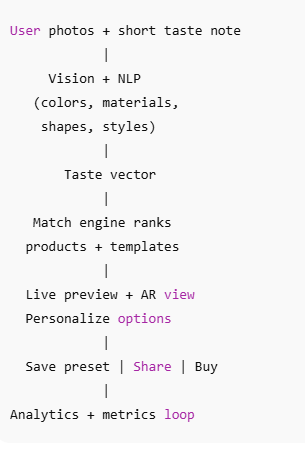
You can let people try ideas on before they buy. A simple mobile app can read a person’s taste from saved photos and short descriptions, then match products and let them personalize in real time. This turns browsing into co-creation, which fits the core model of New New Design.
What the app does
- Build a taste profile. The app ingests a user’s saved photos and a short taste description. It extracts color palettes, materials, shapes, and style cues. It then creates a lightweight taste vector that you can use for matching. AI drives this step, so you can scale it with a small team.
- Suggest matches. The app recommends products and configurations that fit the taste vector. It explains why each match fits. Clarity builds trust.
- Preview and personalize. Users see live previews and AR views. They tweak options like materials, finishes, straps, monograms, dial colors, or trims. They save presets and share them with friends or community. Aim for a high personalization take rate.
- Tell the story. Each suggestion links to a short note about design heritage, making, and care. Education makes the value legible.
Why this matters
- Personalization becomes normal. People expect products to fit their taste, not the other way round. The app helps you meet that bar at low cost.
- Story becomes visible. You surface design moves, maker credits, and references at the moment of choice. That builds meaning and prevents shallow “look alike” use.
- Better metrics, faster learning. You see what people try, tweak, and buy. You can tune drops and options with real data.
Use cases outline
Core flows
Onboard
Import 5 to 20 photos. Write a two line taste note. Example prompts help. The app builds a first taste profile. Users can edit it at any time.
Match
The app proposes three tiers.
- Safe fit. Closest to existing taste.
- Adjacent. One or two bold moves.
- Wild card. One idea that stretches the look.
Explain the why for each. Keep the tone friendly, not prescriptive.
Personalize
Expose options that change how the object lives with the owner. For watches, show case size, dial, hands, strap ecosystem, engraving. For bags, show leather, hardware, lining, monogram. Price tiers must reflect depth of change.
Preview
Show photoreal previews and AR placement. Keep controls simple. Let users save named presets and share a link to get feedback in your community.
Buy or save for later
Nudge with a short story clip about heritage, making, and care. Add a “why this fits your taste” note. People buy faster when they feel seen.
What to build it with
- Commerce and configurator. Shopify with Zakeke or Customily for live previews and custom orders. Use a custom configurator only if your options are very complex.
- Content hub. Webflow or WordPress for long form stories and maker pages.
- Analytics. GA4 for traffic, Mixpanel or Amplitude for flows and option picks, Hotjar for friction.
- Community. Discord or Circle for feedback, voting, and early access.
Taste matching logic in plain language
- Read color and texture from photos.
- Read shape language and style labels from the note.
- Combine into a taste vector.
- Rank products and option templates by cosine similarity to the vector.
- Add a small exploration boost so users discover adjacent tastes.
Example mappings
Watch
- Inputs: vintage gauge photos, “tool watch, clean dial, no polish.”
- Matches: bead blasted case, matte dial, simple markers, nylon strap.
- Personalize: 38 mm or 40 mm, sand or coal dial, orange seconds hand, rotor engraving.
Bag
- Inputs: earth tone interiors, “workhorse bag, quiet, clever pockets.”
- Matches: full grain tan, low sheen hardware, gusset that stands, hidden sleeve.
- Personalize: brass or black hardware, striped lining, initials, extra strap.
What to measure
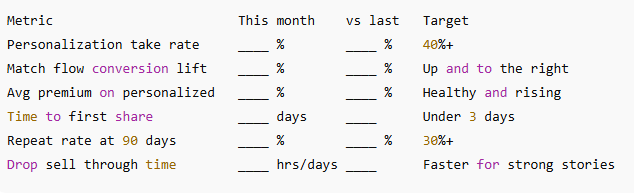
Track these monthly. Review with your team.
- Personalization take rate. Target 40 percent or higher.
- Conversion uplift from match flow. Compare matched sessions to non matched sessions.
- Average price premium on personalized items. Tie to margin.
- Time to first share. Share of users who post or share a preset within 7 days.
- Repeat rate at 90 days. People who return to tweak or buy again. Target 30 percent or higher.
- Drop tuning. Option views, take rates, and sell through time for each limited run.
Simple scorecard
Do not let the app become a spinner of options. Tie every option to a short note, a maker profile, or a design reference. Use your five content pillars, and publish how to guides, process clips, and owner spotlights. This keeps meaning in front of the user while they play.
Guardrails you must follow
- IP and trade dress. Do not ship presets that mimic protected silhouettes or signatures. Build three to five distinctive elements into every design. When in doubt, ask counsel.
- Cultural respect. Credit cultural sources. Partner when you borrow deeply. Share value with collaborators.
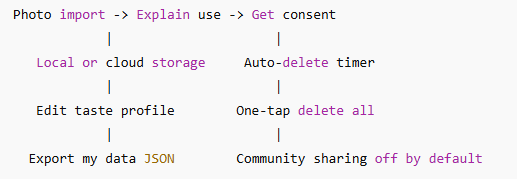
- Data and privacy. Tell users what you collect, why, and how long you keep it. Let them opt out and delete with one tap. Do not sell face data or style photos. Protect consent.
- Avoid algorithmic sameness. Do not let the model push everyone to the same look. Keep a human voice, publish process, and include a wild card suggestion.
Outline of consent and control
Launch checklist
- Set up Shopify, Zakeke or Customily, and GA4.
- Ship v1 with one category and a tight option set. Track the numbers above.
- Publish five evergreen stories that teach taste and show making.
- Open a small community space. Invite feedback and early access.
- Plan the first limited drop that the app can unlock for early users. Number it and document it.
You will help people see themselves in your work. You will also learn faster than any focus group could allow. That is good design in practice.
Conclusion: Toward a Democratized Design Economy
Quality parity has forced complete reconstruction of value architecture. Manufacturing democratization, information transparency, and community platforms have enabled a shift from possession-based value to meaning-based value.
The Opportunity
For entrepreneurs: You don’t need heritage-a five-year-old brand can create comparable cultural value if the story is compelling and community is engaged. Quality is accessible, community is currency, design intelligence wins, and story is product.
For consumers: Exceptional quality without brand overhead, ability to co-author product stories, support brands aligned with your values, and participate in collectibles markets without generational wealth.
The Path Forward
This democratization only succeeds with integrity: respect intellectual property, credit cultural sources, maintain transparency, treat community as partners, prioritize sustainable growth, and create authentic scarcity.
The Cultural Implications
As brands compete on design story rather than logo prestige, consumers become more design-literate. Designers gain recognition and economic benefit. Cultural preservation is sustained rather than extracted. Consumption becomes thoughtful. Value creation is no longer gatekept by capital-talent and story can compete.
The Metrics of Success
Community vitality, healthy secondary markets, maker recognition, cross-generational appeal, cultural conversation generation, and financial sustainability.
A Call to Action
For entrepreneurs: Build brands around design intelligence and authentic narrative. For designers: Demand credit for your work. For consumers: Support brands that align with your values and participate in communities. For legacy brands: Adapt or become irrelevant.
The branding gap is not closing-it’s being redefined. In that redefinition lies the most exciting creative and commercial opportunity of our time. The question is: who will shape it, and how will we ensure it benefits creators, consumers, and culture equally?
Welcome to The New New Design. The story is just beginning, and you are invited to help write it.
Appendices
Design intelligence
Design intelligence is the disciplined ability to make choices that produce outcomes users actually value. It blends user insight, systems thinking, and material know-how, then turns that into form, function, and experience.
What it looks like in practice
- Reads context. Knows the job to be done, constraints, and trade-offs.
- Chooses the right lever. Form, materials, interaction, service, or narrative, chosen with intent.
- Connects parts into a whole. Hardware, software, packaging, support, and business model work together.
- Proves value. Decisions trace to measurable outcomes like fewer steps, lower weight, higher reliability, or higher retention.
Quick test
- Can you show the chain from user need to design choice to metric. If yes, you are using design intelligence.
How to build it
- Map the system. Stakeholders, flows, and failure modes.
- Run small proofs. A-B test micro-interactions, material samples, or service scripts.
- Keep a decision log. For each key choice, record the hypothesis and the evidence.
- Close the loop. Learn from support tickets, returns, and secondary market prices.
Useful metrics
- Task completion time, error rate, strength-to-weight, durability cycles, CSAT after first use, 30 or 90 day retention.
Authentic narrative
Authentic narrative is a true, specific story that explains what you made, why it exists, and how it creates value for real people. It is rooted in facts you can show, not slogans.
What it looks like in practice
- Origin with evidence. A real problem, a real user, and a traceable beginning.
- Transparent choices. Materials, suppliers, and tests that you can document.
- Verifiable promises. Claims a buyer can feel or measure in normal use.
- Consistent voice. The same story in product pages, packaging, service, and updates.
Quick test
- Remove adjectives. Read only the nouns, verbs, numbers, and names. If the story still holds, it is authentic.
How to build it
- Gather receipts. Photos from the workshop, test reports, iteration notes, and supplier data.
- Name the trade-offs. Say what you optimized for and what you did not.
- Give users a role. Show how owners can personalize, maintain, or resell the product.
- Keep a living timeline. Version history, batch numbers, and change logs.
Useful metrics
- Time to first share by new buyers, save rate on product pages, depth of scroll on the Story section, review density that repeats your core claims, resale price retention.
How the two work together
- Design intelligence creates real advantages. Authentic narrative makes those advantages legible and trusted.
- Without design intelligence, the story is empty. Without authentic narrative, the value is invisible.
Simple worksheet you can use today
- User job: Write one sentence.
- Constraint: Name the hardest limit.
- Design choice: State one choice and the metric it targets.
- Proof: Add one piece of evidence.
- Story line: In two sentences, explain the why and the how.
- Participation: List one way the owner can personalize, maintain, or trade.
- Measure: Pick one metric to watch for 30 days.
Use this on a single feature, then scale it to the whole product.