Preamble:
This piece explores what the previous articles missed on the human and cultural side, and how to carry those intangibles when skills move across borders. It lays out lived rituals, intergenerational duties, and local legitimacy. It adds a practical role for AI, logistics, and digital tools that help preserve judgment and lineage, not only throughput. You will see concrete steps like a ritual registry, a sensory lexicon, and terroir protocols, plus historical parallels and a pilot roadmap that ties quality to named people, visible rituals, and measurable feel. In the appendices I created a Framework: Short Sensory Lexicon + Five Judgment-Shaping Rituals and a fictional case study. Pevious artitles: The Last Masters Part 1 : Salvaging Cultural Industrial Legacy in Aging Nations , The last masters Part 2: Diaspora As Carrier Wave
The human angle and consideration
Lived identity and meaning at the bench
The previous pieces map assets, zones, licensing, and diaspora operating models, but they do not get inside how makers locate dignity, status, and belonging in their daily rituals. That includes first-object rites, tool inheritance, saving scrap for the next apprentice, and the moral economy of “good enough” versus “release it” decisions. Without this layer, relocation risks hollow output that passes tests but lacks soul.
- Place-anchored knowledge
Soil, water, climate, and local flora shape taste, color, and surface. Indigo vats, clay bodies, wood seasoning, and fermentation micro-biomes carry a place memory. The plans mention digital twins and SPC, but not terroir mapping or how to build a “new place signature” transparently with origin masters. Add a terroir protocol before any move. - Intergenerational contracts
Apprenticeships are also family compacts. Who feeds whom during low-earning years, and who inherits client lists, is cultural, not just operational. The framework treats training as a 12 to 18 month pipeline, but not the social insurance that keeps apprentices in the game. Budget a stipend pool and a family liaison program in every pilot. - Guild politics and local legitimacy
Real shops sit inside guilds, neighborhood associations, and temples or churches. These bodies arbitrate disputes, set unwritten standards, and gatekeep who is “real.” The plans call for brand councils and audits, but not for local cultural stewards with actual veto in the host city. Give two seats to respected local stewards on every brand council. - Gendered labor and invisible work
Many endangered lines rely on women’s uncredited precision work, home finishing, and seasonal help. If you do not account for care duties, commute safety, and flexible shift design, your training cell will leak talent. Bake childcare blocks, safe transit, and paid home-finishing kits into the pilot economics. - Emotion, grief, and pride
Closure rituals for closing a shop, and pride rituals for opening a new one, matter. Without rites, veterans feel erased, and new teams feel like contractors, not heirs. Add a “line consecration” practice, with masters naming the cell and handing over a first-tool set on camera. - Language, accent, and story
Bilingual SOPs are not enough. You need bilingual story assets that teach taste and judgment. Short films that show what “right” sounds like, smells like, and feels like, next to the numeric bands. Part 2 mentions AR and provenance, but not the sensory lexicon that carries tradition. Build a shared sensory dictionary per product family. - Community spillovers
Shops anchor food stalls, repair kiosks, and micro-services. If you move the shop, you unplug a small ecosystem. Set up a micro-vendor lane inside the zone, so host communities can rebuild the spillovers quickly.
Historical parallels you can lean on, and what they teach
- Huguenot silk weavers to Spitalfields, London
After persecution in France, Huguenot artisans rebuilt silk weaving in London. They preserved finish quality by moving whole family units, tools, and guild norms. Lesson. Move people, tools, and guild rules as a bundle. Protect pattern books. Set local guilds early. - Venetian glass and Murano controls
Venice tried to freeze knowledge in place by banning artisan exit. Leaks still happened, and knowledge spread to Northern Europe. Lesson. Control without positive identity fails. Use open provenance and reputation capital instead of secrecy alone. - Meissen porcelain after Chinese inspiration
Europe could not replicate Chinese porcelain until it codified kaolin recipes, kiln curves, and finishing rituals. Lesson. Treat “crown-jewel” steps as a guarded module, but document the surrounding ecosystem so teams can learn safely. - Swiss watchmaking and refugee skill inflows
Refugees and dissenting communities brought fine skills into the Jura arc. Cottage systems, guild discipline, and later industrial finishing coexisted. Lesson. Allow split-process models for years. Keep complications and finishing at the hub while scale grows at the spokes. - Antwerp to Surat and Mumbai in diamonds
Cutting and polishing shifted with training, diaspora finance, and family firms. Consistent quality rituals kept reputation intact while geography changed. Lesson. Pair capital, kinship networks, and calibrated QC gates. - Japanese farmers in Brazil, then back to Japan
Agricultural expertise moved with the Japanese diaspora, then later flowed back as skills and markets reconnected. Lesson. Plan for boomerang flows. Write repatriation clauses so some capacity can return when demographics shift again. - Vinyl pressing’s global scavenger hunt
Firms salvaged presses, trained teams, and revived a dead capacity by recombining old machines and new QA. Lesson. Salvage the machines, then salvage the rituals. Publish batch data to defend price.
Practical add-ons to your framework so you capture the intangibles
- Ritual registry
Before any move, film five daily rituals and five decision points that define quality. Store them next to the SOPs. Make each cell adopt and name them. - Sensory spec and lexicon
Write a one-page lexicon for each product family. Use shared words in origin and host languages for feel, smell, sound, and visual cues. Tie each to a measurable band to avoid drift. - Terroir protocol
Sample water, humidity cycles, and local inputs. Run paired batches against a golden part and publish the delta with pictures. Decide which differences become the new place signature, with council approval. - Social insurance for apprentices
Create a pooled stipend and transport fund that makes 12 to 18 months viable for low-income trainees, especially women. Track retention and first-pass yield by cohort. - Community compact
Sign a compact with local stewards that defines vendor lanes, hiring minima from the neighborhood, and shared festival events that put the craft in public life. - Closure and consecration rites
Budget one closure rite filmed at origin and one consecration rite filmed at the host cell. Use them in brand storytelling and internal onboarding. - Story assets for every drop
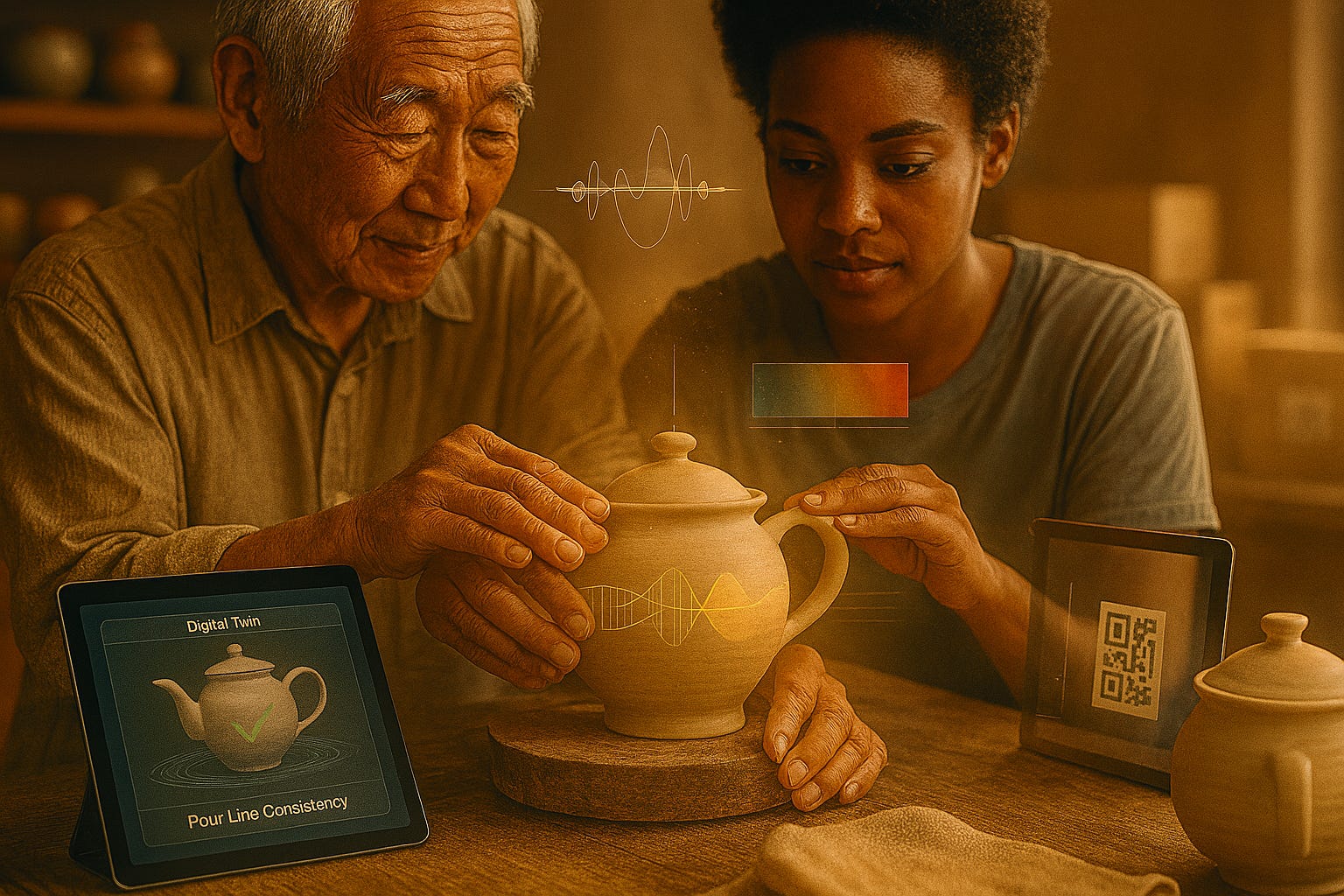
Ship each limited drop with a traceable QR that links to a 90-second film of the named people, the ritual they used, and one metric they hit. This locks identity to humans, not just machines.
The role of modern Tech AI and logistics
Here is a practical map of how modern tech, logistics, and AI can help you translate, replicate, rebuild, recreate, or move endangered industrial capabilities, in the context of these posts.
1) Translation of knowledge
- Capture tacit skill. Record master operators with multi-camera video, audio, and sensor overlays. Use AI to extract step sequences, thresholds, and cues. Output digital work instructions with pictures and tolerances.
- Create bilingual process packs. LLMs translate SOPs, inspection sheets, and maintenance logs. Human reviewers validate terminology. Maintain a controlled glossary and prevent drift.
- Build a digital twin of the line. Model machines, recipes, and quality windows in CAD and process simulation. Stress test new climates, inputs, and utilities before any move.
2) Replication and recreation of processes
- Digitize the product. Use 3D scanning, metrology, and materials testing to fix the critical dimensions and material envelopes that define quality. Lock these into a master spec.
- Recreate jigs and tooling. Convert scans to CAM files. Use CNC and additive to remanufacture jigs, dies, and fixtures. Keep originals as references.
- Instrument for quality. Add inline vision, acoustic sensors, or torque capture. Feed statistical process control dashboards so you can match legacy signatures, not just averages.
3) Rebuild or retrofit equipment
- Controls modernization. Replace failing PLCs and drives with modern equivalents while preserving mechanical geometry. Use digital I/O adapters to avoid re-machining frames.
- Spare parts strategy. 3D print non-critical parts, stock critical OEM spares, and qualify two suppliers per part. Tie this to predictive maintenance alerts.
- Safety and compliance. Map old equipment to current standards. Add guarding, interlocks, and e-stops without changing the process path.
4) Move physical assets
- Decommissioning plan. Create a rigging and route plan from the CAD model. Simulate lifts, center of gravity, and clearances. Photograph and label every cable and hose. Bag and barcode fasteners by subassembly.
- Environmental requalification. Model power quality, humidity, and temperature at the destination. Plan for UPS, chillers, dehumidifiers, or vibration isolation as needed.
- Customs and compliance. Pre-classify equipment and tooling with HS codes. Prepare origin IP licenses, dual-use checks, and temporary admission if you will re-export after training.
5) Logistics, supply, and ramp
- Box the process, not only the machine. Ship a starter kit of inputs that define quality, for example pigments, abrasives, or cloth. Give new teams a reference batch to calibrate against.
- Track and trace. Use IoT tags on crates and critical parts. Mirror sensor data to a cloud log so you can prove chain of custody and handling conditions.
- Phased ramp. Run three batches. Batch 1 under master supervision. Batch 2 with remote oversight and daily quality reviews. Batch 3 with local leads, then audit.
6) AI across the lifecycle
- Process mining. Ingest historical MES, maintenance, and scrap data. AI finds hidden bottlenecks and drift patterns that will break replication if ignored.
- Operator assist. AR headsets display step-by-step cues, limits, and visual overlays. Vision models confirm hand positions or stitch patterns in real time, then flag rework before the next step.
- Predictive maintenance. Forecast failures from vibration, current, or temperature. Schedule maintenance around training windows so new teams see both normal and fault states.
- Document control. AI checks every SOP revision against the master spec, then blocks conflicting edits. All changes require a paired test batch to validate.
7) Brand, IP, and identity protection
- Provenance records. Sign each batch with a digital certificate tied to equipment IDs and operator certifications. Publish a simple QR for customers to verify origin and methods.
- Tiered licensing. Separate training rights, production rights, and brand rights. Keep heritage IP at home, license defined methods abroad, and require audits.
- Style preservation. Encode sensory targets where relevant, for example color Lab* zones, sound profiles, or surface roughness ranges. This protects technique as well as output.
8) Org and financing mechanics
- Create a Salvage SPV. One entity holds equipment, IP licenses, and insurance. It contracts training, logistics, and audits, which reduces risk for small brands.
- Pay for outcomes. Tie trainer fees and local partner bonuses to first-pass yield, rework rates, and on-time delivery, not only hours taught.
9) Readiness checklist for a 12-month pilot
- Month 1 to 2. Select a single product family. Scan tooling, sample three golden parts, and draft bilingual SOPs.
- Month 3 to 4. Build the digital twin. Run climate and input variability tests. Approve a retrofit plan for controls and safety.
- Month 5 to 6. Ship a training skid, spares, and input starter kits. Prepare customs files and site utilities.
- Month 7 to 9. On-site training with two masters and a diaspora interpreter. Produce Batch 1 and 2. Calibrate QC.
- Month 10 to 12. Remote oversight of Batch 3. Independent audit. Decide scale up, hold, or roll back.
10) Metrics that show you are truly replicating
- Technical. Cp/Cpk on the three most sensitive dimensions. Inline defect rate. Mean time between failures.
- Commercial. Lead time to promise. On-time in full. Warranty returns within 90 days.
- Knowledge. Number of certified operators. SOP comprehension scores. Audit pass rate without rework.
Risks and how to reduce them
- Authenticity dilution. Be transparent about “trained in X tradition, produced in Y under master oversight.” Use provenance and publish quality data.
- IP leakage. Keep crown-jewel steps in a controlled module or perform them at a hub. Use contractual and technical controls together.
- Over-automation. Automate measurement and handling first. Keep human judgment where it defines value.
- Talent churn. Bond training to multi-year incentives. Build a local talent ladder, from trainee to cell lead to trainer.
Conclusion:
If you want to move or rebuild endangered capability, protect what people actually value. Start with a short sensory lexicon. Film and adopt five rituals that shape judgment. Pair every drop with three proofs, a named custodian, a visible rite, and one feel metric. Use AI to translate and verify, not to erase nuance. Build a stipend so apprentices can stay. Publish why you vary any element, and let the host place develop a safe signature. Tie revenue back to origin so the next generation can learn. When you do this, technique travels and meaning stays intact.
Appendices
Framework: Short Sensory Lexicon + Five Judgment-Shaping Rituals
Use this framework to keep judgment visible, measurable, and meaningful. You protect lineage, you teach faster, and you give buyers clear reasons to trust the work.
Use this to capture what “good” feels like, tie it to measurable bands, and keep culture alive while you scale.
Part A. Build a short sensory lexicon
Goal. 10 items or fewer that any trained person can use the same day. Each item links a human cue to a simple test and a numeric band.
A1. Team and sources
- Convene three voices. One origin master, one diaspora interpreter-trainer, one host apprentice.
- Gather anchors. Golden pieces, rejected pieces, photos, short clips of touch, sound, and movement.
- Pull cultural references. Terms from guild speech, local language, recipes, music, or rites that carry meaning.
A2. Attribute template
For each attribute, fill this exact card. Keep language plain.
- Name. One or two words that locals already use.
- Sensory cue. What you feel, see, hear, smell, or taste.
- Quick test. How to check it in under one minute.
- Band. A numeric band or discrete pass window.
- Tool. Phone mic, light level, timer, scale, feeler gauge, water at a set temperature.
- Photo or clip. One macro image or a 10 second video.
- Cultural note. Why the cue matters in this lineage.
- Linked ritual. Which ritual reinforces this attribute.
Example 1, ceramics.
Name. Ring sustain.
Sensory cue. Clear bell, not dull.
Quick test. Tap lip with bamboo stick, count seconds.
Band. 2.2 to 2.6 seconds by ear.
Tool. Phone audio counter app.
Photo or clip. 10 second tap video with waveform.
Cultural note. Used in Tokoname to judge body density for tea service.
Linked ritual. Kiln blessing before late reduction.
Example 2, textiles.
Name. Hand of edge.
Sensory cue. Edge bends once, springs back, no crackle.
Quick test. Wrap edge around a thumb, release, listen, feel.
Band. One bend only, silent return.
Tool. None.
Photo or clip. 120 fps slow motion of the bend.
Cultural note. Spitalfields silk finish standard for evening wear.
Linked ritual. Pattern book salute before finishing.
Example 3, metal.
Name. Whisper fit.
Sensory cue. Cap rotates with a soft hiss, no squeak.
Quick test. Three rotations under light finger load.
Band. Continuous hiss, less than 0.2 N additional torque at any point.
Tool. Small torque driver, phone mic.
Photo or clip. Close-up rotation with audio.
Cultural note. Jura watch cases prized for quiet closure.
Linked ritual. Bench silence before final seat.
A3. Scale and scoring
- Use three levels. Fail, Accept, Crown. No more.
- Show a macro board with one Fail, two Accept, one Crown for each attribute.
- Tie at least one attribute to a simple capability index. Example, Cp 1.30 to 1.40 on glaze thickness at the lip.
A4. Terroir protocol
- Record water hardness, humidity, temperature, and key inputs monthly.
- Run a paired test. One origin puck or swatch, one host puck or swatch. Note deltas in color break, ring, or hand.
- Decide if the delta becomes a safe place signature. Publish the reason in one paragraph.
A5. Version control
- Name the lexicon v1.0. Limit edits to a monthly council. Keep a one page changelog.
- Any change requires two proofs. A clip and a metric that show the improvement.
Part B. Film and adopt five rituals that shape judgment
Goal. Rituals focus attention, slow the hands, and transfer tacit knowledge. Each ritual is short, respectful, and linked to at least one lexicon attribute.
How to film, once, then keep alive
- Use one phone on a tripod. No music. Natural sound.
- Shoot in natural side light. Frame hands and the work.
- Record in 1080p, 30 fps. Under 20 seconds per clip.
- Start with the name. One spoken sentence, who and what.
- Store clips next to SOPs. QR link on the batch card.
- Credit people by name. Secure consent in writing.
Ritual 1. Opening the day
Purpose. Reset attention, align team, confirm tools.
Action. Name the line, touch the first tool in sequence, breathe together for three breaths.
Link. Preloads the senses for accuracy and calm motor control.
Attribute tie. Hand steadiness, edge smoothness.
History and culture. Mirrors morning bows in Japanese workshops and guild prayers in European craft halls, both frame the day as shared responsibility.
Ritual 2. Crown step blessing
Purpose. Guard and dignify the one step that carries identity.
Action. Speak the step name, perform a tactile cue, log the exact second by hand, then enter it digitally.
Link. Locks attention at the exact moment when invisible tolerances matter most.
Attribute tie. Ring sustain, whisper fit, pour line, or edge hand.
History and culture. Echoes kiln blessings in Tokoname and Murano door markings, marks the line between ordinary heat and consecrated fire.
Ritual 3. Judgment checkpoint
Purpose. Align feel with data before release.
Action. Three people, three senses, one minute each. Tap, rub, pour, or flex, then compare to the macro board and the numeric band.
Link. Prevents drift from instrument-only pass.
Attribute tie. At least two attributes per batch.
History and culture. Follows guild practice of multiple masters certifying a mark, prevents lone-judge bias.
Ritual 4. Closure and thanks
Purpose. Mark batch completion, carry pride, allow grief for rejects.
Action. Place one reject and one crown piece side by side, say why. Sign the batch card.
Link. Builds shared judgment, reduces silent tolerance creep.
Attribute tie. Any attribute that drove a reject call.
History and culture. Reflects end-of-shift critiques in Kyoto textile houses and concluding psalms in African blacksmith compounds, both join skill to ethics.
Ritual 5. Transmission moment
Purpose. Make tacit moves teachable.
Action. A custodian narrates one micro move while doing it slowly once. Apprentice mirrors once. Both sign a small card tied to that move.
Link. Turns hand memory into language and film, keeps succession alive.
Attribute tie. The hardest cue for the current cohort.
History and culture. Parallels master to deshi whispers in Japanese craft and European side bench coaching, lineage conserves nuance through people, not manuals.
Part C. Governance and proof
C1. People and roles
- Master. Holds veto on crown step, names custodians.
- Interpreter-trainer. Translates feel to tests and language.
- Custodians. Two people who can reproduce crown attributes twice.
- Council. Three to five respected figures, including a local cultural steward with real vote.
C2. Batch proof, every release
- One named person’s certification. A 10 second video with name and role.
- One visible ritual clip. Under 15 seconds, natural sound.
- One transparent metric tied to feel. Example, Cp, ring seconds, pour angle time to drip, or torque curve.
C3. Revenue and reciprocity
- Earmark 5 to 10 percent of net to fund origin apprentices.
- Publish the stipend number and the current apprentice names.
Part D. Implementation sprint, two weeks
Day 1 to 2. Collect anchors, agree top five attributes.
Day 3 to 4. Draft attribute cards, run first macro board shoot.
Day 5. Pilot three rituals, film rough cuts.
Day 6. Calibrate bands with five golden pieces and five rejects.
Day 7. Council review, lock v1.0 lexicon and rituals.
Week 2. Run one full batch with proofs. Publish a one page release note with clips and metrics.
Part E. Cross references you can cite in-story or training
- Japanese tea and kiln practice. Attention, silence, sequence, blessing of heat.
- Murano glass guild controls. Ritual at the furnace, respect for guarded steps.
- Huguenot silk in London. Pattern books and finishing standards carried across borders.
- Jura watchmaking. Cottage precision plus shared checks on fit and feel.
- Diaspora training lines in Brazil. Hybrid language for cues and customer culture.
Ready to copy resources
One-page lexicon sheet, blank.
- Attribute name.
- Sensory cue.
- Quick test.
- Band.
- Tool.
- Photo or clip.
- Cultural note.
- Linked ritual.
- Date and version.
Release note, per batch.
- Cell name, team photo, date.
- Ritual clip 1 link.
- Attribute metric 1 with band.
- Macro board image.
- Named certification clip.
- Stipend contribution figure and current apprentices.
Fictional Case Study: The Hikari Line
Background
Hikari Kiln sat on a slope outside Tokoname. For fifty years, Master Kenji Sato shaped red shudei clay into teapots that poured in a clean, silent line. Collectors knew the lid fit by the soft whisper when rotated. The São Paulo Maker Park invited a training cell to keep the line alive and meet demand from Brazil’s Nikkei community.
Protagonists
- Retiring master: Kenji Sato, age 71, Hikari Kiln, Tokoname.
- Diaspora interpreter-trainer: Akira Tanaka, Japanese Brazilian ceramic engineer, trained in Mino and based in São Paulo.
- Apprentice cohort: Four makers in Brazil, Ana, Bruno, Carolina, and Yuto.
- Skeptical legacy customer: Aiko Nakamura, Kyoto tea merchant whose shop has carried Hikari work for 18 years.
Setting and rituals
- Origin workshop: Hikari Kiln, with a dawn “first pour” ritual. Sato brewed sencha, warmed a reference pot, then tapped the body with a bamboo stick to hear a clear ring. He brushed the kiln door with a sprig of pine before loading.
- Host training cell: Unit B7, São Paulo Maker Park. The cohort kept a “three breaths at the kiln mouth” pause before opening. They named their gas kiln “Luz,” and placed a tiny dish of farofa as a greeting when lighting the burners.
Conflict
Time was short. Sato planned to retire after the autumn firings. He feared dilution. Akira fought permits for gas lines, silica handling, and insurance for vintage burners. The cohort struggled with invisible tolerances. Batch 1 hit temperature curves and shrinkage targets, yet felt wrong. The lid squeaked. The spout dripped at the last second. The ring was short. Aiko poured and said, “This does not carry the line.”
Turning point
Akira called a halt and built a short sensory lexicon with Sato over video.
Lexicon, version 1.0:
- Ring sustain: clear, not dull, 2.0 to 2.4 seconds by ear.
- Lid whisper: smooth rotation with a soft hiss, no chatter.
- Pour line: continuous thread at 40 to 45 degrees, no final drip.
- Skin sheen: satin under 10 a.m. north light, not glossy, not chalky.
- Heat seat: body warms evenly in 8 to 10 seconds with 85 C water.
They paired the lexicon with the guarded crown-jewel step. Sato revealed his lid seating method. He dusted the gallery with fine tea ash, warmed the lid to hand-hot, then made six slow rotations while pressing the knop with two fingers. He exhaled on the final turn. He asked the São Paulo cell to bind this to a respectful ritual. The cohort chose to say “Hikari” together, touch the kiln frame in sequence, then log the exact lid-seat time by hand before any software entry.
Batch 3 followed the ritual. Akira sent six pots blind to the Tokoname guild. Judges tapped, rotated, and poured. The batch passed.
Akira published provenance and QC for a limited drop of 120 teapots to diaspora buyers. The page showed:
- Cell name and team photo.
- Ritual note and timestamp for lid seating and for the reduction soak.
- Spout outflow consistency Cp at 1.35, target 1.30 to 1.40.
- Macro board of acceptable lid-seat bands with close-up images.
Resolution
Sato flew to São Paulo for a day. He signed Batch Card 3 in sumi ink. He named Ana and Yuto as “custodians” after they reproduced the lid whisper and pour line twice in a row.
Seven percent of net from the drop funded a new apprentice stipend at Hikari Kiln in Tokoname. The São Paulo cell earned the right to vary one element. They petitioned to thicken the handle profile for Brazilian grip comfort during long churrasco afternoons. The council published the reason and side by side photos.
Aiko reordered. She asked that her first shipment carry both the master’s seal and the custodians’ initials for one season. “My customers should meet the heirs,” she said.
Proof, shown every release
- Named person’s certification: Short video of Ana signing the batch card and stating, “I certified Ring, Lid Whisper, and Pour Line on Unit B7, Luz kiln.”
- Visible ritual: A 12 second clip of the lid seating ritual. Four hands touch the frame in sequence. The paper log shows the time.
- One transparent metric tied to feel: Spout outflow consistency, Cp 1.35, displayed next to the macro board of lid-seat tolerances.
What changed at origin
With the stipend in place, Sato took two neighborhood teens into a one year apprenticeship. He kept a small kiln warm twice a week. He mailed Brazil a monthly set of shudei test pucks for calibration.
What changed at the host cell
The cohort built a safe “place signature.” São Paulo clay and water gave a faint cocoa cast on ridges. The council documented it as the Brazil note. The team held ring sustain and pour line within origin bands. They published the visual band, the ring targets, and the pour test so buyers could learn the feel.
Results at six months
- Three batches released, returns under 2 percent.
- Waitlist of 1,600 buyers, mostly Nikkei families and tea circles.
- One museum in Porto Alegre requested a making demo.
- Aiko sold through in ten days and now hosts a quarterly “Meet the Custodians” pour clinic.
Replication guidance
- Move people, tools, and rules together.
- Write a short sensory lexicon first.
- Bind the crown-jewel step to a ritual, then measure around it.
- Publish one human, one ritual, and one metric with every drop.
- Share revenue to seed the next apprentices at origin.
The Hikari Line kept its whisper, its line, and its dignity. The work travelled. The soul stayed whole.