Preamble
In Part 2 of this series, I explored why AI-augmented, rugged, and modular devices could eventually outgrow the smartphone. The response from reader Jenna Russell sparked an entirely new direction: What if we adapted this second device concept to a platform framework called “Reality as a Game”?
Her idea, presented in outline form with links to her broader vision, revealed something profound, a way to dissolve the boundary between play and everyday life. This third instalment takes that seed and develops it into a comprehensive framework: one where your second mobile device becomes a portal to ambient gameplay, transforming physical environments into interactive canvases for curiosity, creativity, and collaboration.
This isn’t just about gaming. It’s about reimagining how we interact with our surroundings through storylines built around wellness, environmental stewardship, education, and community connection. The framework presented here includes:
- A vision statement defining the core philosophy of ambient gameplay
- Stakeholder analysis identifying six key groups and their motivations
- Feature specifications outlining the technical and experiential components
- Use cases demonstrating real-world applications from AR classrooms to wellness quests
- Gameplay scenarios with example implementations like Lumina and AeroSpray
I shared an early draft with Jenna, though I haven’t heard back yet. Regardless, the concept feels too rich not to explore publicly. The framework offers both a dual-pathway strategy—working with existing devices while designing next-generation hardware—and a practical roadmap for creators, educators, developers, and communities.
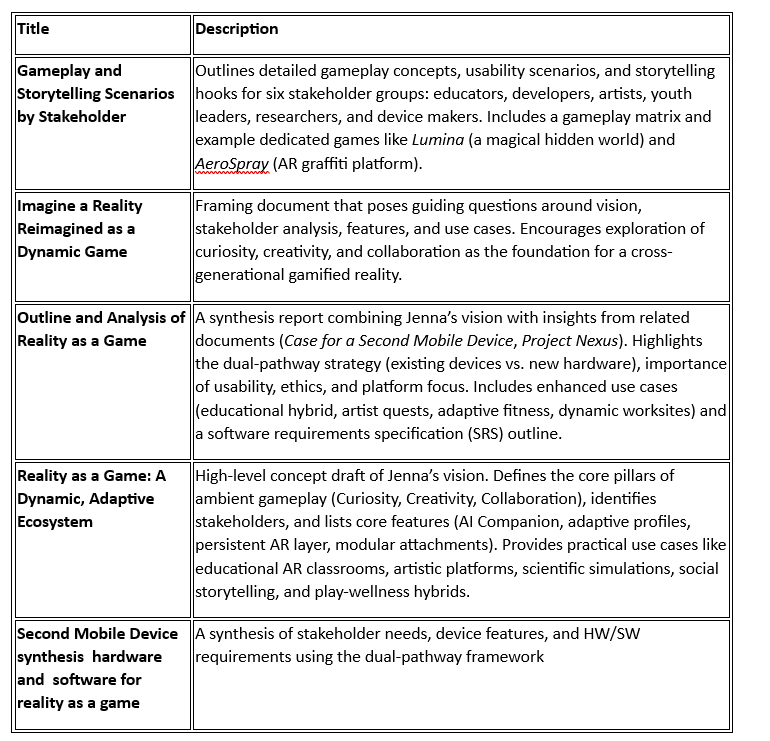
Full supporting materials, including detailed gameplay matrices, hardware requirements, and critical analysis, are available in the Reality as a Game artifact folder.
Note: This interpretation of Jenna’s vision may contain biases inherent to my design perspective. I welcome critique and have included a separate critical analysis document in the linked resources.
As usual some analysis and Reality as a game artifacts
Reality as a Game: A Dynamic, Adaptive Ecosystem
Vision
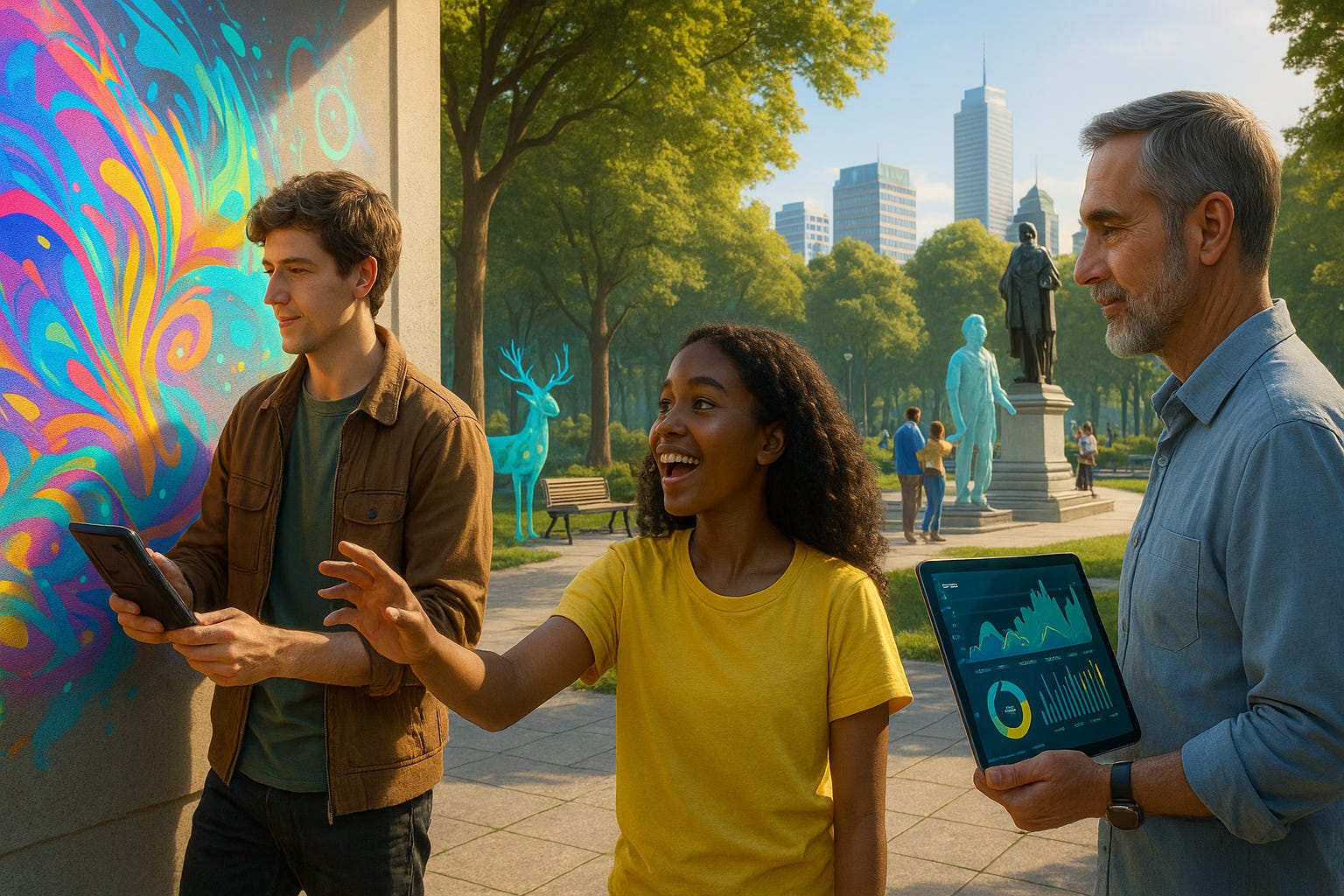
The core philosophy is ambient gameplay: reality becomes a persistent, adaptive layer of experiences powered by AI and AR. This philosophy dissolves the line between play and life, turning environments into interactive canvases where curiosity, creativity, and collaboration thrive.
- Curiosity: Every place becomes a puzzle or hidden story, encouraging exploration.
- Creativity: Users create content, challenges, and artifacts that enrich the shared world.
- Collaboration: Gameplay spans teams, families, and communities, fostering empathy and collective problem-solving.
This vision adapts across generations and cultures by offering experiences that are both playful and purposeful—educational quests for children, artistic expression for creators, simulations for scientists, and shared cultural narratives for communities. Note: This is an outline to understand Jenna vision it may behave a mis interpretation and have errors due to CA design inherent bias
Stakeholder Analysis
Key Players and Roles
- Educators: Integrate AR classrooms and experiential learning modules.
- Motivation: Enhance engagement, improve retention.
- Conflict: Balancing entertainment with academic rigor.
- Game Developers & AR Creators: Build interactive worlds and mechanics.
- Motivation: Access new markets and revenue streams.
- Conflict: Platform fragmentation, monetization disputes.
- Artists & Storytellers: Use the platform as a living canvas.
- Motivation: Expand creative reach.
- Conflict: Ownership of IP, cultural appropriation concerns.
- Youth Leaders & Communities: Drive grassroots adoption, organize events.
- Motivation: Empowerment, inclusion, social cohesion.
- Conflict: Safety and privacy risks for younger players.
- Researchers & Scientists: Use AR layers for simulations and experiments.
- Motivation: Richer data, interactive teaching.
- Conflict: Accuracy vs. entertainment.
- Device & Accessory Makers: Enable modular hardware for different contexts.
- Motivation: Hardware sales, ecosystem lock-in.
- Conflict: Standards and interoperability.
Features
Core Mechanics and Tools
- Adaptive Gameplay Profiles: Tailored to archetypes:
- Dreamers: Story-driven, artistic modes.
- Builders: Creation tools for environments and mechanics.
- Analysts: Data-rich simulations, puzzles, and strategy.
- Persistent AR Layer: Shared memory across environments (urban, wilderness, home).
- AI Companion: Learns user behavior, adapts challenges, supports collaboration.
- Modular Attachments: Accessories for creative production, navigation, safety, or combat play.
- Cross-Environment Continuity: Skills and artifacts earned in one setting unlock advantages in another.
- Community Events: City-scale treasure hunts, backyard tournaments, synchronized exploration.
Use Cases
1. Educational Environments
- Students explore AR classrooms where history overlays actual streets or lab experiments merge with real materials.
- Hardware: Secondary devices with rugged AR features or lightweight AR glasses.
2. Artistic Platforms
- Artists drop evolving installations in physical spaces. Interactions from passersby change the artwork dynamically. (does all graffiti have to be real)
- Example: An AR mural grows new elements with each viewer’s input.
3. Scientific Simulations
- Researchers model ecosystems or physics problems in AR, inviting students or citizen scientists to test hypotheses through interactive simulations.
- Example: A city park becomes a living model of climate adaptation.
4. Social Storytelling Spaces
- Families and communities create shared AR narratives where every member plays a role.
- Example: A neighborhood transforms into a fantasy village for a weekend, blending myth with local history.
5. Play + Wellness Hybrid
- Trails and parks host AR quests that reward conservation behaviors (clean-up, tree planting) with in-game achievements that also support real-world causes.
Conclusion
Reality as a Game represents more than a technological platform—it’s a philosophical shift in how we engage with physical space. By transforming environments into persistent, adaptive layers of experience, we create opportunities for:
- Educational transformation: Moving beyond screens to experiential learning embedded in the real world
- Creative expression: Enabling artists and storytellers to use physical spaces as living canvases
- Community building: Fostering collaboration through shared narratives and collective challenges
- Purposeful play: Blending entertainment with real-world impact, from conservation efforts to cultural preservation
The second mobile device concept from Part 2 finds its most compelling application here—not as a smartphone replacement, but as a purpose-built tool for ambient gameplay. Its rugged design, modular attachments, and AI augmentation make it ideal for the diverse contexts this framework demands: from urban AR treasure hunts to wilderness conservation quests.
Next Steps
For those interested in exploring or developing within this framework:
- Review the supporting documentation: The artifact folder contains detailed gameplay scenarios, hardware specifications, and stakeholder analysis
- Prototype small-scale experiences: Start with single-location AR interactions before scaling to persistent, cross-environment systems
- Engage stakeholder communities: Connect with educators, developers, artists, or community organizers to co-create use cases
- Test the dual-pathway approach: Experiment with existing AR-capable devices while identifying gaps that purpose-built hardware could fill
- Contribute to the conversation: Share your critiques, adaptations, or implementations—this framework thrives on collaborative evolution
The line between play and reality is already blurring. The question is whether we’ll shape that convergence intentionally, with purpose and care, or let it emerge haphazardly. This framework offers one possible path forward