Preamble
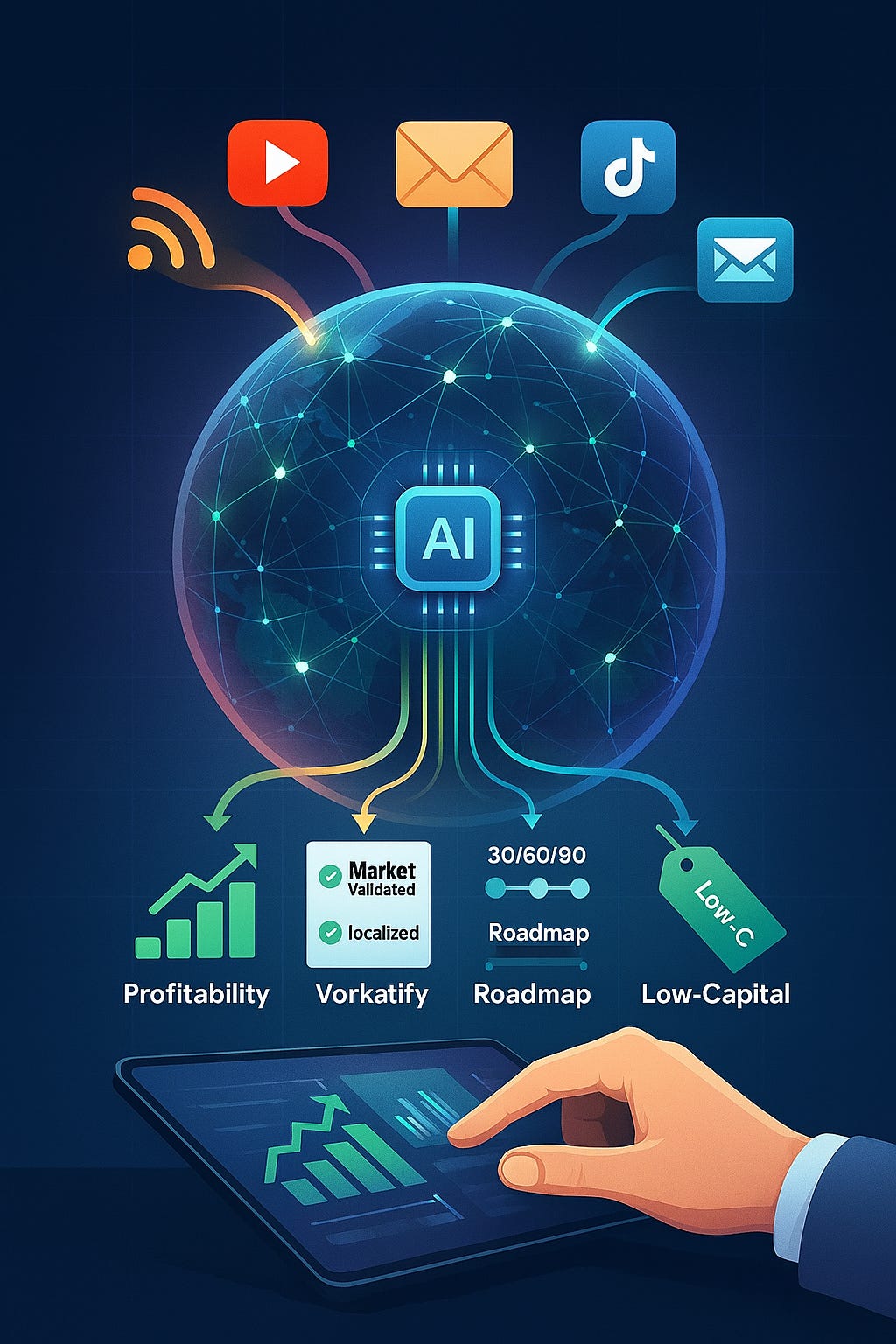
This is the business of the business finder. The Global Business Idea Scout is a specialized AI that automates the most time-consuming part of entrepreneurship: the initial discovery and validation of opportunities. It solves the problem of inspiration overload and analysis paralysis by continuously scanning the entire digital and traditional media landscape from TikTok and YouTube to Substack, podcasts, and international news synthesizing thousands of data points into actionable, scored, and validated business ideas. It bridges the gap between seeing a cool concept online and having a structured plan to execute it in your local market. It also enables exploration of new, novel and cross domain applications.
I have created a pilot custom GPT for users to test: Global Business Idea Scout please use it provide feedback and share. For the first test of the custom GPT the test prompt I used was:
“Based on my attached CV, generate a high-potential business idea I can begin implementing immediately. The concept should align with my skills and experience, require minimal upfront investment, and be capable of generating at least £20,000 in monthly income. Prioritize ideas that are scalable, lean, and suited to rapid validation and growth.”
Outcome: was an idea and analysis with options and the further options to create:
✅ Full Business Plan
✅ 90-Day Implementation Plan
✅ Branding + Positioning messaging
✅ Outreach scripts
✅ Website copy
✅ Pricing calculator
✅ LinkedIn posting calendar
See Appendices for further prompts and converation starters. The most preferable pathway is to have a conversation with the GPT.
For the user guide and FAQ see: USER Guidelines and FAQ or ask the GPT
Is This New?
Originality Check:
- Completely novel [ ]
- Remix of existing concepts [X]
- Niche specialization [X]
- Cross-domain adaptation [X]
While business news aggregators and individual creator analyses exist, no tool systematically cross-references, validates, and evaluates business ideas across such a wide array of platforms (TikTok, YouTube, Substack, Podcasts, International Media) with a structured localization and planning framework. It’s a remix of a business intelligence platform, a market research tool, and a business plan generator, specialized for the modern, platform-driven entrepreneurial era.
Market Position
The Landscape: The market for entrepreneurial content is fragmented and noisy. Aspiring founders spend hundreds of hours consuming content on disparate platforms without a clear path to action. Business plan software exists but requires a starting idea. Market research tools are often expensive and generic.
The Opportunity: This GPT serves the “idea validation” gap. It’s for the person who knows they want to start a business but doesn’t know what or how. It aggregates the inspiration and provides the implementation framework in one place, democratizing access to global business intelligence.
The Scale: Success isn’t about becoming a unicorn startup itself. It’s about becoming an indispensable tool for thousands of solopreneurs, indie hackers, and small business founders, effectively acting as the starting point for countless new ventures.
Stakeholder Ecosystem:
- Aspiring Entrepreneurs (Primary): Need vetted, accessible ideas and clear plans. Pain point: overwhelm and lack of direction.
- Small Business Owners: Need new revenue streams or side projects. Pain point: no time for extensive research.
- Innovation Consultants & Coaches: Need a scalable way to generate and evaluate opportunities for clients. Pain point: manually curating information.
References: The entire knowledge base of the GPT, including templates for Business Plans, Financial Analysis, Marketing Plans, and the Multi-Source Validation Framework, serves as its foundational IP.
Product vs. Feature
The Test: This is a standalone product. While large language models can answer questions, this is a deeply specialized configuration with a proprietary knowledge base (e.g., the Global Evaluation Matrix, specific creator databases, structured templates) that defines a unique, repeatable process.
The Defense: Its defensibility lies in its specialization, comprehensive framework, and integrated workflow. It’s not just an idea generator; it’s an “idea-to-plan” engine. The curated knowledge base of creators, templates, and evaluation criteria creates a high-quality, structured output that a general-purpose AI cannot reliably replicate.
Core Components
What You’d Need:
- Access to a platform capable of hosting a Custom GPT (e.g., ChatGPT Plus).
- The complete configuration document (instructions, knowledge base files, conversation starters).
- A continuous feedback loop with users to refine idea sources and evaluation criteria.
First Steps:
- Access the Global Business Idea Scout GPT.
- Use a Conversation Starter like: *”Show me low-capital business ideas from across all platforms I can start with less than $1,000 in [my country].”*
- Request a Global Business Idea Evaluation Matrix for any idea that resonates.
The Contrarian View
Challenge This Idea: An AI can’t truly understand market nuance or replace human gut instinct and creativity. It might surface already-saturated trends or over-rely on the popularity of a TikTok creator rather than real-world viability. Entrepreneurs learn most by doing, not by over-analyzing scored ideas from a bot.
Why It Might Still Work: The GPT isn’t meant to replace human judgment but to augment it drastically. It handles the 80% of legwork—aggregation, initial scoring, and plan drafting—freeing up the human to focus on the 20% of creative adaptation, execution, and networking. Its Multi-Source Validation Framework is specifically designed to filter out viral hype and identify concepts with cross-platform credibility.
Cross-Domain Potential
If This Doesn’t Work Here: The core engine—multi-platform scanning, synthesis, and structured evaluation—could be adapted for:
- Academic Research: Tracking the emergence of scientific concepts or political narratives across journals, blogs, and social media.
- Trend Forecasting: For fashion, technology, or consumer goods brands.
- Investment Scouting: For VCs and angel investors to identify early-stage trends and startups.
- Internal analysis: For existing companies: competitor analysis , business feature improvement , environmental scanning, product or service development
Next Steps for Builders
If you wanted to pursue this:
- Week 1: Use the GPT daily for a week with various conversation starters. Test its limits and document its strengths and weaknesses.
- Month 1: Develop a system for feeding new, successful creator profiles and sources into its knowledge base to keep it updated.
- Quarter 1: Create a community around the GPT for users to share their implementation success stories, providing real-world validation data.
Resources to explore:
- Platform: OpenAI’s Custom GPT platform.
- Research: The provided knowledge base files (Custom GPT Configuration 2.docx, Instructions.docx, etc.).
- Example to study: The existing configuration is the prototype.
Final Thoughts
This idea matters because it represents the next step in leveraging AI for practical creativity and economic empowerment. It takes the chaotic, inspiring firehose of the internet and turns it into a navigable map for building real things. It’s a tool for builders, by a builder, encoded in intelligence.
We want to hear from you! This entire concept is built to evolve. Please use the Custom GPT and provide your feedback. What was your experience? Did it find you a viable idea? How can it be improved? Your input directly shapes the next version.
This is part of [Ideas snapshots] — a collection of lightweight business blueprints, strategic outlines, and entrepreneurial prompts. Not every idea needs to be built. Some are meant to inspire, remix, or adapt.
What would you do differently with this idea? Reply or share your take.
Appendices
Below is a clean, structured list of conversation starters and prompts tailored specifically for the Global Business Idea Scout — fully aligned with your system instructions and enhanced using the Conversation Starters file and the Enhanced Starters file .
✅ Conversation Starters & Prompts for the Global Business Idea Scout
These prompts are grouped into categories so users can quickly find the right entry point.
Simple
Conversation Starters
- “Show me low-capital business ideas from across all platforms I can start with less than $1,000 in [specific country]”
- “What are the most talked-about business ideas on YouTube, Substack, and podcasts in the last 3 months?”
- “Find me Japanese or Korean business concepts from any media source that could work in [target market]”
- “What business ideas are trending on Reddit’s r/Entrepreneur that have been validated by other sources?”
- “Compare how different creators across TikTok, YouTube, and newsletters present [specific business model]”
- “I have $10K and 3 months to launch. What are my best options from all available sources for [industry]?”
- “Evaluate [specific business idea] mentioned in [source/platform] for implementation in [country] – provide the full Global Evaluation Matrix”
- “Create a complete business plan for [selected idea from specific source] adapted for [target market]”
- “What AI-powered business ideas are being discussed across LinkedIn, Twitter, and tech blogs right now?”
- “Show me sustainability businesses featured in documentaries, TED Talks, or business publications that are beginner-friendly”
- “Track the evolution of [business trend] across different platforms over the past year”
- “What ‘boring but profitable’ service businesses are featured across multiple sources with proven track records?”
- “Find me business ideas from international media (non-English sources) that haven’t been widely covered in US markets”
- “What are the top business ideas from recent podcast episodes on [specific show] or [topic]?”
- “Compare business ideas from traditional media (TV, books) vs. social media – which have better implementation success rates?”
- “I need a 90-day implementation roadmap for [specific business idea from source X] with localization for [region]”
- “What business models are venture-backed startups using according to TechCrunch, Crunchbase, and startup podcasts?”
- “Show me creator economy business ideas from across Instagram, YouTube, and Substack”
- “What are the common themes in business ideas from [geographic region] across all media types?”
- “Generate a marketing plan leveraging insights from [multiple sources] for [business concept] in [market]”
Detailed
1. Ultra-High-Precision Idea Discovery Prompts
(For users who know what type of idea they want)
- “Show me low-capital business ideas (<$1,000) trending on TikTok and YouTube that are beginner-friendly in [country].”
- “Find me business ideas from Japan or South Korea that can be localized for [target market] with high adaptability scores.”
- “What business ideas are trending on Reddit’s r/Entrepreneur that have been validated on YouTube or newsletters?”
- “Show me ‘boring but profitable’ businesses that appear across multiple platforms and have proven operators.”
- “Find me digital businesses with high scalability that founders discussed on recent podcasts.”
2. Cross-Platform Comparison Prompts
(To use your multi-source synthesis ability)
- “Compare how creators on TikTok, Substack, and podcasts describe the same business idea: [idea].”
- “Show the differences between viral TikTok versions and the deeper newsletter/podcast analysis of [business model].”
- “Track how the perception of [trend or idea] changed across TikTok, Reddit, and business newsletters over the last 12 months.”
3. Geographic & Cultural Adaptation Prompts
(Your global localization superpower)
- “Find me unique Japanese, Korean, or Scandinavian ideas that are highly adaptable to the U.S. market.”
- “Show me sustainable business concepts from Scandinavia that could succeed in North America.”
- “Identify service models from Latin America with medium implementation complexity and strong localization potential.”
- “Find innovations from emerging markets (Africa, SE Asia, LATAM) that haven’t reached Western platforms.”
4. Budget-Filtered Prompts
(Aligned with cost categories in your framework)
- “I have $100. What no-capital business ideas from TikTok or newsletters can I start this weekend?”
- “I have $5,000. Show me ideas from YouTube and Reddit that can reach profitability in under 90 days.”
- “What high-investment business models ($50K+) from Asia were featured in major media like Bloomberg/Forbes?”
5. Difficulty & Skill-Level Prompts
(To help beginners, intermediate, and experts)
- “Show me beginner-friendly business ideas requiring no technical skills that I can launch in under 30 days.”
- “Find advanced business models that require specialized expertise and have high profitability potential.”
- “Show me quick-launch ideas validated by multiple sources.”
6. Industry or Theme-Specific Prompts
(Using your categorization themes)
- “What AI-powered service businesses are trending across LinkedIn, Twitter, and tech blogs right now?”
- “Find me sustainability ideas featured in TED Talks, documentaries, or business publications.”
- “Show me Creator Economy ideas being shared across Instagram, YouTube, and Substack.”
- “What PropTech or FinTech models are emerging from Asia and Europe?”
7. Validation & Proof-Based Prompts
(For multi-platform confirmation)
- “What business ideas are validated across 3 or more platforms (TikTok + Reddit + Newsletter)?”
- “Find ideas with proven case studies on YouTube and summarizable frameworks from newsletters.”
- “Identify business concepts that evolved from viral trend → real companies.”
8. Deep Evaluation & Planning Prompts
(To activate your BRD, Business Plan, and Evaluation Matrix tools)
- “Evaluate [business idea] using the Global Business Idea Evaluation Matrix with scoring.”
- “Create a full Business Plan adapted for [country] using the uploaded template.”
- “Generate a 30/60/90-day plan for implementing [idea] in [market].”
- “Prepare a Risk Profile for [idea] using the risk template.”
- “Turn this idea into a Product Backlog + MVP plan based on the global framework.”
9. Trend Tracking Prompts
(For monitoring evolution of ideas)
- “Track the evolution of [trend] across platforms over the past year.”
- “Summarize the fastest growing niche business categories across TikTok, Reddit, and Substack this month.”
- “Show me early-stage trends from global sources that haven’t hit U.S. markets yet.”
10. Hybrid “Mix & Match” Prompts
(To show users how to combine filters)
- “Find beginner-friendly online businesses from European creators, costing under $2,000, validated across multiple platforms.”
- “Show me tech-enabled service businesses from Asia with quick implementation timelines and high scalability.”
- “Give me ideas that combine Sustainability + AI + Local Services from global creators.”
11. Execution & Tool-Hand-Off Prompts
(To activate your external tool guidance system)
- “Give me a full external tool validation workflow (Google Trends, Alibaba, Carrd, SEMrush) for the idea [x].”
- “Help me design an MVP using no-code tools. Recommend which to use and why.”
- “Show me the best tools to validate demand for [niche] before investing.”


