Preamble Part 4 of a recurring series that injects moonshot infrastructure thinking and techno-geopolitical shifts into bold, high-stakes ideas. Each post is a lit match—meant to ignite action, not just admiration. Here is a thought seed for tomorrow’s AI-hungry, water-scarce world.
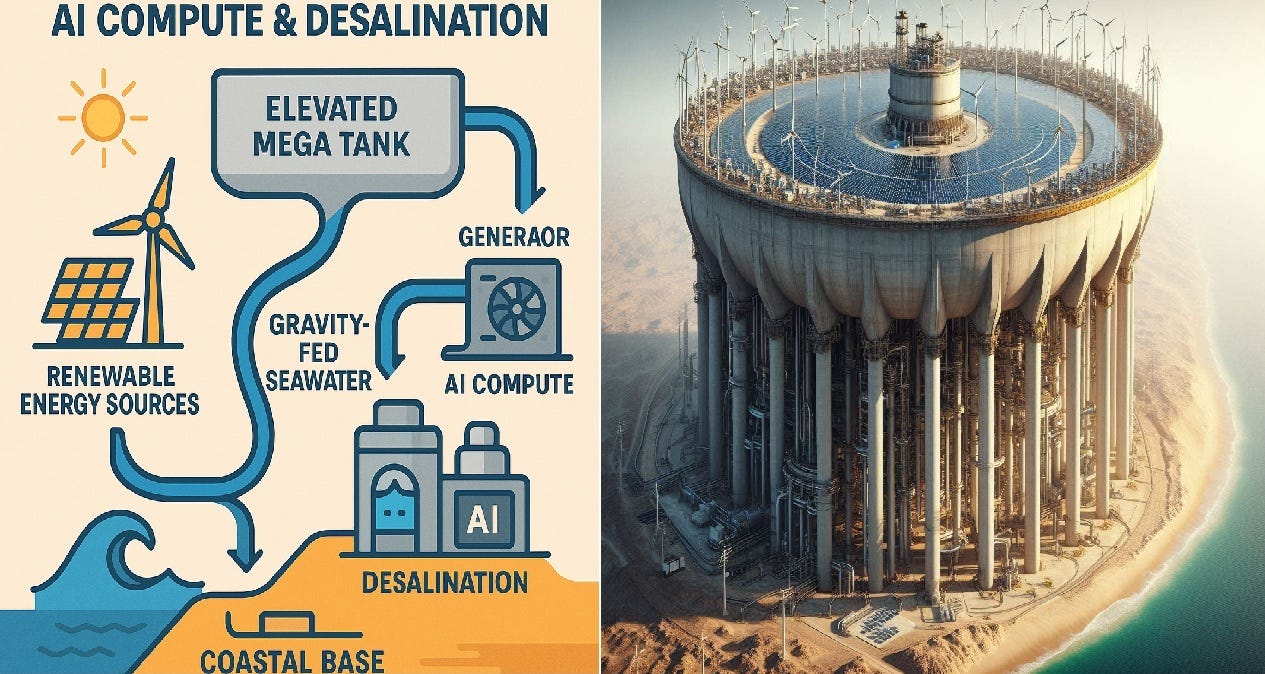
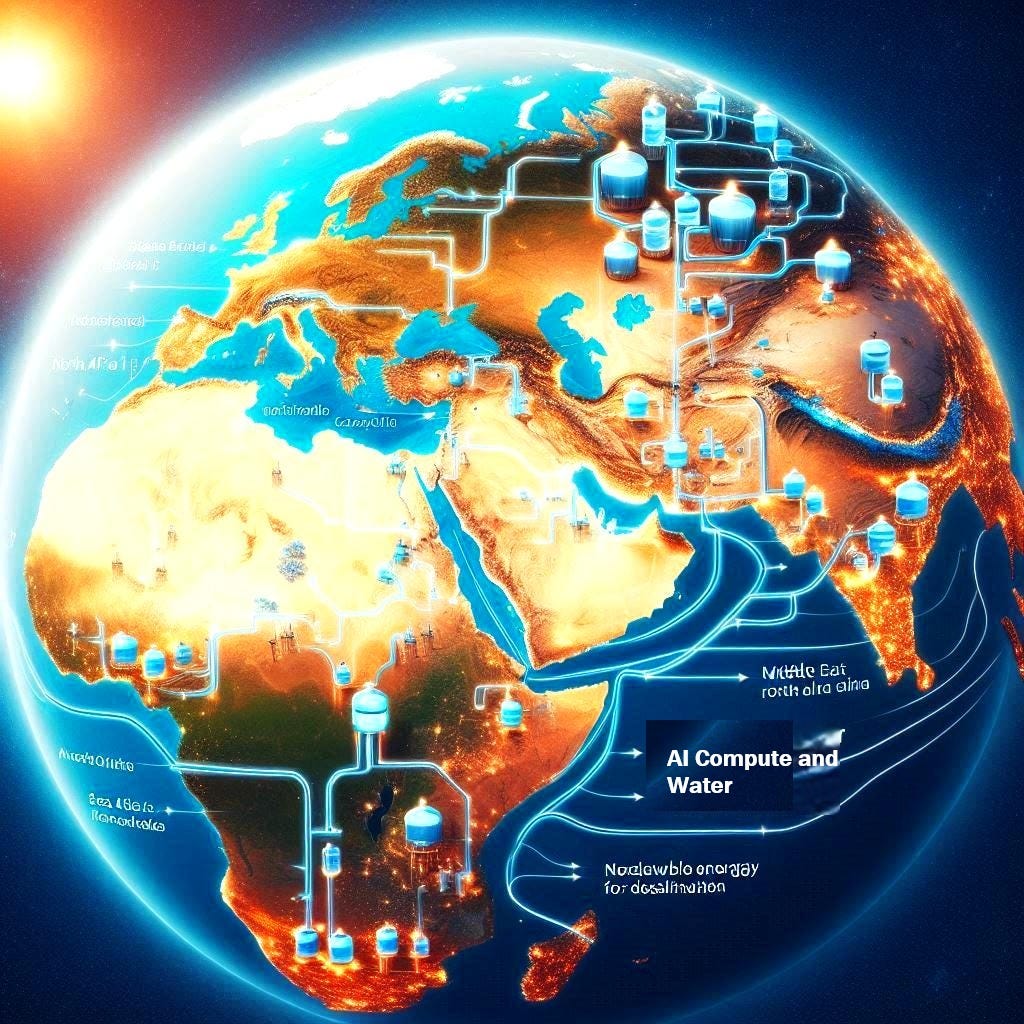
Concept Summary: Global AI compute is on track to outgrow the grid. Desalination remains a last-mile saviour for billions. What if the next mega-infrastructure unicorn is not a chipmaker or a solar farm—it is a gravity-powered AI server farm that makes freshwater as a bonus?
Why Now? The Triggers: Why This Explodes in 2025–2035
What if the next FAANG-style platform participated in the desert and sold power + water + compute as a sovereign service?
Could AI server farms be bundled with desalination as a climate hedge asset class?
What are the ethical trade-offs of building compute meccas in ecologically delicate zones—even if net-zero?
Could “gravity farms” become the Shopify of AI infrastructure: modular, passive, and privately deployable?
Wildcard What if a country built a modular deployable AI server farm with modular megastructure on the coast of a country with sustainable energy Solar, Wind, (future tidal) energy producing electricity , Desalinated water and Salt for stored solar ?
Why coastal deserts:
NIMBY: Mega structure size disrupts sightline and impacts property values in costal residential area
Issues: +ive Access to sea water, -ive Availability of ports , material and construction skills.
Candidates (unevaluated)
1. Atacama Desert – Chile, Peru
2. Namib Desert – Namibia, Angola, South Africa
3. Peruvian Desert (Sechura Desert) – Peru
4. Mojave Desert – USA (California, Nevada)
5. Sonoran Desert – USA (Arizona, California), Mexico
6. Baja California Desert – Mexico
7. Patagonian Desert – Argentina, Chile (semi-coastal in parts)
8. Arabian Desert (Red Sea coastal areas) – Saudi Arabia, Yemen, Oman
Call to Action: What’s your version of a megastructure moon-shot? Reply with your twist, or remix this with your lens. Could your start-up idea plug into this framework?
Regulatory: Water abstraction caps, net-zero mandates, local AI processing laws
Market: Data centre siting logjams, capex-agnostic sovereign funds, energy arbitrage
Social: Decentralized utility governance, STEM rural hubs, water-as-a-service pilots
Appendix 2: Novel Ideas Zone
HydroStack.AI: Stackable, gravity-fed, AI server modules with built-in turbine arrays. Revenue: Compute-as-a-Service. Hook: Zero-carbon data edge with water recycling.
OASYS Vaults: Desert-based sovereign cloud zones with desal export pipelines. Revenue: AI storage + water credits. Hook: New infrastructure currency.
Wildcard Idea: What if AI data centres worked like SimCity blocks—each powered by its own tidal-fed gravity loop, and players upgraded server farms based on clean energy use?
AUTHOR
Steve Adenaike
I am a Business Consultant and Analyst who likes to discuss business ideas and how to implement them. I hope this blog will act as a discussion forum and inspire people to do great thing with their ideas.
Dive deep into the challenges and opportunities across major industrial sectors, discovering how cross-industry repurposing is reshaping traditional boundaries. From agriculture to financial services, uncover novel approaches to innovation that leverage existing solutions in unexpected ways.
This article explains how EntityCraft Studio turns AI agents into personality rich entities. It covers data ingestion, personality synthesis, deployment modes and the platform’s role in the coming era of AI identities.
A deep analysis of the return of phone powered computing, explaining why earlier docking experiments failed and why modern smartphones, cloud workflows, and USB C standards create a real opportunity to replace budget laptops with modular shells.
Discover how to revolutionize water scarcity solutions by becoming a net exporting economy. This comprehensive guide outlines the strategic pathway for creating a renewable-powered desalination economy, analysing profitability, environmental impact, and market potential in regions like the Middle East, North Africa, and China.