Preamble
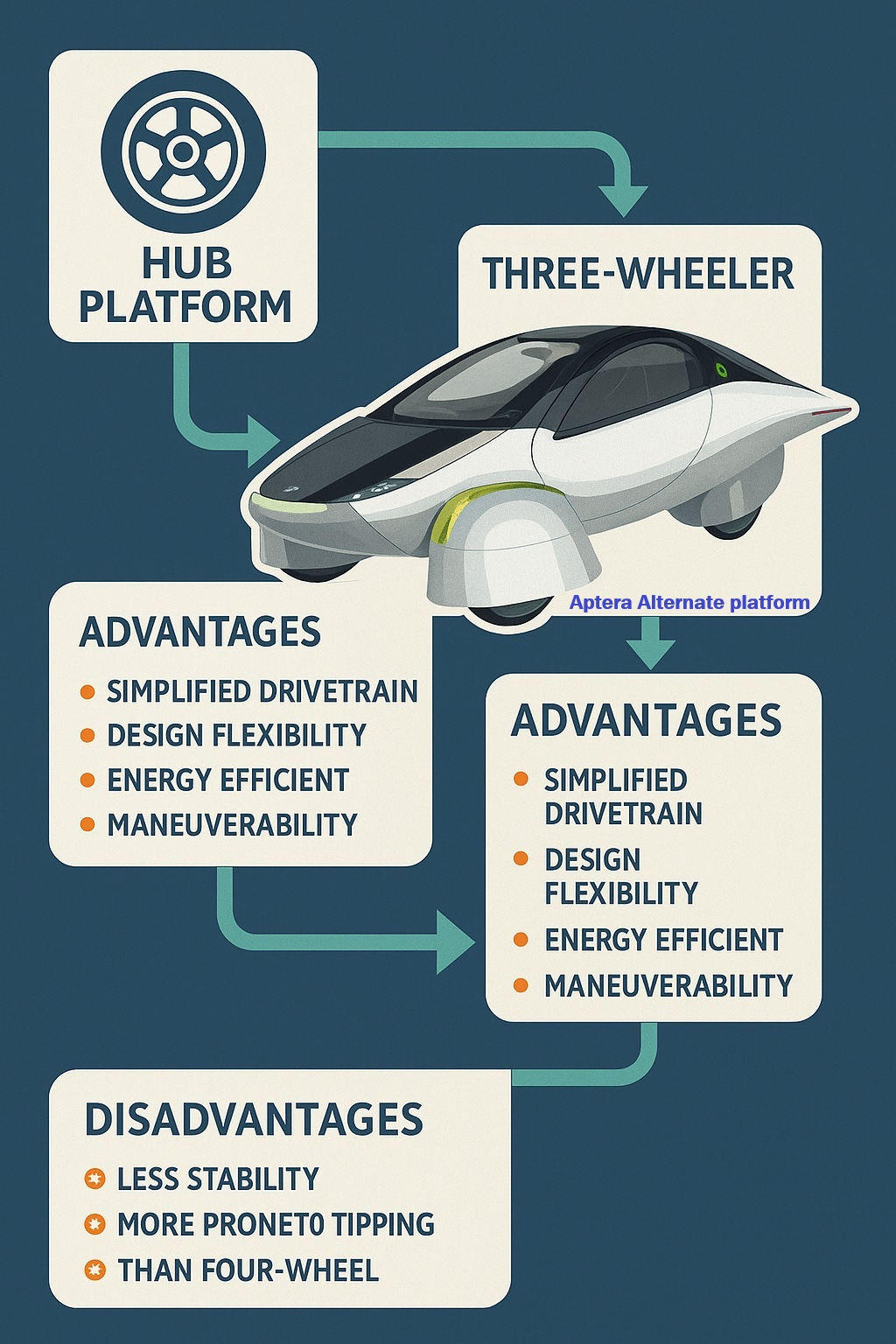
This injects disruptive vehicle architectures and radical engineering models designed to spark new ventures. Each post acts as a catalyst—not a fully fleshed-out plan, but the seed of something bold, timely, and market-aware. I wrote an article called Yuck, for the purist a three-wheeler car! But that car has three wheels and is interesting. And read an article for an electric wheel Hub platform development company called Donutlab and married the two.
Thanks for reading! Subscribe for free to receive new posts and support my work.
Concept Summary
The problem: Urban EVs remain tethered to legacy drivetrain layouts.
The opportunity: What if the future of three-wheeled urban mobility was not built around a central motor—but around wheels that are motors?
What if the next unicorn is not a low-cost city car—it is a direct-drive, hub-motor-powered chassis-as-a-service?
Outline market research: Donutlab and competitor research
Other related research documents: Use case, Proposal , Analysis, etc
Why Now? “The Triggers: Why This Explodes in 2025”
Technology:
- Donut Motors’ ultra-compact, high-torque direct-drive hub motors enable a vehicle with no drivetrain, gearbox, or differential.
- Epicyclic geartrains for in-hub motors now proven in Formula EV contexts.
Regulatory Shifts:
- National EV policies and micro-mobility incentives (India, Nigeria, Kenya, UK, EU).
- 3-wheelers often fall into favourable regulatory categories (e.g., lower taxes, different safety standards).
Market Conditions:
- Urban delivery demand, parking scarcity, ride-share fatigue.
- EV fatigue is real—new formats are needed to spark market excitement.
Social/Cultural Momentum:
- Younger users want sustainable, modular, and weirdly cool vehicles.
- Open-source EV platforms are increasingly seen as viable innovation paths.
Trigger Questions → The Idea Sparks 💥
- What if… the ultimate low-cost city EV was not a car but a 3-wheeler “skateboard” platform with swappable hub-powered wheels?
- Could a vehicle be sold as a rolling API? What if body shells were subscriptions, and only the base (hub motor, battery, chassis) was owned?
- What happens to mechanics when there are no gearboxes, driveshafts, or radiators to fix? What is the new “repair economy”?
- Wildcard: What if IKEA made cars—flat-packed, modular, hub-driven, delivered in a box?
Call to Action 🚀
What is your spin?
- Could this work as an open-source African or Indian EV standard?
- What markets (e.g. gig economy, drone-charging support vehicles, micro-delivery) would benefit most?
Reply with your take or a related build idea!!!
Appendix 1: Expanded “Why Now?”
Technology:
- Donut Motors (3kW–630kW) for various use cases—from scooters to semi-trucks.
- AI torque vectoring, regenerative braking, thermal composites.
Regulatory:
- India’s FAME-II, UK EV grants, EU’s city access zones.
- Regulatory leniency for 3-wheelers vs. 4-wheelers.
Market:
- 3-wheelers dominate urban transport in Asia and Africa.
- High churn rate of small delivery vehicles = opportunity for modular, repairable solutions.
Social:
- Climate anxiety among Gen Z/Millennials = demand for modular, sustainable, minimalist tech.
- Rise of maker culture, open-source vehicle design (e.g. OSVehicle).
Appendix 2: Novel Ideas Zone
Urban Chassis-as-a-Service:
- A standardized 3-wheeler platform with Donut hub motors, open hardware spec.
- Revenue model: leasing to city startups, charging delivery fleets.
- Hook: replace only what breaks—just like a PC.
EV-Ready Boda Platform:
- Asia ,African-targeted 3-wheeler for boda-boda/delivery services.
- Revenue model: local assembly + ride-sharing network.
- Hook: battery swaps + repair hubs = local jobs.
Wildcard Idea:
“What if a 3-wheeler could assemble like a drone?”
Plug-and-play wheels, snap-in battery pack, app-controlled functions.