Preamble
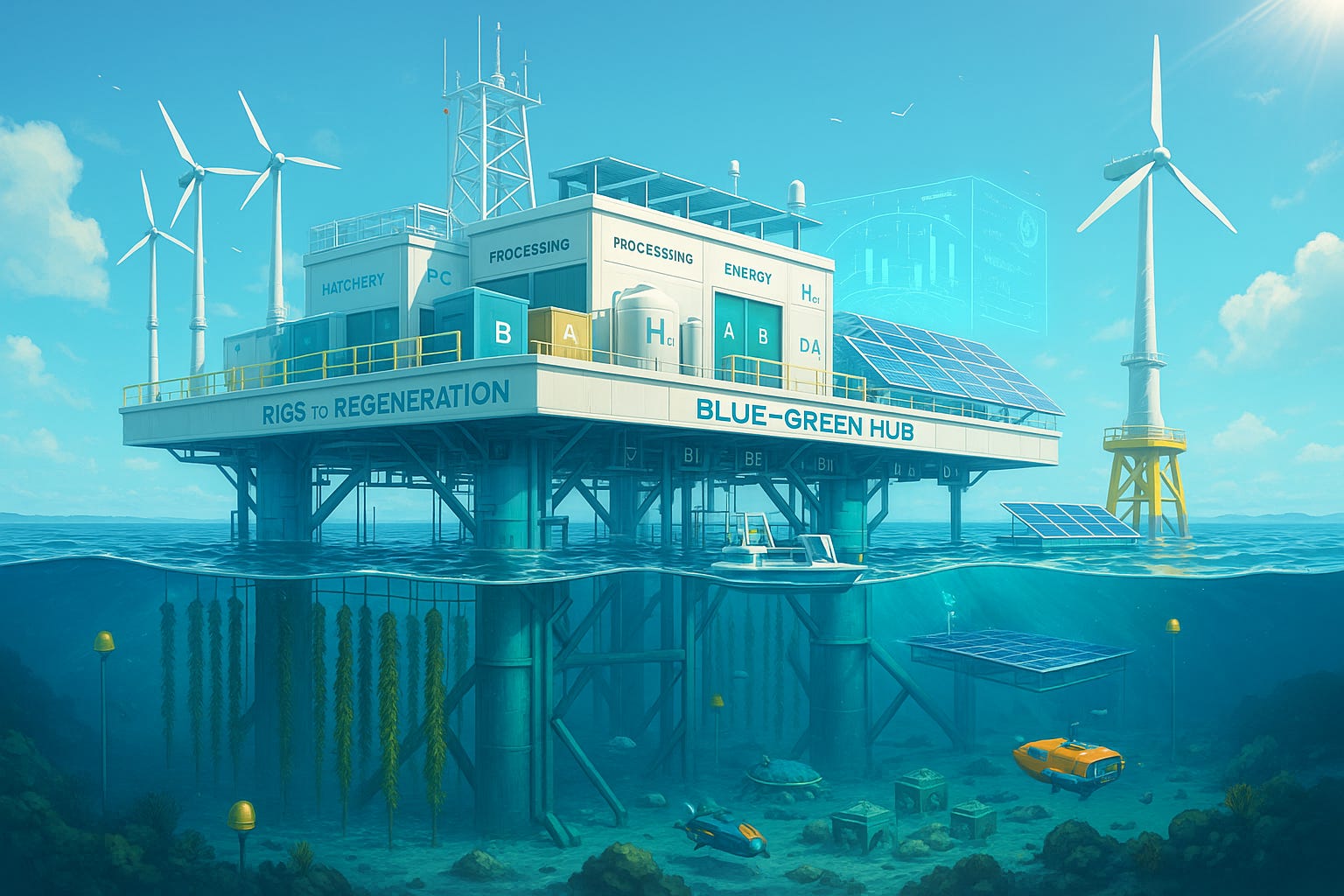
This blueprint shows how to convert idle and decommissioned offshore rigs into working Blue Green hubs that grow food, restore ecosystems, and power operations with renewables. Below the water, lines of kelp and bivalves sit beside reef modules and monitored cleanup plots. On deck, containerized hatchery and processing link to a hybrid microgrid that blends solar, wind, and tidal with battery storage and optional hydrogen. The same platform serves as a live test base for robotics, sensors, and new energy devices. With an estimated 1,500 to 2,000 large disused platforms still standing worldwide, you have a ready canvas with moorings, access, and a clear path to permits. Read the primer that inspired this spec here: https://open.substack.com/pub/cabusinessdesignconsultancy/p/ideas-trigger-10-the-blue-green-economy?r=59m4go&utm_campaign=post&utm_medium=web&showWelcomeOnShare=false.
Blue Green Agricultural Economy on Disused Offshore Rigs
Concept, issues, hardware specification, and site blueprint
1) Purpose and scope
Repurpose disused offshore oil and gas platforms into multi-use “Blue Green” hubs that combine aquaculture, regenerative fishing infrastructure, ecosystem restoration, and environmental cleanup, while hosting modular processing and data systems on the topside. The goal is measurable food and materials output, verified ecosystem services, and safe, compliant reuse of existing marine assets.
2) Context and opportunity
Disused means the rig is idle, abandoned, or moving through decommissioning. Thousands of installations have reached end of life worldwide. A realistic estimate is 1,500 to 2,000 large disused platforms still standing, with big concentrations in the North Sea and the Gulf of Mexico. Many more have already been removed. Some regions run “Rigs to Reefs,” where jackets are left in place to create artificial reefs after topside removal. These sites give you pre-existing moorings, hard substrate, navigation markings, power tie-ins, and access for vessels.
Aquatic production on and around these structures can feed into proven markets. Food ingredients, hydrocolloids, biostimulants, and packaging feedstocks are already scaling, with seaweed market estimates in the tens of billions this decade. Freshwater complements like hydroponics and duckweed add protein and year-round output.
3) Design vision, at a glance
A converted jacket supports three zones:
- Below water. Seaweed longlines on radial frames, bivalve racks, fish aggregation units for stock recovery, and monitored bioremediation plots.
- Waterline and midwater. Sensor buoys, USV docking, ROV launch cage, floating wetlands for nutrient capture, and silt or oil absorbent arrays for cleanup pilots.
- Topside. Modular containers with hatchery and nursery, controlled environment “artificial farm” pods for premium marine crops, power and comms spine, micro-biorefinery for blanching, drying, milling, and simple extractions. The artificial farm pods deliver five times ocean yield potential and year-round cycles for high value outputs.
4) Key issues to resolve up front
- Regulatory pathway. Align with regional decommissioning rules and any rigs-to-reefs options, then secure aquaculture, fisheries, and processing permissions. Build compliance into the design and operations software.
- Structural integrity. Prove jacket stability, corrosion allowance, and topside load capacity for new modules. Add cathodic protection and safe access routes.
- Navigation and safety. Maintain lighting, AIS beacons, guard zones, and emergency plans for crew and contractors.
- Environmental baselines. Measure carbon, nitrogen, biodiversity, and contaminants before intervention, then run an MRV program.
- Biosecurity. Use native species, seasonally aligned calendars, and iodine and contaminant controls for food streams.
- Stakeholder consent. Engage fishers, coastal authorities, insurers, and local councils early. Track consultations and navigation risk reviews.
- Offtake first. Secure two anchor buyers per site, one food or ingredient, one agriculture input, to de-risk cash flow.
5) Functional modules and hardware specification
Below are minimum viable specs you can procure or build against. Values are indicative and can scale by site.
A) Sensing and edge
- Buoy sensor packs. Temperature, salinity, pH, dissolved oxygen, turbidity, chlorophyll or nutrients, current meters, weather. 1 to 5 minute sampling, MQTT telemetry.
- Imaging. HD and stereo cameras on lines and ROVs for growth and fouling detection. Edge compute gateway for video compression and event flags.
- Comms. 4G or 5G maritime where available, LoRaWAN for low bitrate, satellite backup, GPS RTK for survey.
B) Robotics
- USV surveyor. ADCP, CTD, camera mast, route following with collision avoidance, remote takeover for patrols.
- ROV inspector. 4K camera, sonar, manipulator for tags, tethered from a workboat or a rig davit, ROS 2 nodes for control.
- AUV mapper. CTD, fluorometer, optional side scan sonar, waypoint missions with docking or manual recovery.
- Harvest assist. Cutter and lift coordination on droppers with PLC interlocks, e-stops, and light curtains for safety.
C) Farm gear and restoration arrays
- Seaweed frames. Radial longline arms from the jacket, 8 to 20 lines per arm, droppers at 1 to 2 meter spacing, quick-release for storm events. Yields of 75 to 200 tonnes wet per hectare per season in temperate waters are a planning band.
- Bivalve racks. Mussel and oyster baskets on protected faces for water polishing and food output.
- Bioremediation plots. Seaweed or macroalgae chosen for nutrient capture near outfalls, with harvest and safe handling SOPs. Track nitrogen removal and contaminants.
- FADs and habitat. Reef modules attached to the jacket to restore structure and nursery function while respecting navigation clearances.
D) Topside production and processing
- Artificial farm pods. Containerized tanks for controlled marine culture of premium species. Sensor and pump control, zero contamination positioning, year-round cycles, and QC loops for high value outputs.
- Hatchery and nursery. Seed string production for Saccharina latissima and other natives, 4 to 6 week nursery cycle, seed-to-twine QA.
- Processing spine. Dewatering, blanching, drying, milling, freezing, inline spectroscopy for moisture and iodine, batch genealogy and HACCP records.
- Energy. Hybrid system using grid tie where possible or on-rig gensets with battery buffer, optional wind or wave add-ons for auxiliary loads.
- Water handling. Intake screens, filtration, UV, and discharge monitoring that meet permit conditions.
E) Data platform, “AquaOS”
- Pipelines. Kafka or MQTT broker, time series store for sensors, object store for imagery, PostGIS for sites and gear, feature store for ML.
- Models. Growth prediction by species and site, biofouling risk, optimal harvest timing, quality prediction, and logistics planning.
- Apps. Farm Ops for seeding and harvest plans, Hatchery Ops, Processing QA, Sales and offtake, Compliance with permit rules, and an MRV module for carbon and nitrogen.
6) Operations model
- Calendar. In temperate zones, seed in late autumn and harvest in spring to avoid fouling peaks. Use controlled pods to smooth seasonality and serve premium contracts.
- Work routine. Weekly USV patrol and sensor checks, scheduled ROV inspections, seasonal AUV surveys.
- Processing. Stabilize fresh kelp quickly, then blanch, dry, or freeze based on buyer specs. Manage iodine by species and harvest month.
- Offtakes. Food grade cuts and milled ingredients, hydrocolloid feedstock to extractors, biostimulant streams, and materials feedstock to packaging partners.
7) MRV and KPIs
- Productivity. Yield per line and per hectare, survival, and harvest quality. Target 120 tonnes wet per hectare in the base case at pilot scale.
- Economics. Cost per harvested kilogram, uptime, unit margins by product, cash cycle days, contracted volume coverage.
- Ecosystem services. Carbon and nitrogen accounting with transparent factors, biodiversity indicators on reef modules, water clarity trends, and contaminant logs tied to safe handling.
- Compliance. Permit condition checks, navigation notices, EFSA-aligned QA for food.
8) Risk register, with mitigations
- Storm and corrosion. Exposure-appropriate gear, quick-release droppers, sacrificial anodes, scheduled inspections.
- Regulatory delay. Early scoping with seabed managers, permit workflow software, and staged pilots in friendly jurisdictions.
- Market volatility. Diversify products and sign multi-year offtakes across food, agri, and materials.
- Biosecurity. Native species, seasonal calendars, and continuous monitoring to catch issues early.
9) Pilot site blueprint, single rig
Objective. Prove safe multipurpose reuse and unit economics within 12 months, then scale to a small cluster.
Layout.
- 4 radial seaweed frames on the jacket, 15 droppers each.
- 2 bivalve racks on leeward faces.
- 1 restoration and bioremediation plot near a nutrient source.
- Topside: 6 containerized modules for nursery, processing, artificial farm pods, power, comms, and storage.
- Robotics: 1 USV, 1 ROV, seasonal AUV charter.
Throughput targets.
- Seaweed wet biomass 150 to 300 tonnes per season across frames.
- Biostimulant pilot line, 250 to 500 tonnes wet equivalent per year.
- Verified nitrogen removal where site conditions allow.
12-month plan.
- Months 0 to 3, structural survey, permit scoping, buyer MOUs, hatchery run.
- Months 3 to 6, install frames, sensors, and processing spine, seed lines.
- Months 6 to 9, routine patrols, QC, offtake logistics, data model training.
- Months 9 to 12, harvest, MRV reporting, EBITDA assessment, scale decision.
10) People and governance
- Core crew. Site lead, hatchery tech, processing lead, ROV pilot, data technician, HSE officer.
- Governance. Role-based access, audit logs, and data lineage in the platform, with incident playbooks and key rotation.
11) What it looks like
From sea level, you see a marked platform with clean lines, solar on rails, a wind microturbine, and container modules. Below, longlines radiate like spokes with kelp forests, interspersed with bivalve racks and reef blocks. A small USV glides patterned transects. An ROV inspects lines and tags wear points. The control room shows a digital twin of the rig, with biomass forecasts, weather windows, and harvest plans. The processing bay runs blanching and drying with inline spectroscopy and batch traceability. The dashboard rolls up yields, QA, delivery windows, and MRV results in one place.
12) Expansion path
- Cluster scale. Link three to five rigs into a network. Share processing at one hub.
- Freshwater sidecar. Add a duckweed and azolla module at a nearby harbor site to supply protein meal and balance seasonality.
- Licensing. Offer the AquaOS stack and robotics playbooks to partners once the pilot shows repeatable KPIs.
Appendices
Addendum, integrated renewables and testbed on disused rigs
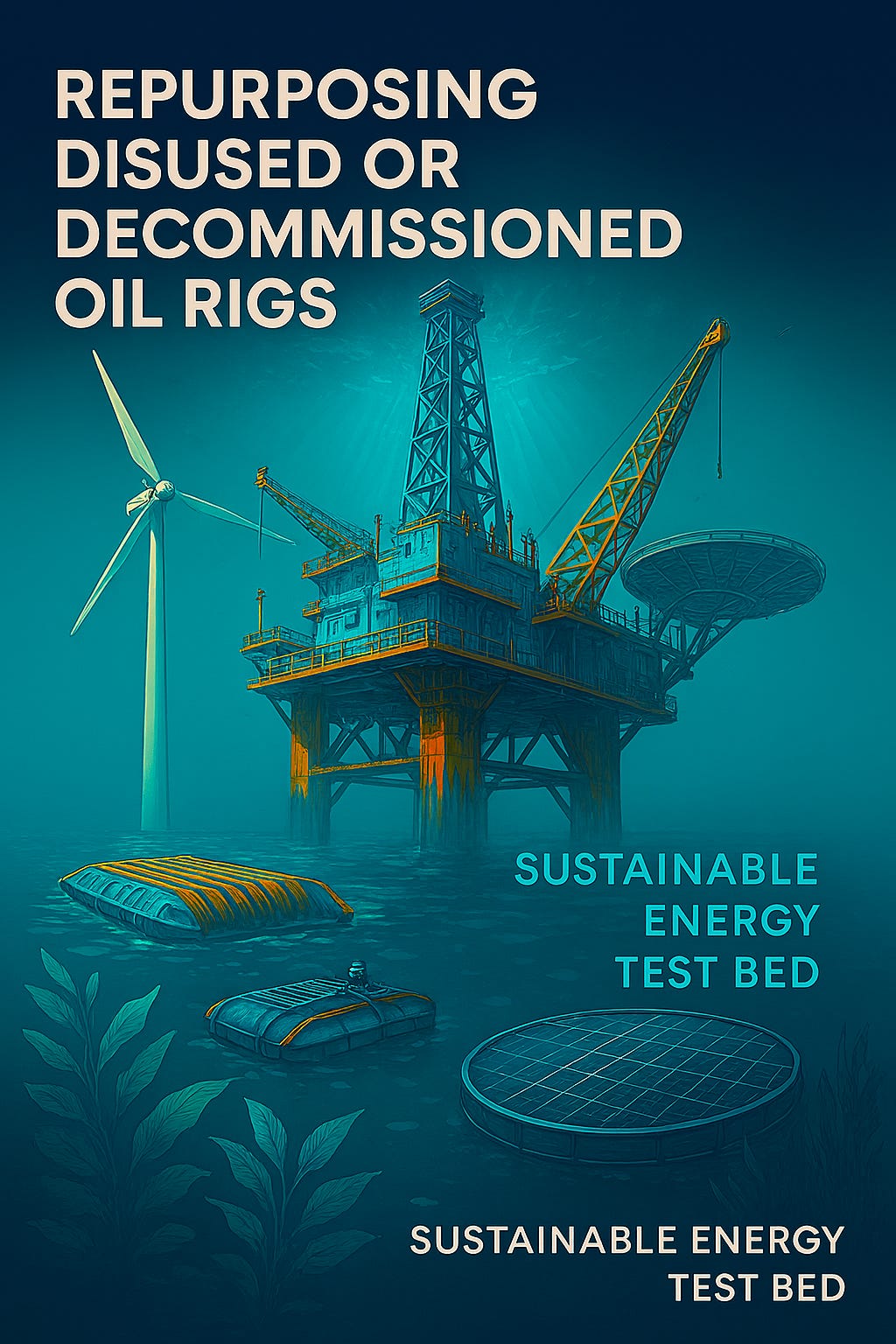
This builds on the rig reuse spec. You get a clean microgrid that mixes solar, wind, and tidal, plus a live test range for new technology. It powers farming, processing, robotics, and monitoring, then opens revenue from pilots, certifications, and data.
1) Energy vision at a glance
- Put a hybrid microgrid on the topside.
- Mount PV on railings, walkways, and container roofs. Add a floating PV skirt if seas allow.
- Attach small wind on the structure, and place one medium turbine on an auxiliary jacket or nearby monopile where loads permit.
- Mount tidal stream units on braced frames at leg bases or on seafloor tripods in the rig safety zone.
- Use a DC backbone with hybrid inverters, a battery, and optional green hydrogen for long storage.
- Feed heat pumps and low temperature dryers to cut processing energy use.
2) Target loads, quick sizing
Adjust these to your site and product mix.
- Hatchery and nursery, 10 to 40 kW continuous.
- Pumps, UV, and water handling, 20 to 60 kW.
- Sensors, IT, and comms, 2 to 10 kW.
- Robotics charging and deck gear, 10 to 50 kW.
- Cold storage and ice, 10 to 30 kW.
- Drying example, 10 tonnes wet kelp to 15 percent moisture per day with a heat pump dryer. Electrical energy about 1.4 to 1.9 MWh per day, depending on COP.
- Typical pilot site peak, 250 to 500 kW. Typical daily use, 3 to 6 MWh.
3) Microgrid architecture and interfaces
- Backbone. 800 V DC bus, 50 Hz AC distribution for legacy loads.
- Inverters. 2 to 4 hybrid units, each 125 to 250 kW. Grid-forming, black start capable, island and grid-parallel modes.
- Battery. 2 to 4 MWh LFP, 0.5 to 1 MW charge and discharge. 2 hour minimum at rated power. Fire-safe enclosure plus gas detection.
- Hydrogen option. 100 kW electrolyzer, 200 kg storage at safe pressure in certified tanks, 100 kW fuel cell for long backup and peak shaving.
- Heat. Heat pump loop for dryers and space heat. Glycol circuit, plate exchangers, and thermal store.
- Controls. EMS with priorities by safety, cold chain, hatchery, then processing. Curtailment rules for storms.
4) Generation blocks you can mix and match
- Solar PV
- 250 to 750 kW on deck and containers at 15 to 20 percent coverage, non glare glass near helidecks.
- Optional floating PV raft, 200 to 500 kW with wave barriers.
- Rapid shutdown and salt fog rated connectors.
- Wind
- On structure, 5 to 20 kW vertical axis pairs for low maintenance.
- Near rig, one 200 to 500 kW horizontal axis turbine on a dedicated support if clearances and loads allow.
- Vibration and fatigue sensors on tie points. Lightning and surge protection throughout.
- Tidal stream
- 2 to 6 units at 50 to 250 kW each, ducted or kite style, mounted to leg frames or seabed tripods.
- Quick lift mechanisms for service. Fish friendly rotor design and acoustic monitoring.
- Wave add on
- Small point absorbers at bracing nodes, 10 to 50 kW total, for test purposes and trickle charging.
5) Testbed, how it runs
You turn the rig into a certified proving ground.
- Zones. Mark deck bays and seabed footprints as Test Zone A to D with clear cable routes and lift points.
- Power and data. Standardized DC and AC taps, Ethernet and fiber spurs, seabed wet-mate connectors, and timing via GPS.
- Measurement. Class grade torque meters, flow meters, vibration, power quality, and high speed weather.
- Safety. Lockout tagout, e-stop loops, exclusion arcs for blades and kites, and dynamic risk displays.
- Process. 90 day test windows, witnessed runs, shared data formats, and reports that help vendors certify devices faster.
- Commercials. Charge a berth fee, sell data services, and take success fees on devices that convert to orders.
6) Novel opportunities this unlocks
Energy and fuels
- Green hydrogen and oxygen. Use curtailment to run the electrolyzer. Sell oxygen to hatchery and nearby aquaculture.
- Low carbon heat. Heat pump dryers slash kWh per tonne. Waste heat warms nursery tanks.
- Ammonia or methanol pilots. Small synthesis units for research, not fuel bunkering.
- Vessel charging. Fast DC for USVs and hybrid crew boats at scheduled windows.
- Grid services. If a cable exists, offer frequency response and reserve during low farming activity.
Aquaculture and processing
- Year round premium crops in artificial farm pods powered by the microgrid.
- Onsite biorefining for food cuts, hydrocolloid feedstock, and biostimulants.
- Rapid QA with inline spectroscopy, moisture, and iodine checks that sync to lot IDs.
- Biofouling trials for new coatings, materials, and cleaning robots.
Ecosystem and cleanup
- Tidal and jacket reefing with structured habitat modules and eDNA baselines.
- Nutrient removal credits verified with sensors and harvest records.
- Oil absorbent pilots using bio-based sorbents around legacy seep points where allowed.
- Acoustic listening posts for marine life and vessel noise.
- Carbon MRV for seaweed growth and bivalve filtration using open methods.
Communications and autonomy
- Subsea charging and data nodes that let ROVs and AUVs dock and upload.
- Acoustic and optical comms comparisons in real sea states.
- 5G maritime trials for cameras and control links.
- Digital twin that unifies energy, farm gear, weather, and compliance in one live model.
Markets and finance
- Power purchase agreements for research power and for nearby users when export exists.
- Device leasing. You host early fleets of tidal or wave units and take a clip of output.
- Data as a product. Sell anonymized time series for model training and design.
- Insurance products that price risk with your measured availability and failure rates.
7) Bill of materials, pilot scale
- PV 400 kW, marine rated racking and inverters.
- Wind 2 x 10 kW VAWT on structure, 1 x 300 kW HAWT on auxiliary support where feasible.
- Tidal 2 x 150 kW stream units with lift frames.
- Battery 3 MWh LFP, 1 MW PCS.
- Electrolyzer 100 kW, 200 kg storage, 100 kW fuel cell.
- Heat pumps 600 to 900 kW thermal across dryers and HVAC.
- Hybrid inverters 3 x 200 kVA, switchgear, EMS, SCADA, and protection.
- Wet-mate connectors, seabed cables, davits, and a service crane upgrade.
8) Control strategy
- Prioritize life safety, cold chain, and hatchery loads.
- Forecast wind, sun, and tides to plan harvest and drying windows.
- Push excess to hydrogen after the battery reaches 80 percent.
- Shed non critical loads when forecasts dip.
- Use a rolling 7 day plan that shows energy, farm tasks, and weather windows on one screen.
9) KPIs you track
- Energy, MWh per day by source, curtailment hours, and round trip battery efficiency.
- Cost per tonne dried, kWh per kilogram of water removed, and dryer uptime.
- Testbed device availability, failures, and mean time to service.
- Biodiversity and water quality trends on reef and tidal footprints.
- Incident free days and near miss closeouts.
10) Risks and mitigations
- Fatigue on tie points. Add strain gauges and inspect on a fixed cycle.
- Blade or rotor hazards. Maintain exclusion zones and remote shutdowns.
- Biofouling on turbines. Plan cleaning cycles and coatings trials.
- Power quality. Keep harmonics within limits and set fast ride through.
- Weather. Pre storm mode drops lines, locks devices, and sets safe headings for USVs.
11) What it looks like
From above you see PV sheets on rails, a small wind row, and one larger turbine off the starboard side. A floating PV raft sits in the lee when seas are calm. Tidal units sit on frames at two legs with quick lift towers. Inside the control container, the dashboard shows power flow, state of charge, hydrogen status, and scheduled test runs next to the farm plan. The deck has marked test bays with standard connectors and load-rated lift points. Below water, kelp frames sit clear of tidal devices. ROVs dock at a subsea node to recharge between inspections.
12) How to start
- Run a three month resource and load study.
- Fit 200 kW PV, 1 MWh battery, and one 100 kW tidal unit first.
- Convert one dryer to heat pump.
- Open two test bays and publish data schemas.
- Add the larger wind and electrolyzer after six months if performance hits targets.