Preamble:
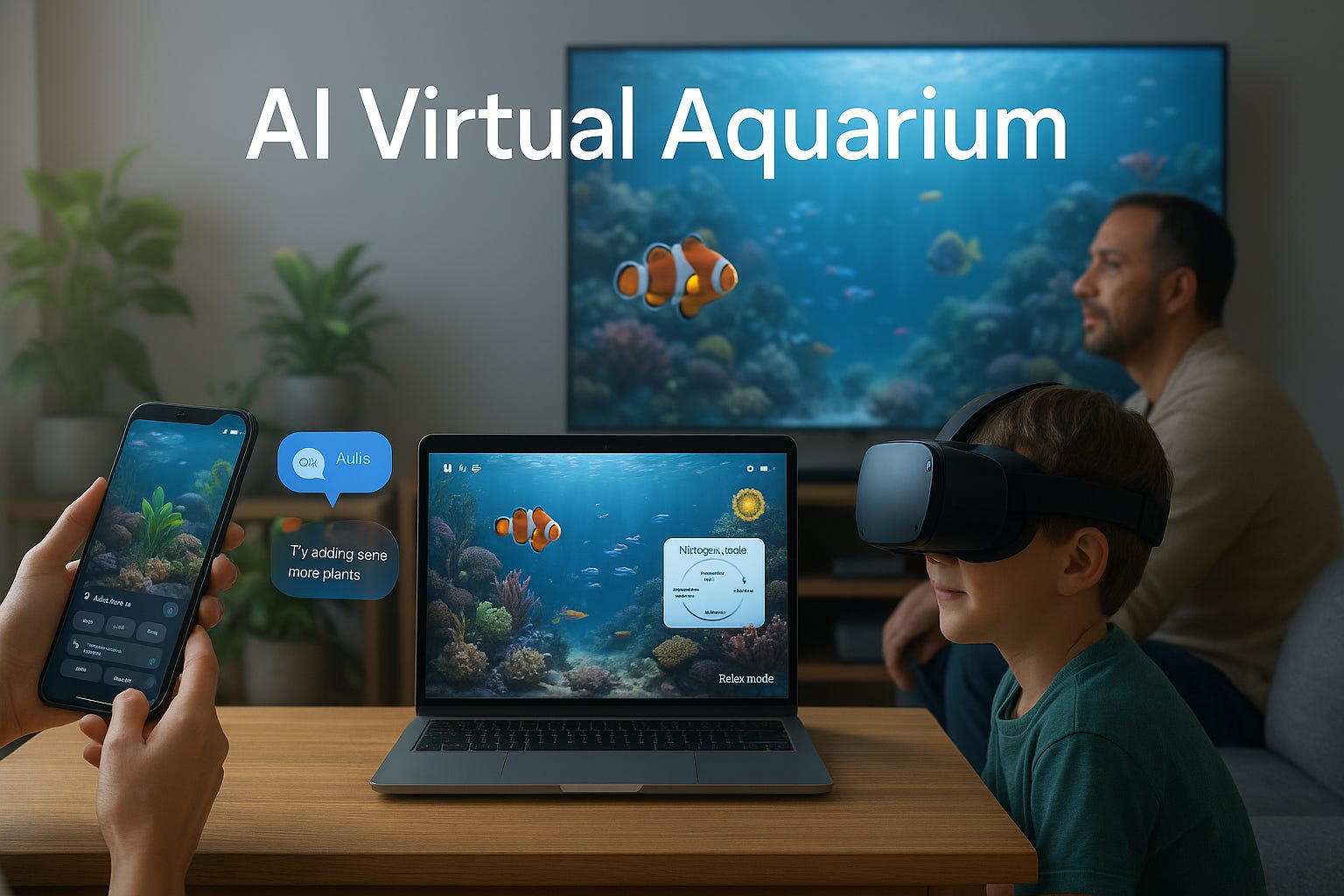
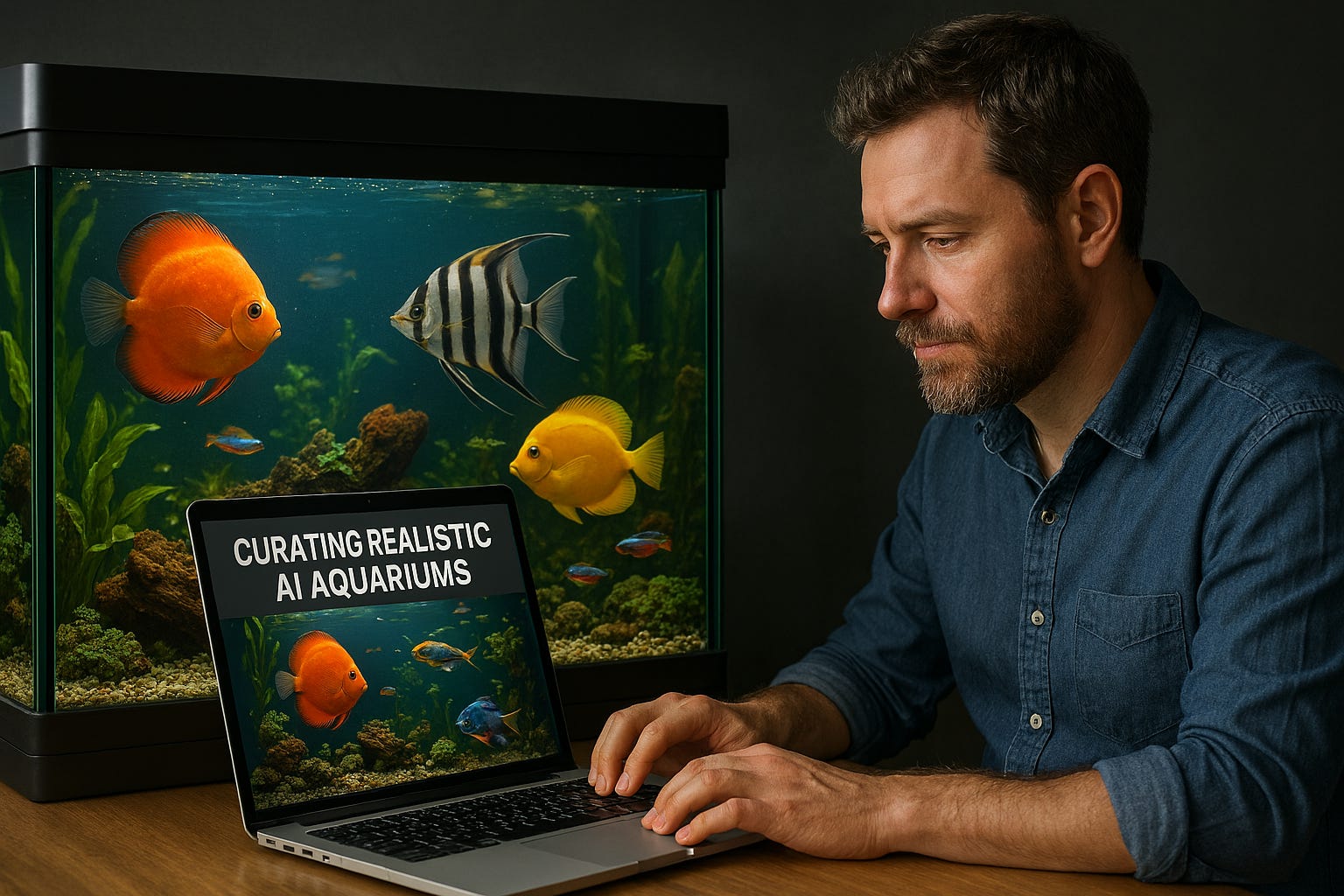
You are building a photorealistic virtual aquarium that runs on mobile, web, VR, and more. Users create tanks, learn biology, and relax. Creators publish fish, habitats, lessons, and stories, with clear revenue paths. The platform combines an AI behaviour engine, an education hub, and a creator marketplace that scales high quality content. This mix lowers barriers to aquarium keeping and adds real learning value. It also gives schools and families measurable outcomes that standard games cannot provide.
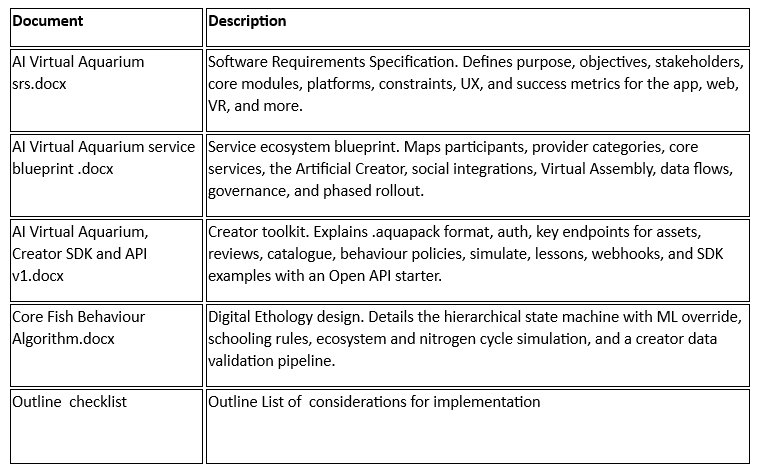
This analysis positions the AI virtual aquarium as a convergence play in gaming, education, and wellness, with clear paths to validation and scale. As usual my stuff that enables you to build it : SRS , Service and User Ecosystem , Algorithms
AI Virtual Aquarium: Business Analysis & Development Plan
1. Core Problem & Solution
Problem: Traditional aquarium keeping has high barriers (cost, maintenance, expertise, space) while digital pet experiences lack realism and educational depth.
Solution: AI-powered photorealistic virtual aquarium with authentic fish behavior, cross-platform compatibility, and educational integration.
Beneficiaries:
- Aquarium enthusiasts seeking low-maintenance alternatives
- Children learning about marine biology
- Educators teaching aquatic ecosystems
- Wellness-focused individuals seeking calming digital environments
Why Now:
- AI can generate photorealistic visuals and complex behavioral models
- Cross-device ecosystems enable seamless experiences
- Growing market for digital wellness and educational gaming
- Real-time fish behavior data increasingly available
2. Stakeholders
Key Actors:
- Primary Users: Hobby aquarists, families with children, educational institutions
- Content Creators: 3D artists, marine biologists, behavioral scientists
- Platform Partners: App stores, gaming platforms, educational publishers
- Hardware Partners: VR/AR device manufacturers, smart TV makers
Incentive Mapping:
- Users: Low-cost, authentic aquarium experience
- Content creators: Revenue from fish/environment assets
- Educators: Engaging teaching tools
- Platform partners: Premium app revenue sharing
Likely Blockers:
- Compute-intensive AI rendering
- Limited consumer AR/VR adoption
- Competition from established gaming companies
- Regulatory concerns around microtransactions for minors
3. People, Process, Technology
Key Roles:
- AI/ML Engineers (fish behavior modeling, procedural generation)
- 3D Artists & Animators (photorealistic fish assets)
- Marine Biologists (behavioral accuracy consultation)
- UX/UI Designers (cross-platform experience)
- Platform Engineers (cloud/edge computing architecture)
Operating Workflows:
- Fish behavior research → AI model training
- 3D asset creation → behavior integration → testing
- User acquisition → engagement analytics → content optimization
- Educational partnerships → curriculum integration
Enabling Technologies:
- Real-time ray tracing for photorealism
- Edge computing for responsive AI behavior
- Computer vision for fish movement capture
- Cross-platform development frameworks
4. Product & Data Model
Core Modules:
- Fish Marketplace: Purchase/collect virtual fish species
- Aquarium Builder: Customize tanks, backgrounds, equipment
- Behavior Engine: AI-driven fish interactions and ecosystem simulation
- Education Hub: Species information, care guides, biology lessons
- Social Features: Share aquariums, trade fish, community challenges
Must-Have Datasets:
- Fish species database (appearance, behavior, compatibility)
- Real aquarium footage for AI training
- Water chemistry and environmental parameters
- User interaction patterns and preferences
Key Events & Decision Points:
- Fish purchase/acquisition triggers
- Health/compatibility warnings
- Achievement unlocks and progression gates
- Educational milestone completions
5. Market Analysis
Market Segments:
- Primary: Digital pet/simulation gaming ($2.3B market)
- Secondary: Educational software ($8.2B market)
- Tertiary: Wellness/relaxation apps ($1.2B market)
Buyer Personas:
- “Digital Aquarist”: Adults who want aquarium experience without maintenance
- “Learning Parent”: Parents seeking educational entertainment for children
- “Wellness Seeker”: Individuals using apps for stress relief and mindfulness
Demand Drivers:
- Urban living constraints on pet ownership
- Growing interest in marine conservation
- Increased screen time seeking meaningful digital experiences
Substitutes & Competitors:
- Traditional aquarium keeping
- Generic digital pet apps (Tamagotchi-style)
- Nature documentaries and YouTube aquarium videos
- Meditation/ambient sound apps
6. Business Model
Revenue Streams:
- Freemium App: Basic fish/tanks free, premium species/features paid
- Fish Marketplace: Individual fish purchases ($0.99-$9.99)
- Premium Subscriptions: Advanced features, unlimited fish ($9.99/month)
- Educational Licensing: Schools/institutions bulk licensing
- Brand Partnerships: Real aquarium equipment/fish store integrations
Cost Drivers:
- AI model training and inference costs
- 3D asset creation and licensing
- Cloud computing and storage
- Customer acquisition costs
Unit Economics:
- Target: $15 average revenue per user (ARPU) annually
- 30% conversion from free to paid users
- $5 customer acquisition cost target
7. Go-to-Market
Market Entry Wedge: Start with enthusiast aquarium community through specialized forums and social media.
Channels:
- App stores (iOS/Android primary launch)
- Aquarium hobby websites and forums
- Educational technology distributors
- Wellness app marketplaces
Lighthouse Customers:
- Aquarium societies and clubs
- Elementary schools with science programs
- Senior living communities (digital wellness)
Proof Milestones:
- 10,000 downloads in first month
- 15% conversion to paid features
- 70%+ user retention after 30 days
- Educational pilot program completion
8. Risks & Legal
Key Risks:
- Technical: AI rendering performance on mobile devices
- Market: Established gaming companies entering space
- Legal: App store policies on virtual purchases
- Operational: Content creation scaling challenges
Mitigations:
- Progressive AI quality based on device capability
- Focus on educational differentiation vs. pure gaming
- Clear parental controls and purchase transparency
- Marketplace model for user-generated content
Standard Terms:
- Educational institution bulk licensing agreements
- Content creator revenue-sharing agreements
- Platform partnership terms
- Age-appropriate use policies
9. KPIs & Feedback Loops
Metric Tree:
- Acquisition: Downloads, conversion rate, CAC
- Engagement: Daily/monthly active users, session length
- Retention: 7-day, 30-day, 90-day retention rates
- Monetization: ARPU, lifetime value, purchase frequency
- Quality: App store ratings, bug reports, educational efficacy
Action-Informing Metrics:
- Low engagement → Improve fish behavior realism
- High churn → Simplify onboarding flow
- Low conversion → Adjust freemium feature balance
10. Roadmap
90-Day Pilot:
- MVP with 5 fish species and 3 tank environments
- iOS launch with freemium model
- Basic AI behavior and feeding mechanics
- 1,000 user beta test with aquarium community
12-Month Build:
- Android launch with cross-platform sync
- 50+ fish species with full ecosystem simulation
- Educational partnerships with 10 schools
- AR viewing mode for supported devices
- Social features and fish trading
Expansion Triggers:
- 100K active users → International markets
- $500K monthly revenue → VR platform development
- Educational traction → Full curriculum integration
- Technical maturity → Other pet categories (birds, reptiles)
11. Process to Exploit This Opportunity
Phase 1: Validation (Months 1-3)
- Build interactive prototype with 3 fish species
- Test with 100 target users for feedback
- Validate willingness to pay through pre-orders
- Secure initial funding ($250K seed round)
Phase 2: Development (Months 4-9)
- Hire core team (5-7 people)
- Develop AI behavior engine and rendering pipeline
- Create initial fish asset library
- Build cross-platform mobile application
Phase 3: Launch (Months 10-12)
- Soft launch with aquarium community
- Iterate based on user feedback
- Full app store launch with marketing campaign
- Establish educational partnerships
Component Analysis:
- AI Behavior Engine: Most technically complex, highest differentiation
- 3D Asset Pipeline: Scalable through marketplace model
- Educational Integration: Lower complexity, high value for certain segments
- Cross-Platform Sync: Table stakes for user retention
12. Speculative Futures
Bold Extensions (5-7 Year Horizon):
- Ocean Conservation Integration: Partner with marine research organizations to create digital twins of endangered reef ecosystems, with user actions contributing to real-world conservation efforts.
- Biometric Wellness Platform: Integration with wearables to adjust aquarium ambiance based on stress levels, heart rate, and sleep patterns for therapeutic applications.
- Mixed Reality Aquariums: Full AR integration allowing virtual fish to “swim” in real physical spaces, creating impossible aquarium configurations in homes and offices.
- AI-Generated Species: Machine learning creates entirely new fish species based on evolutionary principles, allowing users to participate in simulated speciation experiments.
- Quantum Behavior Simulation: Ultra-realistic ecosystem modeling using quantum computing to simulate complex predator-prey relationships and environmental changes.
- Neural Interface Control: Direct brain-computer interface allowing users to “swim” with their fish or experience the aquarium from a fish’s perspective.
- Global Ecosystem Network: Connected virtual aquariums worldwide that form a massive multiplayer marine ecosystem, with climate change and human impact simulations affecting all users.
13. Open Questions
Critical Unknowns for Fast Testing:
- User Willingness to Pay: Will users pay premium prices for realistic fish vs. cartoon alternatives? Test: A/B test pricing tiers with different realism levels
- Device Performance Thresholds: What’s the minimum device spec for acceptable AI-driven behavior? Test: Performance benchmarking across device categories
- Educational Efficacy: Does the app actually improve marine biology learning outcomes? Test: Controlled study with classroom integration
- Behavioral Model Accuracy: How complex must fish AI be before users notice improvement? Test: Progressive complexity testing with user perception surveys
- Cross-Platform Engagement: Do users engage differently on mobile vs. desktop vs. VR? Test: Multi-platform usage analytics and user interviews
- Content Creation Scalability: Can user-generated content maintain quality standards? Test: Creator tool beta with moderation workflow
- Monetization Model Optimization: Subscription vs. one-time purchases vs. microtransactions? Test: Revenue model experiments with cohort tracking
- Age Demographic Appeal: What age groups find this most engaging long-term? Test: Multi-demographic user acquisition and retention analysis
- Social Feature Value: Do sharing and trading features drive retention? Test: Feature flag testing of social vs. solo experiences
- Real Aquarium Industry Integration: Will physical aquarium stores/manufacturers want to partner? Test: Direct outreach and partnership pilot programs
Conclusion:
Focus the ecosystem on three loops, creation, learning, and sharing. Ship AI assisted building to guide tank setup and compatibility, ship the education hub with badges and teacher dashboards, and ship shareable scenes sized for social video. Open the marketplace to vetted creators, add moderation, and track realism and learning impact as core KPIs. This sequence turns your aquarium into a living platform that grows with every user and partner you add.