Preamble:
Most teams use Business Analysts for workshops, tickets, and translations between business and tech. That leaves a lot of value on the table. This piece reframes the BA as a strategic partner who builds institutional memory, drives discovery, improves change outcomes, and cuts tool waste. You will see a clear path from core delivery to roles like internal entrepreneur, change analyst, knowledge steward, and business architect. The result is faster onboarding, less rework, lower consulting spend, and a steady pipeline of validated opportunities.
Executive Summary
Business Analysts are among your most underutilized strategic assets. While organizations employ them to document requirements and liaise between stakeholders, these professionals accumulate something far more valuable: a comprehensive mental map of your business its capabilities, failures, cultural dynamics, and untapped opportunities. Yet most firms squander this asset by confining BAs to tactical “water-carrier” roles, losing institutional knowledge with each project closure and contractor departure.
This article presents a strategic framework for transforming the BA function from a delivery-focused service into a value-creation engine. By expanding the BA remit across seven critical domains from internal entrepreneurship to business architecture organizations can achieve 30-50% productivity improvements, reduce consultant dependency, accelerate innovation, and build resilient institutional memory.
The Crisis of Underutilization
The Walking Encyclopaedia You’re Ignoring
Imagine an employee who possesses a detailed mental map of your entire value chain. They understand which initiatives succeeded and which failed and more importantly, the unspoken cultural and systemic reasons why. They have engaged with stakeholders across every level, from C-suite executives to external consultants. They have indexed pain points, capability gaps, strategic pivots, and organizational behaviours across multiple business units.
This person is your experienced Business Analyst.
Yet in most organizations, this strategic asset is relegated to narrow intermediary work: capturing requirements, scheduling workshops, and translating between technical and business teams. When the project ends, particularly if the BA is a contractor, this treasure trove of institutional knowledge walks out the door.
The Tangible Costs of the Status Quo
The consequences of BA underutilization are measurable and significant:
Knowledge Loss and Rework
When BAs leave or rotate off projects, their tacit understanding of stakeholder dynamics, decision rationale, and system context evaporates. New team members restart from scratch, repeating interviews, rediscovering constraints, and often recreating the same mistakes their predecessors already encountered.
Requirements Drift
Without dedicated ownership of traceability, requirements get captured but never maintained. Acceptance criteria remain vague, measurable outcomes disappear, and delivery teams build features that no longer align with evolved business needs. The result: expensive rework cycles and stakeholder frustration.
Tool Proliferation Without Governance
Across the typical enterprise, software tools multiply organically. Licenses accumulate, ownership becomes unclear, and usage data remains unmeasured. Organizations pay for redundant systems while lacking critical capabilities all because no one has systematic oversight of the tooling landscape.
Broken Repositories and Slow Onboarding
Projects launch with good intentions to maintain documentation repositories. But without dedicated stewardship, these repositories decay. New joiners face fragmented wikis, outdated diagrams, and missing context. What should take days takes weeks; what should take weeks takes months.
Missed Innovation Opportunities
BAs observe patterns across projects that others cannot see. They notice recurring customer pain points, spot capability gaps, and identify opportunities for new products or services. Yet rarely are they asked to synthesize these observations into actionable business opportunities.
Root Causes: Why Organizations Fail to Leverage BA Potential
Understanding why BA underutilization persists requires examining several systemic factors:
The Contractor Paradigm
Many organizations hire BAs on short-term contracts to meet specific project needs. This approach treats BAs as interchangeable resources rather than knowledge workers whose value compounds over time. Each contractor departure represents a permanent loss of institutional memory, stakeholder relationships, and contextual understanding that cannot be easily replaced.
Siloed Organizational Structures
When BAs are embedded within isolated project teams or business units, their cross-functional perspective gets trapped within narrow boundaries. Information, insights, and learnings remain localized rather than flowing across the organization. The BA who understands both finance operations and customer experience never gets the opportunity to connect the dots between them.
Absence of Career Progression Beyond Delivery
In most organizations, the BA career path offers limited upward mobility. Senior BAs face a choice: remain in delivery roles indefinitely or exit the profession entirely. There is rarely a recognized pathway to strategic positions where their accumulated wisdom can shape organizational direction. This creates a retention problem and signals that BA expertise is not truly valued.
Cultural Misperception of the Role
The fundamental issue is perceptual. BAs are viewed as service providers helpful facilitators who support “real” strategic work done by others. This framing prevents organizations from recognizing BAs as strategic thinkers capable of leading innovation, driving transformation, and designing business architecture.
The Strategic Pivot: Seven Expanded Roles for the Modern BA
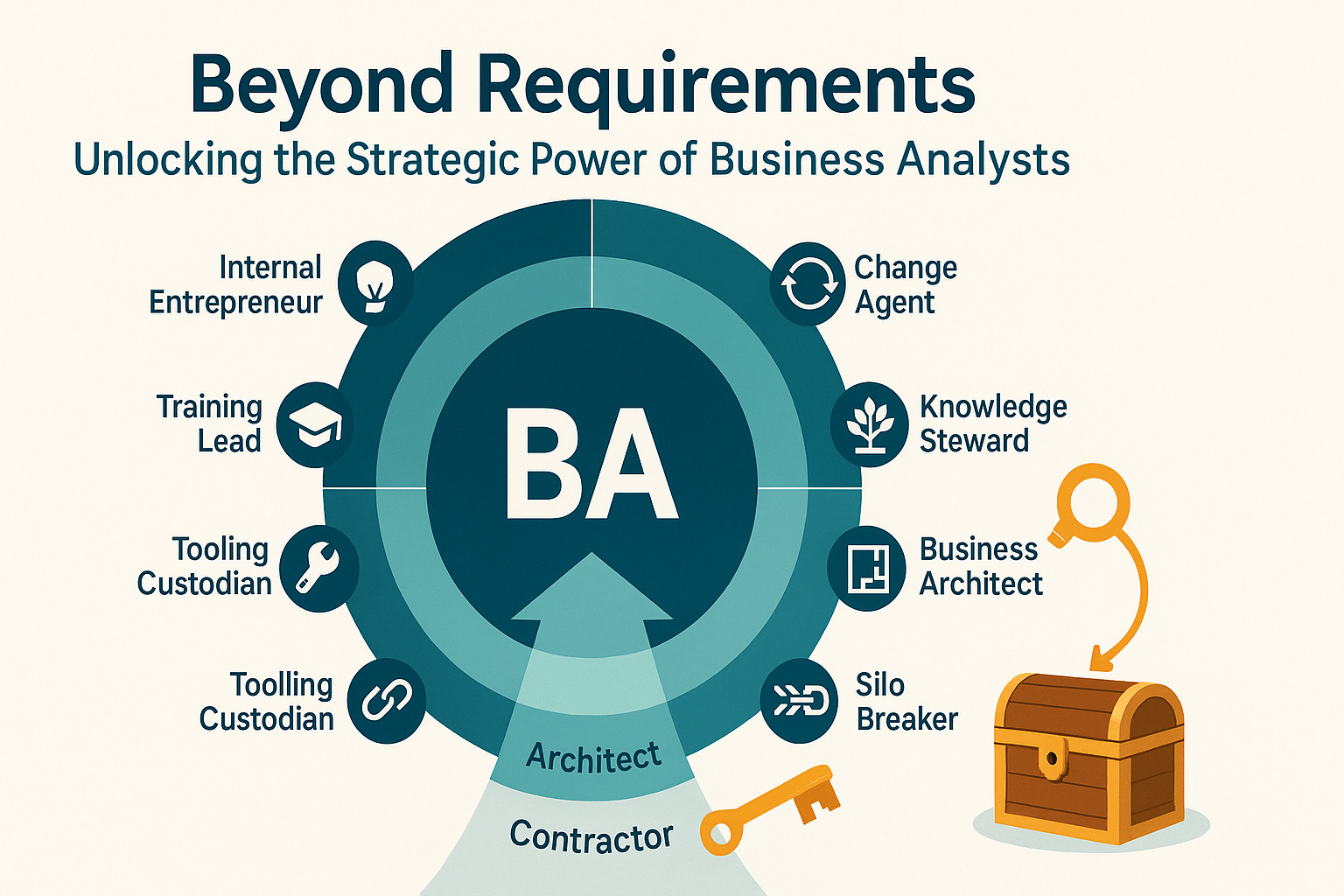
The solution lies in reimagining the BA function across seven strategic domains. Each represents an area where BA capabilities can generate substantial value if properly unleashed.
1. Internal Entrepreneur and Product Discovery Lead
The Opportunity
Your experienced BAs have observed hundreds of stakeholder interactions, customer complaints, workaround solutions, and unmet needs. They possess unique pattern-recognition capabilities derived from comparing projects across their careers. This makes them ideally positioned to identify viable new product and service opportunities.
The Approach
Give senior BAs explicit briefs: “Based on your five years of experience across our organization, what are the three most significant unmet needs in our market? Develop initial opportunity assessments for addressing them.”
Allocate bounded resources perhaps four weeks and a small budget for discovery sprints. Have BAs interview stakeholders, analyse market trends, map capability requirements, and produce opportunity briefs that include:
- Problem statement and target audience
- Preliminary solution concept
- Expected benefits and success metrics
- Key assumptions and risks
- Required capabilities and investment range
This transforms passive observation into active innovation, creating an internal pipeline of well-researched business opportunities.
2. Change Agent and Transformation Analyst
The Opportunity
When projects fail or underdeliver, standard post-mortems rarely uncover root causes. Teams cite surface-level issues unclear requirements, scope creep, technical challenges without examining underlying systemic problems.
BAs, with their process-oriented mindset and cross-functional view, can conduct deeper organizational diagnostics. They can identify patterns invisible to those embedded within single functions: cultural resistance to change, gaps in tacit knowledge transfer, misaligned incentive structures, or capability deficits.
The Approach
Empower BAs to lead structured reviews of failed, stalled, or troubled initiatives. Move beyond “what went wrong” to explore “why did it go wrong”:
- What cultural dynamics contributed to the outcome?
- Where did knowledge gaps create obstacles?
- Which processes proved inadequate?
- What capability limitations became apparent?
- Where did decision-making break down?
Have BAs translate findings into specific, actionable change recommendations not just for the project, but for organizational improvement. Position them as honest brokers who can surface uncomfortable truths that others are reluctant to voice.
3. Knowledge Steward and Repository Guardian
The Opportunity
Every organization struggles with knowledge preservation. Projects begin with enthusiastic documentation efforts that gradually decay as delivery pressures mount. BAs, given their natural inclination toward structure and their understanding of what information future teams will need, are ideal candidates to own this responsibility.
The Approach
Appoint a designated Repository Steward role either a dedicated position or a rotating responsibility among senior BAs. Their mandate:
Create lightweight, living project handbooks that capture:
- Context and strategic rationale
- Scope and boundaries (including what is explicitly out of scope)
- Key decisions and their rationale
- Architecture and integration points
- Stakeholder landscape and communication protocols
- Onboarding guide for newcomers
Maintain traceability from problem statements through requirements to acceptance criteria to test evidence. This enables teams to understand not just what was built, but why it was built that way.
Establish governance practices for repository health: regular reviews, mandatory updates at key milestones, templates for consistency, and feedback loops to improve usability.
The goal is to reduce new joiner ramp-up time from weeks to days and eliminate the frustration of inherited projects with missing context.
4. Capability Builder and Internal Trainer
The Opportunity
Business analysis skills problem framing, stakeholder mapping, process modelling, benefits definition, critical thinking are valuable far beyond the BA role. Developers, project managers, product owners, and operational staff all benefit from understanding how to analyse business problems systematically.
Yet most organizations never systematically transfer these capabilities. Knowledge remains siloed with BAs rather than diffusing throughout the organization.
The Approach
Develop a lightweight internal certification program: “Introduction to Business Analysis” a one-week intensive course for non-BAs. Focus on practical skills:
- How to frame problems clearly
- Stakeholder identification and analysis
- Process mapping and improvement
- Requirements elicitation techniques
- Benefits realization and measurement
- Creating acceptance criteria
Deliver this as a 48 – hour BA” not creating fully-fledged analysts, but giving every employee analytical foundation. This builds organizational capability, creates common language across functions, and increases confidence in business discussions. Usually, a 48-hour course should be enough for people to take the foundation exams for Business analysis if they want to or company sponsored.
For organizations with apprenticeship or graduate programs, make this a core component of early-career development regardless of the person’s ultimate role.
5. Requirements Excellence Manager
The Opportunity
While many organizations have adopted agile methodologies, a critical discipline often gets lost: requirements management. Not just capturing requirements, but maintaining them ensuring traceability, managing change, measuring outcomes, and preserving the chain from business need to delivered solution.
The Approach
Make BAs explicitly accountable for requirements health throughout the delivery lifecycle:
Traceability: Every requirement traces back to a specific business problem and forward to acceptance criteria and test evidence.
Measurability: Requirements include clear, verifiable success criteria not vague aspirations but specific, measurable outcomes.
Change management: When requirements evolve, the change rationale gets captured. Teams understand what changed, why it changed, and what implications follow.
Outcome validation: After delivery, BAs lead reviews to verify whether solutions achieved their intended business outcomes.
This is not bureaucratic overhead it is the discipline that prevents delivery teams from building the wrong thing elegantly.
6. Tooling Auditor and Governance Lead
The Opportunity
Software tools proliferate organically across modern organizations. Teams adopt new platforms for collaboration, development, testing, monitoring, and documentation without coordinated oversight. The result: redundant systems, underutilized licenses, integration nightmares, and spiralling costs.
BAs, with their cross-functional view and natural inclination toward rationalization, can bring order to this chaos.
The Approach
Conduct a comprehensive tooling audit:
- Inventory all development and business tools across the organization
- Identify license owners, active users, and cost per user
- Document what each tool is used for and whether alternatives exist
- Assess integration gaps and redundancies
- Evaluate whether critical capabilities are missing
Based on this analysis, develop a governance framework:
- Retire redundant or underutilized tools
- Consolidate where appropriate
- Fill capability gaps strategically
- Establish ownership and training requirements
- Create a decision framework for future tool adoption
This typically identifies 20-30% cost reduction opportunities while improving the overall tooling ecosystem.
7. Silo Breaker and Business Architecture Pathway
The Opportunity
The ultimate evolution of the senior BA role is toward Business Architecture connecting disparate initiatives, identifying enterprise-wide patterns, designing operating models, and shaping strategic roadmaps. Yet the path from BA to Business Architect often remains undefined.
BAs already possess many architectural capabilities: systems thinking, pattern recognition, stakeholder facilitation, and the ability to translate between technical and business domains. What they typically lack is the organizational mandate and authority to operate at enterprise scale.
The Approach
Create an explicit career pathway from senior BA roles to Business Architecture positions. Define the progression:
Strategic BA: Leads discovery and transformation analysis across multiple business units. Begins connecting cross-functional dots and identifying enterprise patterns.
Business Architecture Apprentice: Shadows enterprise architects, contributes to capability mapping and roadmap planning, and leads specific architecture initiatives.
Business Architect: Owns portfolio-level architecture, shapes investment decisions, breaks down organizational silos, and designs future-state operating models.
Position senior BAs to lead cross-functional initiatives specifically designed to connect siloed work for example, mapping end-to-end customer journeys that span multiple departments, or designing shared capability platforms that multiple business units can leverage.
Strategic Opportunities: The Institutional Transformation
When BAs operate across these seven domains, several strategic opportunities emerge:
Building Reusable Organizational Assets
Rather than institutional knowledge residing solely in individuals’ heads, it becomes systematized in playbooks, templates, repositories, and training materials. This creates compounding returns: each project contributes to organizational capability rather than starting from scratch.
Reducing External Consultant Dependency
Organizations often hire consultants to perform work that experienced internal BAs could do opportunity assessment, process optimization, transformation analysis, and capability design. By empowering BAs in these domains, you internalize expertise, retain knowledge, and reduce consulting spend.
Creating an Innovation Pipeline
Internal entrepreneurship activities generate a steady stream of well-researched business opportunities. Not all will merit investment, but the systematic identification and assessment of opportunities ensure the organization never lacks strategic options.
Accelerating Organizational Learning
When BAs lead transformation analysis and knowledge stewardship, the organization gets better at learning from experience. Mistakes do not repeat endlessly; insights from one initiative inform the next; capability gaps get systematically addressed.
Establishing a Business Analysis and Architecture Office
At sufficient scale, consider formalizing these expanded BA capabilities in a dedicated organizational unit a Business Analysis and Architecture Office. This centre of excellence can:
- Maintain standards, templates, and methodologies
- Coordinate BA capability development and career progression
- Own enterprise-level knowledge repositories and tooling governance
- Lead strategic discovery and transformation initiatives
- Serve as internal consultants for complex business challenges
Operating Model: Making It Real
Transforming the BA function requires more than aspiration. It demands clear roles, structured ways of working, and disciplined governance.
Defining New Roles and Decision Rights
Move beyond generic “Business Analyst” titles to specific functional roles:
Product Discovery Lead: Owns internal entrepreneurship activities, facilitates discovery sprints, and produces opportunity assessments.
Transformation Analyst: Leads post-project reviews, conducts organizational diagnostics, and recommends systemic improvements.
Repository Steward: Maintains knowledge bases, ensures documentation quality, and owns onboarding experience.
Requirements Manager: Ensures traceability, manages change, and validates outcome achievement.
Training Lead: Designs and delivers internal BA capability programs.
Tools Custodian: Maintains the tool inventory, conducts audits, and recommends governance policies.
Business Architecture Apprentice: Connects cross-functional initiatives and contributes to enterprise architecture work.
Not every organization needs all roles immediately, and individuals may hold multiple responsibilities. The key is making these accountabilities explicit.
Ways of Working and Governance
Standard Artifacts and Templates
Reduce friction by providing consistent templates:
- Opportunity briefs (one-page format)
- Decision logs (simple table format)
- Onboarding handbooks (five-section structure)
- Requirements health checklists
- Tool registers
Regular Cadences
Establish weekly reviews of:
- Requirements traceability health
- Repository freshness and completeness
- Tool usage and cost metrics
- Discovery sprint progress
Shared Language
Develop and maintain a glossary of terms, ensuring cross-functional teams speak the same language about requirements, capabilities, and outcomes.
Metrics That Matter
Track leading and lagging indicators of BA effectiveness:
Onboarding Speed: Time required for new team members to become productive contributors.
Requirements Quality: Percentage of requirements with complete traceability to acceptance criteria and test evidence.
Rework Rate: Proportion of delivered work requiring significant revision due to unclear or changing requirements.
Knowledge Capture: Number of decisions logged and subsequently referenced; repository update frequency.
Tool Efficiency: Cost per active user; utilization rates; redundancy elimination.
Innovation Throughput: Number of opportunity briefs produced; proportion that advance to business case development.
Capability Development: Number of staff completing BA training; demonstrated application of analytical techniques.
Action Plan: A 90-Day Pilot Approach
Transforming the BA function organization-wide is daunting. A focused pilot allows you to demonstrate value, learn, and refine before scaling.
Phase 1: Foundation (Weeks 1-2)
Secure Executive Sponsorship
Identify a senior leader willing to champion the expanded BA remit. This person should have authority over resources and credibility across functions.
Select a Pilot Business Unit
Choose a unit where:
- Leadership is receptive to experimentation
- BA capability exists or can be added
- Business challenges are significant enough that improvement will be visible
- Results can be measured relatively easily
Appoint Named Owners
Designate specific individuals for:
- Repository Steward
- Requirements Manager
- Tools Custodian
These might be existing BAs taking on new responsibilities or new hires if capability gaps exist.
Communicate the Vision
Hold a kick-off session with stakeholders across the pilot unit. Explain:
- Why BA roles are expanding
- What capabilities will be added
- How success will be measured
- What is expected from different roles
Phase 2: Quick Wins (Weeks 3-6)
Create the Onboarding Handbook Template
Develop a simple, two-page template covering:
- Project context and strategic rationale
- Scope boundaries
- Key stakeholder contacts
- Architecture overview
- Decision log
- Newcomer quick-start guide
Apply this template to one active project. Measure time-to-productivity for the next person joining that project.
Establish Requirements Traceability
For one initiative in the pilot unit, implement complete traceability:
- Document the business problem
- Link each requirement to that problem
- Define measurable acceptance criteria
- Capture test evidence
- Validate business outcomes post-delivery
Track how this affects rework and stakeholder satisfaction.
Conduct a Retrospective Review
Select one past failed or significantly delayed initiative. Have the Transformation Analyst lead a structured review:
- What happened? (facts)
- Why did it happen? (root causes)
- What patterns are visible? (systemic issues)
- What should change? (specific recommendations)
Produce a findings document with 3-5 actionable organizational improvements.
Phase 3: Expanded Capabilities (Weeks 7-12)
Launch a Discovery Sprint
Brief a senior BA to conduct a four-week product/service discovery sprint:
- Identify three potential business opportunities based on their accumulated knowledge
- Interview relevant stakeholders
- Assess market dynamics and capability requirements
- Produce opportunity briefs with expected benefits, risks, and assumptions
Review these briefs with leadership to determine whether any merit business case development.
Complete the Tooling Audit
The Tools Custodian should:
- Inventory all development and business tools used in the pilot unit
- Identify license counts, active users, and costs
- Document purpose and owner for each tool
- Identify redundancies and gaps
Present findings with recommendations to retire, consolidate, or add tools.
Pilot the Internal Training Program
Design and deliver a one-week “Introduction to Business Analysis” course for 10-15 non-BAs in the pilot unit (developers, project managers, operational staff). Cover:
- Problem framing
- Stakeholder analysis
- Process modelling
- Requirements techniques
- Benefits definition
Survey participants on confidence improvement and practical application.
Phase 4: Assessment and Scaling (Week 13+)
Measure Outcomes
Compare pilot unit metrics before and after:
- Onboarding time for new team members
- Requirements-related rework rates
- Stakeholder satisfaction scores
- Tool costs and utilization
- Knowledge capture and reuse
- Organizational learning (insights from transformation reviews)
Capture Learnings
Conduct a thorough pilot review:
- What worked well?
- What proved more difficult than expected?
- Where did resistance emerge, and how was it addressed?
- Which artifacts and processes need refinement?
- What resources and support are required for scaling?
Develop the Scaling Plan
Based on pilot results, create a roadmap for expanding to additional business units:
- Prioritize units based on receptiveness, need, and impact potential
- Plan for additional BA hiring or capability development
- Refine templates, processes, and training based on pilot learnings
- Establish the governance structure for coordinating across units
- Consider whether a formal Business Analysis and Architecture Office is warranted
Secure Ongoing Sponsorship
Present pilot results to senior leadership with a clear recommendation: continue, scale, or pivot. Emphasize ROI demonstrated during the pilot and projected benefits from broader implementation.
Expected Outcomes: What Success Looks Like
Organizations that successfully transform their BA function can expect concrete improvements across multiple dimensions.
Financial Outcomes
Reduced External Consulting Spend (15-30% reduction)
By leveraging internal BA expertise for transformation analysis, capability assessment, and opportunity discovery, organizations reduce reliance on external consultants. Knowledge developed internally gets retained rather than purchased repeatedly.
Lower Tool Costs (10-25% reduction)
Systematic tooling audits identify redundant licenses, underutilized systems, and opportunities for consolidation. Organizations stop paying for tools no one uses and negotiate better rates for genuinely needed capabilities.
Decreased Rework (20-40% reduction)
Improved requirements traceability and management prevent teams from building the wrong thing. Changes get managed systematically rather than creating surprise rework late in delivery cycles.
Faster Time-to-Value (25-50% improvement)
Better knowledge capture and onboarding practices dramatically reduce ramp-up time for new team members. Projects restart with context intact rather than starting from scratch.
Capability Outcomes
Institutional Memory and Knowledge Retention
The organization stops losing critical knowledge with every contractor departure or role change. Context, decisions, and insights become systematized in accessible repositories.
Enhanced Cross-Functional Collaboration
BAs operating as silo-breakers create connections across traditionally isolated functions. Opportunities that require coordinated action across departments become visible and actionable.
Internal Innovation Pipeline
Product discovery activities generate a steady stream of well-researched business opportunities. Strategic planning becomes informed by bottom-up insights from those closest to operations.
Organizational Learning Culture
Transformation analysis and systematic knowledge sharing create an environment where the organization genuinely learns from experience. Mistakes become learning opportunities; successes become replicable patterns.
Strategic BA Career Progression
Clear pathways to Business Architecture and strategic roles improve BA retention and attract higher-calibre talent. The perception of BAs shifts from tactical resources to strategic partners.
Operational Outcomes
Improved Project Success Rates
Better requirements management, preserved context, and access to historical learnings reduce project failure rates and increase on-time, on-budget delivery.
More Effective Change Initiatives
Transformation analysis that addresses root causes rather than symptoms leads to change programs that actually stick. Cultural and systemic barriers get identified and addressed explicitly.
Higher-Quality Business Cases
Opportunity assessments produced by experienced BAs are more thorough, realistic, and actionable than rushed business cases developed without appropriate analytical rigor.
Stronger Risk Management
Pattern recognition from experienced BAs helps organizations anticipate and mitigate risks based on historical patterns rather than discovering them the hard way repeatedly.
Cultural Outcomes
Elevated Value of Analytical Thinking
When BAs operate strategically, the organization signals that deep analytical capability is valued as highly as technical excellence or leadership skill.
Increased Psychological Safety
Transformation analysis that focuses on systemic issues rather than individual blame creates space for honest reflection and genuine organizational improvement.
Broader Business Acumen
Internal training programs that diffuse BA capabilities across the organization create shared language and understanding, improving communication between technical and business teams.
Risks, Challenges, and Mitigations
No organizational transformation is without obstacles. Anticipating challenges allows for proactive mitigation.
Resistance from Existing Teams
Challenge: Delivery teams may perceive expanded BA roles as bureaucratic overhead or as threatening their autonomy.
Mitigation:
- Secure executive sponsorship and communicate the “why” clearly
- Start with quick wins that demonstrably reduce pain points
- Keep artifacts lightweight and purposeful no forms for forms’ sake
- Co-design processes with delivery teams rather than imposing them
- Celebrate and publicize early successes
Resource and Time Constraints
Challenge: Organizations already feel stretched. Adding responsibilities to BAs may seem impossible without additional headcount.
Mitigation:
- Begin with a focused pilot requiring minimal additional resources
- Demonstrate ROI through reduced rework, faster onboarding, and consultant savings
- Consider that better knowledge management often frees up time previously spent recreating lost context
- Use the pilot to build the business case for additional investment
Role Confusion and Boundary Conflicts
Challenge: As BA roles expand, boundaries with other functions (product management, project management, enterprise architecture) may become unclear.
Mitigation:
- Publish explicit decision rights and role descriptions
- Facilitate cross-functional discussions to clarify responsibilities
- Focus on collaboration rather than rigid boundaries
- Emphasize that BAs complement rather than replace other roles
- Review and refine role definitions based on practical experience
Skill Gaps and Development Needs
Challenge: Not all BAs possess the capabilities required for expanded roles. Strategic thinking, facilitation, teaching, and business acumen may need development.
Mitigation:
- Conduct a capability assessment to identify development needs
- Provide training, coaching, and mentoring
- Allow for gradual role evolution rather than expecting immediate transformation
- Hire strategically to fill critical gaps
- Create “apprentice” roles that allow BAs to grow into expanded responsibilities
Sustaining Momentum After Initial Enthusiasm
Challenge: Pilot success does not guarantee lasting change. Without ongoing attention, initiatives often revert to previous patterns.
Mitigation:
- Establish regular governance cadences (weekly reviews, monthly retrospectives)
- Track and report metrics consistently
- Adjust incentive structures to reward expanded BA contributions
- Build expanded BA capabilities into job descriptions and performance frameworks
- Create a community of practice where BAs share learnings and support each other
Conclusion: From Water Carriers to Fountain Builders
The modern Business Analyst is far more than a requirements gatherer or stakeholder liaison. They are pattern recognizers, knowledge synthesizers, and strategic thinkers with a unique cross-functional perspective that few other roles provide.
Yet in most organizations, this potential remains untapped. BAs are hired for narrow tasks, their accumulated wisdom discarded when projects end, their capabilities limited to tactical delivery work.
The cost of this underutilization is significant: lost knowledge, repeated mistakes, missed innovation opportunities, consultant dependency, and organizational amnesia. But it is not inevitable.
By expanding the BA remit across internal entrepreneurship, transformation analysis, knowledge stewardship, capability development, requirements excellence, tooling governance, and business architecture, organizations can unlock extraordinary value.
This is not theory. The capabilities exist. The opportunities are real. What is missing is organizational will—the recognition that BAs deserve strategic roles commensurate with the value they can create.
The question facing every executive, every transformation leader, every HR professional is straightforward: Will you continue using your BAs to carry water between stakeholder meetings? Or will you empower them to build fountains—sustainable systems that generate value long after individual projects end?
The choice will determine whether your organization merely executes projects or systematically builds capability, captures learning, and creates competitive advantage through superior institutional intelligence.
Stop wasting your secret weapon. Start building the Business Analysis function your organization deserves.
Call to Action
For Executives:
- Review your current BA utilization across the organization
- Identify your most experienced BAs and ask them: “What opportunities are we missing?”
- Sponsor a 90-day pilot in one business unit
- Champion the expanded BA remit at the leadership level
For HR and Talent Leaders:
- Redesign BA job descriptions to reflect strategic capabilities
- Create clear career pathways from BA to Business Architecture roles
- Develop capability frameworks that support BA evolution
- Review contractor vs. permanent hiring strategies for BAs
For Transformation and PMO Leaders:
- Engage BAs in post-project transformation analysis
- Establish Repository Steward and Requirements Manager roles
- Build BA capability development into transformation programs
- Measure and report on knowledge capture and reuse
For Business Analysts:
- Advocate for expanded responsibilities aligned with your capabilities
- Volunteer to lead pilot initiatives in any of the seven domains
- Document your cross-project insights and patterns
- Build relationships with senior leadership to demonstrate strategic thinking
The transformation begins with a single conversation, a single pilot, a single decision to stop accepting the status quo. Start today.
Appendices
Essay: The Secret Weapon Hiding in Your IT Department: Why Your Best Intrapreneurs are Actually Your Business Analysts
The “Water Carrier” Crisis: Stop Squandering Your Internal Capital
In the high-stakes theatre of corporate transformation, leadership often falls into a predictable, expensive trap: they hire external consultants to map the future while ignoring the “walking mind maps” already sitting in their IT departments. Most organizations relegate their Business Analysts (BAs) to the role of a “water carrier”—a tactical intermediary ferrying requirements between developers and stakeholders. When you treat a BA as a glorified note-taker, their invaluable institutional knowledge evaporates the moment a project ends. This is a massive leakage of strategic potential. To dominate the landscape of 2025, you must command a shift from using BAs to “carry water” to empowering them to “build fountains”—self-sustaining sources of innovation, efficiency, and venture-grade growth. The 2025 mandate transforms the Business Analyst from a support function into an Internal Venture Builder .
Takeaway 1: Your BAs are “Walking Mind Maps,” Not Just Note-Takers
An experienced BA does not just “gather requirements”; they possess a detailed mental map of your company’s entire value chain. They understand the “why” behind past failures, the nuances of stakeholder politics, and the technical debt hidden beneath the surface. This level of insight is essentially a “48-hour MBA” gained through the sheer density of cross-functional exposure. While others see a single project, the BA sees the “Corporate Body of Knowledge.” Without their stewardship, this knowledge becomes a “graveyard of outdated documents.” With it, it becomes an asset that prevents your organization from starting every new initiative “from the middle” without context. “Experienced BAs see where ‘value leaks’ happen—knowledge loss, requirements drift, and tool sprawl. This is the exact vantage point needed to originate and de-risk internal ventures.”
Takeaway 2: From “Requirement Taker” to “Internal Venture Builder”
The most significant shift in human capital strategy for 2025 is the formalization of the BA as Intrapreneur . While an entrepreneur builds with personal capital and high risk, an intrapreneur builds new products and services inside your firm using company resources to de-risk growth. The best BAs already think like venture designers. By shifting their mandate from “taking requirements” to “making opportunities,” you unlock a pipeline of testable ideas. Consider these high impact intrapreneurial behaviours and their artifacts:
- Pattern Recognition: Spotting recurring pain points across silos to identify hidden demand.
- Outcome: Opportunity Briefs and Problem Trees that serve as a pipeline for testable venture ideas.
- Stakeholder Facilitation: Building the coalitions required to secure sponsorship and unblock decisions.
- Outcome: Accelerated access to user data and reduced political friction.
- Venture Design: Redesigning target journeys and quantifying value at every step.
- Outcome: Clear value theses and costed changes that justify investment.
Takeaway 3: In 2025, AI is the BA’s Co-Pilot, Not Their Replacement
The future of business analysis isn’t about technology replacing people; it’s about high-level human critical thinking being amplified by machines. In 2025, the BA role splits into specialized “AI-Human Liaisons” and “Process Automation Designers. “To maintain a competitive edge, your BAs must master NLP (Natural Language Processing), AutoML, and Celonis for automated modelling and elicitation. “AI won’t replace Business Analysts — but Business Analysts who use AI will replace those who don’t. “The “Must-Have” AI-adjacent skills now include:
- Prompt Engineering: For rapid research and documentation generation.
- Ethical Audits: Ensuring AI-driven decisions align with organizational values and regulatory frameworks.
- Data Storytelling: Using LLMs and platforms like Power BI to translate raw data into “Opportunity Briefs” that executives can actually act upon.
Takeaway 4: The Strategic Power of “Repository Stewardship”
A “broken repository line” is a silent killer of ROI. When projects stop and start, or team members rotate, organizations lose the “why” behind previous decisions. This forces new teams to repeat expensive mistakes. The BA as Repository Steward fixes this by maintaining the “Living Record.” By institutionalizing the use of Decision Logs and Onboarding Handbooks , BAs provide a financial win that the CFO will notice:
- Onboarding Acceleration: Cutting the time for a new joiner to reach their first meaningful contribution from weeks to mere days.
- Consultant Spend Avoided: By maintaining internal context, you eliminate the need to pay external firms to “re-learn” your own business.
Takeaway 5: The 20%–30% Tooling Tax You Didn’t Know You Were Paying
Unmanaged “tool sprawl” is a budget leak that most executives ignore. Without oversight, redundant licenses and overlapping platforms multiply. The BA acts as the Tools Custodian , auditing the stack to ensure the organization maintains the “lightest viable stack” for innovation.
- The Audit Win: Systematic rationalization typically leads to a 20% to 30% reduction in tool spend.
- The Metric: BAs should be measured on “Cost per active user,” ensuring you aren’t paying for “shelfware” that adds no value to the development lifecycle.
Takeaway 6: The Pathway to Business Architecture
The natural career evolution for a Senior BA is the role of the Business Architect . This is the bridge between executive strategy and operational execution. Organizations only realize the need for this role when they face “capability fragmentation”—where different departments are building the same things in different ways. Business Architects move beyond mapping requirements to Capability Mapping . They design the future-state capabilities required to meet strategic goals, ensuring that every IT investment is a coherent step toward the enterprise vision rather than a siloed experiment.
Conclusion: Stop Carrying Water, Start Building Fountains
Your Business Analysts are the key to a lower-waste, high-innovation organization—but only if you give them the mandate to discover, test, and scale . This transformation isn’t a theoretical exercise; it is a structured 90-day activation process involving the appointment of Discovery Leads and Repository Stewards. As you review your project portfolio, ask yourself this: How much consultant spend could we have avoided if we had empowered our internal BAs to lead the discovery? If you formalize these intrapreneurial roles today, you will see faster learning, lower waste, and a steady stream of investable ideas. Stop asking your BAs what the system should do and start asking them what the business could be .