Idea Snapshots – Brief, strategic glimpses into business possibilities.
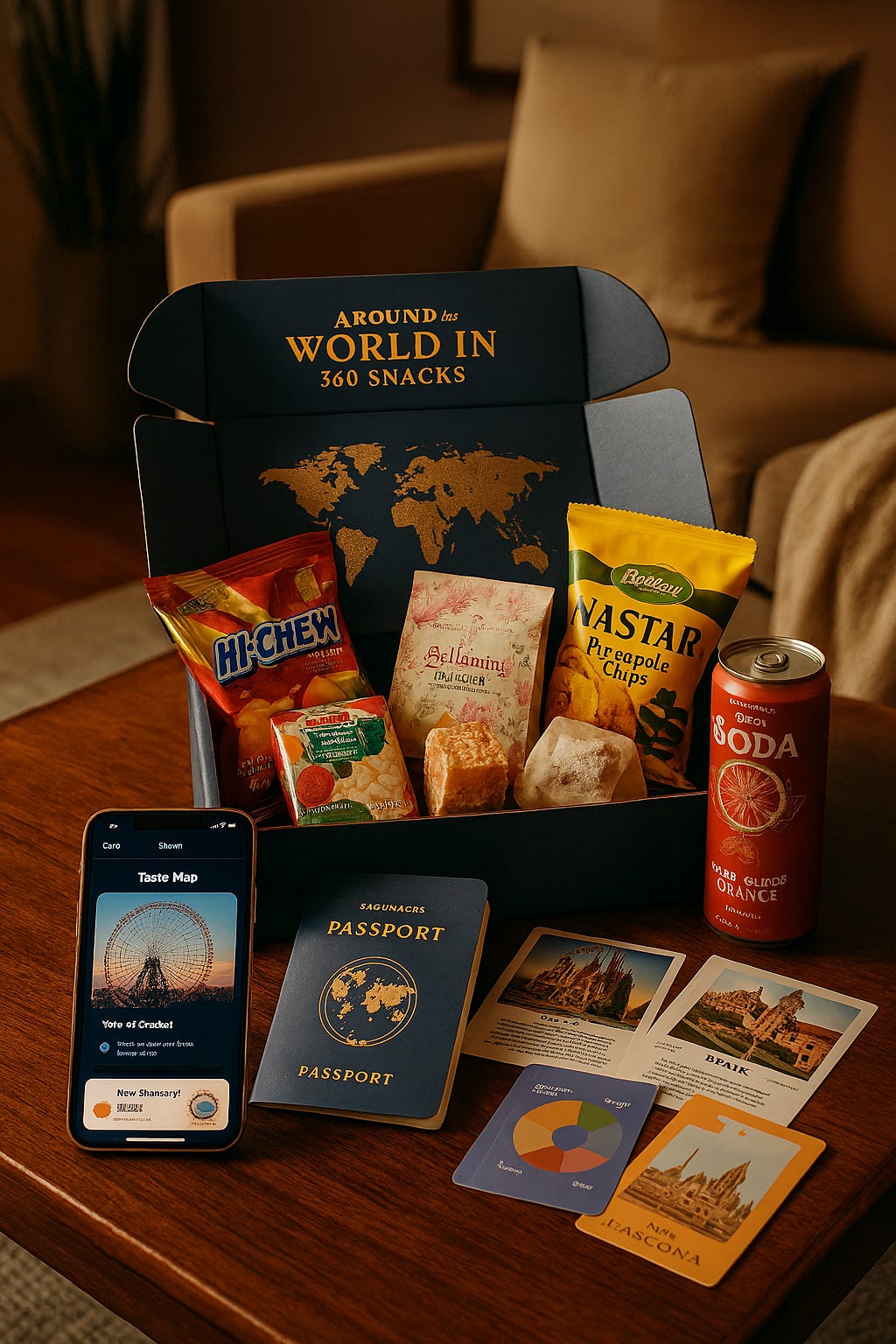
Imagine opening a box and stepping into a street market in Accra, then biting into something from Osaka. This isn’t tourism it’s taste-driven cultural exploration delivered to your door. Around the World in 360 Snacks combines subscription boxes, one-off purchases, and an app that learns your flavour preferences while you discover global confections and savoury treats. The twist? It’s not just B2C. Tourism boards, embassies, corporate event planners, and cultural institutions can use these boxes as welcome kits, event swag, or diplomatic gifting tools. You get affordable global discovery; partners get a tangible story they can hand to guests.
The market for snack boxes is crowded, but most players focus purely on subscription retention or novelty gifting. Few integrate personalization software, B2B channels, and cultural calendar tie-ins into one model. This concept addresses subscription fatigue with flexibility (mix-and-match, one-offs, curated options), uses app-tracked preferences to reduce churn, and taps revenue streams beyond individual consumers. It’s positioned where food meets data, gifting meets diplomacy, and discovery meets community.
Is This New?
Originality Check:
- [ ] Completely novel
- [x] Remix of existing concepts
- [x] Niche specialization
- [x] Cross-domain adaptation
Analysis: Global snack boxes exist (Bokksu, Universal Yums), as do subscription models with curation (Charisnack). What’s different here is the integration of four layers: (1) app-based taste tracking and personalization, (2) B2B channels targeting tourism and diplomatic sectors, (3) flexible purchasing (subscription, one-off, mix-and-match), and (4) cultural calendar synchronization for limited drops. Most competitors pick one or two of these. Combining all four creates a defensible position through operational complexity and multi-channel revenue.
The remix isn’t about inventing snack boxes it’s about turning static discovery into dynamic, data-informed exploration while opening corporate and institutional revenue streams that most DTC-focused players ignore.
Market Position
The Landscape:
The global snack market is projected to reach $750 billion by 2030, driven by convenience, novelty, and health-conscious demand. The subscription box segment is saturated with players offering themed curation (international, dietary-specific, gourmet). Barriers to entry are low anyone can source products and ship them but retention is the challenge. Customer acquisition costs are high, churn is significant, and differentiation is difficult when the core product (curated snacks) is easy to replicate.
The B2B gifting and corporate event market is less crowded but harder to access. Tourism boards, embassies, and event planners need culturally resonant, ready-to-gift items but often default to generic swag or expensive bespoke solutions. There is a gap for affordable, story-rich, scalable gifting products tied to cultural authenticity. See: Market Outline
The Opportunity:
This concept sits at the intersection of three underserved niches:
- Personalization-driven subscription boxes that reduce churn through data (most boxes don’t track preferences systematically)
- Flexible purchasing models that let customers opt in and out without full subscription commitment
- B2B cultural gifting for tourism, diplomatic, and corporate channels where storytelling and authenticity matter
The cultural calendar angle (Diwali, Eid, Lunar New Year, Día de Muertos) creates urgency and relevance without relying solely on Western holiday cycles. The app layer transforms a transactional product into a social, gamified experience taste maps, badges, sharing which increases engagement and lifetime value.
The Scale:
This isn’t a unicorn play. Realistic success looks like:
- 5,000–15,000 active subscribers within 18 months
- 20–30% of revenue from B2B channels (corporate, tourism, events)
- Contribution margin of 40–50% after scaling operations
- Strategic exits could include acquisition by a larger gifting platform, tourism tech company, or international grocer
The viable middle ground is a profitable, regionally-focused business with 7-figure revenue that serves both consumers and institutions, not a venture-scale blitzscale model.
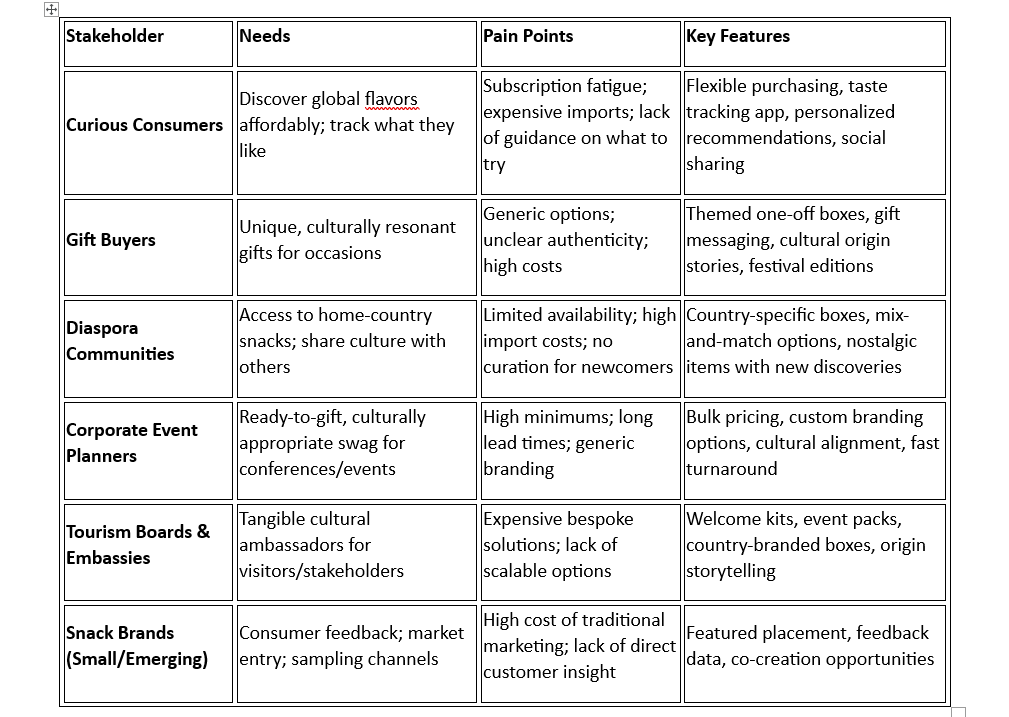
Stakeholder Ecosystem
Product vs. Feature
The Test:
Could a large player like Amazon, Bokksu, or a tourism platform simply add this as a feature? Partially. The subscription box part is replicable. The B2B gifting angle could be added to existing e-commerce. But the integration of personalized taste tracking, flexible purchasing, and multi-channel B2B partnerships creates operational complexity that’s harder to bolt on.
The Defense:
- Data moat: The app builds a proprietary dataset of taste preferences across regions, which powers better curation and can be monetized for brand partnerships
- Operational specialization: Managing food safety, labeling, import compliance, and right-sized portions across multiple channels requires expertise that generic platforms won’t build
- Cultural credibility: Deep partnerships with embassies, tourism boards, and cultural institutions create distribution advantages and brand trust that DTC-only players can’t match quickly
- Speed and focus: A specialized player can move faster on cultural calendar drops and niche partnerships than a large platform optimizing for scale
This works as a standalone product if execution is tight and the brand story is strong. The risk is being absorbed as a feature, but the defense is depth: do this better, faster, and with more cultural authenticity than anyone else.
Core Components
What You’d Need:
- Supplier network: Vetted sources across 10–15 regions with full specs (ingredients, allergens, shelf life, import legality)
- Food safety and compliance lead: Either in-house or contracted expert to manage HACCP-style controls, labeling, and regulatory requirements per market
- Packaging and fulfillment system: Recyclable mailers, compostable or resealable pouches, barcode tracking, and efficient kitting workflows
- App/web platform: Lightweight MVP with taste tracking, ratings, wishlist, reorder, social sharing, and personalized recommendations
- B2B sales pipeline: Outreach to 5–10 embassies, 3–5 tourism boards, and 10–20 corporate event planners for pilot partnerships
- Brand identity and storytelling: Visual system (modern travel journal aesthetic), unboxing experience, origin story cards, and QR-linked content
- Data infrastructure: Backend to track preferences, generate insights, and create co-creation briefs for brand partners
Novel ideas to combat subscription fatigue and alternative models
1. Cultural Calendar Commerce
2. Product Launch Partnership Platform
3. Embassy & Tourism Board White-Label Program
4. Corporate Cultural Competency Kits
5. University & Student Welcome Program
6. Pop-Up Tasting Events & Festival Partnerships
7. Gift Concierge & Corporate Gifting Service
8. Media & Influencer Partnership Boxes
9. Recipe Kit & Cooking Experience Boxes
10. Airport & Transit Retail Partnership
11. The role of your APP
For details see : Novel ideas and process
First Steps:
- Source 30 SKUs across 3 regions with full compliance documentation (ingredients, allergens, import legality, shelf life). Prioritize items not widely available in your target market but with proven appeal elsewhere.
- Build no-code web app MVP using tools like Bubble, Webflow + Airtable, or similar. Focus on: user registration, taste ratings (1–5 scale), wishlist, simple flavor profile visualization, and social share cards.
- Run 150 paid beta orders across three price tiers (Mini Discovery, Passport, Collector’s Edition) and two festival-themed drops. Measure: repeat intent (target 35%+), CAC vs. first order margin, refund rate (target <3%), and qualitative feedback on packaging and curation.
The Contrarian View
Challenge This Idea:
- Subscription fatigue is real. Consumers are overwhelmed with recurring boxes. Why would they choose this over canceling everything?
- Regulatory complexity kills margins. Food safety, labeling, import duties, and allergen management are expensive and risky. One incident could destroy the brand.
- B2B sales cycles are long and unpredictable. Relying on tourism boards and embassies for 20–30% of revenue is optimistic—these institutions move slowly and have budget constraints.
- The market is saturated. Bokksu, Universal Yums, and dozens of niche players already exist. What’s stopping them from copying the app layer or B2B angle?
- Unit economics may not work. Right-sizing portions to keep prices affordable could compress margins too much, especially with freight and customs costs.
Why It Might Still Work:
- Flexibility combats fatigue. The mix-and-match and one-off options directly address subscription burnout. You’re not forcing a recurring model—you’re offering it as one path among many.
- Compliance is a moat, not just a cost. Yes, it’s hard—but that’s why most players avoid it or do it poorly. Hiring a food safety lead upfront and building SOPs creates defensibility. Partner with co-packers who already have certifications in key markets.
- B2B is a hedge, not a dependency. Even if B2B grows slowly, the DTC model can stand alone. B2B revenue is upside, not the core—but early pilots (university welcome boxes, embassy events) are achievable within 3–6 months.
- Operational integration is hard to copy. Large players can add features but struggle with the operational complexity of multi-channel fulfillment, cultural partnerships, and compliance. You win by doing it better and faster in a focused niche.
- Data improves unit economics over time. Personalization reduces waste (fewer returns, better curation) and increases lifetime value (higher retention, upsell to full-size products). The app isn’t just a feature—it’s a revenue and margin engine.
Cross-Domain Potential
If This Doesn’t Work Here:
- Beauty and skincare: “Around the World in 360 Formulas” – global beauty rituals and products curated by region, with skin profile tracking
- Beverages: Coffee, tea, or craft soda/kombucha discovery boxes with flavor tracking and origin stories
- Craft and DIY materials: Regional craft supply boxes (textiles, tools, techniques) for makers and hobbyists
- Kids’ education: “Culture Kits” combining snacks, crafts, and stories from different countries for homeschooling families
- Corporate wellness: Health-focused global snack boxes as employee perks with team challenges and shared taste maps
The core model—curated discovery + data tracking + flexible purchasing + B2B channels—translates to any category where:
- Products are small, shippable, and have cultural or regional variance
- Personalization improves experience and retention
- B2B gifting or corporate use cases exist
- Community and storytelling add value beyond the physical product
Next Steps for Builders
If you wanted to pursue this:
Week 1: Validation Sprint
- Interview 20 potential customers (consumers, gift buyers, corporate planners) to validate pain points and willingness to pay
- Map out 5 potential B2B partners (embassies, tourism boards, event planners) and cold-reach to gauge interest
- Research compliance requirements for 3 target markets (e.g., UK, US, EU) focusing on labeling, allergens, and import rules
Month 1: MVP Build
- Source 30 SKUs with full specs and compliance docs
- Build no-code web app with ratings, wishlist, and basic flavor profile
- Design packaging mockups with recyclable/compostable options
- Create 3 box themes (e.g., Southeast Asia, West Africa, South America) and price at 3 tiers
Quarter 1: Beta Launch
- Run 150 paid beta orders with clear success metrics (35%+ repeat intent, CAC under target, <3% refunds)
- Close 2–3 B2B pilot agreements (university welcome box, embassy event, tourism kit)
- Launch 2 festival-themed limited drops (e.g., Lunar New Year, Holi) to test urgency and cultural relevance
- Gather structured feedback via post-purchase surveys and app ratings
Resources to Explore:
- Compliance: Hire a food safety consultant or partner with a co-packer experienced in multi-market compliance (search for HACCP-certified facilities)
- Packaging: Landpack or similar sustainable packaging suppliers with experience in food-grade materials
- App/Web: Bubble.io, Webflow + Airtable, or Shopify + custom integrations for taste tracking
- Supplier Networks: Alibaba, Faire, regional import/export brokers, or direct partnerships with artisanal producers
- Market Research: BrandBusiness Boundless and AVVALE templates for snack business planning; Charisnack franchise model as a reference
Final Thoughts
This isn’t about reinventing the snack box. It’s about turning a saturated category into a data-informed, multi-channel experience that serves consumers, institutions, and brands simultaneously. The opportunity lies in the integration: personalization reduces churn, flexibility combats subscription fatigue, B2B channels diversify revenue, and cultural storytelling creates emotional resonance.
The hard parts—compliance, logistics, supplier relationships—are also the moats. Most players won’t do the messy work of managing food safety across markets or building embassy partnerships. That’s where you win.
Success here isn’t about becoming the next Instacart or DoorDash. It’s about building a profitable, culturally resonant business that bridges discovery, data, and diplomacy. The world is full of flavors. Most people will never travel to taste them all. You’re building the passport.
Alternative takes:
- Start purely B2B (focus on tourism and events first, add DTC later)
- Launch as a white-label platform that lets cultural institutions create their own branded boxes
- Partner with a diaspora-focused media company or influencer network to co-create boxes with built-in audiences
- Build the app first as a standalone taste-tracking tool, then layer in the physical product
This is part of Ideas Snapshots – a collection of lightweight business blueprints, strategic outlines, and entrepreneurial prompts. Not every idea needs to be built. Some are meant to inspire, remix, or adapt.
What would you do differently with this idea? Reply or share your take.