
How these emerging subgenres can become culturally viable, historically literate, artistically distinct, and commercially legible without collapsing into extraction, branding capture, or shallow novelty
Preamble
Every new music category arrives with two stories.
The first story is the exciting one: a new sound is emerging, a scene is forming, language is shifting, young listeners are identifying with it, and industry actors begin to feel that something new can be named, packaged, and grown.
The second story is the harder one: very little in culture is created from nothing. Most “new” genres are reconfigurations of existing traditions, older sounds, living communities, inherited rhythms, and power relations that predate the market language later wrapped around them.
That second story matters here.
Afro Trap, Afro Yoruba Trap, and Fuji Trap should not be approached as mere branding opportunities or playlist labels. They are proposals about how African and specifically Yoruba expressive worlds can enter into dialogue with trap, which is itself inseparable from African American musical history and Black urban modernity. That means these genres cannot be built honestly without naming what is inherited, what is newly added, who must be credited, and who may be harmed if the process becomes extractive.
My central claim is simple:
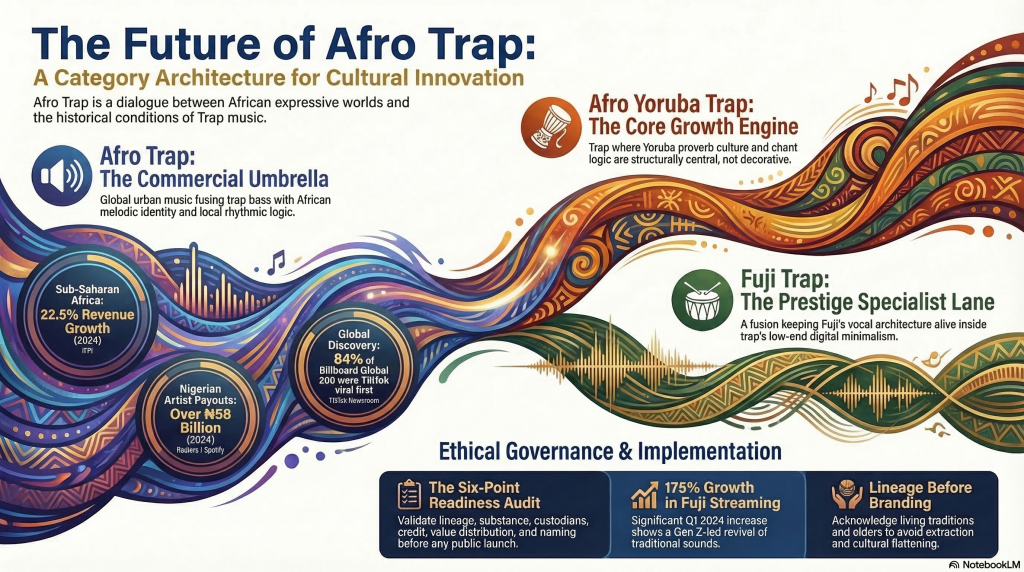
Afro Trap can function as a broad commercial umbrella. Afro Yoruba Trap is the strongest and most scalable identity lane. Fuji Trap is the most culturally charged and distinctive, but also the highest-risk and most ethically demanding subgenre.
This document therefore does three things at once. It offers a critical essay on emergence, a genre-definition document, and an ethical governance charter for responsible development. As usual references: Afro trap
1. The central question
The question is not whether these genres can be named. Of course they can.
The real questions are:
- Should they be named?
- What exactly is being named?
- Who gets to name them?
- Are they describing a living practice or trying to manufacture one?
- Are they extending culture or extracting from it?
- Can they be built in a way that is musically serious, culturally grounded, commercially viable, and ethically defensible?
These are not side questions. They are the real foundation.
2. What trap means in this context
Trap is not just a drum pattern or a production preset. It is a Black modern musical language that emerged through African American experience, especially through conditions of urban pressure, coded speech, survival, aspiration, threat, swagger, grief, and spectacle. So when trap travels into African contexts, it is not neutral software. It carries history with it.
That does not mean Africa cannot reinterpret trap. It means reinterpretation requires literacy.
The point is not to treat trap as sacred and untouchable. The point is to recognize that trap, like jazz, hip-hop, blues, house, and many other Black forms, is both a style and a historical condition. Therefore, African adaptations should not present themselves as detached invention. They should present themselves as dialogue, translation, and re-situation. That is especially important when building new categories around it.
3. Category architecture
Afro Trap
Definition: African urban music using trap-era bass design, drum programming, and sparse sonic tension, fused with African melodic identity, African language use, and local rhythmic logic.
This is best understood as the umbrella commercial lane, not the deepest identity claim. It is useful for metadata, export framing, playlisting, and broad market language. It is not precise enough on its own to serve as the final cultural thesis.
Its strength is reach. Its weakness is vagueness.
Afro Yoruba Trap
Definition: Trap-influenced African urban music in which Yoruba language, proverb culture, chant logic, coded street speech, social commentary, and local rhythmic sensibility are structurally central rather than decorative.
This is the strongest founder lane because it is closest to an already existing practice. It feels less like fabrication and more like consolidation. The sound world, linguistic world, and audience logic are already partly present in Nigerian music culture.
Its strength is coherence. Its weakness is that people may mistake it for “Yoruba vocals over imported beats” if not defined properly.
Fuji Trap
Definition: A contemporary fusion in which Fuji’s vocal architecture, praise-energy, percussive discipline, ensemble motion, and social force remain alive inside trap’s low-end design, programming, and digital minimalism.
This is the prestige or specialist lane. It is potentially the most original, the most visually and sonically striking, and the most critically important. It is also the lane with the greatest flattening risk.
Its strength is distinctiveness. Its weakness is that it can easily become superficial if Fuji is treated as texture rather than structure.
4. Emergence: why these subgenres are appearing now
These forms are emerging now because several forces are converging.
First, trap has become a globally circulating Black production language. It is now one of the dominant sonic grammars of urban music worldwide, including across African markets.
Second, Yoruba-language music already possesses strong internal resources for trap adaptation: proverb culture, tonal flexibility, chant energy, coded speech, social drama, status performance, irony, prayer, humor, and linguistic compression. Afro Yoruba Trap works because Yoruba already has the density needed to inhabit trap seriously.
Third, Fuji has long been rhythmically forceful, socially responsive, and vocally dynamic. It already contains intensity, repetition, ceremony, praise, urgency, and pressure. In principle, those elements can speak to trap’s tension and low-end minimalism.
Fourth, digital culture rewards hybrid naming. Once audiences begin to detect repeated patterns, labels emerge, whether from artists, fans, bloggers, DSP editors, or marketers. That makes naming inevitable. The only question is whether naming arrives with rigor or confusion.
5. What is inherited and what is new
A genre earns legitimacy when it can distinguish inheritance from invention.
Afro Trap inherits:
- trap bass architecture and programmed tension
- African melodic phrasing
- local rhythmic patterning
- urban African storytelling and aspiration
What is new is the broader African recoding of trap as an exportable youth language.
Afro Yoruba Trap inherits:
- Yoruba language and coded speech
- proverb logic and oral compression
- indigenous rap and chant traditions
- Nigerian street-pop and Afrobeats habits
- trap percussion, bass, starkness, and menace
What is new is the stable meeting point: a sonic and lyrical world where Yoruba expression is not ornamental but structurally decisive.
Fuji Trap inherits:
- Fuji vocal phrasing
- call-and-response
- praise forms
- ensemble propulsion
- Yoruba ceremonial and social references
- trap’s digital restraint and bass design
What is new is not just fusion. It is the recomposition of Fuji’s social energy inside a contemporary urban production frame.
That distinction matters. Without it, the genre becomes a costume.
6. Why Afro Yoruba Trap is the strongest candidate
Of the three, Afro Yoruba Trap is the most viable.
Why?
Because it does not need to leap too far from existing practice. Yoruba-language rap, indigenous flows, street-pop, chant-based music, and coded urban writing already exist in relation to mainstream Nigerian listening. Afro Yoruba Trap is therefore not trying to invent a bridge; it is naming and sharpening one that is already partly built.
It also has the best balance of:
- local credibility
- diaspora accessibility
- lyrical uniqueness
- digital scalability
- brand clarity
It can work on the street, online, in editorial culture, and in artist identity-building.
7. Why Fuji Trap is both powerful and dangerous
Fuji Trap is the highest-risk, highest-distinction proposition.
It is powerful because Fuji is not thin material. It brings with it social force, vocal pressure, lineage, depth, and ritual residue. A serious Fuji Trap record could sound unlike almost anything else in contemporary African popular music.
But that is exactly why it is dangerous.
Fuji is a living tradition, not a vault of cool signifiers. It has elders, lineages, performance ethics, live-band discipline, percussion intelligence, and social memory. A shallow Fuji Trap experiment will feel like younger creators extracting prestige and energy from Fuji without submitting to its craft or acknowledging its custodians. That is the clearest route to backlash.
So Fuji Trap should be treated not as a quick trend, but as a governed cultural experiment.
8. Cultural and societal influences
These genres sit at the intersection of several forces.
Urban pressure
Trap works where social tension exists. Afro Trap and Afro Yoruba Trap respond to unemployment, hustle culture, status anxiety, migration, precarity, digital self-making, and street morality.
Language politics
Afro Yoruba Trap matters because it gives local language structural prestige in a modern sonic framework. It says Yoruba can carry danger, sophistication, tenderness, irony, philosophy, prayer, and urban cool without needing translation into a more globally legible surface.
Intergenerational tension
Fuji Trap raises questions of inheritance. Can younger artists modernize without trivializing? Can older traditions accept transformation without feeling erased? This tension is not a problem to eliminate. It is part of the genre’s meaning.
Class and legitimacy
Some audiences will hear these forms as innovative. Others will hear them as vulgar, unserious, or commercially opportunistic. That contestation is normal. In fact, many genres become real only once they provoke argument.
Diasporic circulation
These genres may achieve local meaning first and diaspora monetization second. Afro Yoruba Trap especially has strong potential to travel through identity-rich diaspora networks.
9. Messaging: what the genre should say
Each lane needs distinct messaging.
Afro Trap messaging
“We are African urban modernity in trap form.”
This lane should emphasize youth culture, global fluency, pressure, ambition, style, and export energy.
Afro Yoruba Trap messaging
“This is Yoruba-coded urban modernity, not borrowed trap with local garnish.”
The message here is that Yoruba is not a decorative layer. It is the engine of worldview, language, rhythm, and emotional intelligence.
Fuji Trap messaging
“This is not Fuji sampled for novelty. It is Fuji discipline in contemporary dialogue.”
This must be said repeatedly. Fuji Trap must frame itself as lineage-aware, collaborative, and serious. If it speaks carelessly, it will lose moral legitimacy.
10. Style and aesthetics
Afro Trap
- sleek, urban, nocturnal
- metallic tones, neon accents, digital cool
- cars, cityscapes, speed, coded aspiration
Afro Yoruba Trap
- local luxury
- coded streetness
- Yoruba text, symbols, and textures used carefully
- prayer beads, old market aesthetics, notebooks, concrete, buses, walls, language fragments
- less “tribal styling,” more lived urban intelligence
Fuji Trap
- disciplined grandeur
- live-band seriousness
- drums, calligraphy, ceremonial residues, performance authority
- no parody costumes, no token traditional props, no lazy heritage fetishism
The best visual system is one that understands culture as environment, not as costume.
11. Engagement and onboarding
For these genres to become socially real, people must be onboarded carefully.
Artists
They need definitions, references, sonic rules, and lineage education. Do not just tell artists to “make Afro Yoruba Trap.” Give them the language, the boundaries, and the historical frame.
Producers
They must understand that the task is not to lay stock trap drums under any local vocal. Producers need to study cadence, chant, tonal motion, silence, pressure, percussion, and vocal placement.
Audiences
Audiences should be onboarded through repeatable cues:
- core phrases
- visual anchors
- live sessions
- short-form content
- annotated lyric explanations
- “story behind the sound” mini-docs
Media
Journalists and editors need talking points that prevent lazy framing. Afro Yoruba Trap should not be sold as “Nigeria’s version of Atlanta.” Fuji Trap should not be pitched as “Fuji with 808s.” Both framings are reductive.
Industry
Labels, DSPs, bloggers, and curators must be onboarded through a shared definition memo and a lineage note. Otherwise they will distort the term before the scene can define itself.
12. Discovery and growth strategy
The best pathway is inside-out.
Lagos / Ibadan / Abeokuta / Abuja first, then London / Toronto / Houston / Atlanta, then broader export framing.
This path works because:
- local culture gives the sound real meaning
- diaspora audiences often monetize identity-rich forms earlier
- export media responds more seriously once a scene already looks socially real
Channel logic
Discovery
Short-form video, clips, chant moments, live snippets, artist personality.
Conversion
Streaming platforms, catalog development, repeat listening, playlist placement.
Legitimacy
Long-form video, studio sessions, mini-documentaries, breakdowns, interviews.
Community
WhatsApp channels, Telegram groups, campus ambassadors, listening circles, small live events.
A genre becomes real when audiences do more than stream it. They quote it, argue about it, imitate it, wear it, and recognize its boundaries.
13. What makes these forms unique
Afro Trap
Its uniqueness lies in African recoding of trap as continental youth modernity.
Afro Yoruba Trap
Its uniqueness lies in the meeting of trap austerity with Yoruba verbal density. It has the chance to become a truly legible lane because its lyrical world can be deeply distinctive: hustle, faith, coded speech, local irony, swagger, pressure, romance, betrayal, and social navigation.
Fuji Trap
Its uniqueness lies in whether it can keep Fuji structurally alive inside digital modernity. If it succeeds, it will be one of the few genuinely striking recompositions of a living Nigerian performance tradition into a new urban format.
14. Ethical governance charter
This section is non-negotiable.
Principle 1: Lineage before branding
No public launch should happen without a lineage memo naming the traditions, artists, and scenes involved.
Principle 2: Acknowledgement without ornament
Acknowledgement must be embedded in interviews, notes, visuals, and press language, not hidden in afterthoughts.
Principle 3: No naming capture
No label, platform, media actor, or executive should behave as though naming equals ownership of a collective cultural process.
Principle 4: Substance before category
If the music does not cohere without the label, the label is premature.
Principle 5: Custodian respect
Fuji Trap especially requires respected insiders, elders, arrangers, percussionists, or lineage-bearing collaborators to hear, shape, or validate the work before it is overclaimed.
Principle 6: Fair value distribution
If money flows, collaborators, source artists, session players, and sample-origin contributors must participate fairly. This is especially important where living traditions are involved.
Principle 7: Clear rights practice
A shared tradition does not make a recording public domain. Samples, hooks, arrangements, chants, and identifiable phrases still require clearance and care.
Principle 8: Let contestation happen
Do not fear debate. Genres often harden through argument. But debate must be answered with humility, not marketing spin.
15. Readiness tests
Before formalizing Afro Yoruba Trap or Fuji Trap, pass these tests:
Lineage test
Can you clearly name the traditions and practitioners you are building from?
Substance test
If the label disappears, does the music still feel real?
Custodian test
Have respected insiders judged the work serious?
Credit test
Are notes, splits, visuals, and interviews explicit?
Value test
Will those who contributed share in benefit?
Naming test
Does the term describe practice, or seize power over it?
16. Proceed / Test / Pause
Inference is justified here because this is a novel, high-uncertainty category-building problem with cultural, market, and governance implications.
Afro Trap
Proceed
It is commercially viable now, useful as an umbrella, and broadly understandable. The main risk is genericity.
Afro Yoruba Trap
Proceed
This is the strongest founder lane. It is the most scalable, the most defensible, and the most likely to become socially real if artist-led.
Fuji Trap
Test
This is promising but should not be overdeclared. It requires bridge figures, lineage discipline, and stronger governance than the other lanes.
17. Conclusion
Afro Trap, Afro Yoruba Trap, and Fuji Trap do not present the same challenge.
Afro Trap is a market umbrella.
Afro Yoruba Trap is a plausible new lane.
Fuji Trap is a demanding cultural experiment.
The mistake would be to treat them as identical or to launch them with one branding logic.
The deeper truth is this: a new genre is not made real by naming it, styling it, or putting it in a deck. It becomes real when artists create founding works, audiences recognize a shared world, insiders and outsiders argue over its boundaries, and the people building it can explain what is inherited, what is new, and why it deserves to exist.
That is the standard.
So the way forward is not hype. It is disciplined emergence.
Use Afro Trap as the export umbrella.
Build Afro Yoruba Trap as the core growth engine.
Treat Fuji Trap as the prestige test case under ethical governance.
That is the most viable cultural path, the strongest strategic path, and the least irresponsible one.
Abbreviations & Uncertainty Tags
KK = known known
KU = known unknown
UU = unknown unknown
DSP = digital streaming platform
IP = intellectual property