A practical framework for creating a new brand, genre, movement, or category in music, film, food, fashion, media, or any field shaped by culture, precedent, copyright, and intellectual property
Preamble
Creating something “new” in a cultural field is rarely about inventing from nothing. Most new genres, brands, and creative categories emerge from existing histories, communities, symbols, aesthetics, techniques, and inherited knowledge. That is what makes cultural innovation powerful, but also sensitive.
Whenever you try to define a new lane in music, film, food, or any culturally loaded industry, you are not only making a commercial or artistic decision. You are entering a field of memory, authorship, ownership, influence, power, and meaning. Someone came before you. Someone shaped the language you are using. Someone may still be under-credited, underpaid, excluded, or misrepresented in the very space you now want to build in.
For that reason, creating a new category is not just a branding exercise. It is a responsibility. You must ask not only whether the idea is exciting, scalable, or marketable, but whether it is historically grounded, ethically framed, creatively distinctive, and legally safe. The strongest new categories do not erase lineage. They clarify it. They do not exploit ambiguity. They define their position honestly. They do not merely borrow cultural value. They contribute new value while properly acknowledging what made their existence possible.
This framework is designed to help creators, executives, founders, curators, and strategists build new categories with imagination, rigor, and respect.
Verdict: Afro-country is a good idea only if it is treated as a historically accountable Black diasporic continuation rather than a novelty category, a costume exercise, or a cynical market invention. If handled badly, it will look opportunistic, under-researched, and ethically thin. If handled well, it could become a small but culturally powerful lane: not a replacement for country, not a copy of Nashville, but a new African-rooted branch of Black global roots music. That is also the core tension already visible in your documents: the question is less “how do we make it?” than “do we have the moral and artistic right to make it, and under what terms?”
Research and papers Afro Country
| Name | Short description |
| Afro Country A Critical Review and Analysis.docx | A critical essay examining whether Afro-country should exist, framing it as a historical, ethical, and market question rather than a simple fusion experiment. |
| Building New Cultural Categories Responsibly.docx | A manifesto and framework for creating new cultural brands or genres without erasing history, exploiting culture, or misclaiming ownership. |
| Market analysis.docx | A market-facing Afro-country strategy document outlining audience logic, artist references, launch channels, and a test-first commercial pathway. |
| eassy.docx | An academic-style paper on Afro-country that explores cultural lineage, market logic, ethical authorship, appropriation, and genre legitimacy. |
| AFRO COUNTRY A STRATEGIC ANTHROPOLOGICAL & MUSIC INDUSTRY ANALYSIS.docx | A structured analysis of Afro-country through historical lineage, cultural ethics, aesthetic coherence, and market viability, arguing it is only viable under strict ethical conditions. |
| Ethical Strategy Report_ Strategic Framework for the Afro-country Genre Launch.docx | it is a launch framework focused on ethical strategy for Afro-country. |
| Ethical Governance Strategic Report_ The Afro-Country Framework.docx | it focuses on governance, accountability, and oversight for the Afro-country framework. |
| How New Genres Are Born.docx | A reference-style document on genre formation, likely used to compare Afro-country with how other genres become defined, contested, and legitimized over time. |
What should “Afro-country” mean?
The definition has to come first, otherwise the whole project collapses into branding.
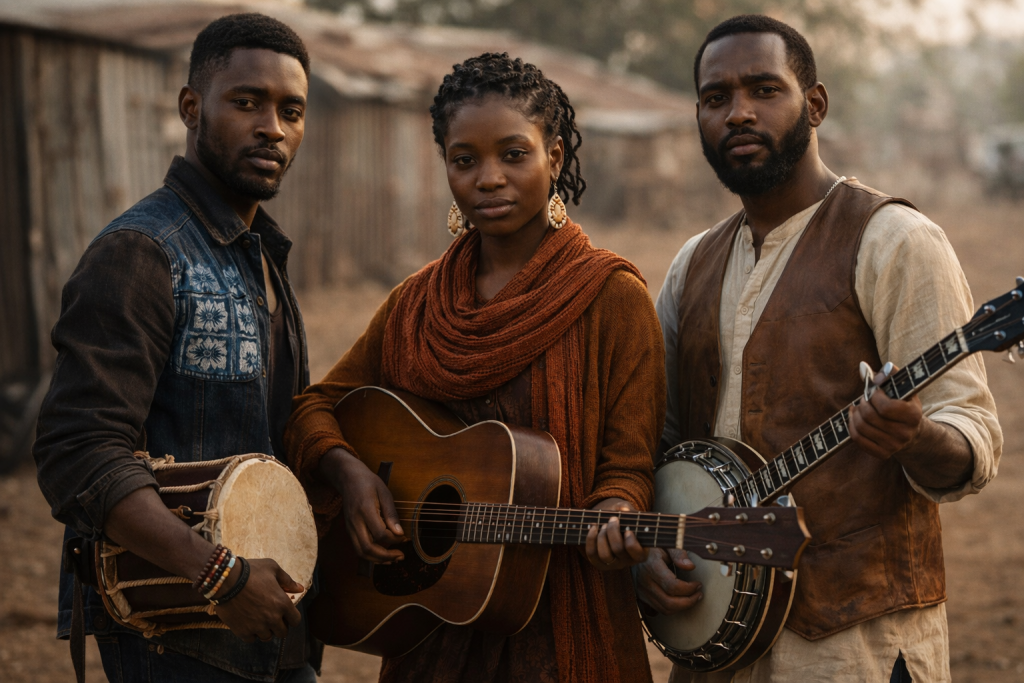
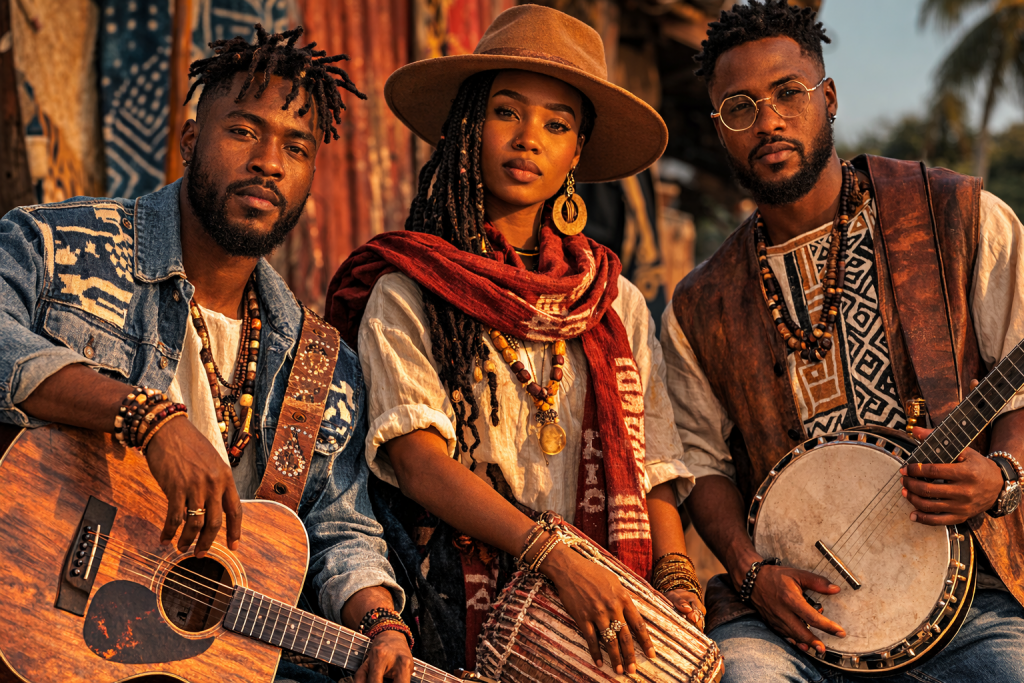
The strongest definition is not “African people doing country,” and not “Afrobeats with banjos.” It is this: Afro-country is African-rooted narrative music that draws on country’s storytelling architecture, acoustic intimacy, and themes of land, memory, migration, work, faith, and love, while being led by African rhythmic logic, African languages or accents, and African lived realities. That is close to the best material in your files, which frames it as “country storytelling + African rhythm systems + Nigerian social reality + frontier/rural identity + contemporary global production.”
That matters because if the definition is weak, the genre becomes a playlist tag. If the definition is strong, it becomes a worldview.
Why is Afro-country emerging now?
It is emerging now because several historical and market currents have converged.
First, there is a wider reopening of country’s Black history. Black Opry explicitly positions country, Americana, blues, and folk as forms Black people have made and loved since their conception, while recent chart events involving Beyoncé and Shaboozey have pushed that conversation into the mainstream. Beyoncé became the first Black woman to top Billboard’s country albums chart in 2024, and by 2025 her Cowboy Carter tour was being framed publicly around the Black roots of country. (Black Opry)
Second, Afrobeats has already proved that a genre can scale globally without waiting for U.S. gatekeepers to authorize it. IFPI reported that recorded-music revenue in Sub-Saharan Africa grew 22.6% in 2024 to about $110 million, passing $100 million for the first time, while Spotify-linked royalty payouts to Nigerian and South African artists rose sharply in 2024. That does not prove Afro-country is a market; it proves that African music ecosystems now have enough momentum to incubate new subcategories locally and diasporically before the U.S. becomes central. (IFPI)
Third, digital culture now rewards hybrids. Your uploaded framework is correct on this point: genres increasingly become legible through scenes, platforms, playlists, and conflict, not just through radio classification. Afro-country is plausible now because audience formation is more bottom-up and algorithmic than before.
Why it could be a good idea
It could be a good idea for four reasons.
1. It has genuine historical logic.
This is the deepest argument in its favor. Afro-country is most defensible when framed not as invention from nothing, but as a re-rooting of a diasporic lineage whose African and Black American components were historically split, commercialized, and unevenly credited. The banjo’s African origins are well documented, and the Black roots of country are increasingly being foregrounded by artists, scholars, and institutions. (folklife.si.edu)
2. It has emotional logic.
Country at its best is music of place, family, work, grief, yearning, endurance, and mobility. Those themes map naturally onto African realities: village-to-city migration, “japa,” land and cattle, church and ancestors, remittance, heartbreak under economic pressure, return, waiting, distance. Your notes are strong here: Afro-country works when it sounds like “Nigerian frontier soul,” not cowboy cosplay.
3. It has market logic as a niche.
Not as a mass genre today, but as a premium niche with sync potential, diaspora appeal, and strong editorial value. African country scenes already exist in Kenya, Malawi, Nigeria, Eswatini, and South Africa, and acts like Dusty & Stones and Peter One show there is already African precedent for country-adjacent practice. (OkayAfrica)
4. It has symbolic power.
Handled correctly, Afro-country says: Black musical memory is not linear, national, or owned by one gatekeeping city. It says Africa is not a late borrower from America, but an active participant in a longer Black Atlantic conversation. That is artistically meaningful.
Why it could be a bad idea
It could also be a very bad idea.
1. It may be too designed.
One of the sharpest insights in your files is that Afro-country currently risks existing as an architecture before it exists as a living scene. Manifesto, branding, visual palette, rollout logic, ethics council, market persona: all of that may be useful, but genres do not become real because documents say so. They become real when multiple artists make undeniable work, listeners repeat the label, and outsiders resist it enough to force its boundaries into view.
2. It may be read as opportunism.
If Afro-country appears only after country becomes commercially fashionable again, critics may say this is trend-chasing dressed up as theory. The timing of the Black-country resurgence gives the idea opportunity, but also suspicion. (AP News)
3. It may create ethical backlash from the very people it claims to honor.
Some Black American artists, scholars, or fans could reasonably ask: if Black people in the U.S. are still fighting for recognition inside country, why should an African rebrand arrive now and claim fresh symbolic territory? That is not a trivial objection; it is perhaps the hardest one.
4. It may become parody.
The moment the music relies on borrowed twang, imported imagery, or template aesthetics rather than African lifeworlds, it stops being a genre and becomes a skit.
Acknowledgement, appropriation, copyright, intellectual property: the ethical center
This is the section that most determines whether the project deserves to exist.
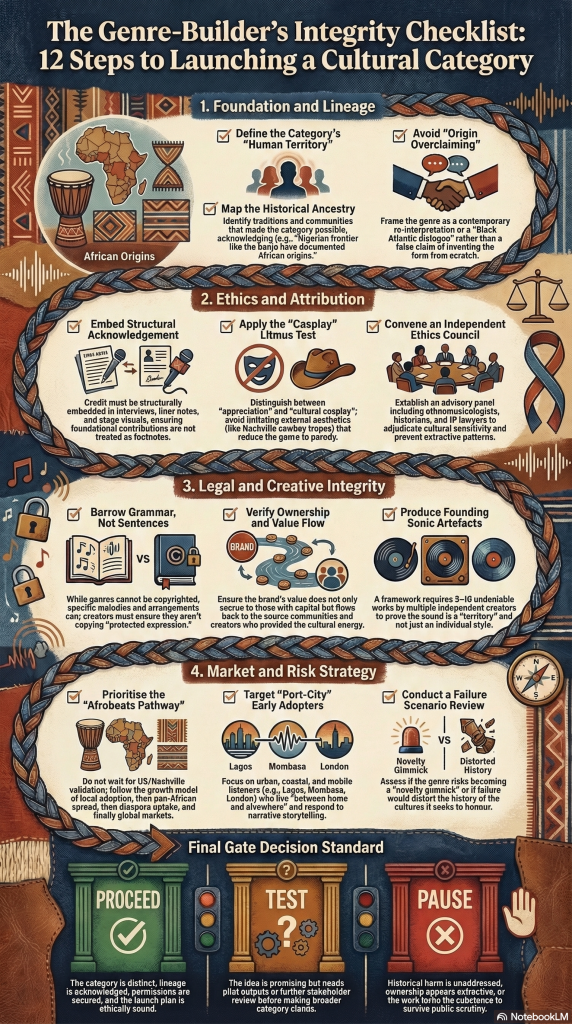
1. Acknowledgement
Acknowledgement cannot be a footnote in a press release. It has to be structural.
That means every serious Afro-country framework should say, plainly:
- country music developed in the United States, but Black musicians were foundational to its ancestry and evolution;
- African instruments and rhythmic logics are part of that long prehistory;
- Afro-country is not a claim that Nigeria or Africa “invented country”;
- it is a new African chapter in a shared Black diasporic musical story. (folklife.si.edu)
Acknowledgement must also be practical: cite lineage in interviews, liner notes, documentaries, stage visuals, educational materials, collaborations, and playlist curation. If it is not embedded in the public narrative, it is not real.
2. Appropriation
The question here is subtle because this is not a simple case of Western extraction from Africa. It is a reverse-direction or circular diasporic problem: what happens when Africans reinterpret a form that emerged in the U.S. but contains deep Black ancestral ties?
My answer is that it is not appropriation by default. But it becomes appropriation when any of the following happen:
- it erases Black American struggle inside country;
- it overclaims African origin in a triumphalist way;
- it uses Black American country as symbolic raw material without relationship;
- it copies surface codes instead of building African substance;
- it centers investors, labels, or strategists before creators and communities.
So the right standard is not “Are Africans allowed to do this?” Of course they are. The standard is: Are they doing it with historical humility, reciprocal credit, and artistic seriousness?
3. Copyright
Legally, you cannot copyright a genre, a vibe, or a style. Copyright protects specific original expressions: songs, lyrics, compositions, sound recordings, and some arrangements. The U.S. Copyright Office is clear that copyright does not protect ideas or systems, while musical works and sound recordings can be protected. That means “Afro-country” as a category is open, but direct melodic borrowing, unlicensed sampling, and too-close derivative arrangements can create legal risk. (U.S. Copyright Office)
So the rule is simple: you may borrow grammar, not sentences.
4. Intellectual property beyond strict copyright
There is also a broader cultural IP issue. WIPO’s work on traditional cultural expressions is useful here: some cultural materials are not neatly protected by ordinary copyright, yet communities still have legitimate interests in how they are used, framed, and commercialized. That is especially relevant if Afro-country draws on oral forms, local motifs, indigenous dress systems, proverbs, or community performance traditions. (WIPO)
So ethically, you need more than copyright compliance. You need:
- consent where identifiable communities are directly involved,
- fair splits and written agreements,
- transparent crediting,
- protection against extractive branding,
- moral rights thinking, not just legal minimums.
How to acknowledge African Americans properly
This is non-negotiable.
If Afro-country is serious, it must openly say that African Americans helped make the conditions for country to exist. Not as a rhetorical concession, but as a constitutive truth. Black labor, Black southern musical forms, Black string-band practice, Black gospel, blues, and the afterlives of African instruments all sit in country’s family tree. Black Opry’s own mission statement rests on the fact that Black people have long been overlooked within country and roots music. (Black Opry)
In practice, that means:
- featuring Black American country artists and scholars in the canon;
- not speaking as though Africa is skipping over the African American chapter;
- treating Afro-country as standing on Black shoulders, not bypassing them;
- supporting collaboration, archival work, and education across the Atlantic.
Without that, the project is morally compromised from the start.
Why the growth path may be Afrobeats-led rather than Nashville-led
This is one of the strongest commercial insights in your material.
Afro-country probably should not seek first legitimacy from Nashville radio, Nashville festivals, or U.S. chart gatekeepers. That route is historically narrow, culturally suspicious of outsiders, and still visibly wrestling with race and belonging. The more plausible route is the Afrobeats route: local scene first, pan-African spread second, diaspora uptake third, editorial/live/sync amplification fourth, and the U.S. last. (The New Yorker)
Why is that smarter?
Because the earliest audience is likely not traditional U.S. country listeners. It is:
African urban listeners with roots sensibilities, diaspora listeners comfortable with multiple identities, Black global audiences newly alert to country’s Black history, and genre-fluid younger listeners discovering music through TikTok, YouTube, playlists, and sync. Your brand notes identify this segment well.
So the first win condition is not “convince Nashville.” It is “make enough undeniable records that a distributed audience starts using the term.”
Market outlook: is it viable?
There is no clean standalone market dataset for Afro-country yet. That is a KU, and pretending otherwise would weaken the analysis. But there are adjacent signals.
Sub-Saharan recorded music revenue is growing quickly. Spotify-linked payouts to Nigeria and South Africa rose strongly in 2024. Country consumption is also expanding in markets like the UK, where BPI and UK-CMA data indicate renewed growth and increasing stream share. Those trends do not prove Afro-country will become a large standalone business, but they do suggest a widening overlap between African export momentum and an expanding appetite for country-adjacent storytelling. (IFPI)
My commercial reading is this:
- in the near term, Afro-country is probably a small market, high-significance niche;
- its best revenue pools are likely streaming, live showcases, sync, documentary/editorial framing, and brand partnerships;
- its biggest strategic value may be category ownership, not initial volume;
- its worst mistake would be forecasting mainstream scale too early.
So if country music is worth X globally, could Afro-country become Y? Yes, but Y should be modeled as a tiny single-digit percentage niche or less in the early years, not as an immediate parallel industry. The attraction is not that it instantly rivals country. The attraction is that it could become a culturally distinct premium lane with export and sync value.
If it fails, what happens?
Failure here would not necessarily mean disappearance.
More likely outcomes:
- it gets absorbed into Afro-folk, alt-Afrobeats, Black Americana, roots-pop, or singer-songwriter lanes;
- it survives as a critical vocabulary rather than a mass consumer genre;
- one or two artists succeed while the label “Afro-country” itself fades;
- it mutates into a broader African roots revival rather than a stable genre.
That would not be unusual. Many genre labels matter most as transitional scaffolding. The lesson from cultural history is that genres often begin as contested naming exercises and only later harden, dissolve, or get replaced. Your own research file makes that point well: genres are built, named, contested, and institutionalized, not born fully formed.
General lessons about building a new creative genre or brand
This case teaches several broader rules.
A new genre needs:
a repeatable sound, a worldview, a creator cluster, a visible conflict, a naming convention, and at least a few undeniable flagship works. A document can help. A manifesto can help. A strategy can help. But without records, artists, and audience ritual, there is no genre.
The work must arrive before the bureaucracy hardens.
The risk in Afro-country is over-governance before evidence. The opportunity is that careful framing can prevent ethical disaster. So the right move is not full institutionalization on day one. It is disciplined prototyping.
Discovery, promotion, and building strategy

The strategy should be narrower and more ethical than a conventional genre launch.
Start with:
a manifesto, yes, but paired with 3 to 8 tracks that genuinely cohere sonically and lyrically; artist-led live sessions; documentary short-form explaining lineage; and curated playlists that place African tracks beside Black American country lineage without flattening differences. This mirrors the strongest thinking already present in your materials.
Promotion should prioritize:
Lagos, Accra, Nairobi, Cape Town, London, Toronto, and diaspora digital spaces before trying to “break” mainstream American country. Sync is especially promising because the form is cinematic by nature.
Artist strategy should prioritize:
writers and performers who already possess roots sensibility, not pop artists wearing the genre for one quarter.
Ethics strategy should prioritize:
an independent advisory circle including African American country voices, West African music historians, and IP counsel. Your documents gesture in this direction; I would make it mandatory.
So: should you or shouldn’t you do this?
Yes, but only under strict conditions.
You should do it if:
- the music comes first;
- the definition is clear;
- Black American lineage is explicitly centered;
- Africa is framed as participant, not conqueror;
- the sound grows from African reality, not U.S. costume;
- the early goal is testing and legitimacy, not hype.
You should not do it if:
- it is mainly a brand deck searching for artists;
- it needs borrowed Americana symbols to feel legible;
- it refuses external ethical critique;
- it overstates market size;
- it treats acknowledgement as a paragraph rather than a structure.
My final judgment is that Afro-country is not inherently a bad idea. It is a fragile idea. It can become either a serious Black Atlantic cultural intervention or a very sophisticated naming mistake.
Right now, the wise posture is not triumph. It is discipline.
Proceed / Test / Pause: Test. Build a pilot body of work, a compact ethics charter, and a cross-Atlantic acknowledgement framework before trying to institutionalize the genre. Pause any grand claims of category dominance until there is a real creator scene and a repeatable audience response.
A few of the older uploaded files appear to have expired on my side, so I worked from the accessible attachments plus current sources. Re-uploading any expired files would let me tighten this further around your full source set.
Abbreviations & Uncertainty Tags: KK = known known,KU = known unknown, UU = unknown unknown
Conclusion
A new cultural brand or genre succeeds not simply because it is catchy or commercially attractive, but because it earns legitimacy across four tests: creative distinctiveness, historical awareness, ethical responsibility, and market resonance.
If you cannot explain what is truly new, what you are building upon, who should be credited, what permissions may be required, and why the category deserves to exist beyond hype, then the idea is not ready. But if you can define the category clearly, locate it within its lineage, honor its precedents, protect yourself legally, and create real value for audiences and communities, then a new category can become more than a label. It can become a meaningful contribution.
The aim is not to avoid influence. Influence is inevitable. The aim is to handle influence intelligently, lawfully, and honorably.
Appendices
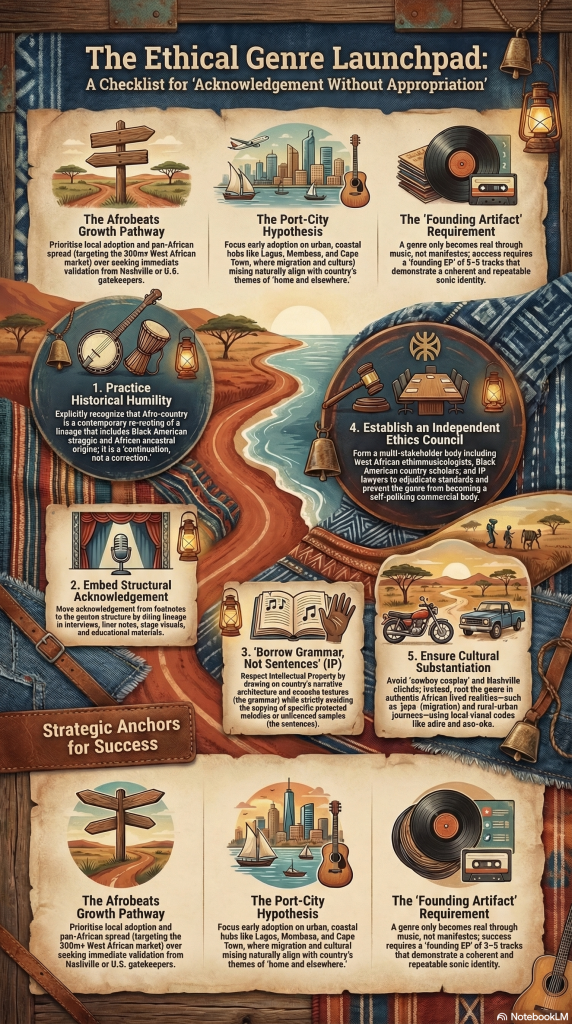
Generic Checklist for Creating a New Brand, Genre, or Category
1. Definition
- Can I define the new category in one clear sentence?
- What makes it genuinely distinct from existing categories?
- Is it a true new category, or just a variation, subgenre, or marketing label?
- Does the name clarify the idea or create confusion?
2. Lineage and Precedent
- What existing traditions, genres, communities, or bodies of knowledge does this build on?
- Who are the major predecessors?
- Which people or groups have historically shaped this space?
- Am I acknowledging the correct lineage publicly and consistently?
3. Cultural Sensitivity and Ethical Positioning
- Does this idea draw from a culture, community, or tradition that has been historically marginalized, exploited, or miscredited?
- Am I benefiting from cultural work others were denied recognition for?
- Have I distinguished inspiration from extraction?
- Is my framing respectful, accurate, and accountable?
4. Authorship and Credit
- Have I properly credited collaborators, influences, source communities, and originators?
- Are there liner notes, public statements, educational materials, or brand language that should include explicit acknowledgement?
- Who might feel erased if this category is presented carelessly?
5. Copyright and Intellectual Property
- Am I borrowing only general ideas and influences, or am I copying protected expression?
- Have I checked for risks involving melody, lyrics, design, trademarks, trade dress, samples, recipes, scripts, visual identity, or proprietary methods?
- Are permissions, licenses, clearances, or contracts required?
- Is the category name legally usable and protectable?
6. Community and Stakeholder Impact
- Who benefits if this succeeds?
- Who may be harmed, displaced, or misrepresented?
- Have I consulted people with real knowledge of the tradition or area?
- Is there a fair way to include origin communities, experts, or collaborators in the value created?
7. Creative Integrity
- Is the work artistically compelling without the story around it?
- Would the idea still matter if the marketing language disappeared?
- Is this culturally alive, or just conceptually clever?
- Does the execution feel authentic, serious, and sustainable?
8. Market Viability
- Is there a real audience for this, or only curiosity?
- What problem, desire, identity, or emotional need does this category serve?
- Is the opportunity niche, premium, mass, or speculative?
- What evidence supports demand?
9. Positioning and Narrative
- Can I explain why this should exist now?
- Is the public story honest and historically sound?
- Does the narrative overclaim, oversimplify, or erase complexity?
- Am I launching a category, a movement, a product line, or simply a campaign?
10. Governance and Risk
- What are the reputational risks?
- What are the legal risks?
- What are the ethical risks?
- What criticism is most likely, and is it fair?
- Do I have a response framework before launch?
11. Testing and Validation
- Have I tested this with audiences, experts, and affected communities?
- Are people organically using the language or category?
- Does the category make sense outside my internal team?
- What evidence would prove the concept is working?
12. Longevity
- Can this category grow beyond a moment or trend?
- Does it rely on one personality, one market, or one platform?
- If it fails, does it fold into an existing category or damage the brand?
- What would success look like in 1 year, 3 years, and 10 years?
13. Final Decision Questions
- Should this exist?
- Why does it deserve to exist?
- What is new here?
- What is inherited here?
- Who must be acknowledged?
- What must be protected?
- What must be avoided?
- What would an ethical launch look like?