The Global South Smartphone Opportunity: Could Two Screens Create a New Affordable Premium Market?
Preamble
The global smartphone market presents an interesting opportunity for manufacturers, technology entrepreneurs, investors and software developers willing to reconsider an idea that has already been tried: the dual-screen smartphone.
This article is not proposing an entirely new technology. Instead, it explores whether existing rigid OLED displays, conventional hinges, affordable Android hardware and increasingly mature multitasking software could be combined into a commercially viable smartphone designed for the needs of the Global South.
The central question is whether two separate screens could deliver greater practical value than expensive foldable displays, particularly for content creators, small businesses, mobile professionals and people who increasingly depend on smartphones to generate income.
The scale of the potential market deserves attention.
According to the GSMA’s 2026 State of Mobile Internet Connectivity research, approximately 4.8 billion people worldwide used mobile internet by the end of 2025. Earlier GSMA research established that around 3.3 billion people in low- and middle-income countries were already connected in 2024. These figures illustrate the enormous scale of mobile connectivity across emerging economies, although mobile internet users should not be confused with smartphone owners.
The smartphone market also reveals distinct purchasing segments. Research from Omdia indicates that approximately 1.25 billion smartphones were shipped globally in 2025, with substantial differences in consumer purchasing power.
Using indicative international price categories:
| Smartphone category | Price range | Global shipments, 2025 |
| Entry-level and budget | Below $200 | Approximately 502 million |
| Lower and mainstream midrange | $200–$399 | Approximately 282 million |
| Upper midrange and affordable premium | $400–$799 | Approximately 194 million |
| Premium and flagship | $800+ | Approximately 263 million |
These figures describe worldwide annual smartphone shipments, not the number of existing users in the Global South. Comparable, reliable ownership figures broken down by these price categories across all Global South countries are not readily available. Establishing them is an important part of the proposed market research.
Nevertheless, these figures reveal an important commercial opportunity. More than 470 million smartphones shipped globally in 2025 were priced at $400 or above, illustrating a substantial market for customers willing to pay more for additional functionality.
India provides a particularly interesting example. Counterpoint Research reported that smartphones priced above ₹30,000 represented approximately 22% of Indian shipments in 2025, suggesting an expanding market for premium features, although this does not establish demand for dual-screen devices.
The opportunity may lie between conventional midrange phones and expensive foldables.
Rather than competing directly with flagship phones costing $1,500 or more, a dual-screen smartphone priced around $499–$699 could be investigated as an affordable productivity and content-creation platform.
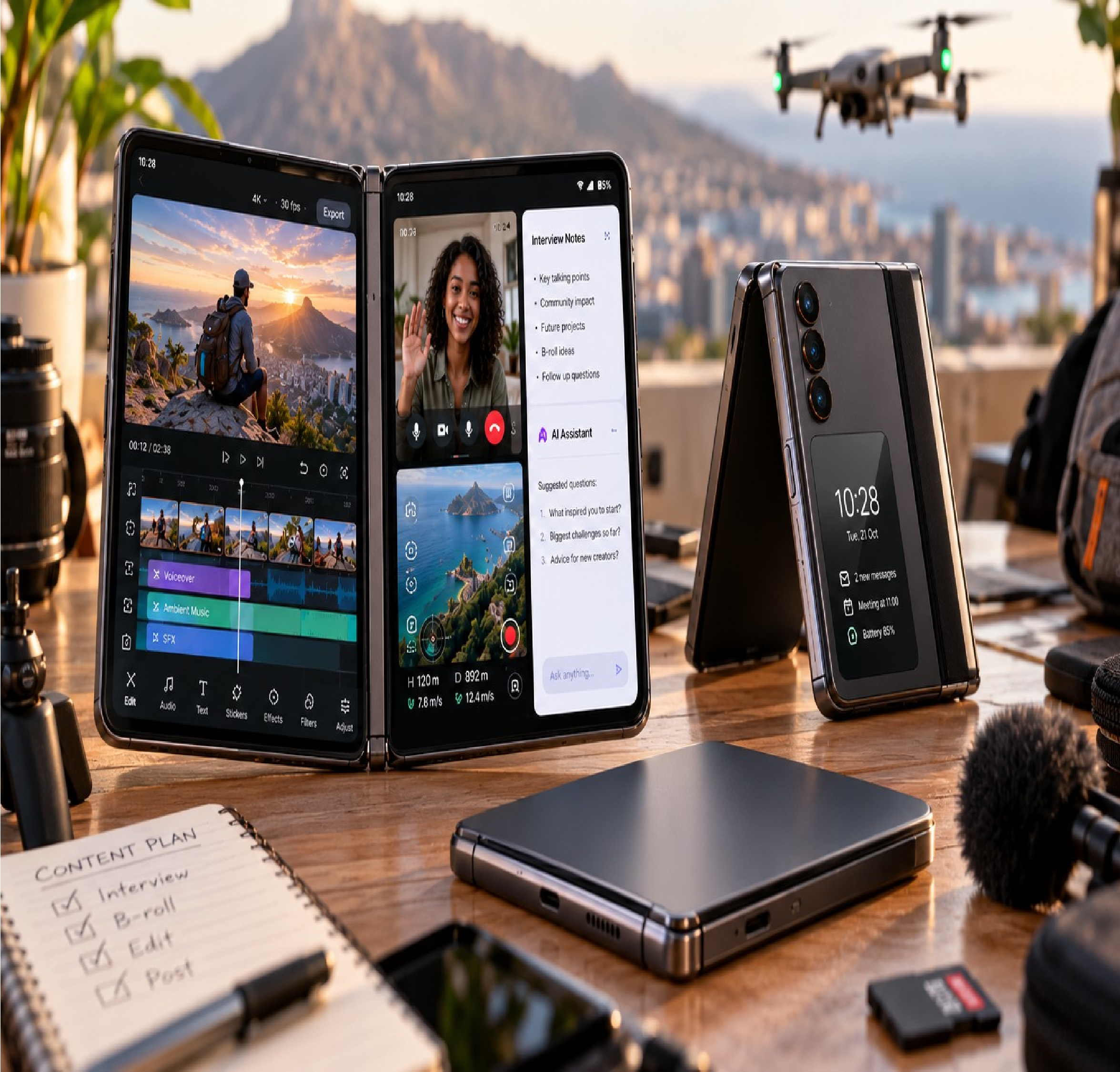
Imagine a mobile journalist conducting an interview while displaying questions and recording controls, a creator editing video while consulting an AI assistant, or a small business owner managing orders and customer communications simultaneously.
A hinged, two-screen device could also become a self-supporting miniature workstation, without requiring the cost and complexity of a continuous flexible display.
However, affordability remains a significant barrier. The GSMA reported in September 2026 that an entry-level internet-enabled handset could cost the poorest 20% of people in low- and middle-income countries approximately 44% of their monthly income, rising to 76% in Sub-Saharan Africa. A $699 device would therefore address a specific income and productivity segment, not the entire emerging-market population.
An Opportunity for Investigation, Not a Proven Business Case
This article offers an initial research and product strategy brief for entrepreneurs, smartphone manufacturers, Android developers, designers and investors interested in evaluating the commercial potential of a modern dual-screen smartphone.
It examines why earlier devices struggled, what has changed in Android, which applications could benefit, how manufacturing economics might work, and which markets offer the strongest opportunities.
India, Indonesia, the Philippines, South Africa, Brazil, Kenya and Nigeria are among the potential markets worth investigating, although their attractiveness will vary significantly by price point, customer segment and distribution model.
The objective is not to claim that dual-screen smartphones will succeed. It is to identify whether a combination of mature technology, real customer needs and accessible pricing creates an opportunity worth validating.
Perhaps the next meaningful smartphone innovation is not a more expensive folding screen, but two conventional screens working intelligently together.
DUAL-SCREEN SMARTPHONE REVIVAL 2026–2030 | Global South
Strategic, commercial, technical and product feasibility
DRAFT • INVESTMENT POSTURE: TEST EXECUTIVE VERDICT
The investment decision
RECOMMENDATION • Prototype and validate. Do not authorise mass production
$599–699 Retail price band to test
3 markets
India, Indonesia, South Africa
16 weeks
Controlled validation programme
What looks promising
Discrete screens can support independent tasks, mobile
content creation, interviews, commerce and AI-assisted
workflows.
What is unproven
Customers’ willingness to pay; genuine task improvements;
third-party app compatibility; manufacturing economics.
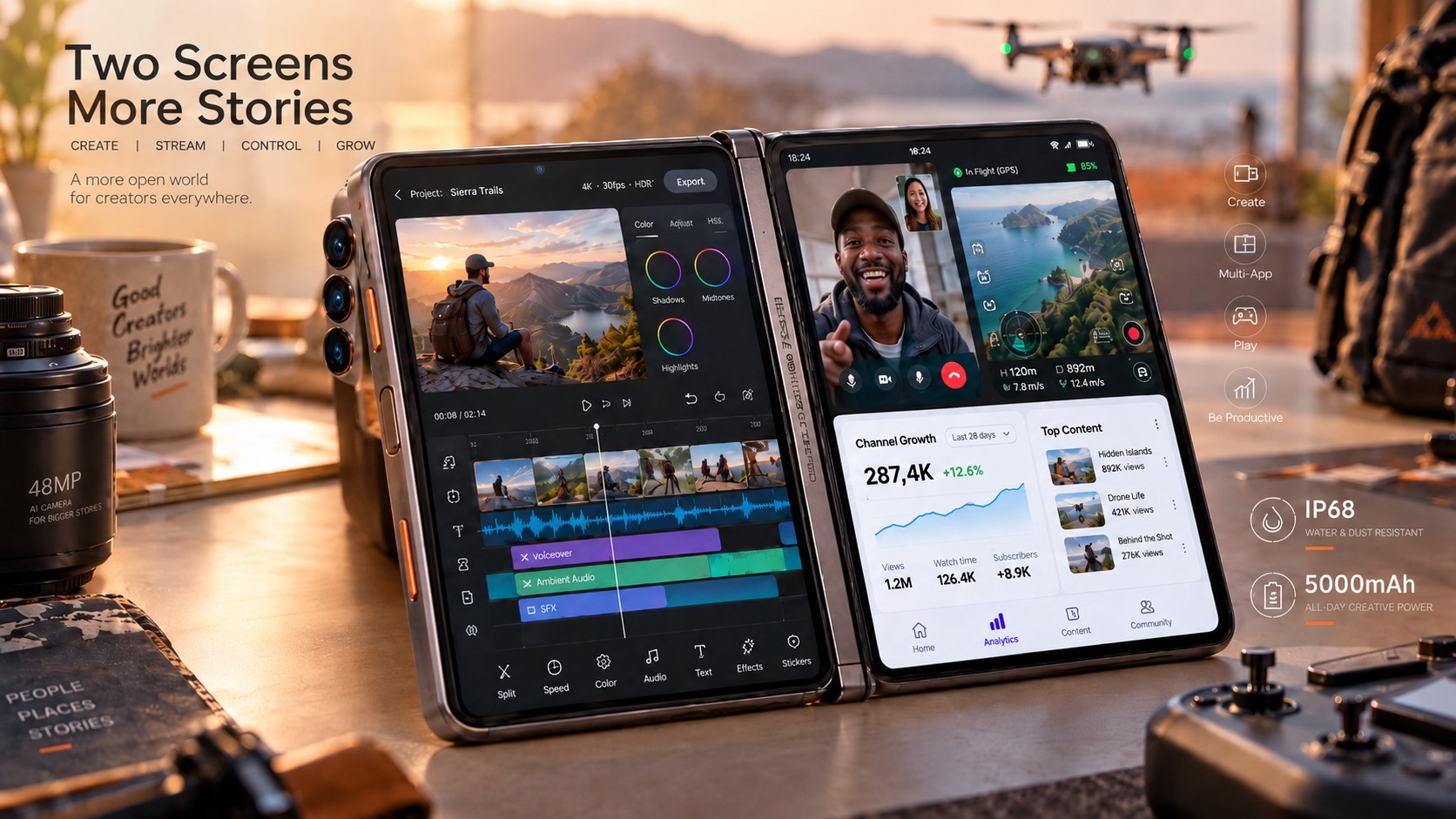
A mobile workstation, not a cheap foldable
Positioning
One phone for recording, editing,communicating and selling. The value is simultaneous useful work, not novelty.
Competitive proposition
Compared with a flexible OLED foldable: lower price potential, rigid screens and separable tasks. But no continuous canvas.
HISTORICAL LESSONS
Why previous dual-screen phones struggled
Failure was multi-causal. Improving Android alone does not guarantee commercial success
Device / era /Intended advantage/ Dominant limitation
Kyocera Echo 2011 Two-app use/Weak battery and app support
Sony Tablet P / NEC Medias W Portable dual-display/Inconsistent experiences
ZTE Axon M 2017 Flexible display modes/ Bulk and limited optimisation
LG G8X / V60 2019–20 Detachable extra screen/Accessory bulk and app friction
Microsoft Surface Duo 2020–21 Mobile productivity ,Price, execution, app and ergonomics
Why the opportunity is stronger in 2026
01 Android is adaptive
Large-screen patterns, multi-window and hinge-aware APIs have improved significantly.
02 Phones are production tools
Creators increasingly shoot, edit, publish and communicate using mobile devices.
03 Mobile AI is more capable
An assistant can remain visible alongside the source task andoffer contextual help.
04 Foldables provide a price anchor
The premium foldable category creates room for a lower-priced, workflow-led alternative.
ANDROID ECOSYSTEM
Android readiness: strong foundations, not a finished product
Android 16–17 large-screen rules do not automatically apply to two narrow independent displays.
Platform component /Readiness/Product work needed
Multi-window / multi-resume
Established : Stability and focus management
WindowManager / folding feature
Established: Reliable posture + gap awareness
Adaptive layouts / Compose
Established: Dual-pane optimisation
Drag and drop
Conditional: Per-app compatibility tests
Display routing / continuation
Partial: Custom OEM integration
Cross-app AI orchestration
Partial:Consent, SDK, app partnerships
INFERRED ENGINEERING SCORES
Software readiness depends on the workflow
| Productivity
Communications Education AI assistance |
80/100
80/100 75/100 70/100 |
Commerce
Gaming Creator editing Drone control |
70/100
60/100 55/100 40/100 |
Illustrative assessment, not measured application compatibility or market adoption.
FORM-FACTOR OPTIONS
Three display architectures to validate
A • Two displays, 360° hinge
One panel can face outward when closed. Potentially best economics, but exposed glass and camera geometry need testing.
B • Two plus small cover
A compact notification and call screen improves closure use. Adds moderate BOM and UI cost.
C • Two plus full cover
Best conventional-phone experiencebut a three-display device with higher weight, cost and energy consumption.
Test A as the primary cost hypothesis; keep B and C as comparison prototypes.
Creator Studio: the most convincing lead use case
Timeline + library without context switching
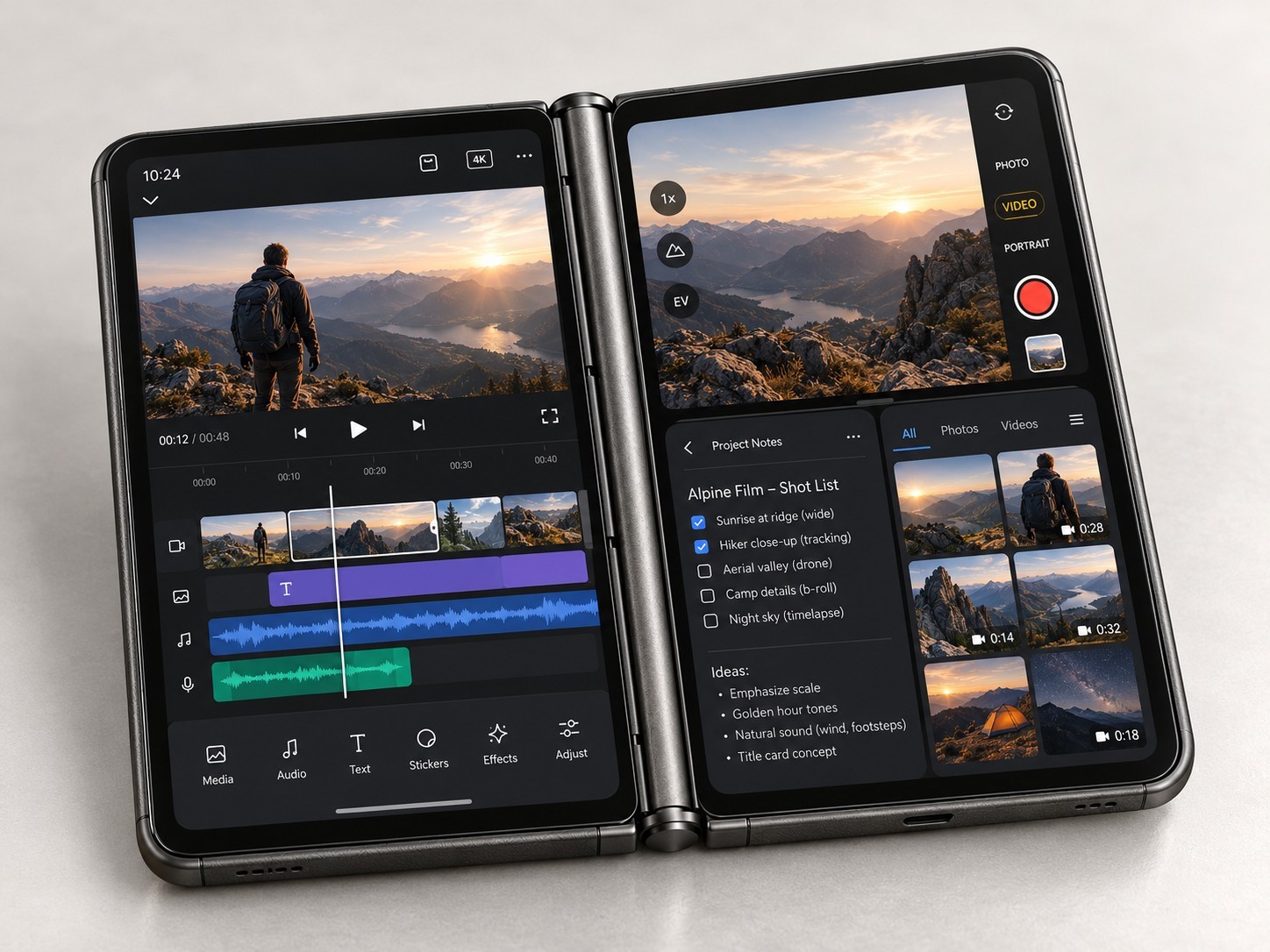
Preview + editing controls independently visible
Capture, transcribe and reference notes
AI assistance beside the working task
Record workflow time, interruptions and usage
The phone becomes a portable production studio
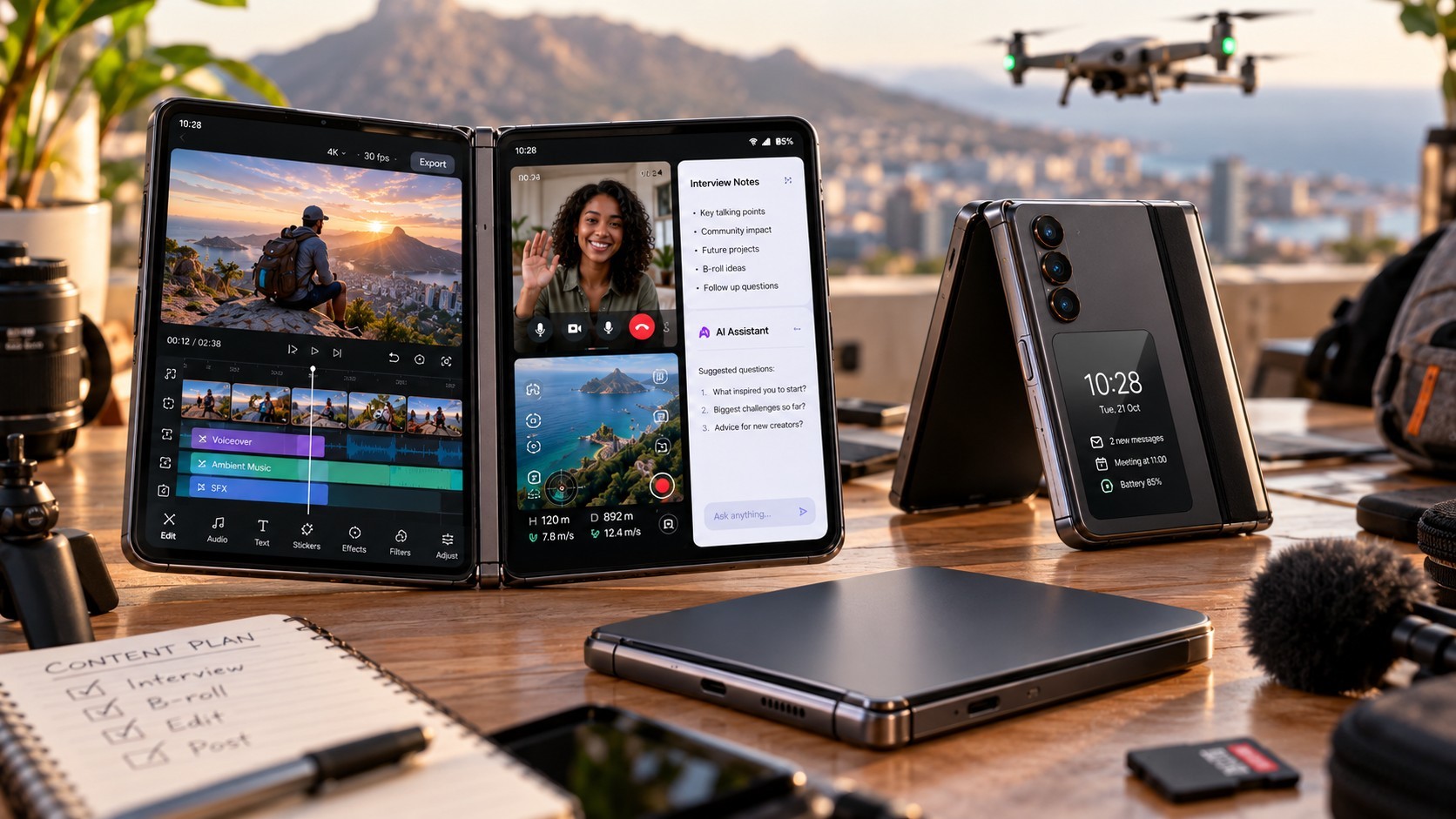
Interview and desk mode
Hinge serves as support; outward-facing camera records the subject; interviewer sees notes and recording controls.
Engineering requirement
Verify lens sightline, balance, audio quality, thermal stability and consent-aware capture while the second display is active.
Novel applications with genuine two-sided value
Merchant
Staff console + customer-facing transaction
Translator
Speaker language + listener language
Drone
Camera feed + telemetry / controls
Education
Lesson + notes or AI tutor
Field service
Live equipment view + repair workflow
Journalism
Subject recording + scripts and notes
Screen orientation and real integration rights determine feasibility, not the concept image.
SEGMENT PRIORITY: These are willingness-to-pay hypotheses, not validated purchasing behaviour.
Prioritise customers by task intensity
Rank/Segment/Primary value
Price hypothesis
1 Working creators Edit, research, publish $599–799
2 Mobile entrepreneurs Customers + orders + payments $499–699
3 Journalists Capture + notes + publishing $599–899
4 Mobile professionals Documents + meetings + AI $599–899
5 Educators / learners Lessons + active notes $399–599
6 Drone operators Live feed + flight information $699–899
GO-TO-MARKET
Market ranking: start with three countries
Priority /Market/Strategic role/Primary issue
1 India Large-scale creator and professional test Price and intense competition
2 Indonesia Creator + mobile commerce adoption Channel and localisation
3 South Africa Premium-value professional pilot Smaller scale
4 Philippines Communications + social creators Financing affordability
5 Brazil Later professional expansion Taxes and import economics
6 Vietnam High-performance midrange users Strong incumbent brands
Ranking is analyst judgement and must be revisited at each tested retail price.
DESIGN LANGUAGE
Industrial design: premium, but commercially credible
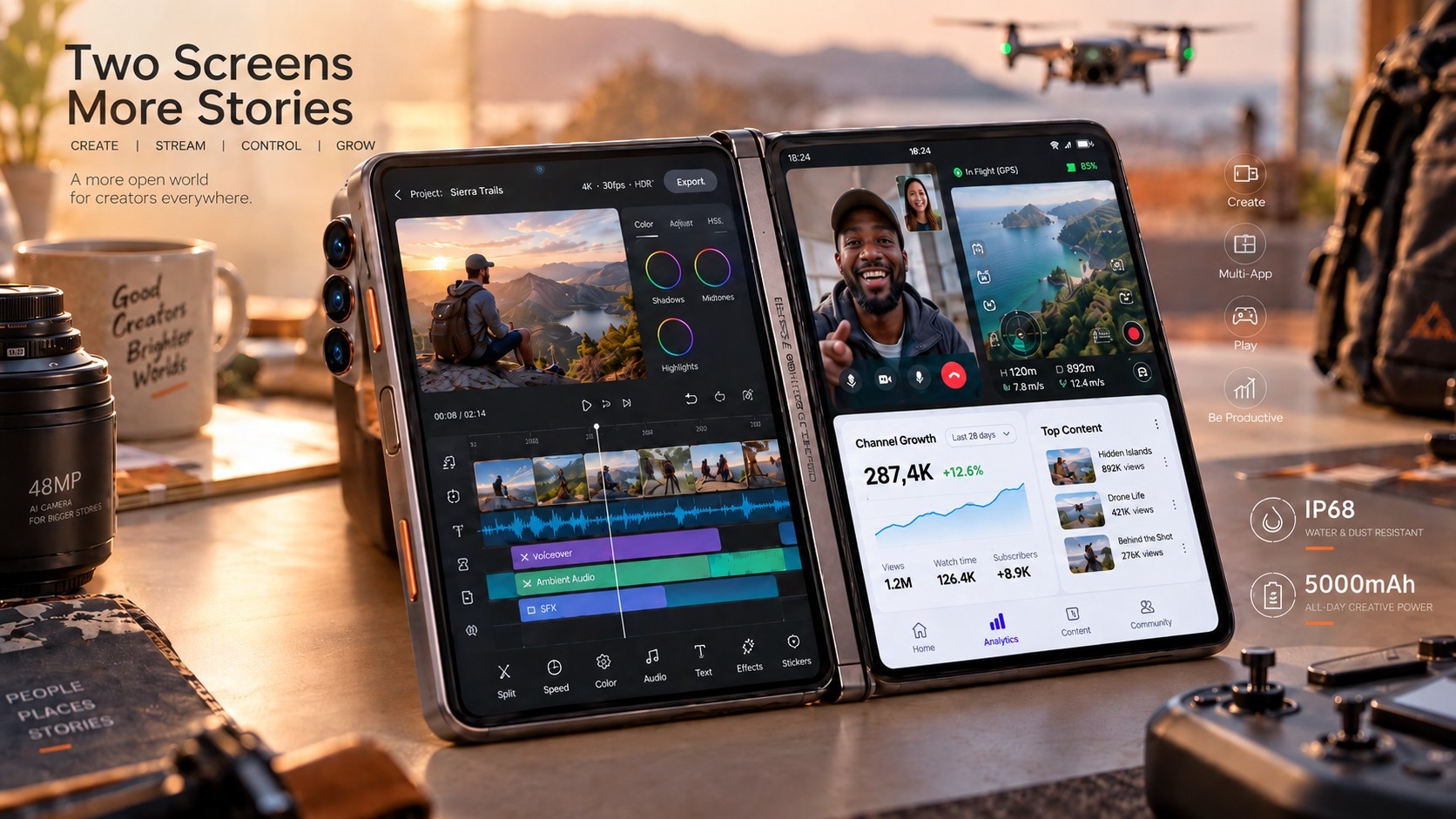
Matte graphite / restrained copper detailing
Precise hinge and symmetrical bezels
Meaningful camera system, not decorative lenses
Balanced closed-phone ergonomics, Repairable individual rigid displays, if feasible IP rating only after validated testing
CANDIDATE PRD
Hardware baseline: standard two-panel product
System/Candidate specification/Test priority
Display × 6.1″ rigid OLED; FHD+; 90–120 Hz ,2.Independent power and brightness
Chip / memory Upper-midrange 5G; 12 GB / 256 GB, Concurrent video + editing
Camera / audio 50MP OIS; stable 4K30; external mic, Desk capture and thermal stability
Battery / charge 5,000–5,800 mAh; USB-C PD, Dual-active and single-use runtime
Hinge / frame Multi-angle; 200k cycle target ,Drop, dust, stiffness and balance
Connectivity Dual subscription; Wi-Fi 6; NFC, Country-specific certification
Support / security Five-year security target, OTA, repair and secure inputs
9 mm closed thickness and IP68 are not accepted production claims.
SOFTWARE PRD
Dual Workspace OS: where product value is built
WORKFLOW EXPERIENCES
Creator | Interview | Commerce | Education | AI
▼
OEM WORKSPACE SERVICE
App pairs | Posture | Display routing | Camera orchestration
▼
ANDROID FRAMEWORK
WindowManager | multi-window | Adaptive layouts | Permissions
▼
Hybrid screen abstraction, deployed in phases: robust independent apps first
HARDWARE / HAL
Rigid OLEDs | Hinge | Cameras | SoC | Battery
SOFTWARE PRD
Software release: make five workflows excellent
MUST • App pairing
One-touch launch, screen swap and reliable task continuation.
MUST • Interview mode
Camera, recording controls, notes, microphone andpermissions.
MUST • Creator workspace
Editing plus reference or asset panel, without app-breaking assumptions.
MUST • Secure independent tasks
Protect payment, work, personal and sensitive information.
MUST • Graceful fallback
Unsupported apps work reliably as conventional one-screen applications.
COST ESTIMATE • NOT QUOTATIONS
Illustrative hardware bill of materials
Dual OLED display assemblies$76
5G SoC / modem$60
RAM + storage$35
Camera modules$33
Hinge and interconnect$24
Frame and housing$24
Other electronics, RF, audio$60
Battery and charging$15
Thermal components$8
Factory assembly and test$20
Baseline totals $355 per unit; exclusions include warranty, distribution, overhead and R&D.
$355illustrative base product cost
COMMERCIAL SENSITIVITY
Pricing: $699 is plausible, not guaranteed
Retail/Net proceeds/Gross profit/Pre-warranty margin
$499,$372,$17,4.6%
$699,$521,$166,31.9%
$899,$670,$315,47.0%
$1,099,$819,$464,56.7%
ASSUMPTIONS
Product cost $355; 10% tax; 18% channel deduction; no warranty, marketing or R&D.
BUSINESS CASE
Economics and investment need an OEM partner
$8–20m Indicative development programme
80k Units to recover $12m at $150 contribution
160k Units at $75 contribution
Preferred operating model
Co-develop with an Android OEM/ODM. Reuse chipset support,production processes, certifications, distribution and repair.
Main threat
Third-display costs, lower yields, software support obligations and channel economics can erode the intended price advantage.
These are scenario calculations, not supplier bids or unit-sales forecasts.
COMMERCIAL VALIDATION
16-week evidence programme
WEEKS 1–3
Discover–120 interviews in 80 countries 3
WEEKS 3–6
Prototype architectures, 3 Android compatibility
WEEKS 6–10
Observe 40–60 user task trials
WEEKS 10–13
Price test 500+respondents, competing devices
WEEKS 13–16
Decide Supplier quotes, risks, investment gate
Pre-register test thresholds and decision owners before trials begin.
APPROVAL GATES
What evidence authorises progression?
Dimension/Proposed threshold/Method/Utility % improvement on 3 tasks 20≥Controlled task comparison
Habit 50 % Use 4 days/week≥Diary and consented telemetry
Usability 80 % unassisted completion≥Observed testing
App support 95 % priority test cases pass≥Compatibility regression
Economics Positive contribution after warranty, Supplier and channel quotes
Reliability No critical test failure, Qualified test programme
Approval required from product sponsor, technical lead and investment owner.
FINAL RECOMMENDATION
Decision: TEST, do not yet scale
Proceed with proof, not production
Build a functional Android prototype. Run comparative creator and merchant tasks. Validate willingness to pay at $599–$699.
Quote a two-panel assembly and alternative form factors.
Investment blockers
No proven paying segment; no live BOM quote; no lab-tested app compatibility; no validated hinge, thermal, battery or water-resistance performance.
NEXT DECISION • Approve scope and budget for discovery + Android feasibility prototype.
Research notes and sources
The market figures above are grounded in published research:
– GSMA, September 2026: 4.8 billion mobile internet users worldwide in 2025; handset affordability remains a major obstacle.
GSMA +1 – GSMA, 2026 methodology: Approximately 3.3 billion mobile internet users in low- and middle-income countries in 2024.
GSMA – Omdia, 2025 shipment data: Price-band figures are rounded from reported shipments and total approximately 1.24 billion units.
Semiconductor Today +1 – Counterpoint Research, February 2026: India’s premium-priced segment exceeded one-fifth of shipments.
- Concept imagery: three user-supplied product renders (illustrative, not engineered prototypes).
- Background: IdeasWiz January 2026 article; Why Dual-Screen Smartphones Could Beat Foldables in 2026 | Market Analysis
- Android Developers adaptive APIs and WindowManager guidance.
- Market context: GSMA Africa studies and Counterpoint India research cited in the original report.
- All costs, pricing, readiness scores, rankings and volumes are hypotheses until independently validated.
DOCUMENT STATUS: DRAFT • NOT AN APPROVED COMMERCIAL FORECAST, MANUFACTURING SPECIFICATION OR INVESTMENT MEMORANDUM