Preamble: Beyond the Deliverable: Reciprocal Learning and the Knowledge Dividend
Over the years, working across different organisations, projects and programmes, I’ve often wondered whether we make full use of the knowledge and experience that contractors and consultants bring into the workplace.
We employ them to deliver specific outcomes, yet their wider experience of other organisations, industries, methodologies and working practices may offer considerable additional value. Equally, consultants learn from the organisations they serve, sometimes discovering approaches, capabilities and lessons they had never encountered before.
Much of this learning happens informally, and some of it disappears when an engagement ends.
This raises an interesting question: could organisations and external specialists gain more from these relationships through a few deliberate conversations and opportunities for knowledge exchange, without creating another costly or bureaucratic process?
Not every engagement will justify the effort. Existing mentoring, training and knowledge-management arrangements may already provide better alternatives.
This article explores where the opportunities lie, when they are worth pursuing and how both parties might benefit from what I call the knowledge dividend. Read the detailed Research article: [Detailed article ]
We hire contractors and consultants for their expertise. But how much of that expertise do we actually retain, what do they learn from us, and when is the additional effort of knowledge transfer genuinely worthwhile?
The value we may be overlooking
Imagine a consultant who has spent six months working inside an organisation.
The assignment is completed. The agreed deliverables are accepted. The invoices are paid. The consultant packs up and moves on.
By conventional measures, the engagement may have been entirely successful.
But consider a few additional questions.
What did the organisation learn beyond the formal deliverables? What knowledge did its permanent employees acquire? Did the consultant notice weaknesses, duplication or opportunities for improvement outside the immediate assignment? Did they discover something that the organisation does particularly well?
And, perhaps most interestingly, what did the consultant learn from the organisation?
Over the years, I have observed how much experience contractors and consultants bring into an organisation, often considerably more than their formal responsibilities require.
They may have worked across multiple sectors, encountered different operating models, used alternative methodologies, implemented a variety of tools and witnessed both successful and unsuccessful transformations.
Yet much of that experience remains untapped.
We employ people to complete particular tasks, and understandably concentrate on delivery.
Meanwhile, valuable knowledge passes through the organisation, sometimes without being recognised, shared or retained.
I have come to think of this potential additional value as the knowledge dividend.
It is not a new management theory, nor am I suggesting that every consultancy contract should include an elaborate knowledge-transfer programme.
Quite the opposite.
The question is whether we can obtain more mutual value from external engagements through a few better questions, some deliberate learning opportunities and better use of the organisational arrangements that already exist.
There is also a condition worth stating from the outset.
Not every engagement is suitable, and sometimes doing nothing additional is the right decision.
We hire for the task, but expertise rarely arrives in neat compartments
Consider an experienced business analyst employed to support a particular project.
The organisation may need requirements documentation, process models or stakeholder analysis.
But the analyst might also have considerable experience in organisational design, business architecture, procurement, governance, software licensing, transformation programmes or workforce development.
An engineer might bring knowledge of maintenance practices from another industry. A programme manager may have witnessed several unsuccessful initiatives and understand why particular approaches repeatedly fail.
A finance consultant might have encountered more effective reporting and control arrangements elsewhere.
Of course, their expertise must be relevant, credible and applicable to the organisation concerned.
Experience in one environment does not automatically translate into competence in another.
Nevertheless, it is worth asking whether the organisation understands the broader capabilities of the people it has engaged.
Most organisations review CVs, experience and qualifications before appointing external specialists.
But the assessment generally concentrates on the work being commissioned.
How often do we then ask:
What other experience are you bringing that might be useful to us, and where does your expertise end?
That second part matters. Good professional judgement includes recognising the limitations of one’s own knowledge.
A consultant who openly acknowledges those limitations may be considerably more useful than someone who appears to have an answer to everything.
Knowledge transfer works in both directions
There is a tendency to think about consultants as people who bring knowledge into an organisation.
But organisations are also environments in which consultants learn.
They encounter different cultures, governance structures, ways of collaborating, processes, technologies and approaches to solving problems.
They may discover practices that are more effective than their preferred methods.
They may see employees overcoming operational challenges that would be difficult to appreciate from outside.
They may also discover why a method that works beautifully in theory fails under particular organisational conditions.
This is an important part of the relationship.
The consultant is not necessarily the most knowledgeable person in every room.
An experienced external engineer may possess exceptional analytical expertise, while a permanent operator understands the practical behaviour of a production process in far greater depth.
Together, they may arrive at a solution neither could have developed independently.
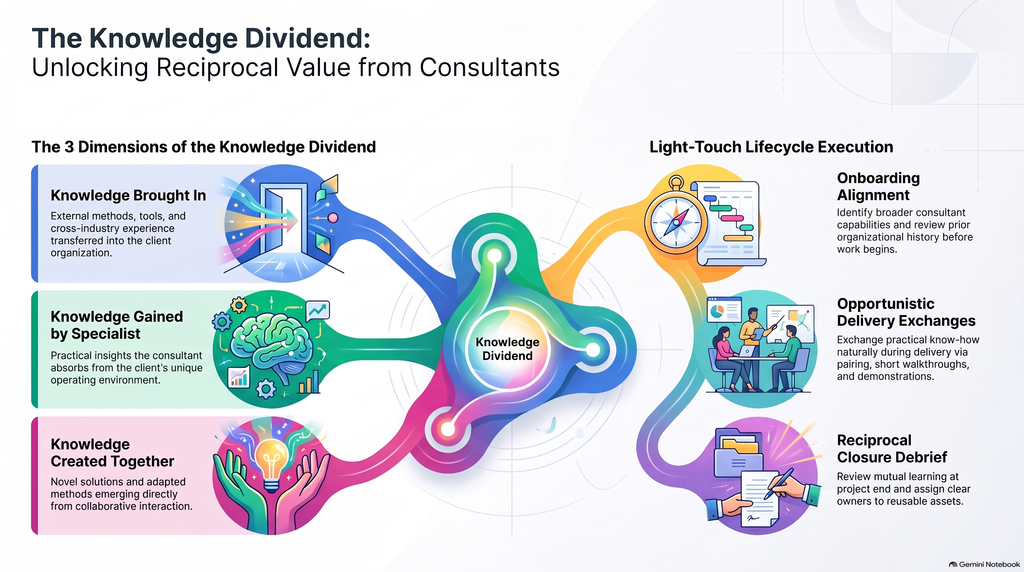
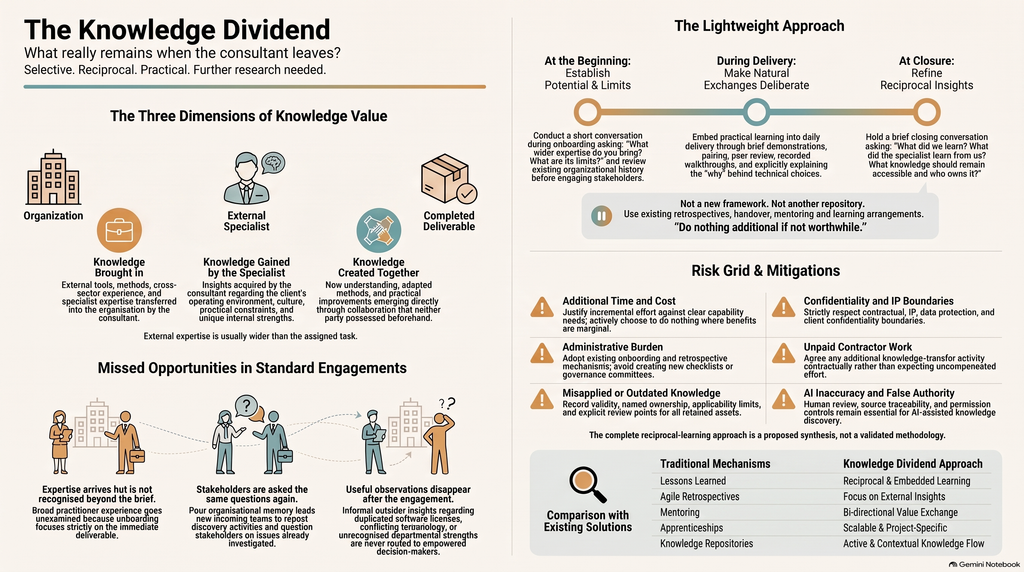
That creates three kinds of knowledge value:
Knowledge brought into the organisation. External expertise, methodologies, experience and techniques.
Knowledge gained by the specialist. Understanding acquired from the client’s people, processes, practices and particular operating environment.
Knowledge created together. New approaches, adapted methods, shared insights and practical improvements emerging from collaboration.
This third category is especially valuable because it recognises that knowledge is not always transferred as a finished product.
Sometimes it is created through working together.
Research by Andrew Sturdy, Karen Handley, Timothy Clark and Robin Fincham challenged the simplified view that consultants merely disseminate business knowledge to clients. Their work suggests that knowledge flows in consultancy projects are more complex than that conventional description implies.
That seems consistent with what many practitioners experience.
We learn from the organisations in which we work, just as those organisations may learn from us.
The question is whether anyone asks us to reflect on that exchange.
The organisation may not recognise what it already does well
An external consultant can sometimes identify strengths that an organisation has stopped noticing.
Perhaps a department has developed an unusually effective way of managing operational risks.
Perhaps one team has a successful process for coordinating work that neighbouring departments could adopt.
Perhaps a particular employee has developed considerable skill in a methodology that the wider organisation barely understands.
The consultant may encounter these practices and recognise their value because they have experience of alternatives.
But where does that observation go?
Sometimes nowhere.
It remains an informal conversation with another contractor or a comment made after a meeting.
The same applies to weaknesses.
A consultant might notice several departments buying similar software licences independently, multiple projects recreating comparable models, or different teams developing conflicting terminology for the same business concepts.
Such observations do not automatically mean the organisation is doing something wrong. There may be valid reasons for the differences.
Nevertheless, they may deserve investigation.
A simple opportunity exists in asking external specialists what they have observed, what the organisation appears to do particularly well and which issues may warrant further consideration.
The organisation can then evaluate those observations through its normal management and governance arrangements.
The consultant provides insight. The organisation decides whether that insight has merit.
No new committee is needed.
Another project, another set of familiar questions
There is a related organisational problem that deserves attention.
I have seen situations where a new project or programme begins, accompanied by a new group of contractors or consultants, and stakeholders are asked questions they have already answered several times.
Perhaps the initiative has previously been attempted.
Perhaps earlier funding was withdrawn, technology changed, organisational priorities shifted or the work was abandoned.
A new programme may be entirely justified.
But that does not mean everyone should begin from scratch.
Imagine being a stakeholder asked for your requirements for the third time, without anyone acknowledging what happened to your previous contributions.
It can be frustrating.
It also risks undermining confidence in the initiative before meaningful work begins.
Would it not be better if the organisation and the incoming specialists first examined the available history?
What was previously attempted? What was accomplished? What remained unresolved? Why did the initiative stop? Which assumptions have changed?
The next stakeholder conversation could then begin differently:
We understand that this was attempted previously and that you contributed to it. Here is what we have found. What has changed, what remains relevant and what needs to be reconsidered?
That is a considerably more informed and respectful starting position.
It also illustrates why knowledge retention matters long after a consultant has left.
There are already opportunities to learn during delivery
Much of the most useful knowledge exchange happens naturally.
Someone demonstrates a modelling technique during a workshop. An experienced practitioner explains why they chose one approach over another. A colleague observes how a difficult problem is resolved.
An external specialist learns why an organisation’s standard process contains an unusual exception.
These exchanges do not necessarily require formal training sessions.
Sometimes thirty minutes spent explaining the reasoning behind an approach can be more useful than producing another lengthy document.
Other possibilities include practical pairing, brief demonstrations, peer reviews, mentoring conversations, visual process maps and short recorded walkthroughs.
Modern collaboration tools can make some of this relatively straightforward.
But we should avoid assuming that because something has been recorded, knowledge has been transferred.
A fifteen-minute video that nobody can find or understand is not necessarily an organisational asset.
Equally, watching someone perform a task does not mean the observer has acquired the competence to perform it independently.
The real test is whether knowledge can be understood and applied.
And we should remember that what appears to be spare time on a project is not automatically free time.
Contractors have agreed responsibilities. Learning activities may have costs, and additional services may require contractual agreement.
The opportunity is to make suitable interactions more useful, not to extract uncompensated work.
But isn’t this what lessons learned already does?
To an extent, yes.
Most established project and programme disciplines contain mechanisms for reflection, review, handover and closure.
Scrum includes Sprint Retrospectives. Traditional project environments use lessons logs, reviews and closure reports. Continuous improvement disciplines have their own ways of examining successes and failures.
We certainly do not need another framework simply to ask what went well and what did not.
However, the Association for Project Management makes an important distinction: organisations may document lessons without reliably learning them or changing their practices.
That is the difference between creating a record and creating useful organisational knowledge.
A project can close with an excellent lessons-learned report that no future team reads.
A valuable process model can be archived somewhere nobody knows to look.
A contractor can explain an important technique without anyone retaining the ability to use it.
This is not necessarily a failure of the methodology.
It may be a failure to connect project closure, knowledge ownership, employee development and future project initiation.
A useful extension to existing closure activities would be to ask:
What knowledge remains useful, who owns it, and where might it be needed again?
We should also distinguish what is suitable for reuse, what requires adaptation, what is retained only as historical reference and what has become obsolete.
More documentation is not necessarily the answer.
Better use of existing knowledge is.
The question we should ask before doing any of this
There is a risk that enthusiasm for knowledge transfer becomes another organisational obligation.
Every consultant is asked to mentor someone. Every project must produce a training video. Every programme must submit a new knowledge-transfer checklist.
Before long, a sensible idea becomes another administrative burden.
That would miss the point.
The right question is not how to introduce knowledge transfer into every engagement. It is how to identify the engagements where additional knowledge exchange is likely to be worthwhile.
Consider two contrasting situations.
In the first, an organisation engages a highly specialised contractor for a short, tightly defined assignment. The permanent team already understands the relevant method, the work is largely routine and suitable learning resources already exist internally.
What additional value would a formal knowledge-transfer exercise create?
Possibly very little.
In the second, a consultant joins a transformation programme for nine months, working alongside permanent employees who will eventually own and maintain the solution.
The consultant possesses specialist knowledge that the organisation lacks. Several employees need to develop that capability, and the programme may generate reusable methods, models and decisions.
The opportunity is much stronger.
But even here, the organisation should ask whether a more effective route already exists.
Perhaps its learning and development function operates an excellent mentoring programme. Perhaps the relevant expertise is already available in another department. Perhaps an accredited course would offer better structured learning.
Contractor-assisted learning should complement those routes, not compete with them.
What makes an engagement suitable?
I would consider seven factors.
First, there must be a meaningful knowledge or capability need. It is not enough that the consultant knows interesting things.
Second, the specialist must possess relevant expertise and be able to communicate it appropriately.
Third, there must be someone willing and able to receive, apply or maintain the knowledge.
Fourth, the assignment must provide practical opportunities for exchange without undermining delivery.
Fifth, the proposed benefit should justify the incremental time and cost.
Sixth, confidentiality, intellectual-property and contractual boundaries must allow the intended activity.
Finally, the organisation should establish whether an existing alternative would achieve the same outcome more effectively.
Sometimes the answer will be a deliberate mentoring arrangement.
Sometimes it will be a short demonstration during normal delivery.
Sometimes it will be a reference to an existing internal resource.
And sometimes the answer should simply be no additional activity required.
That is an entirely legitimate outcome.
What about apprenticeships and professional development?
The principle becomes particularly interesting where organisations already support apprenticeships, graduate development, professional training or mentoring.
An external specialist might possess exactly the practical knowledge an employee needs to develop.
But rather than introducing a separate mentoring arrangement, the organisation could identify whether that expertise can contribute to an existing development objective.
In England, apprenticeship off-the-job training guidance recognises that eligible mentoring, coaching and shadowing can contribute to planned learning, subject to the relevant requirements.
That does not mean any informal conversation with a consultant automatically counts as funded apprenticeship training.
The activity must fit the occupational standard and applicable training arrangements, with the employer and training provider confirming eligibility.
This is a promising opportunity because the learning need, intended competence and evidence arrangements may already exist.
The external specialist contributes where useful.
The existing programme remains responsible for learning and assessment.
That seems a more sensible starting point than creating another initiative.
Can artificial intelligence help?
Potentially, and particularly where organisations have accumulated large volumes of documents, project histories, models and recordings.
AI-assisted search could help incoming consultants discover previous work before approaching stakeholders.
It could help organise approved learning material, identify apparently duplicated documents, summarise decisions and suggest which earlier artefacts might be relevant to a new project.
It could also help convert a recorded demonstration into a concise guide or visual learning resource.
But we should be cautious.
An AI-generated summary is not necessarily an accurate account of organisational history.
A document being available does not make it current, approved or reusable.
AI may also confuse an old assumption with a verified decision.
Human review, source traceability, permissions and ownership remain essential.
And none of this automatically requires a sophisticated AI agent or a new enterprise knowledge repository.
Existing document management and collaboration tools may already be sufficient.
Technology should reduce friction, not provide a new reason to create it.
So what would I actually recommend?
Start with a conversation, not a framework.
When a suitable contractor or consultant joins an organisation, establish what wider expertise they bring and whether there is a relevant internal learning need.
During delivery, encourage appropriate knowledge exchange through work that is already happening.
At the end, include reciprocal learning in the normal review.
Ask what the organisation learned, what its employees can now do, what the consultant learned, what worked unexpectedly well and which knowledge should remain accessible.
Where something valuable emerges, give it an owner and place it in an existing system where people can find it.
Where nothing additional is justified, do nothing.
That restraint is important.
The aim is not to maximise the number of mentoring sessions, recordings or learning artefacts.
It is to improve the value obtained from an engagement without creating unnecessary costs.
Conclusion: what remains after the engagement?
A contractor or consultant is ordinarily judged by their contribution to the agreed work.
That should remain the primary measure of performance.
But I suspect that some organisations are overlooking a wider opportunity.
External specialists can bring experience beyond their assigned roles. Permanent employees can develop practical knowledge through working alongside them. Consultants can learn from the organisations they serve, sometimes discovering approaches that challenge their own assumptions.
Together, they may create knowledge that neither possessed beforehand.
The challenge is recognising when these exchanges are valuable and ensuring that useful learning does not disappear when the engagement ends.
Not every project requires additional knowledge transfer. Not every specialist is suited to mentoring. Not every observation deserves action. And not every piece of project documentation deserves permanent retention.
The opportunity is selective, reciprocal and practical.
Perhaps the most useful change is to add four questions to the way we think about external engagements.
What did we receive? What did our people learn? What did the specialist learn from us? And what knowledge will continue to create value after they have gone?
If the answers reveal something worthwhile, we may have discovered a return on external expertise that the original contract never explicitly measured.
That is the knowledge dividend.
What next?
For organisations, I would start by examining two or three suitable engagements and asking whether additional learning is possible, worthwhile and already available through existing arrangements.
For permanent employees, the starting point is a specific capability they would like to develop, rather than a general request for mentoring.
For contractors and consultants, it is worth reflecting not only on what expertise they brought into the engagement, but also on what they learned from the client and what limitations they discovered in their own approaches.
And for project or programme leaders, perhaps the greatest opportunity is ensuring that lessons from previous initiatives influence the next initiative before stakeholders are asked to repeat work they have already done.
For those who want to explore the research, practical selection criteria, project closure, apprenticeships and knowledge governance in more detail, the companion long-form research article, The Knowledge Dividend: Why organisations and their consultants should learn from each other, not just complete the contract, provides the deeper analysis and references.
Research article: [Detailed article ]
Appendix A. A light-touch suitability test
Before introducing additional contractor-assisted learning, consider the following questions.
| Criterion | Favourable indication | Reason not to proceed |
| Clear knowledge need | A specific capability gap or useful organisational question | No identifiable need |
| Specialist expertise | Relevant, demonstrated knowledge | Expertise unverified or inappropriate |
| Recipient readiness | Staff have time, interest and opportunity to apply learning | No available recipient or owner |
| Engagement fit | Collaboration is natural and practical | Too short, restricted or time-critical |
| Incremental value | Credible benefit relative to time and cost | Marginal benefit or excessive effort |
| Governance | Rights, confidentiality and scope are clear | Material restrictions unresolved |
| Existing alternatives | No better route already available | Internal training or expertise is more suitable |
Suggested decision: Proceed with a small learning activity, use an existing alternative, or take no additional action.
Appendix B. What should be considered for retention?
At project closure, distinguish between artefacts that are reusable, adaptable, historical, superseded or unsuitable for reuse.
For significant material, identify its owner, source, validation state, intended use, relevant limitations and review point.
Do not confuse preservation for audit purposes with approval for future operational use.
Where projects end abruptly, prioritise salvaging critical decisions, reliable models, unresolved issues and knowledge that can help future work.
Appendix C. What would a small pilot involve?
Select a few contrasting engagements, preferably where employees will need to retain the capability when external specialists leave.
Use existing onboarding, retrospective and closure activities.
Capture no more than the learning required to determine whether the approach worked.
Evaluate whether knowledge was applied, whether useful assets were reused, whether both parties learned something, and whether the incremental cost and effort were justified.
Scale only if the evidence warrants it.
References and further reading
- Nonaka, I. (1994). A Dynamic Theory of Organizational Knowledge Creation. Organization Science, 5(1), 14–37. Research paper. Explores the relationship between tacit and explicit organisational knowledge.
- Szulanski, G. (1996). Exploring Internal Stickiness: Impediments to the Transfer of Best Practice Within the Firm. Strategic Management Journal, 17(S2), 27–43. Research paper. Explains why even useful, established knowledge can be difficult to transfer.
- Sturdy, A., Handley, K., Clark, T. and Fincham, R. (2008). Rethinking the Role of Management Consultants as Disseminators of Business Knowledge. In The Evolution of Business Knowledge, pp. 239–258. Research chapter. Examines the complexity of knowledge flows during consultancy projects.
- Association for Project Management. Lessons Learned. Professional guidance. Distinguishes capturing lessons from applying them.
- UK Cabinet Office (2022). The Consultancy Playbook. Government guidance. Includes a dedicated guidance note on knowledge and skills generation, transfer and sharing throughout consultancy engagements.
- Chartered Institute of Personnel and Development (2025). Coaching and Mentoring. Professional guidance. Addresses appropriate use of mentoring, coaching and development arrangements.
- Schwaber, K. and Sutherland, J. (2020). The Scrum Guide. Official guide. Describes continuous improvement through the Sprint Retrospective.
- International Organization for Standardization. ISO 30401:2018, Knowledge Management Systems: Requirements. Standard overview. Provides a reference for organisational knowledge-management systems.
- UK Government (2026). Apprenticeship Off-the-Job Training Guidance. England-specific guidance. Relevant to assessing whether contractor-supported mentoring or practical learning can complement an apprenticeship.
- The Knowledge Dividend: Long-form Research Article. Companion research covering reciprocal learning, organisational knowledge, project closure, mentorship, artificial intelligence, practical implementation, and UK apprenticeship considerations. [Insert published research URL.]
Editorial note: The reciprocal knowledge dividend and the proposed selection criteria are practical propositions informed by existing research. They should not be interpreted as a separately validated methodology or evidence that every consultancy engagement produces a measurable additional return.