Preamble: Why AI makes product reconstruction, not decompilation, the real strategic capability.
There is a tempting story about AI and software. Pick an established application. Ask an agent to decompose it. Rebuild a version quickly. Remove the logos, change a few screens and call it innovation.
That story misses where the hard work sits. It also points teams toward the wrong risk. A useful product is not a collection of screens or code files. It is accumulated knowledge about users, work, data, exceptions, integrations, quality, support, trust and the legal boundaries around all of it.
AI makes it easier to generate software components. It does not make it safe to copy a product, or wise to inherit its architecture, or possible to operate a business with no account of why a feature exists. The opportunity is not automated cloning. It is responsible product reconstruction.
The disruption is real, but it will not look like every established software product suddenly gets copied and replaced. It will look more like the cloud, open source and RPA transitions: rapid experimentation at the edge, followed by selective enterprise adoption once security, integration, accountability and support catch up. See: The disruption is real
The emergence of Clean Room as a Service
Clean Room as a Service, CRaaS, is a governed service that helps an organisation create an independent software product, modernise an owned legacy estate, or build an interoperable alternative without allowing protected code, confidential materials or copied expression to contaminate the build
Probable market size
Clean Room as a Service is too new to have a credible standalone market-size figure. It should be sized as a specialist layer within three existing spend pools:
- Application and legacy modernisation
- Product engineering and systems integration
- AI governance, assurance and managed delivery
Current estimates place global application-modernisation services at roughly $22 billion to $28 billion in 2026, with forecasts of about $51 billion to $68 billion by 2031. The range reflects different analyst definitions, but the direction is consistent: modernisation is a large and fast-growing market. (mordorintelligence.com)
see: Clean room as a service and play book to create this: outline clean room playbook
In the appendices of this blog there is a description of supporting references see: supporting documents
The outline framework is in the appendices
The asset is not the code
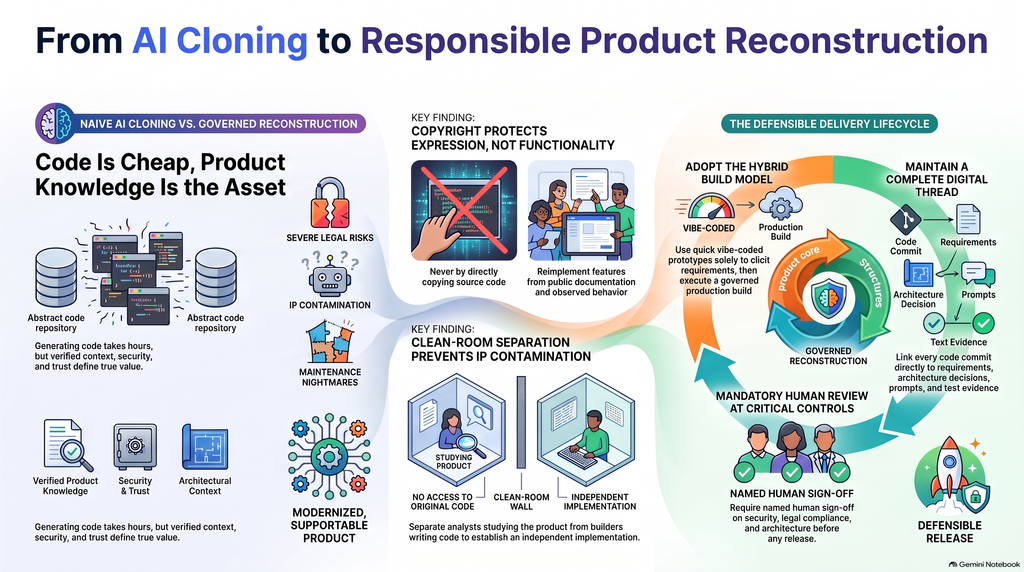
When a team can generate a user interface, a service layer and a starter test suite in a few hours, raw code becomes less scarce. The scarce asset becomes verified product knowledge. That means knowing the real user problem, the business rules that matter, the behaviours customers depend on, the places an incumbent failure, and the risks that the existing product hides.
This is why an established supplier does not lose its advantage simply because an AI can imitate a feature list. Mature products usually carry years of integration work, implementation knowledge, support practice, data relationships, operational controls, partner ecosystems and trust. A new entrant can close some of the feature gap. It still needs a reason for customers to move.
The better question is therefore not, “Can we build this again?” It is, “What can we learn lawfully about this category, what must we preserve for users, and what should we redesign for the world we now live in?”
The hype is real. The buying decision is harder.
Across social media, developer communities and technology blogs, AI-assisted rebuilding is often presented as an inevitable collapse in the cost of software. The demonstration is compelling: an individual can describe an application, generate a working interface and share a prototype in a weekend. That changes who can experiment. It does not answer who will maintain the service, connect it to a customer’s identity and data estate, train users, respond to incidents, patch vulnerabilities or accept liability when an important workflow fails.
The current evidence suggests a transition rather than a settled outcome. McKinsey’s 2026 global survey reports that organisations are most often scaling AI agents in IT, knowledge management and software engineering. Stack Overflow’s 2025 developer survey, however, found more respondents’ distrust than trust the accuracy of AI tools, alongside widespread concern about accuracy, security and privacy. The sensible interpretation is that interest and practical use are growing faster than institutional confidence. [1][2]
That gap explains why reverse engineering and AI reconstruction attract attention but will not become a single mass-market behaviour overnight. The technology lowers the cost of making an option. It does not lower, by itself, the cost of making that option dependable for a particular group of people.
Who pays, who changes and why
Individual users, internal teams and enterprise buyers change software for different reasons. Treating them as one market leads teams to overvalue visual feature parity and undervalue the conditions of adoption.
| Audience | What they normally value | What they must believe before changing |
| Individual user or small team | Price, immediate usefulness, familiar workflows, speed, privacy, accessibility, portability and the ability to leave without losing work. | The alternative solves a job better with low learning effort and low personal risk. |
| Internal business team building for itself | Fit with local workflows, control over priorities, fast iteration, safe use of internal knowledge and reduced workarounds. | The team can own the product, protect internal data, support it and keep it aligned with changing practice. |
| Enterprise buyer or regulated organisation | Supportability, integration, scalability, identity, data governance, security, accessibility, training, procurement assurance, vendor viability, long-term cost and liability allocation. | The new product reduces a material business problem without creating unacceptable migration, operating, compliance or reputational risk. |
| Developer, partner or implementation ecosystem | Documented APIs, stable contracts, extension points, test environments, observability, fair commercial terms and a route to build expertise. | The platform will remain predictable enough for them to invest time, code and reputation in it. |
This is why an enterprise rarely buys “an AI-built equivalent.” It buys an operating capability. The visible interface may be only a small part of the total cost and value. Integration, migration, permissions, records retention, business continuity, training, service management, security expertise, supplier due diligence, support and upgrade paths often determine whether a product can be adopted at all.
Equally, an organisation may decide to build inside its own ecosystem rather than sell externally. A private capability can be justified by unique workflows, sensitive data, sovereignty needs, a lack of market fit or the value of keeping specialist expertise close to the business. It still needs the same discipline. The fact that software has no external customers does not remove the consequences of a security failure, unmaintainable architecture or an unsupported handover.
How large is the disruption likely to be?
Do not measure disruption only by how cheaply an AI can generate software. Measure it by the share of customer value that can move from an incumbent product to a new, credible alternative. The first pressure will appear where common workflows, visible user dissatisfaction, high licence costs and weak portability meet. It will be slower where a supplier has deeply embedded data, identity controls, regulatory assurance, integrations, implementation partners and trusted support.
This creates two separate questions. First, how exposed is a software category to AI-enabled reconstruction? Second, how ready are buyers to adopt a replacement, sidecar or modern alternative? A category may be easy to recreate in a narrow form yet difficult to adopt at scale. Equally, customers may want change but lack the migration, security or operating capability to make it safely.
The Reconstruction Disruption Index measures category exposure. It considers recurring dissatisfaction, standardised workflows, lawful and public routes to independent requirements, data portability, API availability, price friction, incumbent differentiation and migration barriers. A high score means a focused challenger may have a credible route to a better alternative. It does not create a right to inspect, copy or use protected material. Legal rights, contractual obligations and clean-room controls are non-negotiable gates.
The Enterprise Absorption Index measures buyer readiness. It considers the business case, data and migration readiness, integration and identity fit, assurance, operating support, skills, change capacity, AI governance and ecosystem support. A high score means an organisation can move from interest to a supported deployment. A low score means the sensible next step is likely to be an internal tool, a pilot or a sidecar product rather than a wholesale replacement.
| Measure | What it tells you | High score means |
| Reconstruction Disruption Index | How exposed the category is to a credible AI-enabled alternative. | A focused challenger can create a differentiated, lawful product proposition. |
| Enterprise Absorption Index | Whether buyers can integrate, govern, support and migrate. | Customers can move beyond a pilot into a supported deployment. |
| Adoption Velocity Indicators | Whether interest is converting into operating use. | Pilots become repeatable deployments, references and expansion. |
| Incumbent Resilience Indicators | How well the current supplier can defend its position. | Data, integrations, trust and ecosystem strength slow displacement. |
The market will usually move through four stages. First comes experimentation: prototypes, discovery work and bounded internal tools. Second comes augmentation: a reporting layer, AI assistant, governed integration or workflow extension around the existing platform. Third comes selective substitution: replacement of a painful module, team workflow or business-unit capability. Fourth comes platform transition: a modular core, portable data, APIs, support services and an extension ecosystem. The final stage will be slowest because it requires buyers to trust the operating model, not merely the software.
For this reason, adoption should be tracked separately from attention. Look for pilots converting into supported releases, users moving to the new workflow, completed migrations, renewal and expansion, measurable task improvement, lower support demand, API and plugin use, and the growth of implementation capability. A category is genuinely disrupted when deployments become repeatable, customers can switch without unacceptable risk and partners invest in the new ecosystem.
A practical adoption test
Before treating a category as a serious reconstruction opportunity, test it across the following criteria. The score is not a market forecast. It is a way to decide whether you have a hobbyist experiment, a narrow specialist product, a credible enterprise opportunity or a category that needs more evidence.
| Criterion | Signals of a credible opportunity | Signals to pause or narrow scope |
| Persistent unmet demand | Complaints recur across public forums, support channels, sectors or regions; users describe costly workarounds. | A small number of vocal feature requests with no evidence of consequence or willingness to change. |
| Technology and architecture gap | The existing category struggles with portability, integration, accessibility, AI governance, security patching, data export or modern deployment. | The incumbent already solves the problem well and the proposed difference is only cosmetic. |
| Switching value | Users can quantify time saved, risk reduced, revenue enabled, compliance improved or capability gained. | The benefit does not outweigh data migration, retraining, coexistence and procurement effort. |
| Evidence and rights route | Public standards, authorised assets, user research and legitimate interoperability needs support independent requirements. | The concept depends on proprietary code, copied content, restricted APIs or uncertain contractual rights. |
| Operating capability | A team can provide security, support, incident response, release management, integration maintenance and training. | The plan ends at a prototype or assumes the buyer will absorb all operational responsibility. |
| Ecosystem potential | There are defensible extension, partner, marketplace, open-source or managed-service opportunities. | The product needs isolated custom development for every customer and cannot sustain maintenance. |
The likely time horizon follows the evidence. In the short term, AI will expand prototyping, internal tools, migration accelerators and niche products where the blast radius is limited. In the medium term, stronger opportunities emerge where teams can show integration, operational assurance and a clear switching case. In the longer term, the most durable effect may be more modular, portable and agent-ready software ecosystems, but only where standards, security models, trust and support practices mature with the technology.
Reverse engineering is an evidence technique, not a product strategy
Reverse engineering has legitimate uses. Organisations recover knowledge from systems they own. Security researchers investigate weaknesses. Teams create interoperable implementations around permitted interfaces. Communities improve open-source and public-domain software. These are not the same as pointing an AI at somebody else’s proprietary application and asking for a clone.
A responsible programme begins with rights before inspection. What are you allowed to study? Under which licence, contract, statutory exception or written permission? What must be excluded? Which materials are public, which are confidential, and which would contaminate an independent build?
This changes the role of analysis. The aim is to establish a functional baseline: a disciplined description of workflows, domain concepts, business rules, integrations, data needs and non-functional requirements. It separates the function a product performs from the particular code, copy, artwork and visual expression used by one supplier.
That distinction matters. Function can inspire a new solution. Expression can be protected. A serious reconstruction effort needs legal advice appropriate to its jurisdiction and a record of the evidence that informed each decision.
The clean room needs an AI-era update
The classic clean-room approach separates the people who study permitted material from the people who build. The analysis team produces a clean functional specification. The build team works from that specification, without direct exposure to protected expression. A legal or governance reviewer maintains the boundary.
AI makes this model more useful and more complicated. An agent can absorb every file, image, prompt and URL placed in its context. If you give it protected source code or a proprietary binary, you may have contaminated the build process instantly. If an untrusted attachment can instruct an agent, prompt injection becomes a practical security concern. If a model produces code at speed, a team can mistake a convincing answer for a verified implementation.
The response is not to ban AI. It is to treat AI as a controlled contributor. Give it narrow tasks, permitted context, defined tools and explicit review points. Record the prompt, model, sources, output and acceptance decision where the risk warrants it. Let people make the decisions that carry legal, architectural, security or customer consequences.
What a reconstruction programme actually produces
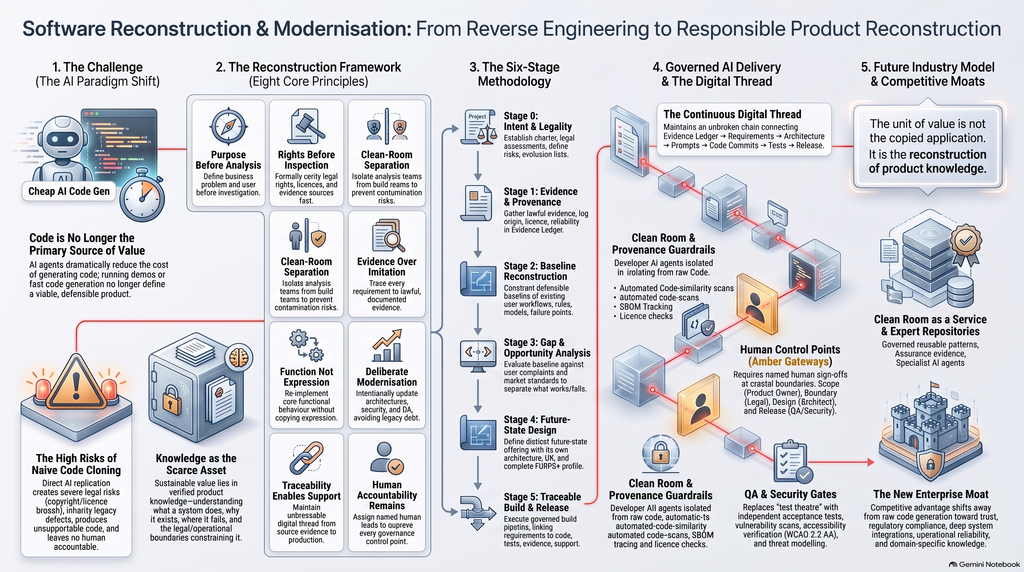
The output should not be a mysterious codebase that nobody can defend or support. It should be a product and delivery system with an evidence trail. The following six stages provide a practical starting point.
| Stage | The question | Key outputs |
| 1. Intent and rights | What problem are we solving, and what may we lawfully examine? | Charter, rights assessment, exclusions list and initial risk register. |
| 2. Evidence and provenance | What do we know, where did it come from, and how reliable is it? | Evidence ledger, source register, confidence notes and clean-room controls. |
| 3. Baseline reconstruction | What does the product category or owned system actually do? | Workflow map, domain model, business-rule catalogue, integration map and NFR baseline. |
| 4. Gap and opportunity | What should we retain, remove, improve or re-invent? | Complaint taxonomy, opportunity register, differentiation statement and prioritised choices. |
| 5. Future-state design | What will we build for current users and operating conditions? | Vision, PRD, SRS, architecture decisions, UX principles, API contracts and test strategy. |
| 6. Build, assure and learn | Can we release safely, support the product and improve it? | Traceability matrix, test evidence, SBOM, release pack, runbooks and learning register. |
This is deliberately more rigorous than “describe, generate, ship.” That is not bureaucracy for its own sake. It gives a team enough context to make a product that can survive contact with customers, auditors, incidents and the next change request.
A simulated sprint is not a release
AI can simulate an impressive amount of delivery activity. It can propose epics, write user stories, draft acceptance criteria, generate test cases, create a prototype and open pull requests. Those outputs are valuable. They help teams explore options, estimate work and discover missing requirements.
But simulation is not delivery. A generated backlog becomes a real delivery commitment only when a product owner accepts the outcome, an architect accepts the design, security and privacy controls fit the context, independent tests pass and an operations owner can support the release.
The practical shift is simple. Use AI to increase the number of options you can inspect. Do not use it to hide the judgement that selects one option. A named person should be able to pause, amend, approve or reject work at the moments that matter.
The digital thread is the new product memory
Git is necessary, but it only tells you about code. A modern product needs a wider configuration baseline. You need to know which evidence set, requirement, architecture decision, prompt, model, dependency, test result, deployment configuration and operating instruction applied to a release.
Think of this as a digital thread: evidence to requirement, requirement to design, design to code, code to tests, tests to release, release to operational learning. When an incident occurs, the team can trace a decision rather than hunt through commits and conversations. When a customer asks why a feature behaves as it does, there is an answer. When an AI-produced artefact enters production, its status is visible rather than guessed.
This is also what makes product reconstruction commercially useful. The same discipline can support work-management software, knowledge platforms, regulated case management, interoperability tools, migration services and owned legacy estates. It enables a company to sell trust, support, integration and assurance, not merely generated source files.
Build a better fit, not a cheaper imitation
The strongest reconstruction opportunities sit where a product category no longer fits its users. The existing software may be expensive, hard to navigate, poorly localised, inaccessible, difficult to integrate or built for an earlier way of working. A team can use permitted evidence, user research and public standards to understand the job, then create a distinctly modern answer.
For example, a future work and knowledge platform might connect product discovery, requirements, programme reporting, architecture models, evidence, decisions, tests and operating records. It could accept external BPMN or UML models through governed imports rather than trying to rebuild every modelling tool. It could make AI-created artefacts clearly identifiable, require review before acceptance and preserve traceability through every release.
That is not a lookalike project. It is category re-invention. It starts with a familiar problem, but changes the architecture, workflow, user experience, data model and value proposition for current needs.
Three opportunity windows that make reconstruction worthwhile
Responsible reconstruction becomes commercially interesting when it uses a familiar category as a starting point, then solves problems that have accumulated around it. Three windows are especially important.
1. The technology has changed beneath the product
Many successful applications were built across several technology eras. Vendors have often extended the original estate instead of replacing it. That is understandable. Existing customers need continuity, and the original platform contains valuable intellectual property, integrations and operating knowledge. Yet the accumulated result can be difficult to configure, update, secure, integrate or use across different devices and ways of working.
A reconstruction programme should not assume that a complete rewrite is the answer. It should ask a sharper question: if this product category were designed for cloud deployment, modern identity, portable data, open APIs, accessibility, mobile and desktop use, AI assistance and controlled agents, what would be deliberately different? The answer may be a new application, a modular service layer, an interoperability bridge, or a phased replacement. The opportunity lies in rethinking the architecture for the current environment, not simply reimplementing yesterday’s choices.
2. Public dissatisfaction is a requirements asset
Users often explain where mature software has failed them. Public app-store reviews, user communities, issue trackers, support articles, accessibility statements, release notes, independent forums and professional discussion threads can reveal recurring friction: slow navigation, poor onboarding, weak reporting, missing integrations, confusing permissions, limited exports, inconsistent mobile support or AI features added without a useful workflow.
An AI can help collect, classify, deduplicate and cluster this public evidence. It should never treat a complaint as a command to replicate a screen or proprietary workflow. The job is to turn a complaint into a neutral problem statement, such as “project sponsors cannot obtain an auditable cross-programme view”, and then design an independent answer.
A sound pipeline records each public source, date and permitted-use status. It separates direct experience from opinion, groups similar complaints, identifies the affected user group, estimates frequency and consequence, and creates opportunity candidates. A product owner, business analyst and architect then decide whether the evidence supports a requirement, an experiment or no action at all.
3. Portability, interoperability and extensibility are a product proposition
The new product does not need to become a closed replacement suite. It can be designed as a flexible environment that works across operating systems, devices and deployment choices. It can use documented APIs, portable data formats, import and export routes, federated identity and a clear compatibility policy. These decisions lower migration friction and reduce dependence on a single vendor or cloud platform.
This also creates room for a safer marketplace. A well-designed extension model gives partners and users a way to build plugins, integrations and sector-specific modules without receiving unrestricted access to every tenant, data set or system action. An open-source core may work where shared infrastructure, standards adapters or basic connectors benefit from community scrutiny. Hosted services, certified extensions, migration support and regulated configurations can remain commercial. The architecture should make those choices possible from the beginning.
Let stakeholders choose what improves first
A backlog should not be an internal guessing game. Once you have created an evidence-based set of improvement candidates, show a suitable audience the problem, the proposed outcome, the trade-offs and the limits of the release. Ask users, buyers, implementers, administrators, developers, security teams and support teams which outcomes matter most, and why.
| Priority dimension | Question to ask | Example evidence |
| Reach | How many users, teams or customers experience this problem? | Public complaint clusters, support volume, research sample. |
| Impact | What does failure cost in time, money, risk or missed opportunity? | Journey analysis, incident history, stakeholder interviews. |
| Confidence | How reliable and representative is the evidence? | Source diversity, recency, direct research and pilot data. |
| Complexity | What architecture, migration, data or operating changes are required? | Architecture assessment, dependency map and technical spike. |
| Risk | Could this introduce privacy, security, accessibility, legal or adoption harm? | Threat model, policy profile, legal and assurance review. |
| Differentiation | Does it create a better fit rather than mimic an incumbent? | Product vision, competitor-independent user research and design rationale. |
Use a weighted score to support discussion, not to replace it. A public vote can reveal preference. It cannot override security, privacy, legal feasibility or the needs of users who are less visible online. Keep the rationale for the final decision. That rationale becomes part of the stakeholder requirement record.
Release, listen and improve
A responsible reconstruction effort needs a deliberate route from early adopter testing to a supported release. Start with a narrow vertical slice and synthetic or carefully governed data. Give test participants a clear description of what the product does, what is experimental, how to report problems and how their feedback will be used. Measure task completion, error recovery, accessibility, performance, support demand and trust, not only sign-ups or feature requests.
Each release should update the product baseline. Feedback becomes evidence. Evidence changes the opportunity register. The opportunity register changes the backlog. This creates a continuous-improvement loop in which priority, complexity, risk, cost and stakeholder value remain visible. It also stops the product from drifting back toward an accidental imitation of the system it set out to improve.
Expect scrutiny from incumbents, and make it part of the method
An incumbent vendor may question a challenger’s use of its product category, public documentation, compatibility claims, APIs, brand cues or customer migration strategy. The exact legal and commercial response will depend on jurisdiction, contracts, intellectual property, market position and the facts of the case. A serious team should expect scrutiny rather than treat it as a surprise.
The practical response is not to publish a defensive essay after the fact. Build a self-audit into the programme: an evidence ledger, exclusions list, rights assessment, analyst and builder boundaries where needed, prompt and model records, independent design decisions, licence and dependency checks, accessibility and security evidence, a distinct brand and interface review, and named release approvals. These controls will not eliminate every risk, especially patent, contract or trade-secret risk. They do show that the team chose an accountable route instead of copying by convenience.
Keep the article readable. Put the detailed clean-room protocol, jurisdiction-specific legal review, policy profiles, non-functional requirements, security testing and liability controls in companion documents. The article should explain the principle and the opportunity. The operating playbook should prove the discipline.
The long-term prize is a repository of expertise
Each reconstruction project should leave more behind than a codebase. It can add permitted evidence, tested patterns, threat models, accessibility checks, migration lessons, domain vocabulary, decision records and specialised agent instructions to a governed repository.
Over time, that repository can support specialist people and agents: an accessibility remediation assistant, an API migration assistant, a regulated-workflow analyst, a localisation specialist or a SaaS security reviewer. Their value comes from curated context, permissions, tests and accountable maintainers. It does not come from pretending that a general-purpose model has perfect knowledge of a sector.
That is the compounding advantage. The organisation gets faster because it learns lawfully and retains what it learns. It gets safer because each project improves the controls, patterns and evaluation methods used by the next one.
Five questions to ask before you start
- What user or enterprise problem makes this worth building, beyond the existence of an incumbent product?
- What evidence may we use, what must we exclude and who owns the rights decision?
- Which existing behaviours are genuinely valuable, and which are historical defects we should deliberately remove?
- Where will people intervene in the lifecycle, especially for data, permissions, security, compliance and release?
- What reusable knowledge, tests and controls will this project contribute to the next one?
The real opportunity
AI will make it normal for smaller teams to explore product categories that once required large budgets. It will make documentation, code scaffolding, test generation and migration work cheaper. It will also make it easier to create fragile, unlawful or unmaintainable software at speed.
The teams that create lasting value will not be the ones that produce the closest imitation. They will be the ones that turn lawful evidence into a clearer understanding of a problem, make deliberate choices about what to change, and preserve the chain of reasoning that makes a product trustworthy after launch.
That is responsible product reconstruction. It is less glamorous than the fantasy of instant cloning. It is also much more likely to produce software that someone can use, support, buy and trust.
[1] McKinsey, “The State of AI: Global Survey 2026”, 25 August 2026. [2] Stack Overflow, “2025 Developer Survey: AI”, accessed 14 October 2026. The survey evidence is directional and should be supplemented with category-specific customer research before investment.
[1] McKinsey, “The State of AI: Global Survey 2026”, 25 August 2026. [2] Stack Overflow, “2025 Developer Survey: AI”, accessed 14 October 2026. The survey evidence is directional and should be supplemented with category-specific customer research before investment.
Appendices:
- The outline distilled framework is REBUILD.
It turns reverse engineering from a code-copying exercise into a governed method for creating a lawful, modern and supportable alternative.
| Stage | Meaning | Core question | Main outputs |
| R. Rights and boundaries | Define what can be studied, used and excluded | What is lawful, permitted and commercially defensible? | Charter, rights assessment, exclusions list, clean-room controls, risk register |
| E. Evidence and provenance | Gather permitted public, owned and authorised evidence | What do we know, where did it come from and how reliable is it? | Evidence ledger, source register, complaint taxonomy, stakeholder research |
| B. Baseline reconstruction | Reconstruct the functional truth, not protected expression | What jobs, rules, data, workflows, integrations and NFRs exist? | Functional baseline, domain model, process maps, requirements baseline, integration map |
| U. User and market opportunity | Identify what should change and whether a market can adopt it | Which pains matter, who pays, and is there a credible switching case? | Opportunity register, prioritised backlog, stakeholder requirements, Reconstruction Disruption Index, Enterprise Absorption Index |
| I. Independent future-state design | Design a distinct, current-generation product | If built today, what would be different in architecture, AI, portability and usability? | Vision, PRD, SRS, architecture, UX principles, API contracts, AI governance design |
| L. Lifecycle build and assurance | Build through a controlled SDLC | Can the product be tested, secured, released and supported? | Delivery plan, test strategy, security and accessibility evidence, SBOM, release pack, runbooks |
| D. Digital thread, deployment and learning | Preserve traceability and improve through real use | Can every release be explained, defended and improved? | Traceability matrix, AI artefact records, deployment record, feedback loop, knowledge repository |
The framework has four cross-cutting controls that apply at every stage:
- Clean-room separation and legal discipline
Protected code, design expression, confidential material and restricted data do not enter the independent build route. - Human accountability for high-consequence decisions
AI can analyse, draft, classify, generate and test. Named people approve rights, architecture, security, release and customer-impacting decisions. - FURPS Plus and non-functional assurance
Functionality, usability, reliability, performance, scalability, security, operability, accessibility, resilience, privacy and supportability shape the product from the start. - Evidence-to-release traceability
Every important requirement can be traced to permitted evidence, a decision, a design element, code, tests, release approval and operational learning.
The commercial logic is equally simple:
Do not ask, “Can we recreate this software?”
Ask, “Can we lawfully understand this category, solve a more valuable problem, and operate a better product for today?”
Your two decision indices sit within the U stage:
- Reconstruction Disruption Index: Is this software category exposed to a credible modern alternative?
- Enterprise Absorption Index: Can target customers safely adopt, integrate, govern and support it?
The expected market path is:
Experimentation → Augmentation → Selective Substitution → Platform Transition
That makes REBUILD useful for three different uses:
- Modernising software an organisation already owns
- Building a lawful, differentiated alternative in an established software category
- Creating a new interoperable platform from familiar but fragmented user needs
It is primarily a software framework. For hardware, the same structure still applies, but the Baseline, Lifecycle and Assurance stages need additional controls for physical safety, materials, manufacturing, certification, supply chain, repairability and product liability.
- References and supporting documents: Supporting documentation
| Document | Short description |
| AI Clean Rooms and Responsible Product Reconstruction Playbook | Practical implementation guide for creating independent software from permitted evidence. Covers clean-room setup, AI and agent controls, vibe-coding risks, public-complaint analysis, traceability, release routes and a 90-day rollout plan. |
| Clean-Room Analyst/Builder Operational Protocol | Formal governance protocol defining analyst and builder separation, lawful reconstruction routes, evidence handling, legal and IP boundaries, AI context controls, audit records and mandatory gates. |
| Integrated Briefing: Turning Reverse Engineering into Responsible Product Reconstruction | Executive synthesis of the overall method. Explains the shift from decompile-and-rebuild thinking to governed product reconstruction, combining legal, product, SDLC, assurance and commercial considerations. |
| Software Reconstruction and Modernisation | Framework article on embedding lawful reconstruction into Agile, DevOps and continuous delivery. Focuses on product baselines, configuration control, quality assurance, operational learning and the long-term repository of expertise. |
| Part One: From Reverse Engineering to Responsible Product Reconstruction | Public-facing methodology article. Sets out the six-stage method, lawful sourcing routes, clean-room principles, AI build choices and the distinction between category re-invention and cloning. |
| AI-Enabled Software Reconstruction: Stakeholders, Enterprise Drivers, Vendor Response and Risk Profile | Strategic market briefing for business and technical architects. Maps stakeholder interests, enterprise use cases, vendor responses, risk controls, target operating model and delivery roadmap. |
| The disruption is real but what is the impact | The disruption is real, but it will not look like every established software product suddenly gets copied and replaced. It will look more like the cloud, open source and RPA transitions: rapid experimentation at the edge, followed by selective enterprise adoption once security, integration, accountability and support catch up. |