Preamble
The robot in the home has become a familiar image long before it has become a dependable reality. We already accept a narrow version of it: the vacuum that maps a room, the mower that stays inside a boundary, the machine that dispenses medication, the camera that lets a relative check in. Yet the imagined leap from these specialised devices to a general purpose helper that can cook, clean, lift, care, shop and reason through an ordinary home remains immense.
The question is not whether robots will enter homes. They already have. The question is which problems justify a physical body, how much autonomy is safe and useful, and what surrounding system must exist for a machine to be more than an expensive object waiting for instructions.
Supporting documents for The State of Play of Robots in the Home: Robot at home
| Supporting document | Description |
| Home Robotics Integrated Vision and Product Requirements | The integrated strategic reference document. It brings together progressive autonomy, stakeholder needs, product requirements, the technology stack, maturity, business models, deployment scenarios and commercial readiness. |
| Home Robotics Compatibility Interoperability and Assurance Architecture | Defines the shared architecture that sits above IoT devices, robot bodies and vendor platforms. It covers cross-vendor compatibility, consent, localisation, task control, cyber security, evidence, repairability and assurance. |
| Home Robotics Readiness and Risk Framework | A practical tool for assessing whether a domestic robot pilot should proceed. It includes readiness gates, stakeholder responsibilities, value measures, risk controls, pilot method and adoption maturity. |
| Home Robotics Dependency and Convergence Map | Maps the people, process, technology, governance and built-environment dependencies needed for household robots to move beyond narrow tasks. It introduces the six integration contracts and shows where technologies converge or require domestic adaptation. |
| Humanoid Development and Deployment Scenarios | Sets out two speculative paths to 2038: managed progression and fast scale followed by correction. It identifies the people, process and technology conditions, deployment gates and decision signals that determine which path becomes more likely. |
| Outline Market Analysis | Reviews commercial investment, market maturity, profitability, major players, demand drivers, PESTEL and SWOT factors, with a particular focus on the United States and China. |
| Major Research Directions for Robot Bodies and Dexterity | Compares the research and strategic priorities of ARIA, DARPA, China, Japan and Singapore. It covers dexterity, tactile sensing, locomotion, embodied data, care, deployment environments and the path from research to commercial application. |
Watch or listen: YouTube Spotify
Executive summary
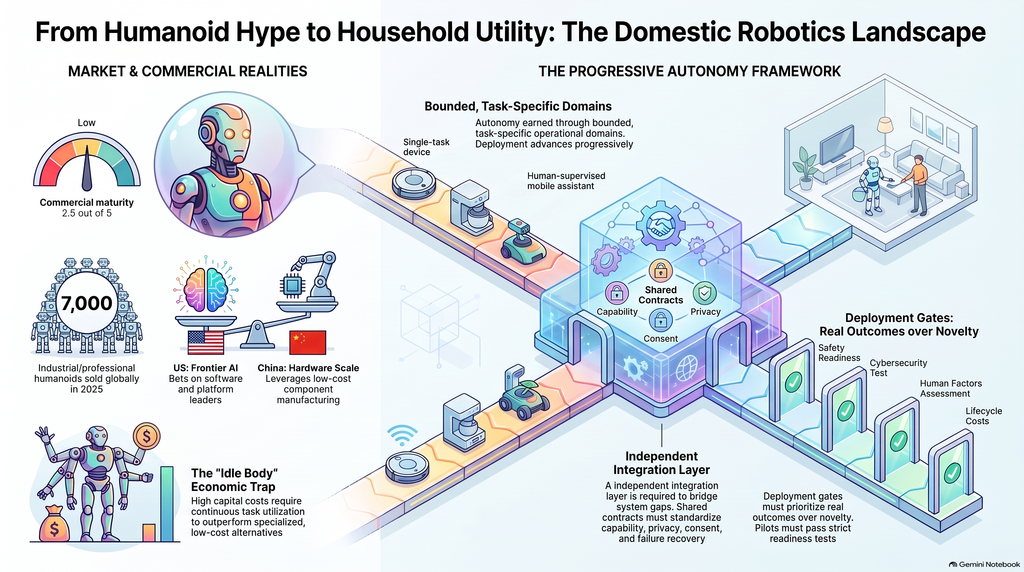
Domestic robotics is a real market, but it is not yet a general humanoid market. The International Federation of Robotics recorded nearly 20 million consumer service robots in its supplier sample in 2024, up 11%, with domestic cleaning and lawn care the largest group. That is mass adoption of constrained automation, not proof that an all purpose household robot is close.
The strongest demand drivers are ageing, disability, time pressure, household labour scarcity, safety and the desire to remain independent. Demand will not arise evenly. It will be shaped by household income, housing layouts, care systems, digital infrastructure, local labour availability, cultural comfort with care technology and regulation. Japan and Korea offer a strong demographic signal. China has scale, manufacturing depth and rapidly ageing demand. Parts of Europe, North America and the Gulf offer high spending power and service gaps. But the home remains harder than a warehouse because it is personal, cluttered, variable and emotionally charged.
The viable route is progressive autonomy. Start with a bounded task, a safety envelope, local control, a recoverable failure mode and a human escalation path. Combine process rules and deterministic controls for the physical task with AI for perception, interaction and exception handling. Treat the home as part of the product: mapping, connectivity, consent, charging, storage, maintenance and accessible design are not afterthoughts.
| What is happening now | What it means | What not to infer |
| Robot vacuums, mowers and pool cleaners | A proven consumer willingness to buy low risk, bounded automation. | A general household body is commercially or technically ready. |
| Care and telehealth devices | Aging and workforce pressure create urgency around assistance and monitoring. | Replacing the relational, safeguarding and judgment parts of care. |
| Humanoids in pilots | Embodied AI, better actuators and vision models are advancing quickly. | Reliable multi hour autonomous work across uncontrolled homes. |
| Robot as a Service growth in professional robots | Subscription, rental and managed service can reduce capital barriers. | A subscription removes the need for safety, repairability or data governance. |
1. The market is already here, but in pieces
The useful definition of a household robot is not a humanoid. It is a physical system that senses, decides and acts in a domestic setting. On that definition, the home already contains robots. The less useful definition is a human shaped machine able to do all household work. That definition bundles together mobility, manipulation, perception, language, safety, affordability, maintenance and trust. Its parts are progressing at different speeds.
This difference matters because it changes investment choices. A floor cleaning robot operates in a constrained plane, with an acceptable recovery path when it fails. A robot that lifts a frail adult, handles a knife, or administers medication operates in a high consequence domain. The first can be tested at scale with consumer telemetry. The second requires clinical, legal, ergonomic and safeguarding evidence.
2. People drivers and demand geography
The demographic case is most visible in long term care. Across OECD countries, the 65+ share was 18.5% in 2023 and is projected to reach 26.4% by 2050. The 80+ share is projected to double on average. This does not mean robots replace care workers. It means assistance with transfer, reminders, mobility, logistics and household tasks may become part of the care capacity conversation, alongside pay, immigration, training, housing and community support.
| Demand cluster | Why it is likely to move first | Constraints to test |
| Japan and Korea | Deep ageing, shrinking working age populations, care workforce pressure and advanced robotics capability. | Acceptance, cost coverage, small homes, care quality and safety. |
| China | Large manufacturing base, high smart home uptake and a fast growing older population. | Regional income differences, interoperability, privacy, and reliable service after sale. |
| North America | High household spending, labour costs, disability and ageing needs, strong venture supply. | Fragmented reimbursement, liability exposure, varied housing and trust in data collection. |
| Northern and Western Europe | Ageing, formal care systems, safety regulation and accessible housing agendas. | Procurement, data protection, cross country rules and public acceptance. |
| Gulf cities and dense Asian cities | High service demand, planned districts, premium households and smart city investment. | Workforce and equity effects, heat and dust resilience, platform dependency. |
The personal driver is not simply convenience. It can be dignity. A person with reduced mobility may value a machine that helps them fetch light objects or connect to a clinician without needing to expose every routine need to a carer. Families may value reassurance. Carers may value fewer repetitive or unsafe movements. These benefits are conditional. A robot that turns private life into continuous monitoring, or leaves a household stranded when an account expires, destroys the very dignity it was meant to support.
3. Partial and full robotisation
Partial robotisation distributes work across specialised devices, smart appliances and sometimes a human operator. It should be the default near term architecture. A robotic arm fixed in a kitchen, a mobile cleaning unit, a medication cabinet, a telepresence screen and a fall detector may collectively create more value than one costly humanoid. They also fail in more legible ways.
| Level | Practical example | Control model | Readiness |
| 0. Smart appliance | Programmable cooker or medication dispenser | User sets rules | Established |
| 1. Single task robot | Vacuum, mower, pool cleaner | Local autonomy within boundary | Established |
| 2. Fixed manipulator | Arm for a repeatable kitchen or laundry task | Guarded process with user confirmation | Emerging |
| 3. Mobile assistant | Moves items, checks a room, telepresence | Mapped home with remote help | Pilot and early deployment |
| 4. Supervised generalist | Multi task body with human escalation | Autonomy plus remote operator | Early experimental |
| 5. General domestic autonomy | Independent open world household work | Machine assumes most decisions | Speculative, no dependable mass market evidence |
The distinction must stay visible in product language. A company can truthfully say that an agent completes a routine, while concealing that it needs a human to rescue it when a chair moves, a pet intervenes, the network drops, or an unfamiliar object appears. The appropriate metric is not an attractive demonstration. It is successful completion over time, across different homes, with recovery time, intervention rate, harm rate and household satisfaction disclosed.
4. The technology stack and the idle body problem
A domestic robot is a stack, not a body. The body contains mobility, actuators, grippers, batteries, materials, cameras, depth sensors, force and tactile sensing, microphones and emergency stops. The intelligence layer contains localisation, scene understanding, task planning, control, user models, safety rules, diagnosis and software update management. The service layer contains onboarding, mapping, warranty, repair, remote support, consent management and end of life recovery.
The idle body problem occurs when a costly general purpose robot spends most of its day waiting for a rare task. A vacuum earns its place because it repeats a simple task frequently. A humanoid that costs far more but carries laundry twice a day has weak utilisation unless it also shares work across households, supports teleoperation, performs multiple verified tasks, or becomes a managed care and service platform. This is an economics problem disguised as a hardware problem.
| Layer | Current pattern | Gap to close |
| Perception | Cameras, depth sensors and LiDAR provide useful mapping in controlled settings. | Reliable perception under darkness, glare, clutter, pets, children, mirrors and unusual objects. |
| Dexterity | Hands and arms can demonstrate impressive picks and place tasks. | Soft, safe, robust handling of varied domestic objects at consumer cost. |
| Movement | Wheels work well on prepared floors; legs navigate some obstacles. | Safe operation across stairs, narrow spaces, rugs, wet floors and changing layouts. |
| Software | Vision language action models and simulation improve generalisation. | Proof of repeatability, bounded behaviour, test coverage and graceful fallback. |
| Home context | Smart speakers, WiFi, cameras and appliances provide fragments of context. | Interoperable consent based domestic map, secure local processing and supportable standards. |
5. Process led automation, AI and RPA
The domestic stack should not be built as pure generative AI. The physical action loop needs deterministic control, validated motion planning, force limits, sensor checks and emergency logic. The process layer answers: what sequence is allowed, when must the machine stop, who may approve a task and what evidence must be logged. AI then improves perception, natural language interaction, anomaly detection, personalisation and task selection within that envelope.
RPA has a role outside the physical action itself. It can schedule maintenance, validate eligibility for a care service, trigger consumable orders, route a repair case, reconcile a subscription and coordinate a human operator. The strongest architecture is hybrid: local real time control for movement, policy and process orchestration for repeatable work, AI for uncertain interpretation, and a human reachable when confidence or consequence crosses a threshold.
6. The home becomes an extended robot environment
An ideal household robot benefits from a machine readable home, but this must not become a new form of domestic surveillance. The minimum viable environment is not a house full of cameras. It may be an opt in local map, clear no go zones, reliable charging, accessible room geometry, robust connectivity and sensor checks on high consequence areas such as stairs, doorways and kitchens. LiDAR, radar, vision and ultrawideband can support localisation, but each introduces cost, maintenance and privacy questions.
Designers should prefer a hierarchy: use on robot sensing first; use passive home markers or a private local map next; use fixed sensors only where risk and benefit justify them; and keep raw data local unless a user has chosen a tightly defined service. Every hardware dependency should come with an installation, update, failure and removal plan.
7. Human control, remote presence and autonomy
The choice is not a binary. A household system can be autonomous for navigation, ask permission before opening a cupboard, call a named supporter for an exception, and allow a trained professional to take temporary remote control of a narrow task. The human control path is not evidence of failure. It is a safety feature and an adoption bridge, particularly for care, installation, maintenance and early deployments.
Remote intervention must be designed as a safeguarded service. Who can take control? From where? What can they see or record? Is the household present and consenting? What is the latency threshold? What commands are blocked? How is the action logged and reviewed? These are product requirements, not legal boilerplate.
8. Economics and business models
Ownership fits a low maintenance, low risk appliance with a clear useful life. Subscription fits a system that needs continual software, servicing, insurance, consumables and support. Robot as a Service fits expensive equipment whose capacity can be managed and whose value is proven by completed outcomes. A care provider or housing association may prefer a fleet contract where it pays for monitored uptime, assistance events or avoided staff travel rather than a depreciating asset.
| Model | Best fit | Risk to manage |
| Outright ownership | Single task domestic robots with understandable maintenance. | Obsolescence, repair cost and manufacturer withdrawal. |
| Subscription | Software rich assistants with service and upgrades. | Household lock in, loss of core function when payment stops, data dependency. |
| Robot as a Service | Care, multi property, premium or expensive mobile systems. | Service quality, fleet downtime, liability split and poor incentive design. |
| Outcome based contract | Care organisations, social housing and insurers. | Measuring genuine outcomes without forcing surveillance or cherry picking users. |
The true comparison is not only robot price versus a human wage. It includes installation, connectivity, mapping, repair, energy, insurance, training, supervision, security patches, asset disposal and failure recovery. It also includes benefits that cash flow models often miss: fewer injuries, more independence, reduced travel, less caregiver strain and the option value of living safely at home for longer. Those benefits need a transparent measurement framework, not marketing claims.
9. Risk profile and the critique of robot first thinking
A household robot can create physical, clinical, cyber, privacy, financial, social, environmental and labour risks at once. NIST notes that smart home devices can become pivot points into more sensitive systems, and identifies access control, authentication, monitoring, data security, governance and network segmentation as mitigations in a health connected home context. A robot with microphones, cameras and physical actuators raises the stakes further.
| Risk | Illustrative failure | Minimum mitigation |
| Health and safety | Collision, pinch point, unsafe lifting, medication error. | Task limits, force and speed constraints, stop controls, test evidence, clinical governance where relevant. |
| Cyber and privacy | Compromised camera, account takeover, home map extraction. | Local processing by default, network segmentation, strong identity, patching, audit trail and transparent retention. |
| Human factors | Fear, overtrust, caregiver burden, poor ergonomics. | Co design with users and carers, accessible controls, training, override and measured workload. |
| Sustainability | Short lived batteries, proprietary parts, energy use and e waste. | Repairability, spare parts, battery stewardship, modular upgrade and take back obligations. |
| Equity | Only affluent households receive capacity expanding tools. | Public procurement pilots, accessible design, shared service models and clear evidence of benefit. |
The critique is simple. A robot body is not always the best answer. The alternative may be better paid and supported care work, accessible home adaptation, a shared community service, a specialised appliance, a remote human service, or acceptance of a demographic choice. A country with a shrinking population must still decide whether it will use migration, productivity, family support, redesigned services, automation or a mix. Robots change the menu. They do not remove the political choice.
10. Lessons from factories, construction and delivery
Factories succeeded with robots by altering the work, not merely inserting a machine into an unchanged environment. Fixtures, standard parts, safeguarded cells, predictable routes, maintenance teams, cycle time measurement and integration discipline made automation economical. Construction shows the opposite lesson: unstructured sites, changing layouts, multiple trades and weather make general automation hard. Delivery and autonomous vehicles show the importance of mapped geographies, operating domains, remote assistance, insurance, public acceptance and local regulation.
The home is closer to construction than a factory. It changes constantly and contains people who have not been trained as operators. The correct translation from industry is therefore not a fenced cell. It is an operational design domain: the precise places, tasks, users, objects and conditions in which the robot is allowed to work. Every expansion beyond that domain should be earned with evidence.
11. Dependency and convergence map
Robotics is fragmented because the components mature on different curves. Dexterous hands without safe task planning do not create a home assistant. Foundation models without embodied data do not create reliable manipulation. A domestic map without security governance creates risk. The integration layer is the missing product category: a standard way to declare capability, task boundary, evidence, home configuration, supervision route, consent and incident record across different bodies and manufacturers.
| Dependency | Why it converges | Who needs to coordinate |
| Actuators, tactile sensing and soft materials | Domestic work requires force control and safe contact, not only visual recognition. | Component makers, safety engineers, rehabilitation and ergonomics researchers. |
| Embodied data and simulation | Rare edge cases cannot all be learned in a real home. | OEMs, digital twin suppliers, researchers, household participants with strong consent. |
| Autonomy, teleoperation and interfaces | Human help makes difficult tasks deployable before full autonomy. | Operators, care bodies, telecoms, UX and accessibility teams. |
| Home IoT and security | The body needs context but the home needs sovereignty. | Device makers, standards bodies, installers, cyber and privacy authorities. |
| Commercial and liability model | Who carries loss determines what gets built and adopted. | Insurers, manufacturers, landlords, care commissioners and regulators. |
12. Timeline and what should happen next
A responsible timeline is task based rather than humanoid based. In the next three years, expect more capable specialised robots, fixed arms, remote assistance, smart home integration and pilots in care and premium service. In three to seven years, some homes may use supervised mobile assistants inside well defined domains, particularly where care providers, housing operators or insurers sponsor the installation. Beyond that, outcomes depend less on a single AI breakthrough than on cost, reliability, regulation, repair networks, built environment design and public consent.
| Stakeholder | Focus now | Decision test |
| Manufacturers | Select one high frequency task and publish operational evidence. | Does the product work repeatedly, recover safely and remain repairable? |
| Care providers and local authorities | Pilot augmentation with staff and users, not technology in isolation. | Does it improve dignity, workload or outcomes without creating surveillance or exclusion? |
| Housing and city planners | Design accessibility, connectivity and service routes into new developments. | Can a resident opt in without a proprietary building lock in? |
| Policymakers and regulators | Define proportionate task based assurance, incident reporting and data rights. | Can innovation proceed without normalising untested physical AI in private life? |
| Investors | Price in service operations, repair, insurance and adoption work. | Is there a credible utilisation model beyond a theatrical demo? |
| Households | Buy the task and service, not the promise of a future general robot. | Can you understand the data, override, repair, ongoing costs and support route? |
What next
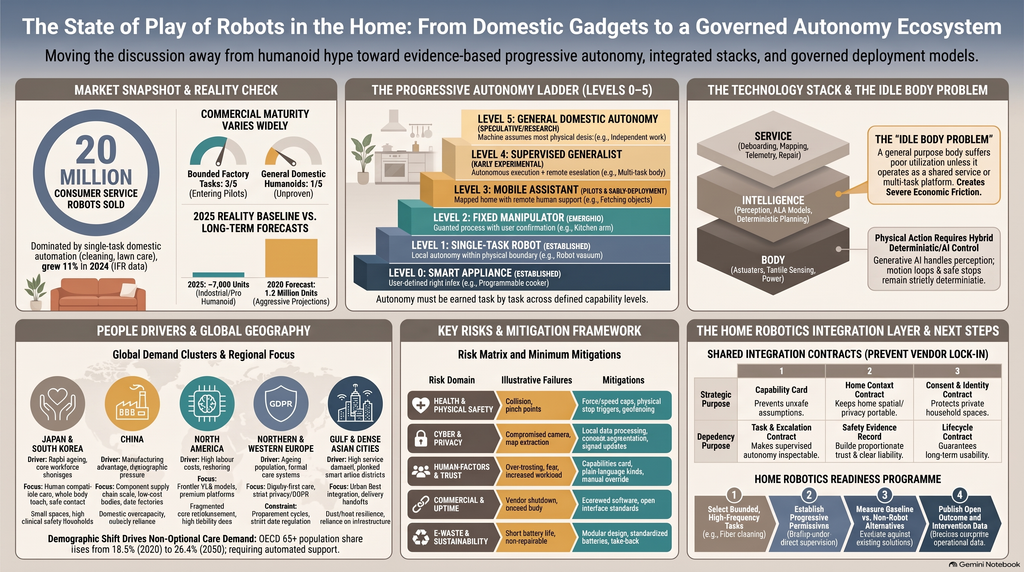
The next phase should be a Home Robotics Readiness Programme. It would test a small set of high value use cases across varied homes, publish intervention and safety data, compare robots with non robot alternatives, and develop a consent and assurance model that households can understand. The aim is not to accelerate every robot. It is to determine where physical AI genuinely adds value, where it does not, and what infrastructure must be present before the market turns domestic life into an uncontrolled beta test.
This article is accompanied by two linked working documents: Home Robotics Readiness and Risk Framework, and Home Robotics Dependency and Convergence Map. Together they move the discussion from prediction to testable deployment choices.
Appendices
Appendix A: Why humanoid bodies are converging on the home, and the alternatives
There is a practical reason why many developers are pursuing humanoid bodies. Homes, tools, furniture, doorways, kitchens and storage systems were designed around the human body. A machine with human-like reach, hands and height may use existing spaces without requiring every household to rebuild its environment.
Familiarity also matters. People understand what an arm, hand, head-height sensor and mobile body are for. A human-shaped machine can make its intended role legible when it carries an object, opens a cupboard or interacts with equipment designed for people.
That does not mean a humanoid is automatically the best household solution. The home is not a standardised workplace. It contains clutter, stairs, rugs, changing furniture, pets, visitors and private routines. A bipedal body adds cost, energy demand, balance risk and repair complexity. A human shape can be useful, but it can also become an expensive answer to a narrow task.
The more credible near-term model is partial robotisation. Different devices can address different needs:
| Need | Likely alternative to a general humanoid |
| Floor and garden maintenance | Robot vacuum, mower, pool cleaner |
| Repetitive kitchen or laundry task | Fixed robotic arm with a constrained operating area |
| Medication and reminders | Smart medication dispenser with escalation to a carer |
| Remote reassurance and check-ins | Telepresence screen, sensor-based alerting and secure video service |
| Light object retrieval | Wheeled mobile assistant in a mapped accessible home |
| Lifting or personal care | Specialist assistive device with professional oversight |
| Home logistics | Smart storage, delivery handoff point, shared building service or remote human support |
The converging forces are ageing, disability inclusion, labour shortages, household time pressure, lower-cost sensors, better AI perception, advances in dexterity and the desire to keep people independent at home for longer. These forces support greater use of physical assistance. They do not prove that one general-purpose humanoid will become the dominant form.
The right question is not, “Can a humanoid do this?” It is, “What is the safest, most accessible and most affordable way to achieve the outcome?” In some cases that will be a humanoid. In many others it will be a specialist device, accessible home adaptation, better paid care work, a shared service or a redesigned process.
References
- International Federation of Robotics, World Robotics 2025 Service Robots.
- OECD, Health at a Glance 2025.
- NIST, Performance of Human Robot Interaction.
- Ideaswiz, The State of Play of Robots in the Home.
Appendix B: IoT, sensors, robot vision and the mapping challenge
A household robot needs more than a body. It needs enough reliable context to understand where it is, what is around it and when it should stop. This creates a convergence between home IoT, sensors, robot vision, mapping, connectivity and human control.
A robot may use cameras, depth sensors, LiDAR, radar, tactile sensing, microphones and ultrawideband positioning. Each method has strengths and limits. Vision can recognise objects but struggles with glare, darkness, mirrors and clutter. LiDAR can map shape and distance but adds cost and may miss contextual meaning. Radar can support presence and movement detection, while tactile and force sensing help a robot understand safe contact. No single sensor provides complete certainty.
The aim should not be to turn every home into a permanently monitored environment. Before a robot performs a task, the household needs a proportionate home-context setup:
- a local map of permitted rooms and routes
- clear no-go and privacy zones
- reliable charging and connectivity
- known risks such as stairs, thresholds, wet areas and narrow passages
- a defined response when sensing, connectivity or confidence fails
- resident controls over data, access and remote assistance
The preferred hierarchy is to use sensing on the robot first. A private local map or passive markers can add support. Fixed sensors should only be added where the safety or service benefit justifies their cost and privacy impact. Raw data should remain local unless a resident has explicitly agreed to a defined support service.
The mapping challenge is not only technical. Homes change. Furniture moves. A visitor arrives. A pet crosses a route. A network fails. A room becomes dark. A robot must recognise when its map or confidence is no longer sufficient and move into a safe state, ask for confirmation or hand over to a human.
This is why interoperability matters. A home should not become dependent on one robot manufacturer’s map, account, sensors or remote service. The household needs portable records of home context, consent, approved tasks, safety limits and support arrangements. These records make it easier to change provider, replace a device or stop a service without losing control of the home.
References
- NIST, Performance of Human Robot Interaction.
- NIST, Cybersecurity and Privacy Risks in Telehealth Smart Home Integration.
- Ideaswiz, Home Robotics Dependency and Convergence Map.
- Ideaswiz, Home Robotics Compatibility, Interoperability and Assurance Architecture.