Preamble: The Future Rarely Arrives Cleanly
How Organisations Misclassify Their Most Valuable Technologies and What the Case Studies Really Teach Us. Part 1 of this series argued that the future rarely arrives in one leap. It arrives through bridges.
Before the fully autonomous robot comes the teleoperated robot. Before the orbital data centre comes the atmospheric platform, the energy campus, the grid-constrained regional compute hub. Before the artificial general engineer comes the AI-assisted CAD tool, the simulation copilot, the digital twin, and the human-in-the-loop workflow.
The difficult part is not only seeing those bridges. It is deciding what to do with them.
Large organisations often possess the future before they recognise it. It sits in laboratories, patent portfolios, discontinued product lines, old technical manuals, failed pilots, internal tools, archived source code, and research programmes that were stopped because the market, materials, compute, regulation, or business model was not ready.
Some of those assets are dead. Some are merely dormant. Some were born too early. Some were misclassified because they threatened the parent company’s core business. Some should have been spun out. Some should have been licensed. Some should have been opened. Some should have been killed sooner.
That is the purpose of this Part 1B.
Part 1 gave the conceptual framework. This will provide the full corporate decision playbook: what to build, spin off, archive, open, license, sell, or let die. This article is the hinge between them. It uses case studies to show what misclassification looks like in the real world.
The central lesson is simple:
A technology is not only judged by whether it works.
It is judged by whether the organisation holding it gives it the right institutional home.
Once an organisation identifies a bridge technology, it must choose the right ownership and action path build, spin out, archive, open, license, sell, or deliberately let it die.
A thought experiment on Revisiting AI Chip Design Revisiting AI Chip Design
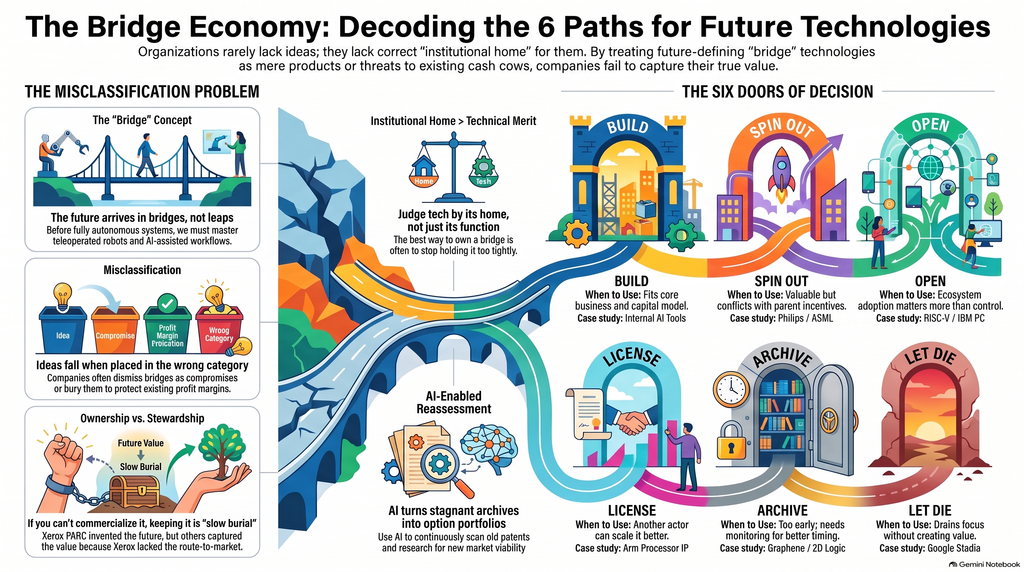
1. The Misclassification Problem
Most companies do not fail because they have no ideas.
They fail because they put ideas in the wrong category.
A bridge gets dismissed as a compromise.
A revival candidate gets mistaken for an obsolete technology.
A platform gets treated like a product.
A product that should die gets protected because it has internal champions.
A technology that should be spun out gets buried because it does not fit the parent company’s sales model.
A standard that should be opened gets enclosed too tightly.
A cash cow blocks the bridge that will eventually replace it.
This is the misclassification problem at the centre of the bridge economy.
A company looking at a candidate bridge must ask six questions:
| Question | What it reveals |
| Should we build it? | The bridge fits the core business and deserves internal funding. |
| Should we spin it out? | The bridge is valuable, but the parent company is the wrong home. |
| Should we archive it? | The idea is too early, but worth preserving and monitoring. |
| Should we open it? | Ecosystem adoption matters more than direct control. |
| Should we license or sell it? | Another actor can commercialise it better. |
| Should we let it die? | The asset consumes more attention than it creates value. |
These decisions are not technical decisions alone. They are organisational decisions. They involve incentives, distribution, timing, capital model, legal control, and the courage to cannibalise yourself before someone else does.
2. Case Studies: What the History Teaches
Case Study 1: Kodak — When the Bridge Threatens the Cash Cow
Context
Kodak did not miss digital photography because it lacked technical awareness. Kodak invented the world’s first digital camera in 1975, developed the first practical megapixel CCD image sensor in 1986, and introduced the Kodak Professional Digital Camera System in 1991. (Kodak) (Kodak)
The problem was classification. Digital imaging was not just another product category. It was the bridge from chemical film to image-based computing, networked sharing, software-driven photography, and eventually smartphone cameras.
PESTLE Snapshot
| Factor | Relevance |
| Economic | Film was a profitable incumbent business; digital threatened the profit pool. |
| Social | Consumers were moving toward convenience, speed, and electronic sharing. |
| Technological | Sensors, storage, displays, and software were improving steadily. |
| Legal/IP | Kodak possessed valuable imaging patents, but patents alone could not preserve the film model. |
Process
Kodak developed digital capability, but the organisation’s dominant economics remained attached to film. In bridge-economy terms, the company treated digital as a managed adjacency rather than the bridge to the next imaging system.
The internal incentive problem was brutal: the better digital became, the more it threatened the margins and habits of the existing business.
Outcome
Kodak entered Chapter 11 bankruptcy protection in January 2012 and emerged in September 2013 as a company focused mainly on imaging for business markets. (Kodak)
Results
Kodak’s digital work had enormous technical and historical significance. But the value of the bridge was captured largely by others: camera companies, software companies, smartphone makers, cloud platforms, and social networks.
Lessons Learned
Kodak teaches the first rule:
When the bridge threatens the cash cow, internal ownership may be the wrong structure.
The better decision may have been to build a separate digital business with permission to attack film, or to spin out digital imaging before internal incentives smothered it.
Bridge classification: Bridge misclassified as a threat.
Likely better door: Spin out, aggressive self-cannibalisation, or separate venture.
Case Study 2: Xerox PARC — When the Lab Invents the Future but the Company Cannot Commercialise It
Context
Xerox PARC is one of the great examples of research ahead of commercial structure. The Xerox Alto and PARC ecosystem helped demonstrate many elements that would later define personal computing: graphical interfaces, networked workstations, WYSIWYG editing, Ethernet-style networking, and office computing. Apple engineers and Steve Jobs visited Xerox PARC in December 1979 to see the Alto’s graphical interface; the Computer History Museum notes that Apple’s Lisa interface was influenced by PARC, while also developed by Apple engineers. (CHM)
Xerox did commercialise some PARC-originated technologies successfully. Laser printing, for example, became a major business, and Xerox describes the Xerox 9700 as one of its most successful products. (Xerox Newsroom)
PESTLE Snapshot
| Factor | Relevance |
| Economic | Xerox’s core business was document reproduction, not personal computing. |
| Technological | PARC had working systems before mass personal-computing markets were mature. |
| Social | Office workers and knowledge workers were beginning to need interactive computing. |
| Process | Research capability was not matched by a product and distribution model for personal computers. |
Process
PARC generated bridges into the future of computing, but Xerox’s strongest commercial pathway remained printing and document systems. Some inventions matched that pathway. Others did not.
Laser printing fit Xerox. Personal computing did not fit as naturally.
Outcome
The broader GUI-based personal computing opportunity was captured more powerfully by Apple, Microsoft, and the PC ecosystem than by Xerox.
Results
PARC’s technological legacy was immense. The organisational lesson is sharper: invention and commercialisation are separate capabilities.
Lessons Learned
Xerox PARC teaches:
If the parent company cannot commercialise the bridge, keeping it in the lab is not stewardship. It is slow burial.
Bridge classification: Multiple bridges; some built, some under-commercialised.
Likely better door: License, spin out, partner, or create a venture unit with its own market logic.
Case Study 3: Philips and ASML — When Spinning Out Creates More Value Than Holding On
Context
ASML is the positive case.
ASML was founded in 1984 as ASM Lithography, a joint venture between Philips and ASM International, created to commercialise wafer-stepper technology developed at Philips. (ASML) ASML’s own history describes the company beginning in a shed near Philips buildings in Eindhoven before becoming a central supplier to the semiconductor industry. (ASML)
PESTLE Snapshot
| Factor | Relevance |
| Economic | Semiconductor manufacturing needed increasingly advanced lithography tools. |
| Technological | Wafer steppers were becoming critical enabling equipment. |
| Process | A focused company could pursue the semiconductor equipment opportunity more directly. |
| Strategic | The technology’s market was larger than the parent’s immediate business unit logic. |
Process
Philips did not simply bury the technology because it was not the centre of its own business. It helped create a focused vehicle with the right mandate.
That is bridge-economy discipline: when the bridge does not belong inside the parent, build a new institutional home.
Outcome
ASML became one of the world’s most important semiconductor equipment companies.
Results
The spin-out structure allowed lithography to become a focused platform business rather than an internal project competing for attention inside a broader electronics conglomerate.
Lessons Learned
Philips and ASML teach the opposite of Kodak:
Sometimes the best way to own a bridge is to stop holding it too tightly.
Bridge classification: Bridge correctly spun out.
Likely best door: Spin out / joint venture.
Case Study 4: Oracle, Sun, and Java — When a Bridge Becomes an Ecosystem
Context
Oracle announced its acquisition of Sun Microsystems in 2009 and described Java as one of the computer industry’s best-known brands and “the most important software Oracle has ever acquired.” (Oracle)
Java was not just a programming language. It was an ecosystem bridge: a way for developers, enterprises, devices, servers, and later mobile platforms to operate across environments.
The later Google v. Oracle dispute showed how difficult it becomes to control a technology once it has become part of a broad developer ecosystem. In 2021, the U.S. Supreme Court held that Google’s copying of parts of the Java SE API for Android was fair use as a matter of law. (Legal Information Institute)
PESTLE Snapshot
| Factor | Relevance |
| Legal | APIs, copyright, fair use, and platform interoperability became central. |
| Economic | Java’s value came partly from ecosystem adoption, not only direct licensing. |
| Technological | Developer familiarity and compatibility mattered as much as code ownership. |
| Social | Millions of developers had built skills and expectations around Java-style interfaces. |
Process
Oracle acquired an ecosystem asset. But ecosystem assets are not controlled like ordinary products. They derive value from adoption, complementors, developer trust, and compatibility.
Outcome
The Supreme Court decision limited Oracle’s ability to use copyright claims to control Google’s API reimplementation in Android.
Results
Java remained strategically important, but the case demonstrated the limits of enclosing a widely diffused bridge technology after an ecosystem has formed.
Lessons Learned
Oracle/Sun/Java teaches:
When a bridge becomes an ecosystem, ownership must shift from product control to platform governance.
Bridge classification: Parallel standalone / ecosystem bridge.
Likely better door: Govern as platform, license strategically, or open selectively.
Case Study 5: Google Reader and Stadia — When Letting Die Is Portfolio Discipline
Context
Not every bridge should be saved.
Google Reader had a passionate user base, but Google announced it would retire the product on July 1, 2013. (googlereader.blogspot.com) Google also shut down Stadia on January 18, 2023, after announcing that users could continue playing until that date and that Google would refund eligible Stadia hardware and content purchases. (blog.google)
PESTLE Snapshot
| Factor | Relevance |
| Economic | Products must justify ongoing engineering, support, and opportunity cost. |
| Social | Reader had loyal users; Stadia had players and developers affected by shutdown. |
| Technological | Cloud gaming was technically possible, but platform execution and adoption mattered. |
| Process | Portfolio discipline requires deciding which products no longer fit strategy. |
Process
Google treated these as products that no longer deserved full continuation under their existing form. This does not mean every shutdown was beloved or strategically perfect. It means product death is a real portfolio tool.
Outcome
Reader’s shutdown remains a classic example of alienating a committed user base. Stadia’s shutdown showed that even technically ambitious infrastructure products can fail to become durable platforms.
Results
The lesson is not “Google was wrong to kill them.” The lesson is that killing must be done deliberately, with learning captured, users treated fairly, and reusable assets transferred into future systems where possible.
Lessons Learned
Google Reader and Stadia teach:
“Let it die” is a legitimate door, but death should produce learning, components, and reusable infrastructure — not just disappearance.
Bridge classification: Product death / possible component reuse.
Likely best door: Let die, but harvest learnings, infrastructure, and user insights.
Case Study 6: RISC-V — When Seeding the Commons Creates Strategic Leverage
Context
RISC-V is an open-standard instruction set architecture. UC Berkeley describes it as a free and open ISA originally developed for research and education and increasingly used for commercial designs. RISC-V International describes the ISA as an open standard for designing and implementing RISC-V processors. (RISC-V International)
PESTLE Snapshot
| Factor | Relevance |
| Technological | An open ISA lowers barriers for processor experimentation and implementation. |
| Economic | Ecosystem value can grow through shared adoption rather than single-firm control. |
| Political | Open architectures matter for sovereignty, education, and domestic semiconductor strategies. |
| Legal/IP | Open standards create a different ownership model from proprietary cores. |
Process
RISC-V shows that not every strategic technology should be enclosed. Sometimes the move is to seed a standard, invite adoption, and let the ecosystem compound.
Outcome
RISC-V has become a major open-standard alternative in processor architecture discussions.
Results
Its strategic value is not only in any one chip. It is in the ecosystem: education, experimentation, verification, software tooling, and national or regional hardware strategies.
Lessons Learned
RISC-V teaches:
If adoption and interoperability matter more than direct product control, opening can be a strategy, not charity.
Bridge classification: Open bridge / ecosystem standard.
Likely best door: Seed publicly, standardise, govern openly.
Case Study 7: Arm — When Licensing Is the Business Model
Context
Arm was founded in 1990 as Advanced RISC Machines Ltd, a joint venture between Acorn Computers, Apple, and VLSI Technology. Arm describes a core part of its model as making processor technology available to many companies through licensing, with upfront licence fees and royalties based on silicon produced. (Arm Newsroom)
Arm’s current filings describe its primary business as licensing IP products to semiconductor companies, OEMs, cloud service providers, and other organisations. (SEC)
PESTLE Snapshot
| Factor | Relevance |
| Economic | Licensing scales through partners rather than owning every end product. |
| Technological | Processor IP can be reused across phones, embedded devices, servers, and AI systems. |
| Legal/IP | The asset is not a single product; it is a licensable architecture and IP portfolio. |
| Process | Ecosystem support, tools, documentation, and compatibility become part of the product. |
Process
Arm did not need to become the manufacturer of every Arm-based chip. Its strategic position came from licensing reusable processor IP and enabling others to build products around it.
Outcome
Arm became a central architecture provider across multiple compute markets.
Results
Arm shows that the correct bridge decision may be neither “build internally” nor “open completely.” It may be “license broadly while maintaining architectural coherence.”
Lessons Learned
Arm teaches:
A bridge can become most valuable when it becomes reusable infrastructure for other people’s products.
Bridge classification: Licensed platform bridge.
Likely best door: License and govern ecosystem.
Case Study 8: IBM PC — When Opening the Architecture Creates the Market, but Weakens Control
Context
IBM launched the IBM PC in 1981. IBM’s own history notes that the team used off-the-shelf parts, embraced an open architecture, and published technical references to help companies develop software and peripherals. A few companies then used the published specifications and reverse-engineered the system boot code to create IBM-compatible computers and peripherals. (IBM)
Intel describes the IBM PC as the beginning of a compatible hardware and software ecosystem that came to define personal computing. (Intel)
PESTLE Snapshot
| Factor | Relevance |
| Economic | Speed to market mattered more than full vertical control. |
| Technological | Off-the-shelf components allowed rapid assembly and ecosystem growth. |
| Legal/IP | Open technical references helped third parties build around the platform. |
| Competitive | Compatibility enabled clones, which expanded the market but reduced IBM’s control. |
Process
IBM chose openness and speed. That helped create the PC ecosystem, but also created the conditions for compatible competitors to scale.
Outcome
The IBM-compatible PC became the dominant personal-computing architecture, while value shifted toward component suppliers, operating systems, software, and clone manufacturers.
Results
IBM helped create a bridge to mass personal computing, but the economics of the ecosystem did not remain fully controlled by IBM.
Lessons Learned
IBM PC teaches:
Opening a bridge can create the category, but the value may migrate to the actors who control the bottlenecks that emerge later.
Bridge classification: Open architecture bridge.
Likely best door: Open selectively, but protect key bottlenecks or ecosystem position.
3. What the Case Studies Teach
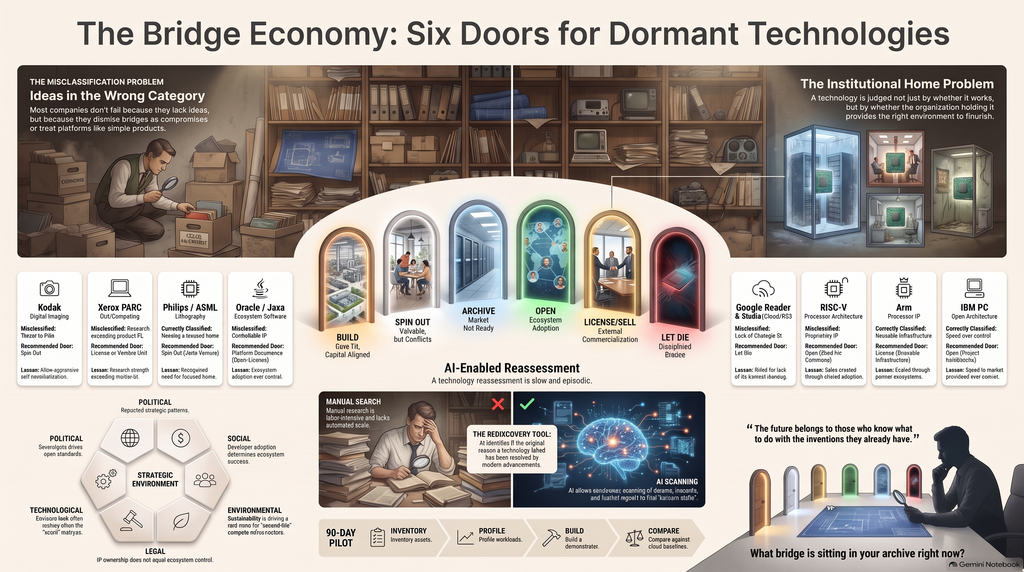
Across the eight cases, the same pattern repeats.
| Case | What was misclassified or correctly classified? | Main lesson |
| Kodak | Digital photography treated as an adjacency despite being the bridge to the next imaging system. | Cannibalising bridges need separate governance. |
| Xerox PARC | Research bridges existed, but not all fit Xerox’s commercial model. | Invention without route-to-market is not enough. |
| Philips / ASML | Wafer-stepper technology given a focused institutional home. | Spin-outs can preserve and magnify bridge value. |
| Oracle / Java | Ecosystem technology treated partly as controllable IP. | Ecosystems require governance, not just ownership. |
| Google Reader / Stadia | Products killed when strategic fit weakened. | Letting die can be disciplined if learning is harvested. |
| RISC-V | Open standard used to grow ecosystem adoption. | Commons can be a strategic lever. |
| Arm | Processor IP scaled through licensing. | Licensing can turn a bridge into reusable infrastructure. |
| IBM PC | Open architecture created the ecosystem but loosened control. | Openness creates markets, but value migrates to bottlenecks. |
The case studies show why it cannot be a simple scoring model. It must be a decision architecture.
The same technology can require different treatment depending on timing, incentives, capital model, rights, ecosystem maturity, and organisational fit.
4. AI Changes the Reassessment Landscape
The next phase of the bridge economy will be different because AI changes how dormant assets can be found, interpreted, simulated, and recombined.
Historically, organisations needed people to manually search patent portfolios, read technical archives, compare old designs, check expired rights, identify market shifts, and connect old research to new use cases. That made dormant-asset reassessment slow, expensive, and episodic.
AI makes it continuous.
AI can scan expired patents, abandoned filings, old engineering documents, discontinued product manuals, open-source repositories, research papers, procurement databases, standards, policy changes, and internal R&D records. It can identify whether the reason something failed has changed: compute became cheaper, sensors improved, materials matured, regulations shifted, customers adopted a new behaviour, or a complementary technology appeared.
This is why the reusable-knowledge platform concept in the thread matters. It argues that the stronger product is not merely a public-domain search engine, but a governed reusable-asset and IP intelligence platform that helps users discover what exists, understand what may be reusable, identify possible conflicts, find cross-industry opportunities, and monitor when the answer changes.
The key insight is:
AI is not just a tool for building new technologies.
It is a tool for rediscovering old ones.
The strongest AI-enabled reassessment system would not simply answer, “Is this patent expired?” It would answer:
- What is the asset?
- What rights surround it?
- What jurisdiction matters?
- What intended use is being considered?
- What related rights may still block reuse?
- What technical constraint originally killed it?
- What has changed since then?
- What adjacent industries have equivalent problems?
- What complementary technologies now exist?
- What should be built, licensed, opened, piloted, archived, or abandoned?
The concept of reuse captures this through an evidence-backed approach: rights are layered, official sources, outrank inference, unknowns remain visible, and high-consequence decisions require human approval.
This is a major shift from archive-as-storage to archive-as-option.
5. Companion Technical Paper: Revisiting AI Chip Design
A companion technical paper should sit beside this article: Revisiting AI Chip Design
“Revisiting AI Chip Design: A Bridge-Economy Reassessment of Dormant Architectures, Substrates, and Materials.”
That paper applies the same lessons to AI infrastructure.
Its core argument is that the question should not be:
“Can this old chip beat a frontier GPU?”
The better question is:
“Can this old asset solve a bottleneck somewhere in the AI compute stack?”
The technical paper should identify a 20-year enterprise archive of mature-node accelerator designs, old GPU/server hardware, discontinued interposer and packaging research, photonics experiments, thermal material patents, cooling-system studies, compiler tools, and internal reports on graphene, 2D semiconductors, SiC, GaN, CNTs, and diamond substrates. The argument is that these should be reassessed as possible bridge technologies for inference, retrieval, digital twins, archive intelligence, regional AI compute, cooling, power delivery, and specialised workloads.
The most important conclusion is not “post-silicon replaces silicon.” It is that AI infrastructure is becoming a layered stack. Silicon remains the base, while materials, packaging, power electronics, photonics, cooling, second-life compute, and workload routing enter where silicon alone is weak.
The paper’s candidate decisions illustrate the action logic:
| Candidate | Recommended action |
| Regional second-life AI compute bank | Build / Reframe |
| Mature-node accelerator for embeddings and retrieval | Pilot |
| Diamond / SiC / GaN thermal and power layer | Build targeted pilots |
| Full custom ASIC for one current LLM | Bypass for now |
| Active Cold Intelligence for technical archives | Build |
| Graphene / 2D / CNT logic replacement | Hold as option |
| Cooling and heat reuse infrastructure | Reframe as infrastructure business |
The most likely practical recommendation is a 90-day pilot: inventory dormant chip and substrate assets, profile workloads, build a small second-life compute demonstrator, and compare cost, energy, latency, reliability, security, and avoided premium GPU hours against a premium cloud baseline.
This is the bridge economy applied to hard technology: not nostalgia, not hype, but disciplined reassessment.
6. The Seven Lessons
Seven lessons
Lesson 1: “Abandoned” is a timestamp, not a verdict
A technology abandoned in 1998 may have failed because compute was expensive, sensors were crude, materials were immature, customers were not ready, regulation was hostile, or the required ecosystem did not exist.
Those conditions may no longer hold.
Lesson 2: The parent company may be the wrong home
Kodak and Xerox show that the owner of a technology is not always the best commercialiser of that technology.
Lesson 3: Spin-outs are not failure
Philips and ASML show that letting a technology leave the parent can create far more value than trapping it inside the wrong incentive system.
Lesson 4: Ecosystems require governance
Java, RISC-V, Arm, and IBM PC all show different ways technologies become ecosystems. Once that happens, control must be balanced against adoption.
Lesson 5: Opening is a strategic choice
RISC-V and IBM PC show that openness can create a market. But openness must be designed carefully, because value often migrates to whoever controls the next bottleneck.
Lesson 6: Product death is not always bad
Google Reader and Stadia show that some products should end. But ending a product should preserve learning, components, infrastructure, and customer insight.
Lesson 7: AI turns archives into option portfolios
AI can connect internal IP, expired rights, public research, open-source assets, market signals, and technical analogues. This makes dormant-asset reassessment a continuous strategic capability rather than a one-off legal search.
7. Bridge-Economy Decision Preview
Take these lessons and turn them into six doors.
| Door | Use when | Case study signal |
| Build | The bridge fits the core business, customers, capital model, and capabilities. | Internal AI tools, active archive platforms. |
| Spin out | The bridge is valuable but conflicts with the parent’s incentives. | Philips / ASML; possible Kodak alternative. |
| Archive | The technology is promising but timing, regulation, cost, or infrastructure is not ready. | 2D logic materials, some post-silicon paths. |
| Open / seed publicly | Adoption and standardisation matter more than direct product control. | RISC-V. |
| License / sell | Another company can commercialise or scale the bridge better. | Arm-style licensing; Xerox alternatives. |
| Let die | The asset drains focus, capital, trust, or maintenance capacity. | Google Reader / Stadia. |
The full decision framework should ask:
- Does the bridge solve current pain?
- Does it create transferable learning?
- Does it threaten the parent’s core business?
- Does it need ecosystem adoption?
- Does the organisation have the right route to market?
- Is the technology too early, or merely underfunded?
- Can it survive as a standalone niche?
- Are the rights clear enough to act?
- Does opening increase or destroy value?
- What should trigger reassessment?
Conclusion: The Bridge Needs a Home
The bridge economy is not only a theory of technological transition. It is a theory of organisational judgement.
Kodak had the bridge and protected the old system.
Xerox had bridges and commercialised some while letting others escape.
Philips helped create the right home for ASML.
Oracle inherited an ecosystem and learned the limits of control.
Google showed that killing products is sometimes part of portfolio discipline.
RISC-V showed that opening can be strategic.
Arm showed that licensing can become the business model.
IBM showed that open architecture can create a market while shifting value elsewhere.
The lesson is not that one door is always right.
The lesson is that organisations need a language for choosing the door.
The challenge is to provide language. That turns these lessons into a practical corporate framework for deciding what to build, spin off, shelve, open, license, sell, or let die.
Because the future does not only belong to the organisations that invent it.
It belongs to the organisations that know what to do with the inventions they already have.
Appendix A — Case Study Details
| Case | Timeline | Organisational dynamic | Technical constraint | IP / rights issue | Missed or captured opportunity | Revival potential |
| Kodak | 1975 digital camera; 1986 megapixel CCD; 1991 DCS; 2012 Chapter 11. | Digital threatened film economics. | Early sensors, storage, displays, and consumer workflows were immature. | Strong imaging IP did not equal market control. | Missed full transition from film to digital imaging platforms. | Historical lesson for cannibalisation governance. |
| Xerox PARC | PARC created Alto-era technologies; Apple visited in 1979; laser printing commercialised. | Research strength exceeded product-market fit in personal computing. | Workstations were expensive and early. | Some assets could have been licensed or spun out more aggressively. | Captured laser printing; undercaptured GUI personal-computing bridge. | Strong lesson for lab-to-market structures. |
| Philips / ASML | ASML founded in 1984 as Philips-ASMI venture. | Parent enabled focused commercial vehicle. | Semiconductor lithography required deep specialisation. | JV structure clarified ownership and commercial focus. | Captured bridge value through spin-out. | Positive model for dormant industrial technology. |
| Oracle / Sun / Java | Oracle announced Sun acquisition in 2009; Supreme Court fair-use decision in 2021. | Ecosystem asset acquired by enterprise software company. | APIs and developer compatibility shaped platform adoption. | Copyright, APIs, fair use, and ecosystem control. | Java remained valuable, but full enclosure was limited. | Lesson for platform governance. |
| Google Reader / Stadia | Reader retired 2013; Stadia shut 2023. | Portfolio discipline versus user/community attachment. | Cloud gaming needed strong ecosystem, latency, content, and business model. | User purchases, refunds, data portability, developer relations. | Shutdowns ended products but could preserve components and infrastructure learning. | Product death should include knowledge harvesting. |
| RISC-V | Originated at UC Berkeley for research and education; now open standard. | Commons-based ecosystem growth. | Requires tooling, verification, software, and commercial support. | Open-standard governance. | Created strategic optionality for many actors. | Model for open bridge strategy. |
| Arm | Founded 1990; licensing model scaled processor IP. | Did not need to manufacture every chip. | Required partner ecosystem, tooling, compatibility, and support. | Processor IP licensing and royalties. | Captured value through reusable architecture. | Model for licensing dormant technical assets. |
| IBM PC | Launched 1981; open architecture and technical references enabled compatible ecosystem. | Speed and ecosystem growth outweighed vertical control. | Relied on third-party hardware and software. | Published references enabled third-party development and clones. | Created category but lost control of much downstream value. | Lesson for controlled openness. |
Appendix B — AI Tools for Dormant Asset Reassessment
A serious AI-enabled reassessment system should include the following capabilities.
| Capability | What it does | Why it matters |
| Patent expiry scanning | Tracks patent expiry, abandonment, legal events, and family status. | Finds assets whose legal barriers may have changed. |
| Copyright and documentation scanning | Searches old manuals, drawings, code, books, training materials, and archives. | Recovers the documentary layer needed to understand why something failed. |
| Rights-envelope modelling | Separates patent, copyright, trademark, design, licence, contract, database, and regulatory constraints. | Prevents the false conclusion that “one expired right means free to use.” |
| Cross-industry mapping | Abstracts the function of an asset and searches for analogous problems elsewhere. | Finds bridge applications outside the original market. |
| Constraint reconstruction | Identifies why the asset originally failed: cost, compute, materials, regulation, demand, infrastructure, or IP. | Separates true dead ends from revival candidates. |
| Context-shift detection | Monitors enabling changes in AI, materials, sensors, policy, standards, manufacturing, and customer behaviour. | Turns reassessment into a continuous watch function. |
| Simulation and feasibility testing | Uses modelling, digital twins, emulation, and workload profiling. | Tests revival candidates before major capital commitment. |
| Evidence graph | Links asset, owner, right, jurisdiction, source, status, use, evidence, opportunity, and uncertainty. | Creates traceability and governance. |
| Human-review routing | Escalates high-risk legal, safety, regulatory, or investment decisions. | Keeps AI as decision support, not autonomous authority. |
The Reuse development plan recommends proving a narrow, evidence-intensive MVP first rather than building a global all-rights database. Its first programme should test whether authoritative sources can be federated, normalised, explained, monitored, and escalated with useful evidence.
Appendix C — Bridge vs Dead End vs Revival Candidate
| Case / asset | Classification | Reason |
| Kodak digital photography | Bridge | It connected chemical imaging to digital imaging ecosystems. |
| Xerox PARC GUI computing | Bridge | It anticipated personal computing but lacked the right commercial route inside Xerox. |
| Xerox laser printing | Built bridge | It fit Xerox’s core document business and became commercially valuable. |
| ASML lithography | Spun-out bridge | It became more valuable in a focused institutional structure. |
| Java | Parallel standalone / ecosystem bridge | It became an enduring platform whose value exceeded single-company product control. |
| Google Reader | Let-die product | Loyal user base, but weak strategic fit under Google’s portfolio logic. |
| Stadia | Let-die product / harvested infrastructure candidate | Technically ambitious but insufficient platform traction. |
| RISC-V | Open bridge | Its value grows through open adoption and ecosystem development. |
| Arm | Licensed bridge | Processor IP became more valuable through licensing than vertical integration. |
| IBM PC | Open architecture bridge | Created the PC ecosystem but shifted value to complementors and bottleneck owners. |
| Mature-node AI accelerators | Revival candidate | Not frontier chips, but useful for stable workloads such as embeddings and retrieval. |
| Diamond thermal substrates | Revival candidate / bridge | Stronger as a heat-spreading and packaging layer than as universal logic. |
| Graphene / 2D logic | Hold as option | Strategically relevant, but near-term manufacturable mass replacement remains uncertain. |
| Second-life AI compute | Bridge / permanent niche | Useful for inference, retrieval, education, rendering, and archive intelligence. |
Appendix D — PESTLE Pattern Summary
| PESTLE factor | Repeated pattern across cases |
| Political | Open standards and sovereign capability become more important when technologies diffuse. |
| Economic | Cash cows suppress bridges; licensing and spin-outs can unlock trapped value. |
| Social | User trust, developer adoption, and ecosystem behaviour often decide outcomes. |
| Technological | Technologies fail early when complements are missing; they revive when the stack matures. |
| Legal | IP ownership is not the same as ecosystem control or commercial freedom. |
| Environmental | Increasingly relevant for AI chips, cooling, circular compute, and second-life infrastructure. |
Abbreviations & Framework Terms
AI = Artificial Intelligence
API = Application Programming Interface
ASIC = Application-Specific Integrated Circuit
CAD = Computer-Aided Design
CCD = Charge-Coupled Device
CNT = Carbon Nanotube
DCS = Digital Camera System
FPGA = Field-Programmable Gate Array
GPU = Graphics Processing Unit
GUI = Graphical User Interface
IP = Intellectual Property
ISA = Instruction Set Architecture
LLM = Large Language Model
PESTLE = Political, Economic, Social, Technological, Legal, Environmental
R&D = Research and Development
RAG = Retrieval-Augmented Generation
SiC = Silicon Carbide
GaN = Gallium Nitride
WYSIWYG = What You See Is What You Get