Idea Snapshots — Brief, strategic glimpses into business possibilities.
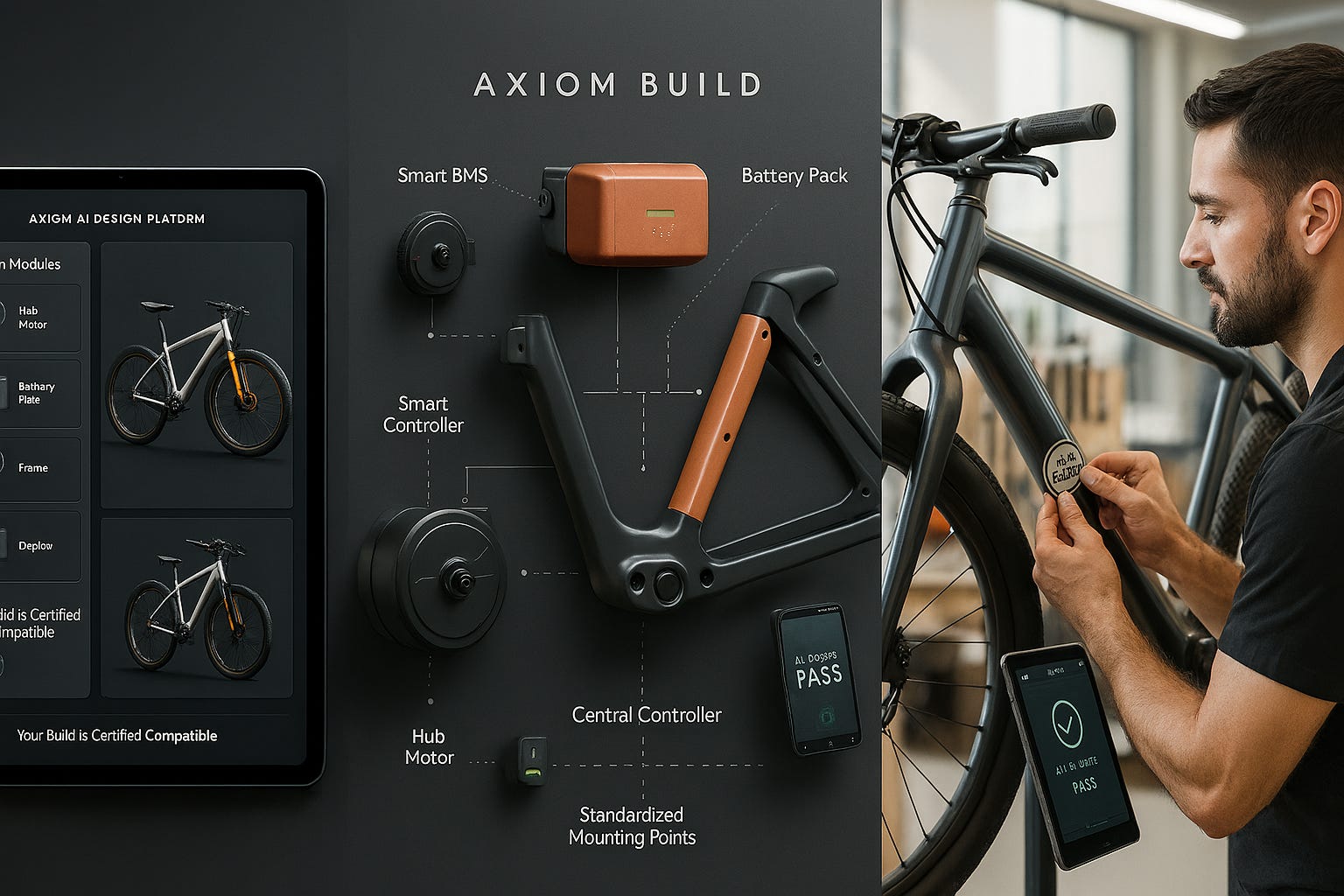
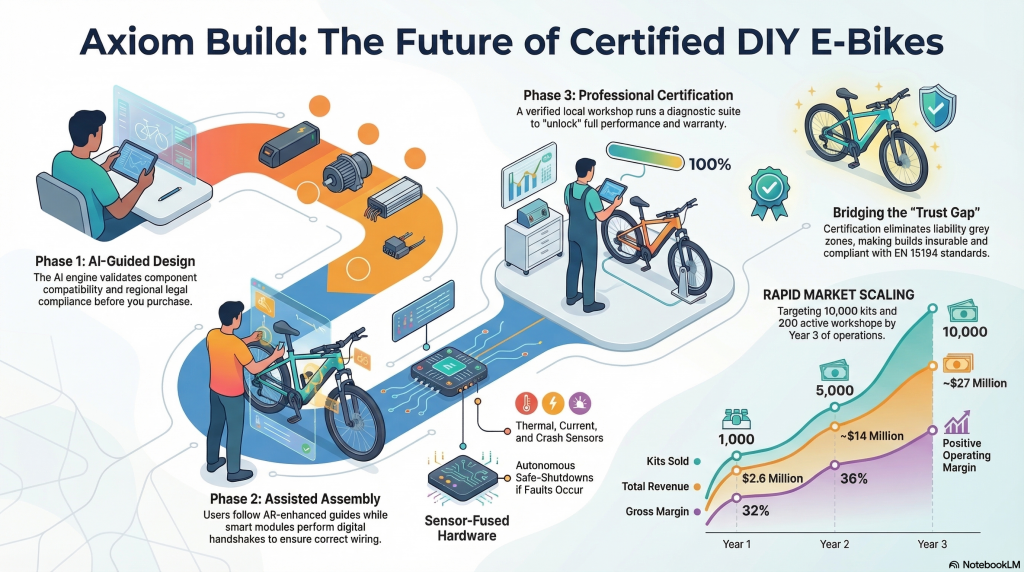
The e-bike boom has created a paradox: while millions want personalized electric bikes, the DIY path remains dangerous and intimidating. Incompatible parts, electrical fire risks, and the specter of battery explosions lock out all but expert builders. Axiom Build solves this through an integrated hardware-software platform that makes building your dream e-bike as safe as following a recipewith AI-guided design, sensor-laden smart modules, and a network of certified workshops that validate your finished bike. It’s the “kit car” model reimagined for the electric mobility era, where manufacturers warranty the parts, the platform ensures compatibility, and professional certification eliminates liability gray zones.
This isn’t just another e-bike kit it’s a trust infrastructure for the personalized EV revolution. By moving safety from an afterthought to the core architecture (embedded sensors, real-time diagnostics, smart firmware), Axiom transforms high-risk DIY into an assured, empowering experience that bridges the gap between mass-market conformity and dangerous experimentation.
Is This New?
Originality Check:
- [X] Remix of existing concepts
- [X] Cross-domain adaptation
Analysis:
DIY e-bike kits exist (Swytch, Bafang conversion kits), as do high-end component suppliers (Grin Technologies) and modular EV platforms for commercial vehicles (OSVehicle, Biliti Electric). However, no one has combined these elements into a consumer-facing, safety-certified platform.
What’s different: The certification layer changes everything. Existing kits are “buyer beware” products. Axiom introduces a trusted middle ground—you get the joy and cost savings of building, but with guaranteed compatibility, embedded safety systems, and professional validation. It’s applying the proven kit car regulatory model (Factory Five, Caterham) to e-bikes, a space where this framework doesn’t yet exist.
The cross-domain innovation: borrowing Donut Lab’s direct-drive hub motor philosophy (lightweight, modular, high-efficiency) and OSVehicle’s platform-as-a-service thinking, then packaging it for individual consumers rather than fleet operators or commercial builders.
As usual some outline idea document: SRS , business plan etc: Axiom Build artefacts
Market Position
The Landscape:
The global e-bike market is projected to reach $120 billion by 2030, growing at 10%+ annually. However, it’s bifurcating: mass-market brands dominate the $1,500-$3,000 segment with standardized designs, while premium custom builders serve wealthy enthusiasts at $5,000-$15,000. The middle market—people who want customization without premium prices or who enjoy building—is underserved and fragmented across sketchy AliExpress parts and incomplete conversion kits.
The DIY e-bike community is thriving on forums (Endless-Sphere, r/ebikes) but remains niche due to intimidation, safety concerns, and the time investment required to research compatible components. Local bike shops are increasingly overwhelmed by customers bringing in unsafe home-built e-bikes they can’t service or certify.
The Opportunity:
Axiom occupies a white space: assured customization. You’re not competing with Rad Power Bikes or Trek on mass manufacturing efficiency. You’re also not competing with custom frame builders on artisanal craftsmanship. Instead, you’re creating a new category: premium DIY with professional validation.
Target segments:
- DIY enthusiasts (200k-500k globally) who want the pride of building but need guardrails
- Cost-conscious buyers (2-5M potential) who can save $800-$1,500 in assembly labor
- Small businesses needing cargo solutions without custom fabrication costs
- Sustainability-focused consumers attracted to Right-to-Repair principles and upgradability
The niche: You’re betting that 5-10% of e-bike buyers (600k-1.2M people annually) value personalization + safety assurance enough to choose a guided build over buying complete.
The Scale:
This doesn’t need to be a unicorn. Success looks like:
- Year 3: 10,000 kits sold annually at $2,500 average = $25M revenue
- Year 5: 50,000 kits + 200 certified workshops + software subscriptions = $150M+ revenue
- Exit path: Acquisition by a major e-bike brand (Trek, Specialized, Bosch) seeking to capture the customization segment, or by an automotive player (like Porsche acquiring Fazua) expanding into micro-mobility platforms
The platform model creates compounding value: each certified workshop becomes a distribution and validation node, each module sold feeds data back to improve the AI, and the safety certification becomes a moat (regulatory capture through standard-setting).
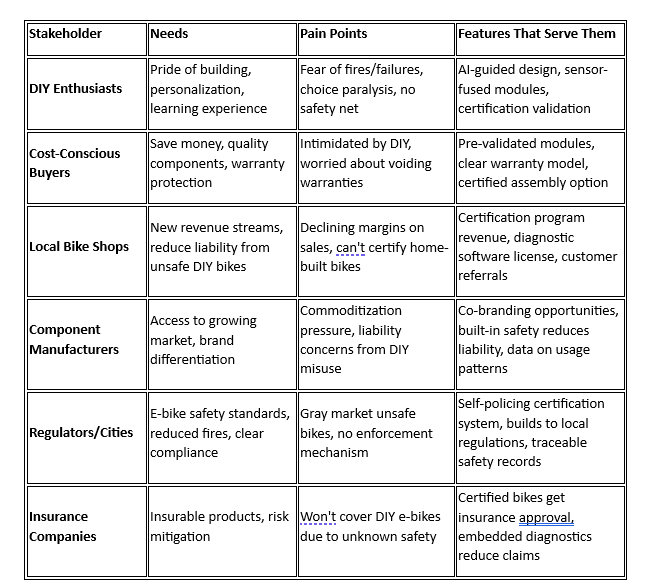
Stakeholder Ecosystem
References
Direct inspirations:
- Factory Five Racing/Caterham Cars: Kit car model with builder certification
- OSVehicle: Open-source modular EV platform for commercial builders
- Grin Technologies (ebikes.ca): High-quality, documented e-bike components with technical support
- Bosch eBike Systems: Integrated ecosystem approach with smart connectivity
- IKEA effect: Psychological value of self-assembly (people value what they build)
Technical foundations:
- Donut Lab hub motor technology (direct-drive, lightweight, high-torque)
- Modular battery systems from EV sector (Tesla’s skateboard platform philosophy)
- IoT diagnostics from automotive (OBD-II protocols adapted for e-bikes)
- Smart BMS (Battery Management Systems) from power tool industry
Regulatory precedents:
- EU’s EN 15194 e-bike standards
- US CPSC regulations for assembled vs. kit vehicles
- UK’s EAPC (Electrically Assisted Pedal Cycles) certification framework
Product vs. Feature
The Test:
Could a Trek or Specialized just add “build-your-own” options to their website? Could Bosch integrate an AI configurator into their eBike Flow app? Technically yes, but they won’t because:
- Cannibalization risk: Their business models depend on selling complete, high-margin bikes
- Liability aversion: Established brands can’t afford the reputational risk of DIY failures
- Distribution conflict: They need dealers, who would revolt against direct DIY competition
- Operational complexity: Their supply chains are optimized for volume manufacturing, not customization
The Defense:
Axiom is defensible through:
- Speed advantage: You can move fast as a startup; incumbents need 2-3 year product cycles
- Community moat: Build a passionate user base that creates content, shares builds, and evangelizes (think Peloton’s early community strategy)
- Certification network: Once you have 500+ workshops locked in, that’s hard to replicate
- Data flywheel: Every build generates data that improves AI recommendations—this compounds
- Position as “Switzerland”: You’re brand-agnostic on components (unlike Bosch/Shimano), attracting builders who want choice
- Platform optionality: If growth stalls, pivot to B2B (license platform to micro-mobility companies) or vertical integration (become a premium boutique brand yourself)
The key insight: Large players optimize for “don’t screw up 95% of customers.” You optimize for “delight the 5% who want something different.” That’s a classic asymmetric advantage.
Core Components
What You’d Need:
- Hardware partnerships: Secure ODM relationships with 2-3 hub motor manufacturers (potentially license Donut’s technology or partner with MXUS/Bafang for certified variants), battery cell suppliers (ideally salvaged EV cells like what companies like Moment Energy do), and frame fabricators who can produce the standardized mounting platform
- Software development: AI/ML team to build the compatibility engine and recommendation system; mobile app developers for AR visualization and assembly guides; embedded systems engineers for the smart controller firmware and sensor integration
- Certification infrastructure: Legal framework for the workshop program; diagnostic hardware/software for verifiers; training materials and quality control systems; insurance partnerships for certified builds
- Regulatory navigation: Lawyers specializing in product liability and vehicle regulations in target markets (US, EU, UK to start); testing facilities for safety certifications (UL, TÜV); relationships with standards bodies to potentially shape emerging e-bike build standards
- Supply chain & logistics: Warehousing for modular inventory; packaging systems that protect sensitive electronics; fulfillment partners who understand hazmat shipping (for batteries)
- Brand & community building: Content creators for assembly guides; community managers for forums/Discord; influencer partnerships in cycling/DIY/sustainability spaces
First Steps:
- Build the MVP hardware: Develop working prototypes of three core modules (hub motor with thermal sensor, smart battery with BMS, central controller) that can communicate and perform basic safety checks. Budget: $150k-$250k. Timeline: 6-9 months. Outcome: Demonstrate the technical feasibility to investors and partners.
- Validate the business model: Presell 50-100 beta kits to early adopters through crowdfunding (Kickstarter/Indiegogo). Include mandatory certification at partner bike shops. Price: $2,000-$2,500. Goal: Prove demand, gather feedback, and test the certification workflow. Revenue: $100k-$250k.
- Establish certification pilot: Recruit 10-20 bike shops in 3-5 cities to become Axiom-Verified workshops. Develop the diagnostic tool and training program. Test the economics: What verification fee makes sense? How long does certification take? What percentage of builds pass on first attempt? This de-risks the entire model.
The Contrarian View
Challenge This Idea:
“This is a liability nightmare.” Even with certification, when someone crashes or a battery catches fire, lawyers will sue everyone: you, the workshop, the component makers. Your insurance costs will be prohibitive, and one viral video of an “Axiom e-bike explosion” destroys the brand overnight.
“The market is too small.” DIY enthusiasts are vocal online but tiny in reality. Most people don’t want to build—they want to buy and ride. You’re chasing <1% of the e-bike market, which can’t support the infrastructure investment required.
“You’ll get squeezed from both sides.” Cheap Chinese kits on AliExpress undercut you by 70%, while premium brands offer peace of mind. You’re stuck in the dreaded middle: too expensive for price shoppers, not premium enough for luxury buyers.
“Workshops won’t play along.” Bike shops are already struggling; they won’t pay licensing fees or take on liability for certifying amateur builds. And if they’re doing the final validation anyway, why wouldn’t they just offer full build services and cut you out?
“Regulations will kill it.” Governments are cracking down on e-bike power levels, battery safety, and speed limits. Your “modular platform” could get outlawed or regulated into irrelevance (like what happened to e-scooter sharing in many cities).
Why It Might Still Work:
On liability: The kit car industry solved this decades ago. You’re selling components with clear warnings; the workshop certification creates a legal buffer (they’re the licensed professionals). Insurance exists for this model—Factory Five has been doing it since 1995. You’ll need aggressive legal structuring (separate entities for hardware, software, certification), but it’s solvable. And one fire? That’s why you invest heavily in safety redundancies—make it 10x safer than uncertified DIY, and you’re still saving lives vs. the status quo.
On market size: You don’t need 50% of e-bike buyers; you need 1-2%, which is 120k-240k people annually by year 5. That’s a $300M-$600M business. The DIY/maker movement is growing, not shrinking (see Prusa 3D printers, Framework laptops, iFixit). Right-to-Repair legislation is expanding globally. You’re riding macro tailwinds.
On price competition: You’re not competing on price; you’re competing on trust and experience. The person buying a $400 AliExpress kit knows the risks—they’re not your customer. Your customer is the $3,500 bike buyer who thinks, “I could build this myself for $2,500 and get exactly what I want, IF I knew it would be safe.” You’re not cheaper than DIY; you’re dramatically cheaper than custom.
On workshop participation: You’re giving shops a lifeline. E-bike sales margins are thin (20-30%), but service is 60%+ margin. You’re offering them: (1) recurring revenue from certifications, (2) diagnostic software they can use on ALL e-bikes (expand your TAM), (3) referrals from customers who discover bikes during certification. Frame it as partnership, not extraction. Some will resist, but you only need 200-500 shops globally to reach critical mass.
On regulations: You’re actually better positioned than anyone. Mass-market brands circumvent rules; Chinese imports ignore them. You EMBRACE regulation: “Every Axiom bike is certified to local standards.” Partner with regulators to define the standards. If governments crack down, you benefit—you’re the compliant option. Play the long game: as rules tighten, your moat deepens.
The real risk isn’t that this is unworkable—it’s that you need capital, patience, and excellence in execution. This is a “10-year build” business, not a “flip in 3 years” startup. Are you ready for that?
Cross-Domain Potential
If This Doesn’t Work for E-Bikes:
The platform model and safety certification framework could be adapted to:
- Electric motorcycles/scooters: The Arch Motorcycle (Keanu Reeves’ company) proves high-end custom e-motos work. Apply Axiom’s safety-first modular approach to the $8k-$25k e-moto market. Larger motors, bigger batteries, same principle.
- Light electric vehicles (LEVs): Think Aptera (three-wheel EVs) or enclosed velomobiles. Use Donut hub motors and modular battery packs for ultra-efficient city vehicles. Target: micro-car market in Europe/Asia where L6e/L7e regulations create space for DIY-adjacent solutions.
- Electric marine (kayaks, paddleboards, dinghies): Modular electric propulsion kits with the same safety architecture. Underwater applications make sensor-fused safety even more critical. Smaller market but underserved.
- Adaptive mobility devices: Wheelchairs, cargo trikes, handcycles for disabled users. These users desperately need customization (body dimensions, use cases vary wildly) and safety is paramount. High social impact, potential for nonprofit/B-corp model.
- B2B micro-mobility platforms: License the technology to delivery companies (DoorDash, Uber Eats), rental operators, or corporate campuses building internal vehicle fleets. Pivot from consumer DIY to fleet customization.
- Franchise model for emerging markets: In regions where e-bikes are primary transportation (Southeast Asia, parts of Africa), license local workshops to assemble and certify Axiom platforms using locally-sourced frames. You become the Intel Inside of e-mobility.
The core IP—smart modules with embedded safety, AI-guided compatibility, certification workflow—is domain-agnostic. You’re building a trust layer for personalized electric vehicles, not just an e-bike company.
Next Steps for Builders
If you wanted to pursue this:
Week 1: Validate demand and map the ecosystem
- Interview 20 active DIY e-bike builders (find them on Endless-Sphere, Reddit, YouTube). Ask: What stopped you from building sooner? What went wrong? Would you pay $500 extra for pre-validated, certified-safe components?
- Contact 10 local bike shops. Pitch the certification concept. Gauge interest: Would they participate for $150-$250 per certification? What objections arise?
- Order components from Bafang, MXUS, or Leafbike. Start building your own e-bike to understand the pain points firsthand. Document everything—this becomes your content library.
Month 1: Develop technical MVP and legal framework
- Partner with an electrical engineer (Upwork, local university, or a cofounder) to design a prototype smart BMS and controller that can perform basic sensor checks. Budget: $15k-$25k.
- Consult with a product liability lawyer specializing in vehicles. Draft the legal structure for component sales vs. assembled vehicle. Research insurance options. Cost: $5k-$10k.
- Build a simple web app (no-code tool like Bubble or Webflow) that guides users through component selection. Test with 10 users. Does the “AI concierge” concept resonate, or do people just want parts lists?
Quarter 1: Launch beta program and prove the certification model
- Crowdfund 50-100 beta kits on Kickstarter. Target: $125k-$200k raised. This validates demand and funds hardware development.
- Finalize agreements with 5-10 pilot bike shops. Train them on certification process. Offer rev-share (you get 50% of certification fee initially to incentivize participation).
- Deliver beta kits, guide users through builds, and certify the finished bikes. Measure: completion rate, time-to-build, failure points, NPS (Net Promoter Score). Document every build with video content—this is your future marketing library.
- Based on feedback, iterate: Does the certification add value, or does it feel like bureaucratic overhead? Can you reduce assembly time? What modules need redesign?
Resources to Explore:
- Endless-Sphere Forum: The birthplace of DIY e-bike knowledge. Read the “Building Your First E-Bike” megathreads. Learn the failure modes.
- Grin Technologies (ebikes.ca): Study their business model. They’re not doing certification, but their customer education approach is world-class. Could they be a strategic partner?
- OSVehicle Documentation: Examine how they structure their open platform for commercial builders. Adapt their chassis-as-a-service model.
- Factory Five Racing: Read their history (book: “Built to Drive”). They solved the liability puzzle for kit cars—apply their lessons.
- UL 2849 Standard: Battery safety certification for light electric vehicles. This will govern your BMS design. Understand it deeply.
- Micromobility Industries Podcast: Guests from e-bike startups, regulators, VCs. Absorb the market intelligence.
- Framework Laptop Community: They cracked modular, user-repairable electronics. How can their design philosophy inform your module architecture?
Final Thoughts
Axiom Build matters because it challenges a false dichotomy: that you must choose between convenience and agency, between safety and customization. In an era of increasing e-waste, planned obsolescence, and cookie-cutter products, this platform represents a counter-movement—one that says, “You can have the thing you want, made by your hands, without gambling your safety.”
The timing is right: e-bikes are transitioning from niche to mainstream, Right-to-Repair sentiment is at all-time highs, and a generation raised on IKEA furniture and YouTube tutorials isn’t intimidated by assembly—they’re intimidated by risk and uncertainty. Axiom removes those barriers.
Beyond the business case, this taps into something deeper: the hunger for meaningful work, for pride of creation, for objects that reflect our identities rather than mass-market averages. Every Axiom bike is a statement: “I built this. It’s mine. It’s exactly what I need.”
Alternative Takes:
- Pivot to B2B first: Instead of consumer kits, sell the platform to emerging e-bike brands in developing markets. Prove the technology, then descend to consumers once certified.
- Partner with an incumbent: License the certification software and AI platform to Bosch or Shimano. Let them own the consumer relationship; you become infrastructure.
- Focus on retrofits only: Skip new builds. Target the 300+ million existing bikes globally. Make Axiom the “Tesla Supercharger” of e-bike conversions—ubiquitous, trusted, certified.
- Go hyper-niche: Start with cargo e-trikes for small businesses (florists, food vendors). Lower speeds = lower risk, commercial buyers value ROI over emotion, and repeat business potential is higher.
This is part of Ideas Snapshots — a collection of lightweight business blueprints, strategic outlines, and entrepreneurial prompts. Not every idea needs to be built. Some are meant to inspire, remix, or adapt.
What would you do differently with this idea? Would you pursue the consumer market or B2B first? Does the certification model create a moat or a bottleneck? Reply or share your take.