Where Guests Become Citizens — Steampunk Entertainment, Studio Production & Community, Built to Last
Preamble
The immersive entertainment industry is booming and breaking. Projected to grow from £98 billion in 2025 to over £351 billion by 2030, the sector is awash with ambition but riddled with cautionary tales: theme parks that burned through capital before finding their audience, experiential hotels that closed within two years, and immersive worlds that promised magic and delivered mediocrity.
Into this landscape steps Brass & Velvet a concept that dares to ask a different question. Not how do we build the biggest immersive world, but how do we build one that actually works?
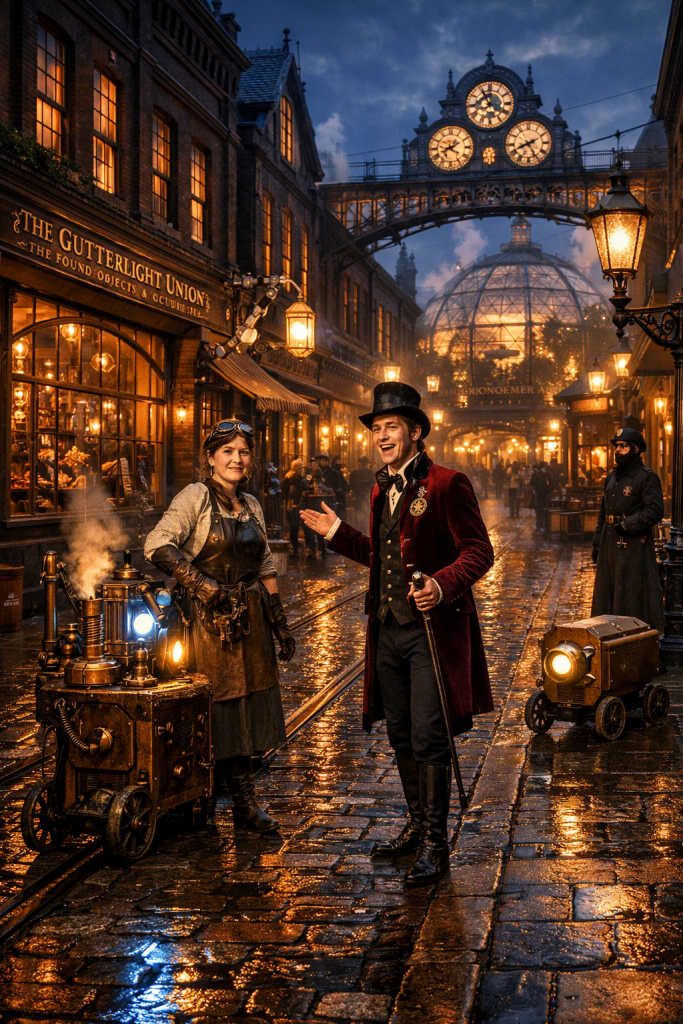
Part themed attraction, part professional film studio, part maker community, part creative real estate Brass & Velvet is not a single thing. It is a district. And within its fictional city of Cinderwick Quay, guests don’t just observe a world. They join it.
This is the story of how Brass & Velvet was conceived, what makes it different, and why it may represent the most thoughtfully engineered approach to immersive entertainment yet attempted.
What is Steampunk: Steampunk is a creative style and cultural movement that blends Victorian-era aesthetics with retro‑futuristic technology imagining a world where steam power evolved into advanced machinery. What Steampunk Is
Steampunk is a mix of: 19th‑century Victorian fashion (corsets, waistcoats, top hats, lace, long coats). Industrial‑era machinery (gears, brass, cogs, pipes, steam engines). Futuristic inventions imagined through old technology (airships, mechanical limbs, goggles, clockwork devices). Speculative fiction influences (Jules Verne, H.G. Wells, Nikola Tesla). It asks the question: “What would the future look like if the Victorians invented it?”Where You See Steampunk Today Steampunk appears in: Fashion & cosplay ,Festivals and conventions, Maker culture (DIY gadgets, props, costumes), Art, jewellery, and craft markets, Films, books, and games, Immersive experiences and themed venues . It’s less about being a mainstream fashion trend and more about a creative community and aesthetic world people enjoy stepping into.Why People Love It: Steampunk appeals because it combines: Nostalgia, Craftsmanship ,Imagination, Performance and identity play, A sense of belonging in a creative subculture, It’s a world where you can build, wear, or become something fantastical. It sometime intersects with other genres neo-Victorian, retro, dieselpunk, Afro futurism, neo baroque and cyberpunk, science fiction.
Pinterest Visual Board: Discover 900+ Steampunk and Retro and steampunk ideas in 2026 | neo victorian, steampunk fashion, dieselpunk and more
Steampunk Media search : steampunk movies – YouTube , steampunk fashion – YouTube ,steampunk creators – YouTube , steampunk festivals – YouTube ,Steampunk books ,
Audio: Youtube ; Brass & Velvet: A Steampunk Mixed-Use District: Working district and theme park , Spotify:https://spotifycreators-web.app.link/e/oYb2INXYQ0b
As usual supporting documents : Brass and Velvet artefacts
Table: Document Names & Short Summaries
| Document Name | Short Summary |
| Steampunk Today: From Subculture to Platform Era – Research Paper | A research paper analysing the evolution of steampunk from a literary aesthetic to a modern experience‑driven scene. Reassesses IBM’s 2013 prediction using current cultural, commercial, and platform‑era signals. Proposes stakeholder maps, trend drivers, and business models suited to today’s creator‑economy landscape. |
| Brass & Velvet – Vision Document | A full venture vision for a mixed‑use steampunk district combining immersive entertainment, themed streets, production studios, maker workshops, and optional residential components. Includes concept architecture, scalability framework, revenue models, market precedents, and long‑term expansion strategy. |
| Brass & Velvet – Internal Operations Manual (v1) | A detailed operational manual defining SOPs, governance, safety protocols, guest experience standards, performance operations, wardrobe/prop management, studio workflows, event operations, maker workshops, F&B, security, maintenance, AI/data operations, and crisis response. Designed as the operational backbone of the Brass & Velvet venue. |
| Curated Steampunk Concepts – Top 30 Business Ideas | A structured opportunity map listing 30 commercially viable steampunk‑influenced business concepts across small, medium, and large scales. Includes monetisation logic, market rationale, and strategic insights for the creator economy, immersive experiences, and hybrid digital‑physical ventures. |
| IBM Social Sentiment Index – 2013 Press Release | IBM’s 2013 analysis predicting steampunk as an emerging retail trend based on social sentiment data. Highlights an eleven‑fold increase in online chatter and forecasts a shift from craft production to mass retail. Provides early cultural signals and demographic insights. |
| Outline Analysis – Steampunk District (Global Business Idea Scout) | A structured outline combining vision, business plan, stakeholder analysis, PESTLE, SWOT, risk assessment, and phased implementation for a steampunk mixed‑use district. Includes critiques, decision logic, and a BRD‑style traceability approach. |
| Brass & Velvet – Story Bible & Venture Playbooks | A worldbuilding and operational playbook defining the narrative universe (“Cinderwick Quay”), factions, characters, locations, seasonal arcs, guest journey, and operational frameworks. Includes playbooks for guest experience, story operations, wardrobe, studio, events, and KPIs. |
| BrassVelvet_Digital_Strategy | Brass & Velvet – Digital Strategy outlines how the immersive steampunk district extends into the digital ecosystem to drive awareness, engagement, revenue, and long‑term community growth. The document defines the digital pillars required to support the venue’s physical experiences, including content strategy, creator partnerships, membership systems, booking flows, and data-driven optimisation. |
Vision Document
Executive Summary
Brass & Velvet is a living retro-future district where guests don’t just take photos—they play, learn, create, and perform inside a steampunk city for a day (or a weekend), supported by real production infrastructure that also serves creators and brands.
A living retro-future district where guests become citizens of a steampunk city, participating in an immersive world that combines themed entertainment, professional production facilities, and a thriving creative community—all within a sustainable mixed-use development.
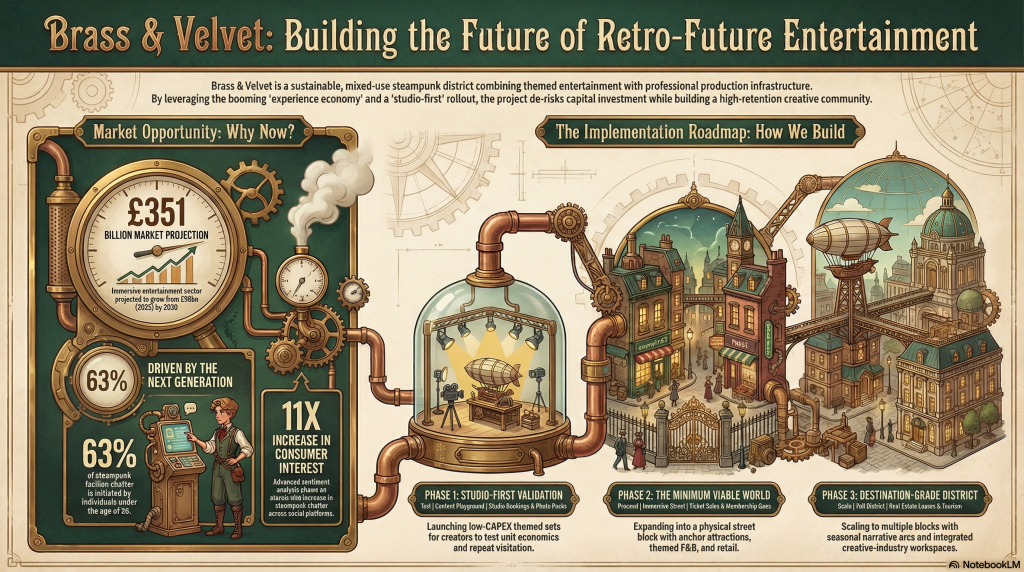
Immersive entertainment is experiencing unprecedented growth. Gensler’s 2025 report projects the sector at approximately £98bn (2025), expanding to £351bn by 2030[1]. However, commercial success remains uneven, with execution quality being the critical differentiator between successful ventures and those that face backlash[2].
The market is mature for a new approach: one that combines entertainment with practical utility, community building with commercial viability, and fantasy with functional infrastructure.
- A destination: A compelling reason to visit the city/region for both tourists and locals
- A creation engine: Recurring studio bookings for creators, brands, and independent filmmakers
- A community hub: Events, maker culture, cosplay community, and workshop programming
- A scalable IP: Original characters and lore not dependent on external licensing
Repeat visitation + membership retention — because one-time photo opportunities create fragile business models. Long-term success depends on building a community that returns regularly.
2. The Concept: Four Integrated Elements
Brass & Velvet combines four distinct but interconnected components:
2.1 Themed Cosplay Photo/Film Studio
A professional production facility featuring:
- Green screen volumes and practical themed sets
- Extensive costume library with makeup services
- Professional photography and videography on staff
- Deliverables including edited photo packs, reels, and short cinematic scenes
A front-of-house immersive street block providing:
- Themed retail and dining experiences
- Live performance spaces
- Interactive attractions and missions
- Maker workshops and artisan stalls
2.3 Back-of-House Commercial Space
Monetizable real estate including:
- Creative industry offices and co-working spaces
- Post-production suites
- Prop and costume workshops
- Sound stages and production facilities
2.4 Optional Residential Component
Future-phase boutique accommodation with:
- Theme-adjacent design (not 24/7 immersion)
- Secure, private living spaces
- Resident-only amenities and access
- Integration with district programming
The project is designed with a phased approach, where each level can be profitable independently and funds subsequent expansion.
Level A: Studio-First (Lowest Capex, Fastest Test)
- 2–6 themed sets plus green screen volume
- Costume library, makeup services, and prop workshop
- Professional photographers/videographers on staff
- Deliverables: edited photo packs, reels, short cinematic scenes
Why it works: Bookable, measurable, and doesn’t require theme-park-level footfall.
Level B: Immersive Street Block (Minimum Viable World)
A contained mini-district with:
- A hero street with 2–4 façades and interiors
- One anchor attraction (interactive + story-driven)
- One food and beverage concept (in-world tavern or tea lab)
- One performance stage (live shows, improv, duels, music)
- Retail and maker stalls (goggles, corsets, leatherwork, brass props)
Level C: Full District (Destination Grade)
Multiple blocks with rotating seasonal content:
- Narrative arcs with quarterly storylines
- Multiple anchor attractions
- Expanded event calendar (festivals, markets, night shows)
- Broader commercial tenancy
Level D: Lodging Component (Highest Risk)
Caution: Disney’s Star Wars: Galactic Starcruiser demonstrates the risks of this model. The experience closed after approximately 18 months due to very high staff/actor intensity, niche demand, and premium pricing that created sustainability issues[3].
Lesson: Only pursue lodging after proving demand and operational excellence at earlier phases.
4. The World: “Cinderwick Quay”
Core Themes:
- Progress vs. consequence: Innovation comes with costs
- Craft over convenience: Celebrating makers, artisans, and hand-built wonder
- Identity as performance: Costume becomes role becomes social belonging
- Time, memory, and myth: Retro-future nostalgia with stakes
- Community resilience: Guilds surviving through cooperation and trade
Tone: Whimsical wonder combined with noir intrigue, cabaret glamour, and optimistic maker culture.
- Aether Pressure: The invisible “steam-beyond-steam” powering clockwork, airships, and lighting
- The Chronometer Grid: Citywide timing system keeping machines synchronized
- The Glasshouse Engine: A future-phase controlled tropical biome powered by stored heat (integrates the Eden-style greenhouse concept)
Visitors arrive during “The Convergence”—a recurring city festival where:
- Inventors unveil prototypes
- Guilds recruit new members
- Mysteries unfold involving sabotage, missing relics, and pressure collapses
Guests become “New Citizens,” issued a Passport of Brass (physical and optional digital), providing both story justification and gamification framework.
5. Engagement Beyond Photography
To transcend the “photo op” model, Brass & Velvet offers multiple interaction layers:
- Live Street Theater: Roaming inventors, airship captains, and clockwork detectives recruiting guests into factions
- Interactive Missions: Choose-your-path scavenger hunts with props, NFC/QR lore integration, and multi-hour mystery loops
- Maker Experiences: Hands-on workshops for building mini gadgets, leather stamping, brass etching, with “Workshop of Wonders” certification tracks
- Escape Rooms: Steampunk labs, sabotage scenarios, time-machine containment puzzles
- Performance Events: Victorian cabaret nights, electro-swing dance, dueling school, improv trials, faction debates
- Science Exhibits: Practical effects demonstrations, pneumatics displays, Tesla coil shows, illusion performances
- Culinary Attractions: Alchemy bar with themed mocktails, tea laboratory, edible “cog” pastries, with staff performing in character
- Creator Services: Rentable soundstages, micro-cinema screening room, editing bays, and post-production partnerships
Design Principle: Every area must support (a) story, (b) interaction, and (c) commerce.
6. Market Precedents and Lessons
| Venue | Key Lessons |
| Steampunk HQ (Oamaru, NZ) | Dedicated steampunk attraction demonstrating niche viability; typical visit 45–60 minutes[4] |
| Meow Wolf (US) | Immersive, explorable narrative environments; Santa Fe location achieved ~400,000 visitors and ~$6.8m first-year revenue[5] |
| Secret Cinema (UK) | Large-scale immersive film events; acquired in deal around £88m[6] |
| Disney Springs / CityWalk | Free-entry districts with entertainment, demonstrating mixed-use viability[7][8] |
Table 1: Successful precedents for immersive entertainment
- Evermore Park: Fantasy world that faced serious financial and legal challenges due to capex overruns and contractor management issues[9]
- Star Wars: Galactic Starcruiser: Closed after ~18 months; illustrates risks of overly actor-intensive models and premium-only pricing[10]
- Eden Project challenges: Even iconic venues face margin pressure from operational costs and demand variability[11]
Key Inference: The market wants immersive worlds, but consistent failure modes include overbuilding, under-operating, weak repeatability, cost overruns, and mismatch between promise and delivery[12].
7. Revenue Model: Stacked Streams
- Day tickets with timed entry
- Mission upgrades (paid quests and premium experiences)
- Maker workshops and certification classes
- Evening show tickets
- Photo packages (digital and print)
- Food, beverage, and themed retail
- Membership programs (monthly perks, priority booking, exclusive content)
- Studio and stage rental (hourly/daily rates)
- Wardrobe and prop rental to production companies
- Post-production services
- Brand partnerships and activations (carefully managed to preserve immersion)
- Back-of-house offices for creative companies (stable recurring rent)
- Maker stalls and artist micro-leases (revenue share model)
- Future-phase residential units (theme-adjacent living)
| Segment | Value Proposition |
| Cosplayers / Alt-Fashion Community | Authentic environment, repeat-worthy content, community events |
| Experience Seekers | Unique entertainment for birthdays, groups, dates |
| Content Creators | Production-ready environments without set-building costs |
| Brands | Campaign shoots, product launches, activations |
| Corporate Clients | Team-building, offsites, unique venue hire |
| Tourists | Packaged attractions integrated with hotels/rail/tourism boards |
Table 2: Target market segments
9. Operating Model: Three Businesses in One
Success requires expertise in three distinct operational domains:
- Guest flow management and capacity control
- Safety protocols and emergency procedures
- Food and beverage service
- Retail operations
- Actor scheduling and performance management
- Script development and story consistency
- Show timing and audience interaction protocols
- Seasonal content rotation
- Equipment management and technical support
- Booking systems and client services
- Post-production workflows
- Industry partnerships
Business Case Strength: Starting with Studio-First (Level A) and expanding only when unit economics are proven provides the most sustainable path.
Optimal Positioning: Edge-of-City Creative District
Advantages:
- Sufficient footfall and public transit access
- More affordable industrial buildings for stages and workshops
- Compatible neighboring uses (studios, nightlife, warehouses)
- Easier parking and logistics than city center
- Potential for district heating integration
City Center: Viable if high-throughput tourist attraction with strong footfall, but must manage noise and crowd constraints.
Outside City: Requires destination resort positioning with hotel partnerships, shuttle services, and weekend-focused programming.
11. Sustainability and Innovation: The Glasshouse Engine
Vision: Year-Round Controlled Environment
A tropical biome integrated into the district, inspired by Eden Project’s success with geothermal heating[13]:
Functions:
- Daytime: Botanical spectacle with dining and quest experiences (“Airship Conservatory,” “Clockwork Jungle”)
- Nighttime: Events, cinema, performances in warm, glowing environment
- Year-round: Winter-proof anchor improving off-season demand
Heat Strategy: Thermal Energy Storage
Leveraging proven technologies:
- Geothermal / Heat Network: Eden Project’s operational system demonstrates viability[14]
- Sand Battery Technology: Polar Night Energy’s high-temperature thermal storage (up to ~600°C) deployed at 100 MWh scale for district heating[15]
- Seasonal Thermal Storage: Integration with district systems to improve overall efficiency[16]
Implementation: Phase 3 expansion after core operations proven. Initial smaller conservatory (400–1,500 m²) tests winter attendance uplift before scaling to Eden-like proportions.
12. Faction System: The Repeatability Engine
Factions create identity, belonging, and return visits through progressive engagement.
| Faction | Playstyle | Revenue Drivers |
| Aetherworks Guild | Engineers/inventors: build, fix, decode | Workshops, maker kits, prop upgrades |
| Velvet Assembly | Performers/social elites: social missions, performances | VIP seating, wardrobe, themed dining |
| Brasswardens | Law/security/detectives: investigations, trials | Detective files, mystery nights |
| Gutterlight Union | Dockworkers/smugglers: heists, underground market | Black-market merch, night events |
Table 3: Faction system overview
- Rank 0: Visitor
- Rank 1: Initiate (first mission completed)
- Rank 2: Agent (2 visits + workshop/show attendance)
- Rank 3: Captain (membership + seasonal finale participation)
Perks include exclusive pins, secret menu access, priority bookings, and members-only scenes.
13. Risk Assessment and Mitigation
| Risk Type | Description | Mitigation Strategy |
| Capability | Operating three businesses simultaneously | Hire experienced GM, technical lead, experience producer early |
| Dependency | Over-reliance on viral traffic | Develop memberships, workshops, studio bookings, B2B hire |
| Economic | Capex creep and fixed labor costs | Strict phase gates, modular design, lease vs. build analysis |
| Regulatory | Licensing, permits, film screening rights | Early workstream, compliance register, documented SOPs |
| Behavioral | Community rejection of inauthenticity | Co-creation with makers/performers, rotating content |
Table 4: Risk profile and mitigation strategies
- Differentiated theme with strong visual virality potential
- Multiple revenue streams reducing dependence on single source
- Phased approach allowing proof before expansion
- Integration of production utility with entertainment value
- Operational complexity across three business types
- High fixed costs if district scaling happens prematurely
- Requires diverse skill sets in management team
- Creator partnerships and brand activations
- Seasonal content resets driving repeat visitation
- Tourism packaging with regional attractions
- District heating and sustainability leadership
- Membership and community building
- Overpromise/underdeliver backlash common in immersive sector[17]
- Capex overruns as seen in Evermore Park[18]
- Copycat competitors and pop-up experiences
- Economic cycles affecting discretionary spending
15. Recommended Implementation Path
Studio-First + Monthly Event Nights
- Launch Level A in lease-friendly building
- Run quarterly “mini street” pop-up builds (portable façades)
- Measure: bookings/week, repeat rate, attach rate, NPS, customer acquisition cost
- Investment: Lower capex, controllable staffing, bookable utilization
Success Criteria: Positive unit economics, repeat booking rate >30%, attach rate on wardrobe/photos >50%
Phase 2: Proceed (18–36 months)
Permanent Street Block (Level B)
- Add one anchor attraction
- Establish one F&B venue
- Build one performance stage
- Launch membership program and seasonal story arcs
- Expand maker workshop programming
Success Criteria: Sustained monthly revenue growth, membership base of 500+, positive EBITDA
Multiple Blocks + Conservatory (Level C)
- Expand to multiple street blocks
- Develop controlled-environment conservatory with heat strategy
- Integrate district heating network
- Expand narrative arcs and multiple anchor attractions
- Increase event calendar frequency
Prerequisites: Demonstrated demand, strong operational track record, capital secured
Phase 4: Optimize (60+ months)
Optional Lodging (Level D)
- Consider theme-adjacent hotel partnership (not full immersion)
- Explore themed floors with existing hotel partners before building
- Residential component only with proven year-round demand
Critical Decision Point: Only proceed if Phases 1–3 demonstrate stable year-round demand and operational excellence
16. Key Performance Indicators
- Net Promoter Score (NPS)
- Repeat visitation rate
- Membership retention rate
- Average spend per visit
- Attach rate (wardrobe, photos, workshops, F&B)
- Stage/studio utilization percentage
- Event occupancy rates
- Entry-to-onboarding time
- Zone congestion levels
- Attraction availability (uptime)
- Revenue per guest
- Revenue per square foot
- EBITDA margin by business line
- Customer acquisition cost (CAC)
- Lifetime value (LTV)
- CAC:LTV ratio
- Incident rate per 1,000 guests
- Safety audit pass rate
- Complaint rate
- Training completion percentage
The project’s long-term viability depends on adhering to these core principles:
- Phase-gate discipline: Expand only when metrics justify next level
- Operational excellence first: Systems, safety, and quality before growth
- Community co-creation: Partner with cosplay and maker communities from day one
- Diversified revenue: Never depend on single income stream
- Modular design: Sets, systems, and spaces must be adaptable and reversible
- Story consistency: Maintain canon while allowing improvisation within boundaries
- Real utility: Provide genuine value beyond entertainment (production services, workspace, community)
- Sustainability integration: Heat-led development and environmental responsibility
- Data-driven decisions: Track KPIs rigorously and adjust based on evidence
- Risk management: Maintain risk register with active mitigation strategies
18. Conclusion: A New Model for Immersive Entertainment
Brass & Velvet represents a evolution in immersive entertainment: a hybrid model that combines the engagement of themed attractions, the utility of production facilities, the stability of commercial real estate, and the community-building power of shared experiences.
By learning from both the successes of venues like Meow Wolf and Secret Cinema, and the cautionary examples of Evermore Park and Galactic Starcruiser, this vision offers a sustainable path forward for the growing immersive entertainment sector.
The phased approach de-risks investment while maintaining creative ambition. The diversified revenue model creates resilience against market fluctuations. The integration of genuine utility—production services, workspace, maker education—ensures value beyond novelty. The faction and membership systems drive repeatability rather than one-time visits.
Most importantly, Brass & Velvet is designed to be financially viable before it is maximally ambitious. Each phase must prove its economics before expansion, ensuring that creativity and commerce advance together rather than in conflict.
This is not just an attraction. It is a district, a community, a creative campus, and a destination—all wrapped in brass, velvet, and impossible steam-powered wonder.
[1] Gensler. (2025). Immersive entertainment market report. Cited in industry press coverage.
[2] The Guardian. (2025, October 19). Experiential entertainment is having a gold rush, but commercial success is far from certain. https://www.theguardian.com/business/2025/oct/19/experiential-entertainment-is-having-a-gold-rush-but-commercial-success-is-far-from-certain
[3] Forbes. (2023, May 28). Why Disney closed Star Wars hotel Galactic Starcruiser. https://www.forbes.com/sites/suzannerowankelleher/2023/05/28/why-disney-closed-star-wars-hotel-galactic-starcruiser/
[4] Steampunk HQ. (n.d.). Official website. https://www.steampunkoamaru.co.nz/
[5] U.S. Securities and Exchange Commission. (2017). Meow Wolf financial disclosures. https://www.sec.gov/Archives/edgar/data/1703018/000167025417000178/document_17.pdf
[6] Campaign Live. (2021). Secret Cinema deal and the future of immersive entertainment. https://www.campaignlive.co.uk/article/secret-cinema-deal-means-future-immersive-entertainment/1800709
[7] Walt Disney World. (n.d.). Disney Springs. https://www.disneyworld.co.uk/destinations/disney-springs/
[8] Universal Orlando Resort. (n.d.). Universal CityWalk. https://www.universalorlando.com/web/en/us/theme-parks/citywalk
[9] Utah Business. (2020, August 21). Evermore Park faces financial ruin. https://www.utahbusiness.com/archive/2020/08/21/evermore-park-faces-financial-ruin/
[10] The Verge. (2024). Disney Star Wars Hotel Galactic Starcruiser becomes Imagineering office. https://www.theverge.com/news/603910/disney-star-wars-hotel-galactic-starcruiser-imagineering-office
[11] The Standard. (2025). Eden Project visitor numbers, losses, and challenges. https://www.standard.co.uk/business/business-news/eden-project-visitor-numbers-losses-b1249797.html
[12] The Guardian. (2025, October 19). Experiential entertainment quality concerns.
[13] Eden Project. (n.d.). Geothermal heating system. https://www.edenproject.com/media-relations/the-heat-is-on-eden-geothermal-is-uks-first-operational-deep-geothermal-project-to
[14] Eden Project. (n.d.). Geothermal project operational details.
[15] Polar Night Energy. (n.d.). Sand Battery technology. https://polarnightenergy.com/sand-battery/
[16] ScienceDirect. (2023). Seasonal thermal energy storage and district heating integration. https://www.sciencedirect.com/science/article/pii/S1364032123010948
[17] The Guardian. (2025, October 19). Quality execution in immersive entertainment. [18] Wikipedia. (n.d.).
[18] Wikipedia. (n.d.). Evermore Park. https://en.wikipedia.org/wiki/Evermore_Park