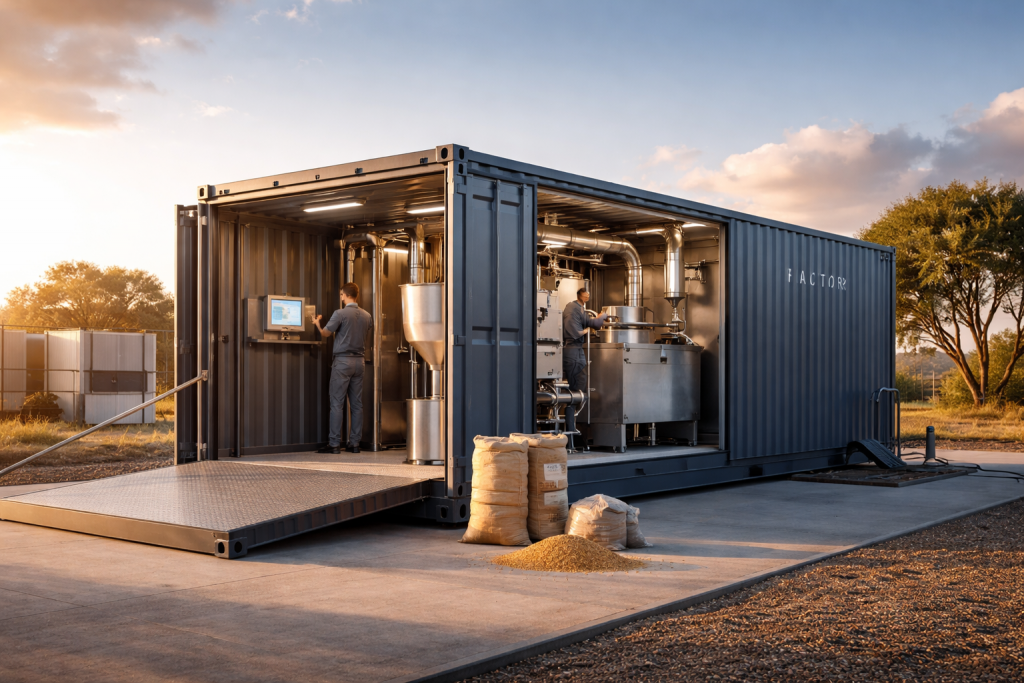
Why Modular Production Wins Differently in Developed Economies and the Global South
Preamble
A shipping container is not a factory.
It is not a strategy. It is not a business model. It is not even the real product.
The real product is predictable production, delivered in a bounded, repeatable, financeable, and redeployable form.
That distinction matters because too much of the modular industry conversation still gets trapped at the level of hardware. People talk about the steel box, the doors, the dimensions, or the novelty of putting equipment inside a container. That misses the point. A container only becomes economically meaningful when it behaves like a disciplined industrial unit, with a defined process core, a controlled infrastructure envelope, a teachable operating model, a clear maintenance logic, and a deployment recipe that can be repeated without reinvention. The concept of a container should be used as a scalable unit of production not a physical container (it is used as a mental reference)
That is the central insight running through both attached documents. One frames the container as a five-layer industrial system and pushes hard on standardisation, utilization, and redeployability. The other sharpens the regional adoption logic and shows that the same module can succeed for very different reasons depending on context. In developed economies, modular production is usually bought for flexibility, resilience, and launch speed. In the Global South, it is often bought for industrial access, infrastructure bypass, and local value capture.
This is not a niche design question. It is a question about how production capability gets packaged, financed, moved, and scaled in an era of uncertain demand, fragile supply chains, uneven infrastructure, and pressure to localise value creation.
As usual some references: Microfactories
| Name | Short description |
| China as a supplier for Modular industries | Overview of China’s manufacturing strength, supplier capacity, and procurement considerations for modular industrial and containerized factory solutions. |
| Beyond the Box Critical Considerations Often Missed in Modular Factory Procurement | Focuses on overlooked post-purchase and deployment issues such as localization, documentation, workforce fit, infrastructure, and operational readiness. |
| Factory in a Container | Introduces a framework for modular production systems, explaining how containerized factories can be designed, deployed, scaled, and evaluated. |
| Developed vs global south adoption | Compares how modular/containerized production is adopted in developed economies versus the Global South, highlighting different economic and operational drivers. |
Introduction
The strongest case for modular manufacturing starts with a simple observation. Not every industrial process needs a permanent building before it can become useful, bankable, or scalable.
In many sectors, what matters first is not maximum theoretical efficiency. What matters is getting production into the field quickly, in a form that can survive real site conditions, prove demand, meet quality requirements, and either scale by replication or move if the first deployment fails.
That is where modular systems matter.
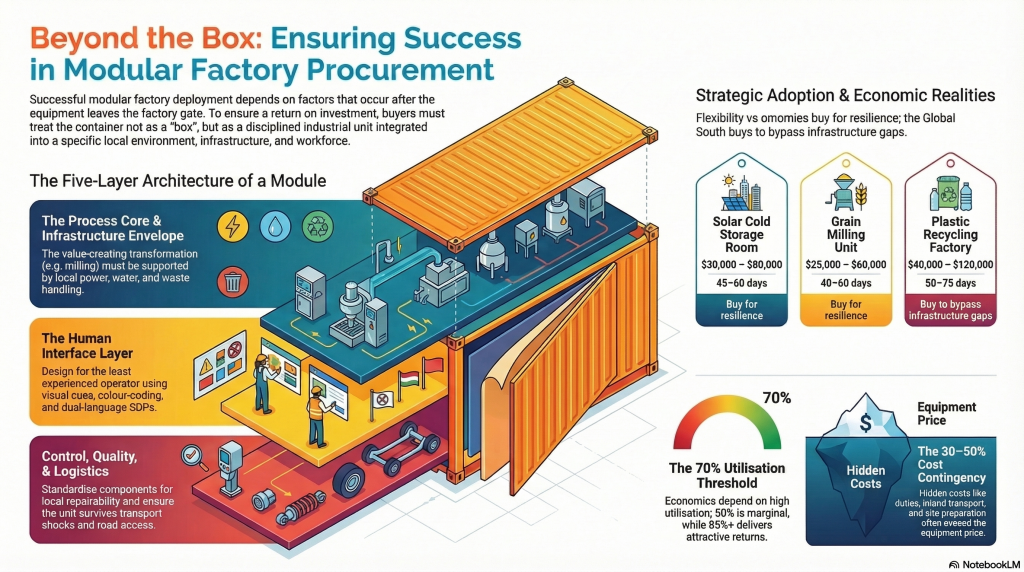
The attached strategy paper makes this argument clearly. It defines a five-layer architecture made up of process core, infrastructure envelope, control and quality, human interface, and logistics and mobility. That is the right frame because it forces the container to behave like a productized industrial asset rather than an improvised build.
The adoption paper then adds the missing commercial lens. It shows that modular wins for different reasons in different places. Developed countries use modular systems to buy optionality. Global South markets use them to buy access. Developed countries care more about labour substitution, speed to launch, and resilience. Global South deployments care more about infrastructure tolerance, reduced spoilage, lower entry barriers, and localisation close to raw materials or demand.
That distinction is more than academic. It affects design choices, financing logic, localization strategy, supplier selection, and the path from small pilot to large fleet.
If you get that wrong, you build a beautiful container that solves the wrong problem.
If you get it right, you do not sell a box. You sell a repeatable unit of industrial capability.
The real shift, from factory as place to factory as asset class
A permanent factory is site-bound. A modular unit is asset-bound.
That changes the decision model.
A permanent site pushes you toward civil works, long permitting cycles, heavy sunk capital, and a commitment to one geography and one operating assumption. A modular unit changes the question. Instead of asking, “Where do we build a factory?” you ask, “What is the smallest reliable package of production capability that can be standardised, financed, operated, monitored, and redeployed?”
That shift matters because it changes how you think about risk.
The attached rewrite gets this right. It argues that the container matters because a bounded footprint forces design discipline around throughput, utilities, operator count, maintenance intervals, safety boundaries, and relocation economics. In other words, the box is useful because it imposes limits. Those limits make standardisation possible.
That is why modular systems work best when you need one or more of the following:
- distributed processing near raw materials
- temporary or seasonal capacity
- rapid deployment
- staged capital commitment
- regional redundancy
- fleet standardisation
- local service delivery in weak-infrastructure environments
They work less well when the process is utility-heavy, permanently fixed, deeply integrated, and running at stable high volume. Both attached documents are consistent on this point. Modular beats fixed plants when flexibility matters more than perfect scale efficiency. Fixed plants still win when load is high, stable, and deeply optimized.
Why developed economies adopt modular differently
In developed economies, modular usually enters through the side door, not the front door.
It is rarely the first choice for a high-volume stable process. It is far more likely to be adopted as a strategic flexibility layer.
That means pilot production, seasonal overflow, distributed specialty manufacturing, backup resilience, near-customer processing, mobile diagnostics, and temporary capacity. The economic logic is not that the module is always cheaper than a permanent plant. It is that it reduces commitment risk, speeds up launch, and avoids overbuilding while demand is still uncertain.
This logic becomes stronger when labour is expensive. High wage environments reward designs that reduce touchpoints, simplify training, support remote diagnostics, and embed guided operation. In those contexts, a module is not competing only on capex. It is competing on speed, staffing efficiency, continuity, and redeployability.
The consequence is straightforward. In developed countries, modular adoption should begin where variability is high and volumes are still forming. That means the best modular projects are often small at first, but designed for disciplined replication.
You do not start with a fleet fantasy. You start with one standard module family that proves utilization and service logic.
Why the Global South often has the stronger structural case
The Global South presents a different industrial problem.
In many markets, the main issue is not whether a permanent plant would be more efficient at full scale. The issue is whether fixed-site industrialisation can happen at all without unacceptable timing risk, infrastructure dependency, or logistics loss.
That is why modular can be structurally stronger in these contexts.
The adoption paper makes this point directly. In the Global South, modular often wins because it bypasses infrastructure gaps, lowers market-entry risk, reduces spoilage, localises value addition, and allows staged investment close to raw materials and demand.
This is especially strong in agro-processing, cold storage, water treatment, repair, low-complexity fabrication, recycling, and distributed service delivery. In these sectors, moving raw material long distances before processing often destroys value. Local modular capability can preserve that value by shortening transport, reducing losses, and keeping more of the margin inside the region.
But this advantage only holds if the unit is designed for local reality.
That means unstable power, dust, heat, road shock, weak spare-parts networks, variable operator skill, financing constraints, and sometimes security exposure. The best modular systems in these settings are usually not the most sophisticated. They are the most repairable, teachable, and serviceable.
That is a hard truth many modular projects ignore. In weak-infrastructure contexts, elegance is less important than uptime.
The five-layer model is the right discipline
The strongest conceptual contribution in the attached material is the five-layer architecture. It is useful because it prevents modular strategy from collapsing into equipment shopping.
Every deployable unit needs to be thought through across five layers:
1. Process core
What transformation creates the value. Milling, drying, filtration, shredding, pressing, cooling, testing, blending, cutting.
2. Infrastructure envelope
What conditions keep output safe and repeatable. Power conditioning, ventilation, water, drainage, waste handling, thermal control, fire safety.
3. Control and quality
What makes the output consistent. Sensors, traceability, inspection tools, calibration, records, quality checks.
4. Human interface
What makes the system teachable. SOPs, operator layout, HMI simplicity, safety cues, visual work instructions, training ladders.
5. Logistics and mobility
What makes the module deployable as an asset. Transport format, anchoring, setup time, spare-parts kit, relocation plan, insurance, service routing.
This structure matters because failure in modular projects rarely comes from the process core alone. It usually comes from one of the surrounding layers. A good mill fails because dust control is weak. A good cold room fails because service is not local. A good clinic fails because staffing and maintenance were treated as afterthoughts. A good recycling cell fails because spare parts or feedstock aggregation were not solved.
The five-layer model stops that kind of blindness.
Small, medium, and large, how modular scales in the real world
One of the best parts of the attached adoption paper is that it separates modular strategy by company size. That is essential because the winning logic changes as scale changes.
Small operators
For small firms, cooperatives, startups, NGOs, and regional operators, modular works because it lowers the first barrier.
The best small deployments usually involve one simple unit, low to medium capex, narrow product scope, strong SOPs, and minimal utility dependence. Good examples include milling, drying, cold storage, water purification, repair workshops, container kitchens, and small recycling cells.
What usually kills small deployments is over-customisation. Too many SKUs, too much utility burden, too much complexity, and too much optimism about operator capability.
At this level, simplicity is strategy.
Medium operators
For multi-site SMEs, processors, municipal operators, and industrial service firms, modular shifts from unit economics to system economics.
Now the questions become standardisation, fleet maintenance, telemetry, regional clustering, and demand aggregation. Medium operators win when they can use a shared template across sites, pool spares, routinise service, and turn multiple small deployments into a coherent operating model.
This is where many serious modular businesses begin to separate from hobby projects.
Large operators
For large industrial groups, government platforms, development finance-backed programmes, and fleet operators, modular becomes an infrastructure portfolio.
At that level, the business is no longer the sale of individual units. It becomes fleet architecture, central control, financing structures, redeployment strategy, data collection, service discipline, and residual value management. The attached rewrite is exactly right when it argues that the long-term moat is not fabrication alone, but performance data, operating discipline, and fleet economics.
Large modular systems succeed when they behave like an asset class.
The supplier lesson, do not confuse equipment with deployable solutions
One of the biggest practical mistakes in modular projects is supplier confusion.
Not every relevant company is a container manufacturer. Not every equipment OEM is a modular integrator. Not every solution provider offers after-sales service in the countries you care about.
That is why the supplier appendix matters.
Some organisations are strong because they offer a clear modular operating model. ColdHubs, for example, positions itself around plug-and-play, solar-powered cold rooms installed in markets, farm clusters, and aggregation centres, and says it designs, installs, operates, and maintains those facilities in Nigeria. That is more than equipment supply. That is operating infrastructure. (coldhubs.com)
Hospitainer is another example. It offers deployable medical-grade container infrastructure, including mobile hospitals and modular healthcare facilities, and states that it provides deployment, maintenance, and emergency stock support. Some products are designed to be delivered and deployed in very short time windows, and certain systems are configured as modular combinations of containers and tents. (Hospitainer)
Plastic Odyssey is useful for a different reason. It frames local recycling factories as containerized micro-factories and documents live deployments and training activity across multiple countries. Its 2026 press material says it tested 15 low-tech recycling systems onboard, documented more than 300 local innovations across 30 countries, trained more than 2,000 entrepreneurs, and launched 15 micro-factories during the expedition. (Plastic Odyssey)
Others sit somewhere between equipment and deployable systems. ABC Hansen Africa is a strong fit for artisanal and small-scale milling equipment and reports a focus on high-value, low-volume milling plants, but the modular container integration may need local system integration rather than a pure off-the-shelf module. (abchansenafrica-info.co.za)
DC-Supply is a good example of a custom container integrator. It states that it designs, develops, produces, and delivers custom-built container solutions worldwide, including mobile container-based slaughterhouses and other production units, with setup for some units completed in a single day after arrival. (DC-Supply A/S)
SkyHydrant and related water systems show another useful pattern. The official SkyHydrant material positions the product as a robust, chemical-free ultrafiltration solution for harsh, remote environments, with each MAX unit producing 10,000 litres or more of clean water daily. That makes it especially relevant where modular water access matters more than large permanent works. (skyjuice.org.au)
The lesson is simple. Your supplier short list should distinguish between:
- process equipment OEMs
- container fabricators
- system integrators
- fleet operators
- managed service providers
- vertical specialists with real compliance experience
If you mix those categories together, procurement becomes guesswork.
The strategic rule that matters most
The two attached documents converge on a rule that is worth making explicit.
Use modular in developed economies when you are buying flexibility.
Use modular in the Global South when you are buying industrial access.
That single distinction clarifies most of the design and investment debate.
If you are buying flexibility, optimise for rapid launch, labour efficiency, fast commissioning, redeployability, and compliance-ready standard templates.
If you are buying industrial access, optimise for robustness, repairability, low skill burden, power tolerance, spare-parts simplicity, local assembly potential, and financing structures that reduce upfront risk.
In both cases, the winning discipline is the same. One vertical. One module family. One maintenance playbook. One financing logic. One localization template per region.
That is how modular production stops being an interesting idea and becomes a repeatable industrial system.
Conclusion
The future of modular manufacturing will not be decided by who can put machines inside steel boxes.
It will be decided by who can convert production into a standardised, monitored, financeable, movable, and teachable asset.
That is the deeper industrial shift. The container is only useful when it becomes a disciplined envelope for repeatable performance.
The attached documents make a strong case for that shift. One provides the architectural spine. The other provides the regional and commercial logic. Together they show that modular systems are most powerful when they are treated not as novelty hardware, but as productized industrial infrastructure.
That is why the strongest players in this space will not look like metal workshops with better branding. They will look like platform operators. They will own templates, telemetry, deployment recipes, maintenance systems, financing partnerships, compliance pathways, and residual-value logic.
They will understand that standardisation is not a design preference. It is what makes modular economics real.
And they will know the essential truth at the centre of this category.
You are not selling a box. You are selling predictable production.
Next steps
Turn this idea into a deployable strategy by doing five things in order.
1. Pick one vertical
Choose a process where modular clearly solves a real deployment problem. Agro-processing, cold storage, recycling, remote diagnostics, and water treatment are stronger starting points than complex heavy industry.
2. Define one standard module family
Lock the operating envelope. Throughput, utilities, operator count, setup time, maintenance interval, compliance path, and mobility assumptions should be fixed before you talk about scale.
3. Choose one business model
Sale, lease, managed service, or hub-and-spoke access. The best answer depends on utilization risk and customer capability. Both attached papers stress that financing logic matters as much as engineering logic.
4. Build one localization template per region
Developed market template and Global South template should not be identical. The first leans toward resilience and staffing efficiency. The second leans toward robustness, training simplicity, and infrastructure tolerance.
5. Treat pilots as data assets
Do not run a pilot only to prove concept. Run it to generate utilization, downtime, service, and operator-performance data. That data is what allows you to scale credibly.
Appendix A. Example high-level suppliers
This is an indicative landscape, not a procurement shortlist.
| Supplier / Organisation | Category | High-level relevance | Notes |
| ColdHubs | Cold chain | Solar-powered modular cold rooms near farms, markets, and aggregation points | Strong example of modular cold infrastructure plus operating model. (coldhubs.com) |
| Hospitainer | Healthcare infrastructure | Containerized clinics, field hospitals, maternal hospitals, emergency medical deployment | Strong vertical specialist with deployment and maintenance capability. (Hospitainer) |
| Plastic Odyssey | Recycling micro-factories | Containerized local recycling factories and training ecosystem | Useful for circular economy and local-factory replication models. (Plastic Odyssey) |
| ABC Hansen Africa | Agro-processing equipment | Small to mid-scale milling systems and related agro-processing equipment | Strong process-equipment fit, but modular packaging may need local integration. (abchansenafrica-info.co.za) |
| DC-Supply | Custom container integration | Mobile slaughterhouses and other containerized production solutions | Strong as a container engineering and custom deployment player. (DC-Supply A/S) |
| SkyHydrant / SkyJuice | Water filtration | Robust ultrafiltration for remote and emergency contexts | Best suited to distributed safe-water deployments rather than heavy permanent municipal systems. (skyjuice.org.au) |
| Fluence | Water and wastewater | Modular and containerized treatment systems for communities and industry | Relevant where larger modular water and wastewater systems are required. (fluencecorp.com) |
Appendix B. Referenced documents and short descriptions
| Referenced document | Type | Short description |
| Developed vs global south adoption | Attached source document | Regional adoption framework comparing developed countries and the Global South across cost, mobility, supply chain reliability, labour, localisation, and scale from small to large operators. |
| Factory in a Container, rewritten and critiqued | Attached source document | Expanded industrial strategy paper framing the container as a unit of industrial design, with five-layer architecture, scorecards, deployment logic, SWOT, PESTLE, and starter supplier landscape. |
| ColdHubs solution page (coldhubs.com) | Official website page | Describes ColdHubs as a plug-and-play modular solar cold room for off-grid food preservation. |
| ColdHubs homepage (coldhubs.com) | Official website page | Confirms its network model and its role in designing, installing, operating, and maintaining cold storage facilities. |
| Hospitainer homepage (Hospitainer) | Official website page | Overview of Hospitainer’s deployable healthcare infrastructure and support services. |
| Hospitainer 50-bed field hospital page (Hospitainer) | Official website page | Shows turnkey modular field-hospital deployment capability and deployment speed. |
| Hospitainer maternal hospital page (Hospitainer) | Official website page | Illustrates autonomous modular healthcare design for weak-infrastructure settings. |
| Plastic Odyssey 2026 press kit (Plastic Odyssey) | Official PDF | Provides current scale signals, including validated systems, entrepreneur training, and micro-factory deployments. |
| Plastic Odyssey local factories page (Plastic Odyssey) | Official website page | Describes containerized local plastic recycling factories. |
| Plastic Odyssey Mauritius recycling unit page (Plastic Odyssey) | Official website page | Concrete example of a repurposed-container recycling micro-factory with stated capacity. |
| ABC Hansen Africa official site (abchansenafrica-info.co.za) | Official website page | Confirms focus on artisanal and small-scale milling plants. |
| DC-Supply mobile slaughterhouse page (DC-Supply A/S) | Official website page | Example of container-based mobile production infrastructure. |
| DC-Supply custom production solutions page (DC-Supply A/S) | Official website page | Confirms design and delivery of custom container-based slaughter and production systems. |
| DC-Supply company page (DC-Supply A/S) | Official website page | Broad evidence of custom-built worldwide container solution capability. |
| SkyJuice / SkyHydrant brochure (skyjuice.org.au) | Official PDF | Describes SkyHydrant as a robust filtration solution for remote and emergency use. |
| SkyHydrant systems page (skyjuice.org.au) | Official website page | Confirms daily output and remote-environment use case. |
| Fluence official site (fluencecorp.com) | Official website page | Positions Fluence around modular and containerized water and wastewater systems. |