Preamble: The Extrapolation Engine
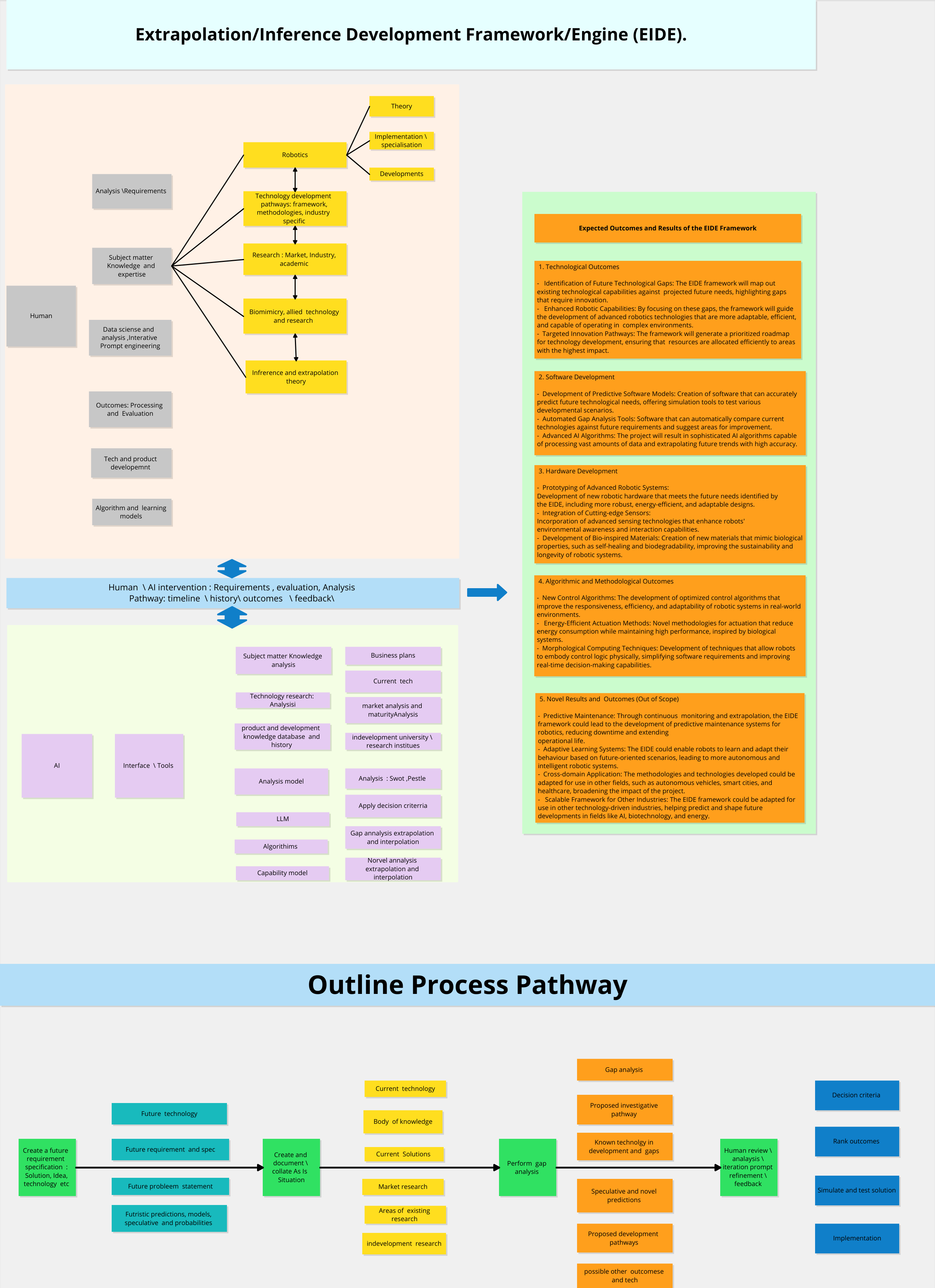
The Extrapolation (or Inference) Engine is an AI-powered framework designed to forecast, ideate, and develop future technologies, products, and innovations. It integrates human deduction, research methodologies, and AI-driven analysis to create actionable pathways toward future development. By comparing known technological landscapes with speculative future requirements, it bridges the gap between current knowledge and visionary breakthroughs, generating structured innovation roadmaps.
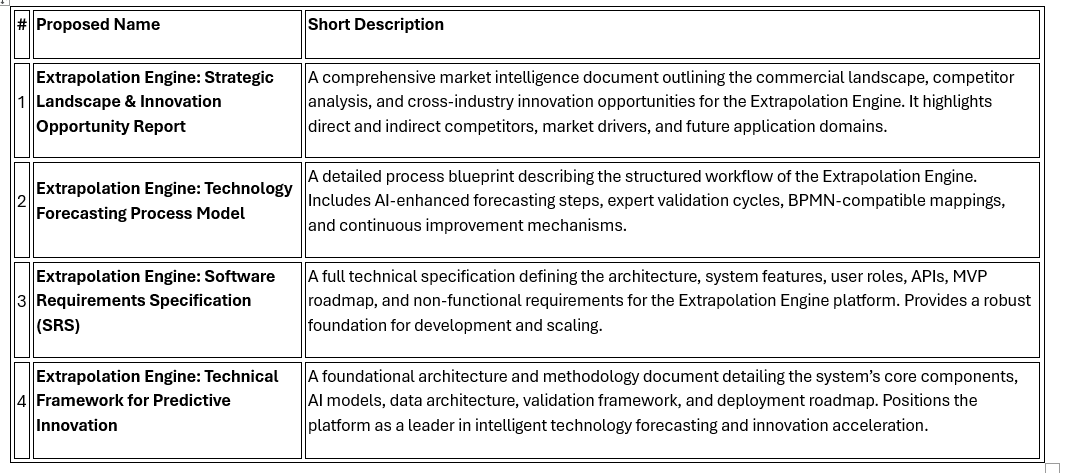
Related Documents : Extrapolation or Inference Engine
Outline: Functionality & Methodology
The Extrapolation Engine transforms future-driven speculation into actionable innovation strategies, bridging present technological limitations with forward-thinking solutions. By combining AI-driven inference, structured human creativity, and multi-domain analysis, it provides a systematic framework for navigating future technological landscapes. (See appendices for Visual outline of Concept or Extrapolation or Inference Engine)
1. Core Concept & Purpose
The Extrapolation Engine serves as a technology foresight and strategic ideation tool, enabling:
· Predictive Technology Mapping
· Identifying probable innovation trajectories.
· Cross-Domain Intelligence Aggregation
· Synthesizing research across disciplines.
· Future Gap Analysis & AI-Assisted Inference
· Recognizing missing capabilities and devising solutions.
· Structured Innovation Pipeline
· Creating clear development roadmaps for emerging technology.
2. Process Framework
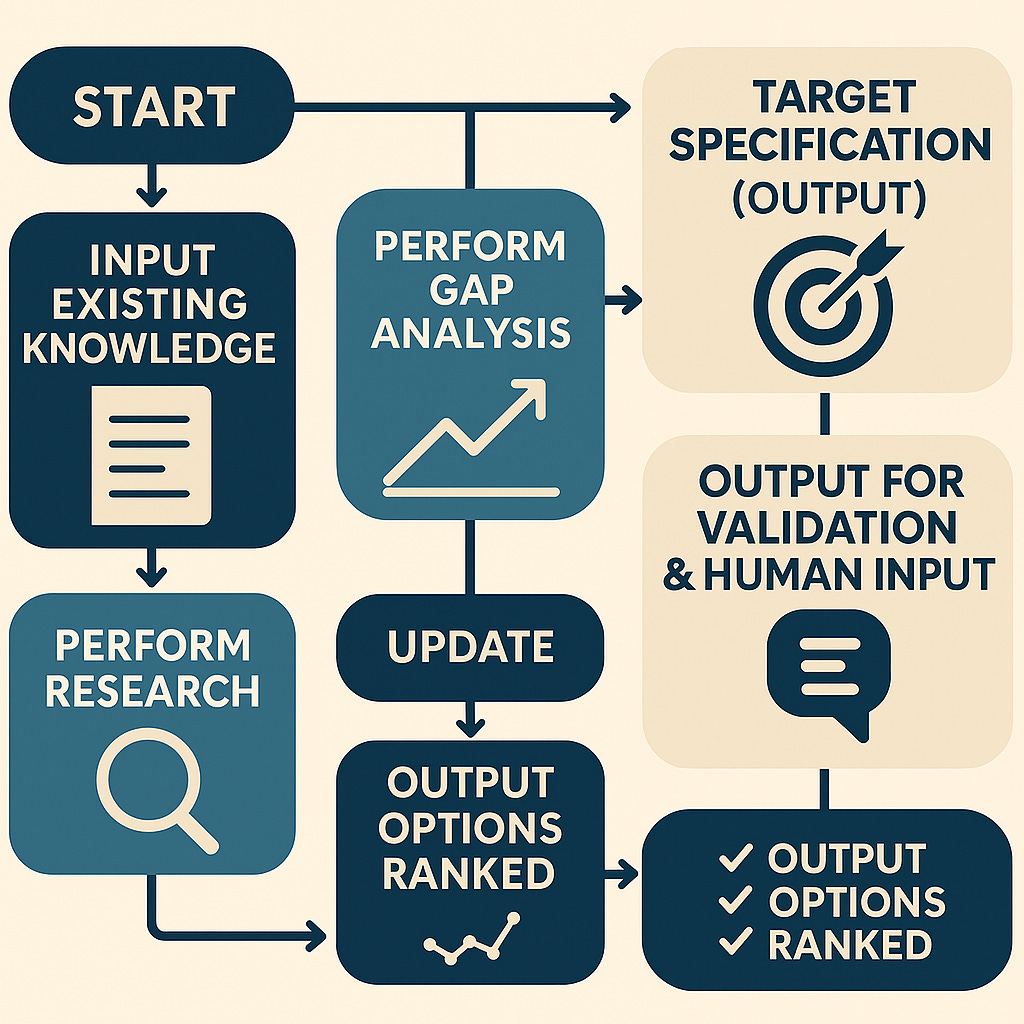
Step 1: Define Future Requirements & Outcomes
The process begins with detailed speculation on future needs, structured as:
- Use Cases – Real-world application scenarios.
- Software & Hardware Requirements – Technical parameters for future systems.
- Conceptual Idea Development – Speculative product/service definitions.
Step 2: Input & Knowledge Compilation
· A multi-source knowledge aggregation process collects relevant insights from:
· Current Technology Status
· Established capabilities vs. emerging innovations.
· Market Research & White Papers
· Industry trends and investment directions.
· Subject Matter Expertise : Contributions from specialists.
· Opportunity Mapping : Highlighting known and undiscovered market gaps.
· Novel Thinking & Related Concepts: Capturing interdisciplinary inspiration.
Step 3: AI-Driven Gap Analysis & Iterative Refinement
The engine uses AI-enhanced comparative analysis to identify discrepancies between present capabilities and future objectives:
· Comparative Assessment – Evaluates present vs. future technological states.
· Missing Links & Innovation Gaps – Identifies barriers and missing technologies.
· Iterative Intelligence Refinement – AI conducts multiple assessment cycles with human oversight.
Step 4: Predictive Outcomes & Technology Roadmap
AI-assisted inference generates probable pathways toward future technology, analysing:
· Known vs. Unknown Gaps – Highlighting where innovation needs to emerge.
· Extrapolated Development Cycles – Projecting timelines for breakthroughs.
· Novel Pathways – Generating new research and engineering approaches.
· Deviation & Probability Models – Estimating variances, uncertainties, and innovation risks.
·Unexpected Future Outcomes – Predicting unforeseen possibilities.
Step 5: Implementation Pathway Creation
After defining likely futures, the Extrapolation Engine builds strategic roadmaps for execution:
· Feasibility Assessments – Prioritizing actionable ideas.
· Technology Development Plans – Structured R&D recommendations.
· Commercial Viability & Investment Strategies – Market potential and funding direction.
· AI-Powered Continuous Monitoring – Updates innovation trajectories dynamically.
3. Key Advantages of the Extrapolation Engine
· Reduces uncertainty in tech development.
· Accelerates innovation via structured AI inference.
· Enhances decision-making by forecasting future needs.
· Encourages interdisciplinary breakthroughs.
· Optimizes R&D investments for long-term viability.
4. Expansion Considerations & Future Enhancements
· Integrating AI-Led Automated Design Prototyping – Using generative AI for hardware/software modelling.
· Adaptive Learning for Continuous Innovation – AI refines its own predictive methodologies over time.
· Cross-Industry Repurposing Capabilities – Applying insights across diverse fields.
· Hybrid Human-AI Collaboration Frameworks – Encouraging interactive ideation between AI models and researchers.
Conclusion
The Extrapolation Engine represents a transformative approach to strategic foresight and future technology development. By combining AI-driven analysis with structured human creativity and interdisciplinary research, it offers a powerful mechanism to anticipate, design, and implement innovations that meet emerging societal and industrial needs. Its structured methodology—from defining speculative futures to delivering actionable roadmaps—bridges today’s technological limitations with tomorrow’s possibilities, creating a practical foundation for innovation leadership and sustainable growth.
Further Steps
To operationalize and expand the impact of the Extrapolation Engine, the following next steps are recommended:
- Prototype Development
Build a working prototype of the engine using available AI and data integration tools. Focus on a single domain or challenge area to demonstrate proof-of-concept. - Collaborative Pilot Projects
Partner with research institutions, think tanks, or industry leaders to run pilot foresight exercises, testing the framework’s predictive and ideation capabilities in real-world settings. - Platformization & User Interface Design
Develop a user-friendly interface to make the Engine accessible to a range of users—including policymakers, researchers, and entrepreneurs—enabling collaborative forecasting and ideation. - Knowledge Graph & Dataset Expansion
Integrate dynamic, domain-specific datasets and expert-curated knowledge graphs to enrich the system’s inferential depth and contextual relevance. - Incorporation of Ethical and Regulatory Insights
Embed modules that assess ethical, environmental, and socio-political implications of proposed innovations, ensuring responsible and inclusive foresight. - Performance Evaluation & Feedback Loops
Establish metrics for measuring the accuracy and utility of generated roadmaps, and create continuous feedback mechanisms to refine the engine’s predictions and processes. - Scalability & Cross-Domain Testing
Expand the engine’s application across multiple sectors (e.g., health, energy, education, infrastructure) to validate its cross-domain adaptability and generate comprehensive innovation portfolios.
Appendices