Preamble
🧠💬 What if code didn’t just compute but communicated, like us?
As we navigate a future shaped by AI, quantum computing, and hyper-connected systems, the limitations of traditional programming languages become more apparent. We’re building smarter machines—but still speaking to them in rigid, logic-first syntax. What if we could change that? This post introduces a bold proposition: designing a programming language inspired by the way humans think, speak, and evolve meaning in real time.
In a world driven by AI, complex data, and adaptive systems, we do not just need faster machines we need smarter languages. I wrote an outline Research Paper It’s a boring read but if you want to deep dive into a semi-literate paper; it is located here Developmental frameworks, references, and analysis for designing a new programming language inspired by linguistic flexibility. or outline: LinguaLog OS . Critique: Critique .The original Post can be found on my Substack: https://open.substack.com
It might spark some interesting ideas i.e. the kind of “this is a known or crazy idea” but has triggered a new train of thought.
Introduction
Why We Need a New Language Paradigm
Traditional programming languages are phenomenal at crunching numbers and enforcing structure. But they falter when faced with nuance—when we try to model real-world systems full of uncertainty, soft logic, and evolving relationships.
- Current tools split qualitative and quantitative data across systems.
- Context-awareness is bolted on, not built in.
- Multilingual and cultural complexity? Usually ignored.
Inspired by natural language flexibility, this new paradigm unifies both hard data and soft reasoning into a single composable framework.
Key Features
Contextual Semantic Shifting
Properties and meanings shift based on situation—just like words in conversation.
Granular State Representation
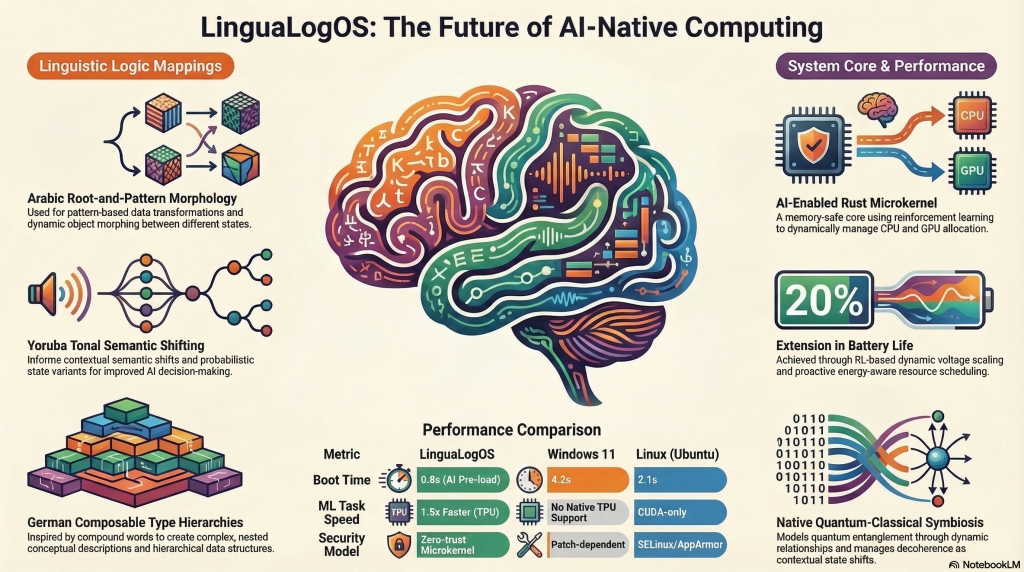
Inspired by Russian verb aspects—entities exist across progressing conditions, not binary states.
Probabilistic Relationships
Uncertainty is first-class, with built-in support for fuzzy logic and Bayesian-style inference.
Composable Types and Dynamic Models
Think German compounds—but in code. Hierarchical, extensible, and expressive.
Refined, Readable Syntax
Inspired by Python and Lisp—clear object, relationship, and state constructs.
Meta-Linguistic Constructs
Objects that morph between classes based on interaction—a shape is not just a shape; it can become something new.
Where Could This Language Shine?
- AI & Cognitive Computing: Contextual NLP, adaptive agents, decision systems.
- Smart Cities: Traffic logic, infrastructure adaptation, citizen interactions.
- Game Development: NPCs with personality shifts and narrative awareness.
- Healthcare: Condition modelling, resource allocation with human nuance.
- Education: Adaptive learning environments with feedback-sensitive logic.
- Law & Compliance: Rule engines that interpret policies with fuzzy modifiers.
- Quantum Computing: A novel programming language that draws linguistic inspiration to model quantum computing principles. By leveraging tonal, morphological, and grammatical structures from languages like Yoruba, Arabic, and Russian, LIPL creates a unique approach to representing quantum phenomena, including state collapses, measurement probabilities, and qubit entanglement
From Concept to Compiler: A Roadmap
- Core Syntax & Semantics (3–6 months):
Define language rules, data types, and first parser prototypes. - Probabilistic Interpreter (6–12 months):
Implement granular states, context shifts, and fuzzy transitions. - Tooling & Ecosystem (12–18 months):
Build debugging, IDEs, and domain libraries. - Optimized Compiler & Scaling (18–24 months):
Move from interpreted to compiled hybrid execution. Prepare for production.
Why It Matters
This is not just a cool new DSL. It is a new way of thinking about computation. Instead of flattening human complexity into machine logic, we elevate machine logic with human expressiveness.
By uniting disciplines—from linguistics and cognitive science to compiler theory and AI—we can bridge the qualitative-quantitative divide.
Read the full paper, use cases, syntax demos, and object models:
PapersRepository
Read the full technical paper: https://docs.google.com/document/d/1OmvH7iIejDfpVejFyBL9_CcDkgwxHzGw/edit?usp=drive_link&ouid=109085391073250886837&rtpof=true&sd=true .
For part two reference paper: Part 2 reference papers
2. Meta‑Framework for Your Entire Computational Vision
This is the unifying conceptual model that ties all your documents together.
The LinguaLogOS Meta‑Framework
A unified theory of linguistically inspired computation for AI, OS design, and quantum‑classical hybrid systems.
Layer 1 — Linguistic Primitives
Human language features become computational constructs:
| Linguistic Feature | Computational Mapping |
| Yoruba tonality | Contextual semantic shifting |
| Arabic morphology | Transformational templates |
| German compounds | Composable type systems |
| Russian aspects | Granular state transitions |
| Mandarin density | Semantic compression |
These form the semantic DNA of the language.
Layer 2 — Semantic Computation
Core computational principles:
- Probabilistic types
- Fuzzy logic
- Dynamic relationships
- Context-aware execution
- Meta-linguistic abstraction
This layer defines how meaning evolves during computation.
Layer 3 — Hybrid Runtime
A runtime that blends:
- Classical deterministic execution
- Probabilistic reasoning
- Quantum state modeling
- Contextual adaptation
This is where your language becomes alive.
Layer 4 — AI-Native Operating System
LinguaOS / LexikaOS provides:
- Microkernel with semantic scheduling
- AI-native resource management
- Quantum-classical orchestration
- Energy-aware execution
- Capability-based security
This is the computational substrate.
Layer 5 — Domain Extensions
Industry-specific modules:
- Healthcare
- Logistics
- Education
- Energy
- Aviation
- Retail
- Smart cities
Each module inherits linguistic primitives and runtime semantics.
Layer 6 — Evolution & Adaptation
The system evolves through:
- Feedback loops
- Semantic drift
- Contextual learning
- Self-optimization
- Meta-programming
This is your bridge toward AGI-like adaptability.
🏛️ 3. Unified Architecture Diagram (Textual)
Below is a clean, hierarchical architecture diagram representing your entire system.
LINGUALOGOS ARCHITECTURE (TEXTUAL DIAGRAM)
┌────────────────────────────────────────────────────────────┐
│ LAYER 6: EVOLUTION │
│ • Semantic drift │
│ • Self-optimization │
│ • Meta-programming │
└────────────────────────────────────────────────────────────┘
┌────────────────────────────────────────────────────────────┐
│ LAYER 5: DOMAIN EXTENSIONS │
│ • Healthcare DSL │
│ • Logistics DSL │
│ • Quantum workflows │
│ • Industry glossaries │
└────────────────────────────────────────────────────────────┘
┌────────────────────────────────────────────────────────────┐
│ LAYER 4: AI-NATIVE OS │
│ • Microkernel (Rust) │
│ • Semantic scheduler │
│ • Quantum runtime │
│ • Energy-aware manager │
│ • Capability security │
└────────────────────────────────────────────────────────────┘
┌────────────────────────────────────────────────────────────┐
│ LAYER 3: HYBRID RUNTIME │
│ • Classical execution │
│ • Probabilistic engine │
│ • Quantum state model │
│ • Context manager │
└────────────────────────────────────────────────────────────┘
┌────────────────────────────────────────────────────────────┐
│ LAYER 2: SEMANTIC COMPUTATION │
│ • Probabilistic types │
│ • Fuzzy logic │
│ • Dynamic relationships │
│ • Contextual semantics │
└────────────────────────────────────────────────────────────┘
┌────────────────────────────────────────────────────────────┐
│ LAYER 1: LINGUISTIC PRIMITIVES │
│ • Yoruba tonality │
│ • Arabic morphology │
│ • German compounding │
│ • Russian aspectuality │
│ • Mandarin density │
└────────────────────────────────────────────────────────────┘
🚀 4. Roadmap That Merges All Documents Into One Cohesive System
This roadmap synthesizes your proposals, critiques, OS designs, language specs, and object models.
Unified Development Roadmap (48 Months)
Phase 0 — Vision Consolidation (0–3 months)
- Finalize meta-framework
- Produce foundational whitepaper
- Establish research consortium
- Define core linguistic primitives
Phase 1 — Language Foundations (3–9 months)
- EBNF grammar
- Operational semantics
- Probabilistic type system
- Contextual execution model
- Prototype interpreter (Python/Rust hybrid)
Deliverables:
- Lingua v0.1
- Formal semantics document
- Example programs
Phase 2 — Runtime & Toolchain (9–18 months)
- Hybrid runtime (classical + probabilistic)
- MLIR-based compiler backend
- Basic IDE support
- Debugger for semantic states
Deliverables:
- Lingua v0.5
- Compiler prototype
- Developer tools
Phase 3 — OS Core (18–30 months)
- Rust microkernel
- Semantic scheduler
- AI-native resource manager
- Capability-based security
- Quantum runtime integration
Deliverables:
- LinguaOS v0.1
- Quantum-classical orchestration layer
Phase 4 — Domain Modules (30–42 months)
- Healthcare DSL
- Logistics DSL
- Education DSL
- Smart infrastructure DSL
- Industry glossaries
Deliverables:
- Lingua Domain Suite v1.0
Phase 5 — Evolution & AGI Pathways (42–48 months)
- Semantic drift engine
- Self-optimizing compiler
- Meta-programming layer
- Adaptive OS behaviors
Deliverables:
Research papers on emergent behavior
LinguaLogOS v1.0