Preamble
The exodus is not inevitable. While Parts 1 through 3 mapped the case for relocation salvaging assets, leveraging diaspora networks, and preserving intangible heritage across borders this piece argues for a different path: staying put and innovating in place.
Many aging societies face a brutal arithmetic. Fewer young workers enter long apprenticeships. Service jobs pay more and demand less patience. Heritage crafts and small factories risk fading into museum exhibits, even as global collectors, fashion houses, and premium buyers hunt for authentic work. The conventional wisdom says move production or watch it die. But that binary is false.
You do not need full relocation to survive demographic decline. You need hybrid models that protect crown-step knowledge at home, grow income through strategic partnerships abroad, and keep cultural identity visible in every batch. This requires rethinking everything: how you pay artisans, how you use technology, how you structure ownership, and how you tell stories that buyers can verify at checkout.
The stakes are not merely economic. When a 72-year-old indigo master retires without a successor, technique vanishes. When a workshop closes, neighborhood ecosystems collapse the tool sharpeners, repair services, and micro-vendors who depend on that anchor. When automation replaces judgment, the very qualities that justify premium pricing disappear. These losses compound silently until revival becomes archaeologically expensive.
But demographic reality need not mean cultural surrender. Governments can close income gaps with surgical subsidies. Museums and universities can become revenue engines instead of archival tombs. Technology deployed carefully can capture tacit knowledge without erasing the human judgment that creates value. Diaspora communities can bridge markets while respecting lineage. And carefully designed hybrid structures can let masters teach, brands scale, and soul travel intact.
This piece shows you how. It maps stakeholder incentives so you align money with meaning. It details policy levers that make craft pay like service work. It offers ten hybrid models you can deploy without moving a single lathe. It provides selection frameworks, risk mitigation strategies, and a twelve-month pilot playbook tested against historical precedents from Huguenot silk to Swiss watchmaking.
The goal is not preservation as museum practice. It is preservation as living evolution where tradition informs innovation, where apprentices earn livable wages, where buyers see provenance in real time, and where the next generation inherits both technique and dignity.
The choice is not between relocation and extinction. The choice is between passive decline and active adaptation. Between hoping demographics reverse and designing systems that work with the world as it is. Between watching the last masters retire into silence and building structures that let their knowledge compound across generations and geographies.
What follows is a tactical manual for that third path one that keeps essence at home while growing capacity and income wherever it makes strategic sense. Use it to fight smarter, not harder, against the demographic tide. See appendices for the role of NGOs, Foundations and Not for profits.
For
– Risk analysis
– Who is and should be considering these posts: Stakeholder integration across all Four posts what are the proposed solutions and probable outcomes
– Can this this partially address depopulation of countryside
See: The last masters part 4 Artifacts
Previous related posts:
The Last Masters Part 1 : Salvaging Cultural Industrial Legacy in Aging Nations
The last masters Part 2: Diaspora As Carrier Wave
The Last Masters, Part 3: The human, cultural preservation and the role of new technology
Stakeholder identification and needs
1) Stakeholder map and incentive design
Use this as your base map when you design any model.
Master artisans. Want status, income, and a live lineage. Worry about authenticity loss and meaning if work moves.
Apprentices. Want paid training, clear ladders, and social status. Long unpaid years are a deal-breaker.
SMEs. Want scale and new markets with tight QC and IP protection. Fear authenticity drift and operational complexity.
Diaspora communities. Can bridge markets and culture, but can face legitimacy debates at home.
Governments. Want identity, jobs, exports, and good optics. Must balance IP control and domestic politics.
Universities and museums. Seek teaching, research, and funding roles. Risk “museum-ification” if they sideline living practice.
Auction houses and collectors. Reward provenance and scarcity, but can trigger counterfeiting if hype outruns control.
Tech platforms. Monetize tracking, archives, and training. Risk over-automation or IP leaks without guardrails.
Local stewards and guilds. Provide legitimacy and informal standards. Risk exclusion if governance migrates abroad.
Design choice: align money with meaning. Pay for outcomes that masters value, and publish proofs buyers trust.
2) Policy and profitability levers that make craft pay like services
Governments can close the income gap quickly if they target both wages and status.
- Salary subsidies and stipends. Guarantee apprentice and master income parity with entry service roles. Pair with social insurance and family support.
- Outcome-based funding. Bonuses for certified skills, yield, export growth, and audited quality. Pay for results, not inputs.
- Premium pricing and certification. Geographic indications, strict provenance, and crown-step certification tied to a living wage floor.
- Institutional roles for income stacking. Pay masters as educators, auditors, and archivists. Rotate between bench and classroom.
- Festivals and brand “drops.” Public making clinics, municipal grants, and national media to raise status and demand.
- Tax and regulatory relief. Credits for hiring certified artisans, investing in legacy equipment, and exporting certified batches.
These levers reposition craft as a viable engine, not a subsidy sink. You create higher wages, better stories, and credible signals for premium prices.
3) Technology as a cultural accelerator, not a replacement
Use tech to teach judgment, not erase it.
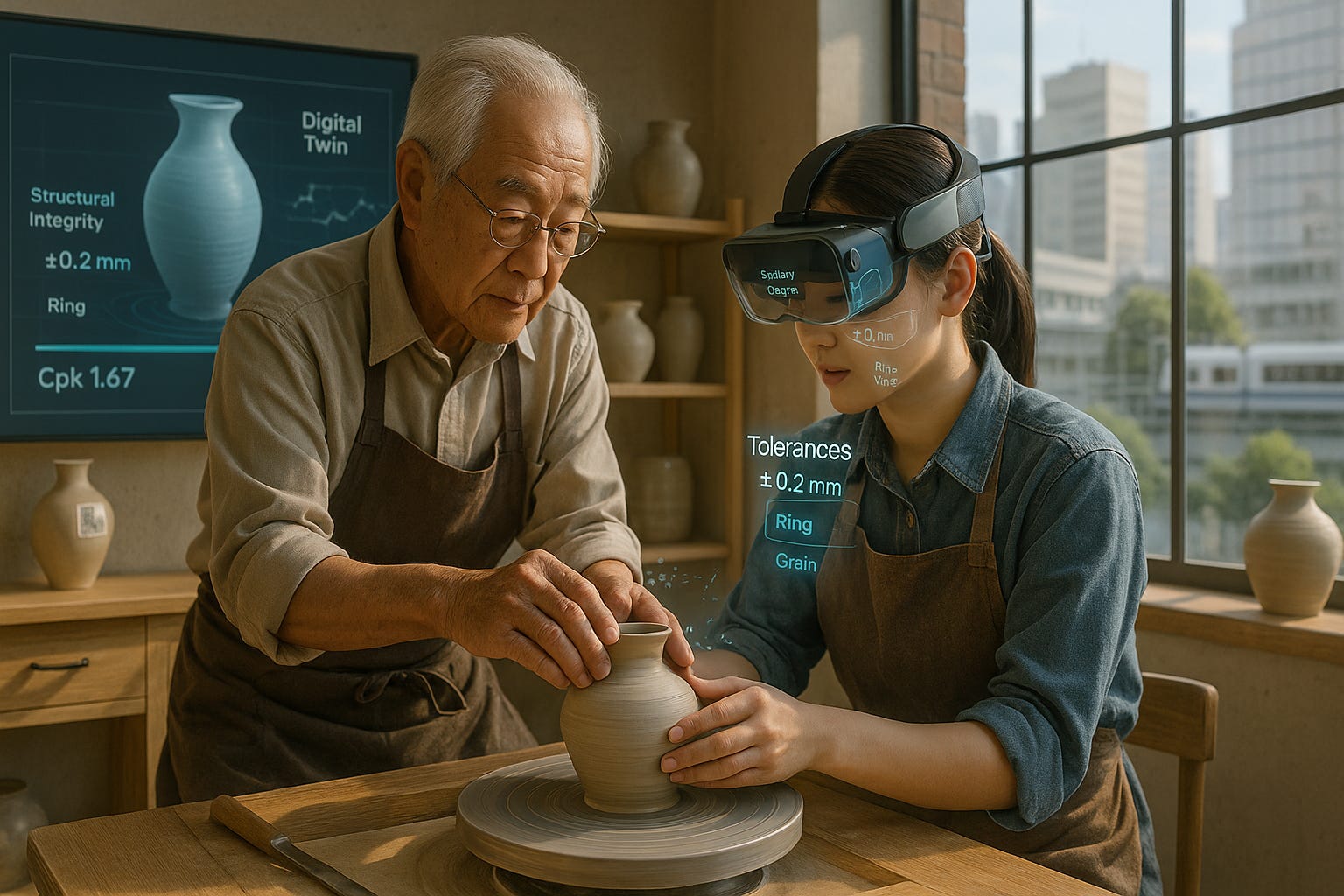
AR operator assists and remote QC. Capture tacit skills with multi-camera recordings. Deliver bilingual SOPs, live annotations, and defect detection to host microcells. Roll out in 12 months using a staged roadmap.
Provenance and digital certification. Log batch data, equipment IDs, operator certifications, and ritual clips. Put a QR on each unit to verify people, process, and metrics.
Museum-lab archives and digital commons. Store ritual footage, sensory lexicons, and curriculum in open but tiered repositories. Charge for audits and certified inputs.
Human layer add-ons. Ritual registry, short sensory lexicon, terroir protocol, closure and consecration rites. These protect soul and explain variance.
4) Institutional roles and legacy infrastructure
Universities and museums can be income engines and IP custodians.
- Keep the crown step in a home “origin hub” lab. Document and teach it. License non-crown steps abroad with audits. Pay masters for teaching, auditing, and curating.
- Run museum-lab and university partner cells that publish results and hold provenance. Students learn, artisans earn, buyers trust.
- Pair auction houses and digital marketplaces with transparent certification and small-batch releases. Capture scarcity, reduce counterfeit risk.
5) Cross-industry and historical parallels you can use
Past moves show what to copy and what to avoid.
- Huguenot silk to Spitalfields. Move people, tools, and guild rules as a bundle. Protect pattern books.
- Murano glass controls. Secrecy alone fails. Build open provenance and reputation capital.
- Swiss watchmaking and refugee inflows. Split-process for years. Keep complications and finishing at the hub.
- Diamonds Antwerp to Surat and Mumbai. Pair kinship finance with calibrated QC and audits.
6) Ten hybrid alternatives that work without full relocation
Choose one or layer several.
- Dual-site split process with origin crown-step hub. Keep irreversible or identity-defining steps at home. Ship semi-finished goods across QC gates.
- Heritage guild franchise. License methods, marks, and tooling to vetted SMEs abroad using outcome-based fees.
- Museum-lab and university partner cells. Institutionalize master steps at home. License finishing stages and publish provenance.
- Traveling master corps with mobile training rigs. Ninety-day rotations, public audit clips, outcome-linked payments.
- In-place revitalization clusters. Keep production local. Concentrate tools, apprentices, buyers, and festivals with power SLAs and retrofit funds.
- Open craft commons with paid secrets. Publish generic SOPs. Keep crown modules sealed. Monetize audits and certified inputs.
- Remote-first microcells. Portable tooling, AR instructions, shared SPC boards, quarterly consecration rites.
- Time-limited relocation with repatriation option. Five-year host runs that bridge succession, then return capacity.
- Government or DFI outcome funding. Trigger payments on first-pass yield, warranty returns, and on-time delivery.
- GI or collective mark strategy. Place-linked cues with certified production under master oversight and published variance bands.
7) Strategy lenses you can apply to any option
PESTLE, example: diaspora-led training anchor
Political. Bilateral ties, export controls, and migration optics at home.
Economic. Premium pricing, working capital tied to outcomes.
Social. Fast-track diaspora youth as interpreter-trainers, secure community legitimacy.
Technological. Capture tacit moves, build twins, add inline sensing.
Legal. Tiered licensing, clear scope, audits, and revocation rights.
Environmental. Retrofit vintage machines for power efficiency inside zones.
SWOT, example: split-site crown-step model
Strengths. IP retention, authenticity, price defence.
Weaknesses. Logistics cost, cross-border coordination.
Opportunities. Certified franchise network, branded education.
Threats. Silent spec drift, counterfeit risks.
Porter’s Five Forces, example: certified heritage textiles
Supplier power. Master trainers and crown-step hubs.
Buyer power. Premium buyers accept price when provenance is visible.
Threat of substitutes. Mass-market goods rise when certification weakens.
Threat of new entrants. High where SOPs are public and audits are weak.
Rivalry. Managed through limited drops and GI protection.
8) Selection framework to localize solutions across countries
Use a weighted scoring matrix, then run phased pilots.
Core criteria and weights.
Infrastructure readiness 25. Human capital 30. Economic and regulatory 20. Cultural and linguistic compatibility 15. Market access 10. Adjust weights by sector.
How to use it.
- Build country profiles with numeric 1 to 100 scores per criterion.
- Adjust weights by sector. Textiles raise human capital to 35. Precision metal raises infrastructure to 30. Food crafts raise regulatory to 25.
- Pick top two pilots. Start with small training cells, diaspora governance, and origin master audits.
- Expand only after quality, yield, and price premiums hold for three drops.
Illustrative scores from the framework.
Vietnam 82, Thailand 79, Bangladesh 72, Nigeria 63, with sector fits listed for each. Use these as examples to tune your own scoring.
9) Profit engine: how you make this pay
- Premium defence. GI or collective marks, QR provenance to named people and machines, public dashboards with batch metrics.
- Story that buyers can verify. A 90 second film per drop that shows one ritual, one named custodian, one metric hit.
- Channel design. Limited certified drops through auction partners and trusted marketplaces to create signal and reach.
- Income stacking. Practitioners earn from bench work, teaching, audits, and archives.
10) Twelve-month pilot playbook
Months 1 to 2. Pick one product family. Scan tooling. Capture master moves. Draft bilingual SOPs.
Months 3 to 4. Build a digital twin. Stress test climate and inputs. Approve retrofits.
Months 5 to 6. Ship a training skid and input starter kits. Prepare customs and utilities.
Months 7 to 9. On-site training with two masters and one diaspora interpreter. Produce Batch 1 and 2. Calibrate QC.
Months 10 to 12. Remote oversight of Batch 3. Independent audit. Decide scale, hold, or roll back.
Metrics that prove replication. Cp or Cpk on three sensitive dimensions. Inline defect rate. Warranty returns. Certified operator count. Audit pass rate.
11) New ideas to add to your toolkit and Additional Ideas Not Previously Considered
- Craft income share agreements. Public funds prepay stipends. Graduates repay a small share of premium sales for five years.
- Craft data cooperative. Shared provenance and QC data across brands to set fair premiums and reduce counterfeit risk.
- Carbon and repair credits. Premiums for longer-life goods with repair guarantees tied to certified microcells.
- Reverse residencies. Two month host-country residencies at home labs for the top trainees each year, filmed and certified.
- Community vendor lanes. Reserve stalls for tool sharpeners, fabric dyers, and repair services inside zones.
- Apprenticeship as public service. Treat certified training hours like national service with tuition credits.
Additional Ideas Not Previously Considered
Craft-Linked Social Insurance and Retirement Planning
The Gap: Current frameworks assume artisans will self-fund retirement through savings, but irregular income and long training periods make this nearly impossible. No existing model treats craft mastery as a public asset worthy of social security protection comparable to civil service.
The Innovation:
- Master Pension Trusts: Pooled vehicles where a percentage of premium sales (3-7%) funds deferred compensation for certified masters, vesting over career milestones
- Teaching Sabbaticals: Government-funded 6-month rotations where masters aged 60+ earn stipends to teach in university labs while their workshops remain active under certified deputies
- Skill-to-Equity Conversion: Retiring masters can contribute documented techniques to a shared IP trust in exchange for equity shares that pay dividends from licensed production
- Intergenerational Transfer Bonds: Long-term financial instruments where buyers pre-purchase future batches, creating working capital for succession planning
Why It Matters: Without retirement security, masters delay teaching and hoard knowledge. With it, they become willing knowledge brokers earlier in their careers.
Craft Tourism as Revenue Stabilizer
The Gap: Craft tourism exists but remains ad hoc—workshops open sporadically, pricing is inconsistent, and visitor experience is not optimized for conversion to high-margin sales.
The Innovation:
- Certified Workshop Trails: Government-backed certification for “open studios” with standardized pricing, booking systems, and multilingual guides
- Making Experience Packages: Tiered programs from 2-hour demos ($150-300 per person) to 5-day intensives ($2,500-5,000) that include material costs, tools, and take-home pieces
- Cultural Consortia Bookings: Regional marketing cooperatives that aggregate multiple workshops into purchasable itineraries for tour operators
- Digital Twin Walkthroughs: VR studio tours that convert 15-20% of viewers to physical visits or limited-edition purchases
- Residency-in-Exchange: International visitors pay for 1-3 month residencies where they train under masters while funding apprentice stipends through program fees
Revenue Impact: Well-executed craft tourism can add 25-40% to workshop revenue while building customer loyalty and creating content for storytelling.
Precedents: Japanese pottery towns (Mashiko, Bizen), Italian leather schools, Scottish whisky trails, and Thai silk villages demonstrate this model at scale.
Reputation Staking and Decentralized Quality Assurance
The Gap: Current certification relies on opaque audits, guild politics, or brand reputation vulnerable to dilution. Buyers lack real-time verification, and counterfeiters exploit information asymmetry.
The Innovation:
- Blockchain Provenance Ledgers: Immutable records linking each batch to named artisans, equipment IDs, material sources, and quality metrics, with secure and transparent verification of cultural heritage authenticity
- Smart Contract Quality Gates: Automatic release of payment only when batch data meets pre-agreed Cp/Cpk thresholds, verified by independent sensors
- Staked Reputation Pools: Artisans and brands lock capital in escrow; warranty claims or quality failures trigger automatic penalties, building trust through financial skin-in-the-game
- Decentralized Audit Networks: Global network of certified quality inspectors paid per audit via smart contracts, with results published on-chain and cross-verified
- NFT-Linked Physical Goods: Each premium piece issued with an NFT certificate storing production video, sensory metrics, and transfer history
Why It Matters: Blockchain platforms can track provenance and authenticate artworks, allowing users to access an object’s history and verify its authenticity, which protects premium pricing at scale while reducing counterfeiting and enabling fractional ownership for high-value collectibles.
Micro-Factory Networks with Shared Infrastructure
The Gap: Individual workshops cannot afford industrial-grade climate control, metrology labs, or safety retrofits. This limits quality, increases insurance costs, and blocks export certification.
The Innovation:
- Hub-and-Spoke Facility Clusters: Central facility (500-1,000 m²) with shared kiln, spray booth, testing lab, and cold storage, surrounded by 8-15 private workshops within 10-minute walk
- Time-Share Equipment Models: High-cost machinery (laser cutters, precision ovens, metallography stations) available by reservation with usage fees covering maintenance
- Collective Compliance Zones: Shared ISO certifications, environmental permits, and export licenses that individual shops cannot afford alone
- Joint Procurement Cooperatives: Bulk purchasing of raw materials, energy contracts, and insurance at 20-35% discounts
- Embedded Technical Services: Resident engineer, quality manager, and logistics coordinator paid through shared membership fees
Precedent: Italian artisan consortia (Emilia-Romagna), German Handwerkskammer facilities, and Korean craft support centers demonstrate viability.
Barriers Addressed: High fixed costs, regulatory complexity, technical skill gaps, and isolation from peer learning.
Carbon Credit and Circular Economy Integration
The Gap: Heritage crafts often use long-life, repairable goods and low-waste processes but receive no financial benefit from this environmental advantage. Meanwhile, fast fashion and planned obsolescence face minimal penalties.
The Innovation:
- Longevity Premiums: Certified “100-year goods” with repair guarantees earn carbon offset credits tradable on voluntary markets
- Right-to-Repair Licensing: Open technical documentation and subsidized spare parts in exchange for tax credits and extended producer responsibility relief
- Repair Service Networks: Certified repair artisans earn revenue from warranty work, creating new career paths adjacent to production
- Material Circularity Tracking: Blockchain-tracked material loops where scrap is logged, refurbished, and valorized through secondary markets
- Heritage Carbon Labels: Consumer-facing labels quantifying emissions per unit vs. mass-market equivalents (e.g., “82% lower lifetime carbon than fast furniture”)
Revenue Unlock: European Union and California markets increasingly value verifiable sustainability, creating 10-25% price premiums for certified low-carbon heritage goods.
Policy Hook: Aligns with Extended Producer Responsibility (EPR) directives and circular economy action plans already law in EU and emerging in Asia.
Gamified Apprenticeship and Digital Credentials
The Gap: Long, unpaid apprenticeships with unclear progression deter young talent. Traditional certification is opaque and non-transferable across borders or sectors.
The Innovation:
- Micro-Credential Pathways: Modular skills certifications (e.g., “Level 2 Glaze Mixing,” “Level 4 Throwing Precision”) stackable toward master status
- Gamified Learning Platforms: AR/VR training modules with real-time feedback, leaderboards, and achievement unlocks that make skill-building visible and motivating
- Portable Digital Badges: Blockchain-verified credentials recognized across countries and industries, increasing apprentice mobility and bargaining power
- Pay-for-Progress Models: Stipends increase automatically upon certification milestones, with bonus pools funded by premium batch sales
- Peer Teaching Incentives: Senior apprentices earn supplemental income by coaching juniors, creating mentorship cascades
Youth Engagement: Makes craft careers legible to digital-native cohorts accustomed to clear progression systems (gaming, coding bootcamps, fitness apps).
Cross-Industry Appeal: Credentials transfer to adjacent sectors (design, restoration, quality control), reducing career lock-in fears.
Slow Consumption Movements and Pre-Order Models
The Gap: Artisans struggle with cash flow gaps while inventory sits unsold. Buyers want unique pieces but lack trust in delivery timelines or final quality.
The Innovation:
- Kickstarter-Style Batch Funding: Buyers pre-order at 20-30% deposits; production begins only when funding threshold is met, eliminating inventory risk
- Subscription Craft Boxes: Quarterly deliveries of small-batch goods with maker stories, sensory guides, and behind-the-scenes videos (models: Cratejoy, Japan Crate)
- “Made-to-Wait” Marketing: Explicit 3-6 month lead times framed as quality assurance and exclusivity rather than production failure
- Transparency Dashboards: Live updates showing production stage, quality checks, and expected delivery with photos and short videos
- First-Access Memberships: Annual fees ($200-500) grant early access to limited drops, studio tours, and voting rights on new product development
Cultural Shift: Reframes waiting as investment in quality, aligned with “slow food” and “conscious consumption” movements already mainstream in affluent demographics.
Cash Flow Benefits: Pre-orders provide working capital, reducing reliance on debt and allowing artisans to pay apprentices during training.
Elder-as-Asset Programs
The Gap: Aging demographics are framed only as problems (labor shortages, pension burdens). But elder knowledge, social capital, and time availability are underutilized.
The Innovation:
- Senior Artisan Corps: Retirees aged 65-80 hired part-time as quality inspectors, archivists, or cultural liaisons at municipal craft centers
- Grandmaster Clinics: Traveling teaching events where retired masters spend 3-5 days in host cities demonstrating crown techniques to local practitioners
- Oral History Acceleration: Government-funded recording projects capturing 500+ hours of master interviews, technique demonstrations, and tool-making tutorials
- Legacy Brand Licensing: Retired masters license their names and reputations to certified workshops in exchange for royalty streams, maintaining quality oversight
- Intergenerational Co-Working: Subsidized studio spaces where retirees work alongside young artisans, fostering informal knowledge transfer
Demographic Reversal: Reframes aging as an asset for craft preservation rather than a threat, improving social cohesion and elder income security.
Policy Alignment: Fits “active aging” initiatives already funded in Japan, Korea, and EU under healthy longevity strategies.
Alternative Ownership Structures
The Gap: Traditional family ownership creates succession crises when heirs lack interest or skill. Worker cooperatives lack capital. Private equity strips intangible value for short-term returns.
The Innovation:
- Perpetual Purpose Trusts: Workshop and brand placed in a trust with a charter mandating quality standards, apprentice training, and community ties; trustees elected by stakeholders
- Steward-Ownership Models: Founders retain decision rights but equity is non-extractive, with profits reinvested or distributed to workers (model: Patagonia, Zeiss Foundation)
- Community Land Trust Variants: Real estate held in trust to prevent displacement; workshops pay below-market rent in exchange for training obligations
- Multi-Stakeholder Cooperatives: Voting shares split among workers, customers, suppliers, and local government, balancing commercial and cultural objectives
- Benefit Corporations: Legal structures requiring consideration of social/environmental impact alongside profit, with enforced transparency
Stability: Prevents hostile takeovers, real estate speculation-driven closure, and value extraction incompatible with long-term craft preservation.
Governance: Enshrines quality and cultural values in legally binding charters rather than relying on founder goodwill.
Crisis-Proofing and Resilience Reserves
The Gap: Craft sectors lack buffers against shocks—pandemics, energy crises, supply chain disruptions, or natural disasters. Individual workshops cannot self-insure.
The Innovation:
- Mutual Aid Insurance Pools: Sectoral risk-sharing funds where members pay premiums based on revenue; payouts cover lost income during forced closures
- Strategic Material Reserves: Government-subsidized stockpiles of critical inputs (rare pigments, specialty clays, specific hardwoods) released during supply shocks
- Disaster Recovery Protocols: Pre-arranged equipment salvage, temporary workspace access, and emergency bridging loans activated within 72 hours
- Diversified Energy Access: Workshops paired with renewable microgrids (solar + battery) to maintain operations during grid failures
- Digital Continuity Plans: Cloud backups of all SOPs, specifications, customer lists, and historical records, with offline redundancy
Recent Validation: COVID-19 devastated artisan sectors lacking digital sales channels, emergency funds, or alternative production sites. Post-pandemic, resilience planning is no longer optional.
12) Answers to the guiding questions
How can aging societies retain crafts without full relocation. Keep crown steps at home in museum-lab hubs. License other steps with strict audits and public provenance.
What hybrid models balance authenticity and profitability. Split-site crown steps, heritage franchising, museum-lab cells, and traveling master corps. Layer them by sector and country.
How does profitability shape interest. When wages match services and premium prices hold, apprentices stay, SMEs invest, and governments defend the sector. Use outcome-based funding and GI pricing.
What role do storytelling, certification, and digital platforms play. They turn lineage into proofs that buyers can see and trust at checkout, which protects margins at scale.
13) Country archetypes and localization tips
ASEAN precision hubs. Vietnam and Thailand suit precision metal, ceramics, and components. Invest in bilingual QC and twin-driven setup.
South Asia textile engines. Bangladesh suits dyeing and weaving. Raise human capital weight and protect IP with sealed crown modules.
West Africa market bridges. Nigeria suits textiles and food crafts. Use zones with power SLAs, diaspora interpreters, and consecration rites to build legitimacy.
14) Risks and how to reduce them
- Authenticity drift. Lock sensory targets and publish variance bands. Use cultural boards with veto on palette and finish.
- IP leakage. Keep crown steps in controlled modules. Split training, production, and brand rights. Revoke on breach.
- Over-automation. Automate measurement and handling first. Keep human judgment where value lives.
- Elite capture. Use a shared Salvage SPV with transparent access and outcome-based fees.
Practical selection framework template
Score 1 to 100 for each criterion, multiply by weight, sum to rank pilots.
- Infrastructure readiness, 25
- Human capital, 30
- Economic and regulatory, 20
- Cultural and linguistic compatibility, 15
- Market access, 10
Adjust weights by sector as noted above. Run two pilots, not ten. Publish KPIs per drop, then scale.
Final take
You can keep the essence at home and grow income abroad. Treat crown steps as sacred. Make proof public. Pay for outcomes. Rotate masters into paid roles as teachers and auditors. Build selection with data, not hope. When you do this, technique travels and meaning stays intact.
Appendices
Non-profits, foundations, and NGOs
Non-profits, foundations, and NGOs can play crucial roles in preserving and globalizing endangered crafts amid aging societies facing demographic challenges. Their roles complement governmental, commercial, and diaspora efforts by focusing on cultural preservation, funding, knowledge transfer, legitimacy, and community building.
Roles and Contributions
- Cultural Stewardship and Legitimacy
- Act as custodians of heritage practices, rituals, and intangible cultural assets that underpin craft identity and authenticity.
- Form or support guild councils and brand boards with veto powers to ensure respect for local cultural norms and quality standards.
- Host archives, ritual registries, and sensory lexicons that preserve tacit knowledge and enable continuity without commodification.
- Funding and Financial Support
- Provide grants, stipends, or pooled apprenticeship funds to sustain long training pipelines, specially for vulnerable demographics such as women and low-income apprentices.
- Facilitate outcome-based funding models that reward quality batches and successful transfers of mastery rather than simply compliance or hours worked.
- Training and Capacity Building
- Partner with museums, universities, and diaspora groups to create training labs, mobile rigs, and digital commons for master-apprentice instruction and capacity scale-up.
- Support production of bilingual work instructions, AR content, and digital twins that encode tacit craft knowledge for scalable transmission .
- Develop social insurance programs, family support, and community compacts essential to retain apprentices in long-duration programs.
- Governance and Multi-Stakeholder Coordination
- Act as neutral facilitators between origin masters, diaspora diaspora actors, local communities, and commercial partners to build trust and shared accountability.
- Provide transparent audit, provenance, and quality certification schemes protecting IP while enabling adaptive local innovation under covenant.
- Promote cultural diplomacy to mitigate migration and relocation sensitivities, reinforcing heritage continuity even with physical asset shifts.
- Market Development and Storytelling
- Craft and amplify authentic narratives linking artisans, branded rituals, and terroir to emerging global customer bases including diaspora and cultural tourists.
- Deploy platforms for interactive provenance tracking, batch storytelling, and ritual videos that tie product identity directly to named custodians and quality proof.
- Organize festivals, exhibitions, and public engagement to elevate craft esteem and generate demand aligned with sustainable economic models
- Research and Policy Advocacy
- Lead interdisciplinary research into sensory lexicons, trade-offs in relocation models, and sustainable ecosystems that keep heritage vibrant.
- Advocate for policy frameworks that enable salary parity, apprenticeship incentives, regulatory clarity, and IP protection aligned with craft realities
In essence, NGOs and foundations function as the cultural conscience, trust brokers, and innovation incubators that ensure craft knowledge migration is not just about moving production but carrying soul, lineage, and dignity across borders, economies, and generations