Idea Snapshots – Brief, strategic glimpse
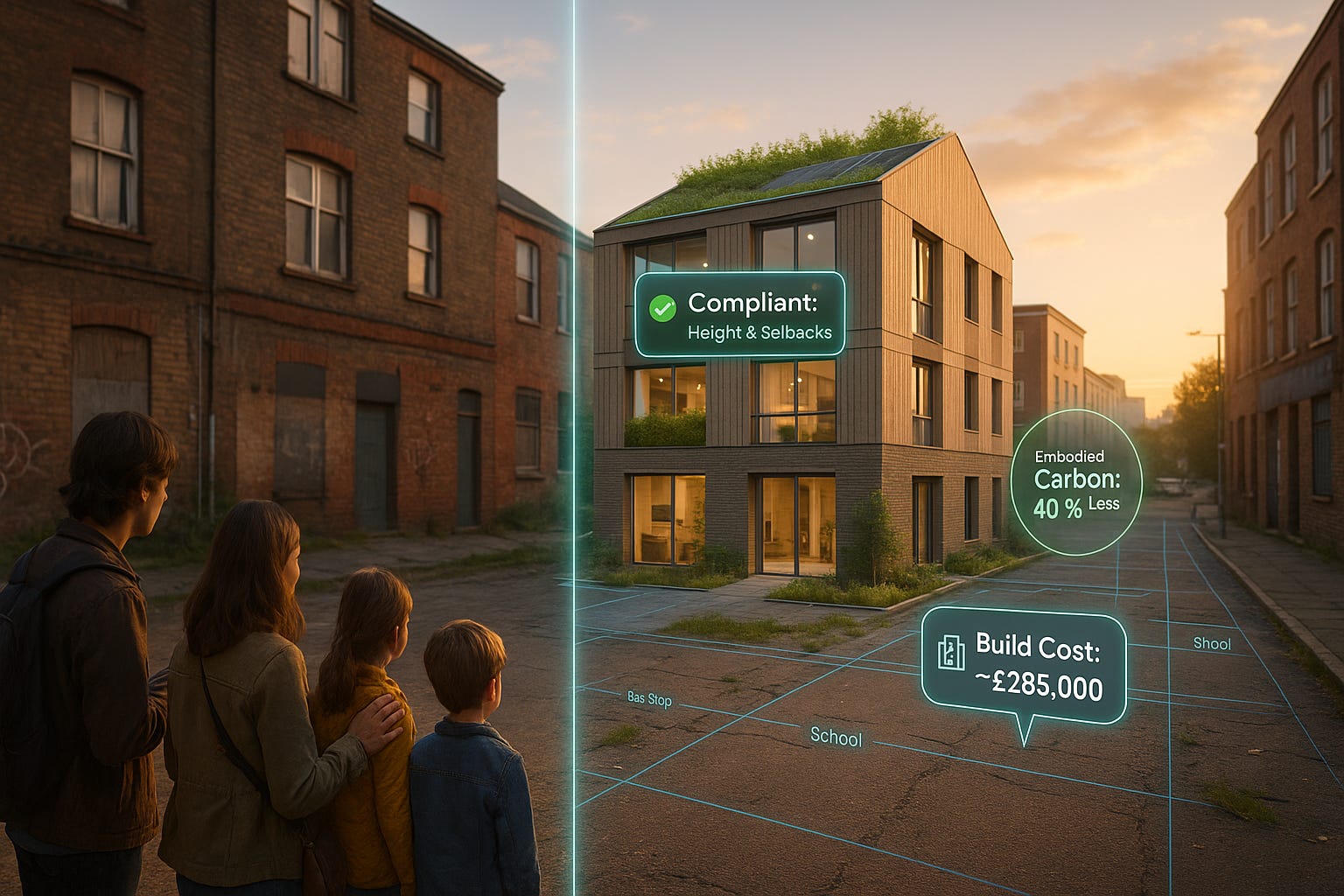
Cities hold thousands of underused parcels and long term empty homes. People struggle to see what is possible, and planning feels slow and opaque. GroundKit turns real places into a playable and or ,professional workspace. You pick an actual site, load live rules and constraints, sketch ideas with blocks or templates, and get AI guidance on policy, cost, time, and carbon. Then you invite collaborators and export a planning ready pack or a 3D printable model. This snapshot sounds like a professional toolbox solution, but initially I would prefer its as a tool for gamers, hobbyist and community or groups. See game play simulation: GroundKit Gameplay V1 or GroundKit Gamplay V2
Is This New?
Originality check:
[ ] Completely novel
[x] Remix of existing concepts
[x] Cross-domain adaptation
Why this angle works: Digital twins and planning tools exist, and city-building games exist. GroundKit blends them into a dual mode experience that is anchored to real parcels, live policy, and reusable templates, with exports fit for real decisions. This pairing of game energy and professional outputs is not common, which creates a distinct position.
Market Position
The landscape: Planning tech is fragmented. GIS tools are powerful but specialist. Community engagement platforms are separate from design. Game engines are accessible but not policy aware. Education uses abstract exercises that do not map to real approvals.
The opportunity: Provide one path from site discovery to side by side scenarios, with advisory policy checks, community polls, and exportable packs. Start with brownfield and vacancy use cases where reuse and clarity matter most.
The scale: Target a solid mid market outcome. Enterprise and education seats plus paid exports and a marketplace can support a multi million GBP business in 3 years, with positive unit economics on planning pack and marketplace attach rates.
As usual some outline artifacts: Vision , SRS, Business Plan , map integration etc : Ground kit
Stakeholder ecosystem: identified needs and features
- Gamer Hobbyist : playing around and building in the digital twin of real world
- Local authorities and housing associations: Faster site triage, transparent engagement, advisory checks with citations, exportable planning packs.
- Small developers and community housing groups: Early cost and time certainty, reuse templates, policy flags before spend.
- Architects, planners, students: Real context, block builder with material performance, IFC export, studio mode.
- Residents and neighborhood groups: Visual options, polls, shared sessions, AR viewing.
References: Ground kit Concept snapshot, Business plan outline, GroundKit vision document.
Product vs. Feature
The test: Can GroundKit stand alone, or is it a feature for GIS or CAD suites? It stands alone because it links parcel-grounded play, policy awareness, collaboration, and submission-ready exports into one workflow.
The defense: Defensibility comes from encoded local rules, brownfield and vacancy surfacing, a validated template library, and a marketplace that builds community lock in.
Gamification
Here is a focused menu of gaming aspects you can borrow from LEGO and popular building games to appeal to hobbyists and gamers, while staying compatible with a serious GroundKit pathway later.
Core loop that feels like LEGO
- Pick a site. Open a parts tray. Snap pieces to a visible grid.
- Tweak colors and materials. Add tiny details that make it feel alive.
- Hit Play to test physics, daylight, people flow, and traffic.
- Save, share, and remix other players’ builds.
Build mechanics players expect
- Snap system: Stud-like snapping, angle snaps, and smart alignment. Optional collision toggle for freeform creativity.
- Parts library: Bricks, wedges, plates, windows, doors, roof pieces, trees, street furniture. Grouped by theme such as terrace, mews, corner plot, pocket park.
- Parametric pieces: Stretchable walls, adjustable roof pitch, window arrays, stairs that auto fit to height.
- Prefabs and mini-sets: Ready packs like “Backyard infill,” “Corner shop,” “Pocket plaza,” each editable.
- Constraints as hints: Gentle ghosting or color cues when a piece breaks a rule. Never hard stop in hobby mode.
- Physics toys: Gravity drop to ground, simple structural stability check, water flow toy for drainage, traffic toy for curb cuts.
- Mini-fig scale view: A walk mode with human height to check sightlines and vibe.
Play modes
- Freebuild Creative: Unlimited parts and undo. Great for relaxing play.
- Challenge Cards: Build within a footprint, height, or budget. Examples, “Fill a 6 by 12 plot,” “Add 4 homes behind a high street.”
- Time Trials: Ten minute micro-builds with a theme.
- Before and After: Start from a messy or vacant lot and improve it.
- Photo Diorama: Set time of day, add people and vehicles, place a camera, and capture poster-worthy shots.
Progression and rewards
- Blueprint unlocks: Finish a challenge to unlock new prefabs or rare parts.
- Skill tracks: Builder, Urbanist, Green Thumb, each with small perks like faster snapping or advanced foliage tools.
- Cosmetics: Colorways, decals, tiny props. Keep cosmetics cosmetic only.
- Collections: Curate “sets” like “London Mews Pack” or “Canal-side Kit” that unlock as you play.
LEGO-like joy details
- Satisfying micro feedback: Soft click on snap, subtle shake when a part misaligns, dust poof on demolition.
- Hands mode: A visible glove cursor that “picks up” parts and rotates them.
- Stud currency feel without grind: Earn “studs” through play that buy cosmetics or diorama props.
Challenges that map to real skills
- Density puzzles: Fit a target floor area without breaking daylight rules.
- Access puzzles: Place ramps, steps, and bike storage to meet targets.
- Green score: Raise a simple habitat and shade score with trees and planters.
- Mobility puzzles: Place crossings and bike racks to reduce simulated conflicts.
- Waste and bins puzzle: Fit collection points on tight plots.
Social and community play
- Remix button: Fork any public build. Auto credit the original creator.
- Build jams: Weekly theme with a fixed parcel and time limit.
- Leaderboards by vibe: Most cozy, most inventive, best small site.
- Photo mode sharing: Export postcard views for Substack or X.
- Co-build: Two to four players editing a site together with voice chat.
Creator economy
- Parts and prefab workshop: Players upload custom parts or mini-sets with tags and simple metadata.
- Curated storefront: Featured sets and creator spotlights.
- Safe monetization: Revenue share on cosmetic packs and prefab packs. No pay to win.
Parent and classroom friendly
- Guided build paths: Step-by-step assembly like an instruction booklet.
- Build journals: Auto capture steps for reflection or teaching.
- Age toggles: Simplify tools for younger players. Advanced toggles for teens and adults.
Bridge to GroundKit Pro without breaking the vibe
- One-click upgrade of a hobby build: Convert pieces to real materials and basic cost bands.
- Advisory overlays: Show light, access, and simple code hints in hobby mode. Full citations appear only in Pro.
- Export paths: Snapshot to image, short video, or printable STL model. Pro users can export a planning pack later.
- Template parity: Prefabs in hobby mode mirror typologies in Pro, so creators can graduate smoothly.
References from well loved genres to guide polish
- Block sandbox: LEGO Worlds, Bricklink Studio, Trailmakers, Besiege.
- City and town vibe: Townscaper for low friction place-making. Cities Skylines for traffic toy inspiration.
- Survival-lite creativity for optional depth: Minecraft Creative for freebuild energy, Satisfactory for tidy modularity.
First drop scope for a playable demo
- 1 compact real site with a tight footprint.
- 150 parts across structure, facade, roof, landscape, and street.
- 10 prefabs, 5 challenge cards, 1 weekly build jam.
- Photo mode, walk mode, and gravity.
- Save, share, remix.
Core Components
What you would need
- Data spine and adapters for parcels, constraints, design codes, brownfield and vacancy layers.
- Block builder with materials library that carries strength, thermal, cost, and carbon values.
- AI services for site recommendation, code checks with citations, first pass cost and timeline, and engagement summaries.
First steps
- Pick one Area with open data and encode common rules for three typologies.
- Ship parcel search, constraint overlays, block massing, save and share, and a basic planning pack PDF.
- Run three pilots: council brownfield, college vacant building challenge, small developer terrace infill. Measure time to first valid scenario and exports.
The Contrarian View
Challenge this idea: Policy is complex and local. Data rights and accuracy vary. Authorities may distrust game like tools. Professionals may fear displacement.
Why it might still work: Keep outputs advisory with sources, watermark speculative mode, show update timestamps and confidence scores, and design clear handoffs to pro workflows. Start with supportive councils and education partners to build proof.
Cross-Domain Potential
If urban planning adoption is slow, adapt the platform for campus planning, industrial estates, energy siting, or disaster recovery scenarios that need fast option tests with community input. The same parcel anchored twin, materials logic, and scenario compare can transfer.
Next Steps for Builders
If you wanted to pursue this
- Week 1: Validate data availability, define the site object and export schema, and encode the first three design rules with citations.
- Month 1: Deliver a working city twin for one borough with parcel tiles, overlays, block builder, saves, and a basic planning pack export.
- Quarter 1: Complete the three pilots, add scenario compare with cost and carbon side by side, and open the STL print pipeline.
Resources to explore
- Planning data portals and brownfield registers for the target council.
- Studio mode partnerships with universities and makerspaces.
- Policy encoding playbook and materials performance dataset.
Final Thoughts
GroundKit lowers the barrier from idea to credible option on a real site. It helps people reuse what cities already have, aligns conversations with evidence, and shortens the path to a pilot. Start small, measure time to first valid scenario, and grow the template and materials library through the marketplace.