Preamble
The organizations that thrive in chaos aren’t the ones with perfect predictions they’re the ones that anticipate intelligently. While your competitors are blindsided by disruption, these organizations have already simulated it, designed around it, and moved ahead. The difference? They’ve built anticipation into their operating system.
The Anticipation Paradox
Here’s the uncomfortable truth: detailed strategic plans often create an illusion of control while leaving organizations vulnerable to surprise. We’ve all seen it companies with elaborate five-year roadmaps disrupted by shifts they “never saw coming,” despite spending millions on consultants and market research. The problem isn’t planning itself. It’s planning that assumes a knowable, linear future.
Futures thinking works differently. Instead of predicting one future, it explores multiple futures possible, plausible, probable, and preferable. This transforms uncertainty from a threat into a landscape you can navigate.
As usual some supporting documentation: Longform article, SRS, Case study applied to the future of Robotics for domestic use cases : Artifacts
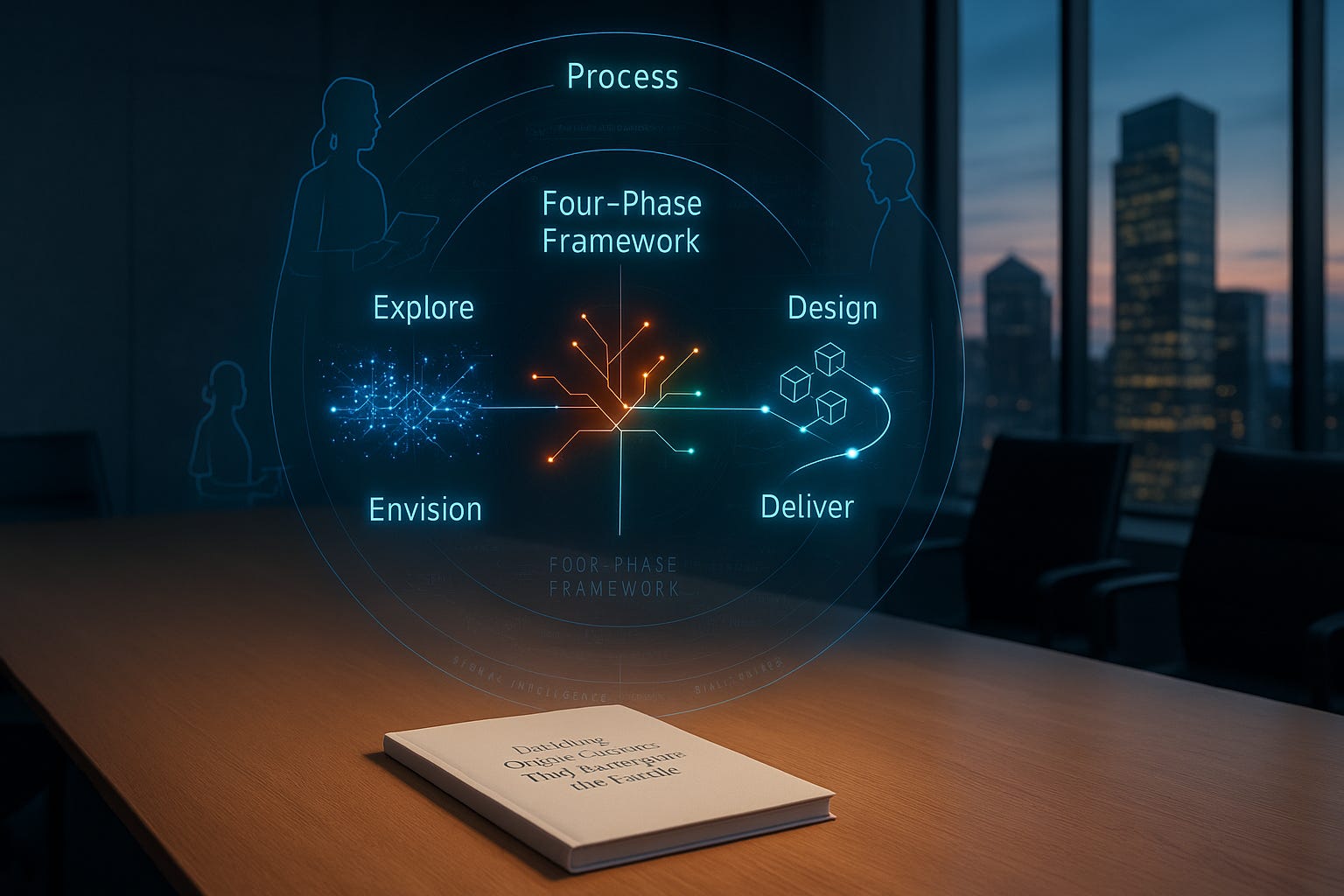
A Four-Phase Framework for Strategic Foresight
Phase 1: Explore — Build Your Early Warning System
Start by establishing situational awareness. This isn’t about consuming more news it’s about systematic intelligence gathering:
- Horizon scanning: Track emerging signals of change across technology, policy, economics, society, and environment
- Driver mapping: Identify the forces shaping your domain and how they interact
- Expert consultation: Use Delphi methods to tap collective intelligence while reducing groupthink
- PESTLE analysis: Scan political, economic, social, technological, legal, and environmental factors
The output: A living map of strategic drivers and weak signals that might become dominant forces.
Critical limitation: You’ll miss unknown unknowns. No methodology can predict truly novel phenomena. The goal is to reduce blind spots, not eliminate them.
Phase 2: Envision — Design Multiple Futures
Now translate signals into scenarios. This is where creativity meets rigor:
- Futures cones: Map the spectrum from possible to preferable futures
- Scenario development: Build 3-4 distinct, internally coherent narratives about how the future might unfold
- Black Swan exercises: Imagine low-probability, high-impact events that could collapse your current assumptions
- Backcasting: Work backward from your preferred future to identify what needs to happen today
The output: A scenario set that spans sufficiently diverse outcomes, plus a clearly articulated vision of your preferred future.
Critical limitation: Compelling scenarios can be less probable than messy, incoherent realities. And teams often become anchored to prepared scenarios, missing the actual emerging future.
Phase 3: Design — Build Strategic Optionality
With scenarios in hand, identify opportunities and design responses:
- Opportunity framing: What spaces exist across multiple scenarios? (These are your robust strategies)
- Concept prototyping: Create low-resolution artifacts that make future possibilities tangible
- Risk mapping: Use decision trees and stress tests to evaluate each strategic option
- Portfolio balancing: Mix incremental innovations with transformative bets
The output: A portfolio of risk-adjusted design concepts with built-in adaptive capacity.
Critical limitation: Strategy-execution gaps are vast. Even excellent foresight fails without implementation discipline—and organizational inertia resists futures-oriented change.
Phase 4: Deliver — Implement and Learn
Strategic foresight dies unless it shapes actual decisions:
- Adaptive roadmapping: Create plans that update as conditions shift
- Implementation pilots: Test concepts with maximum learning and minimum resource commitment
- Feedback loops: Track both quantitative KPIs and qualitative impacts
- Resilience testing: Simulate how your strategies perform under stress
The output: A living roadmap that evolves with reality, not against it.
Critical limitation: Outcomes may take 5-10 years to validate—beyond typical leadership tenure. This makes proving ROI difficult and sustaining investment challenging.
Making It Work: The Augmentation Imperative
The framework alone isn’t enough. Organizations need three augmentation layers:
1. People Augmentations
- Diverse expertise networks: Include futurists, artists, indigenous knowledge holders, and “domain renegades” alongside traditional experts
- Adversarial red teams: Dedicated contrarians to challenge consensus
- Youth councils: Voices less anchored to current paradigms
- Futures literacy training: Build organizational capability, not just consultant dependency
2. Process Augmentations
- Continuous foresight operating system: Replace episodic sprints with always-on strategic intelligence
- Participatory mechanisms: Crowdsource weak signals across the organization
- Scenario-based strategy: Explicitly link all strategic plans to scenario assumptions
- Trigger-based reviews: Pre-commit to strategic shifts if early warning indicators fire
3. Technology Augmentations
- AI-powered signal intelligence: Use NLP and machine learning to scan millions of sources across languages
- Simulation platforms: Create computational laboratories for testing strategic hypotheses
- Collaborative knowledge graphs: Connect signals, scenarios, and strategic implications in queryable systems
- Adaptive learning systems: Models that improve prediction accuracy through continuous feedback
The Honest Limitations
Strategic foresight has inherent constraints we must acknowledge:
Epistemic limits: Complexity cascades create unpredictable outcomes beyond modeling capacity. Human cognitive biases contaminate expert forecasting. Accuracy degrades exponentially beyond 3-5 year horizons.
Resource intensity: Full roadmap cycles demand 6-12 months and require rare combinations of expertise. Many organizations perform “innovation theater” without genuine strategic integration.
Measurement paradoxes: Outcomes take years to validate. Attribution is messy. You can’t measure “disasters avoided.” And teams game whatever metrics you choose.
External shocks: Geopolitical upheavals, regulatory surprises, and technological breakthroughs can render careful scenarios obsolete overnight.
The framework doesn’t eliminate these challenges—it makes you aware of them while building adaptive capacity.
From Framework to Operating System
The real power emerges when foresight becomes embedded in organizational rhythm:
Monthly: Update horizon scanning databases with AI assistance
Quarterly: Refresh scenario relevance; hold standing decision forums on futures implications
Annually: Full roadmap recalibration; strategy-foresight reconciliation
This transforms foresight from an episodic exercise into organizational muscle memory.
Getting Started
Don’t try to implement everything at once. Here’s a pragmatic sequence:
Year 1 — Foundation
- Establish a cross-functional foresight team
- Complete your first Explore → Envision cycle
- Deploy basic AI-powered scanning
- Train leadership in scenario thinking
Year 2 — Operationalization
- Run parallel Design and Deliver phases
- Launch strategic pilots
- Build collaborative platforms
- Refine measurement systems
Year 3+ — Institutionalization
- Embed foresight in all planning cycles
- Achieve continuous adaptation
- Scale successful anticipatory strategies
- Develop industry-leading capability
The Strategic Choice
Organizations face a fundamental choice: treat the future as something that happens to them, or as something they can intelligently navigate.
Perfect prediction is impossible. But systematic anticipation—combining diverse expertise, rigorous methods, and adaptive technologies—transforms uncertainty from a threat into a source of competitive advantage.
The organizations that master this don’t just survive disruption. They shape it.
This framework synthesizes best practices from GO-Science Futures Toolkit (UK Government), IDEO Futuring Methods, Why Every Company Needs a Futurist-in-Residence , OECD Strategic Foresight Manual, and strategic decision analysis frameworks. For deeper exploration of specific methods, see the references and tools mentioned throughout.
Related topics: #foresight #strategic-planning #scenario-planning #futures-literacy #innovation #systems-thinking #decision-intelligence #horizon-scanning #organizational-learning #transformation