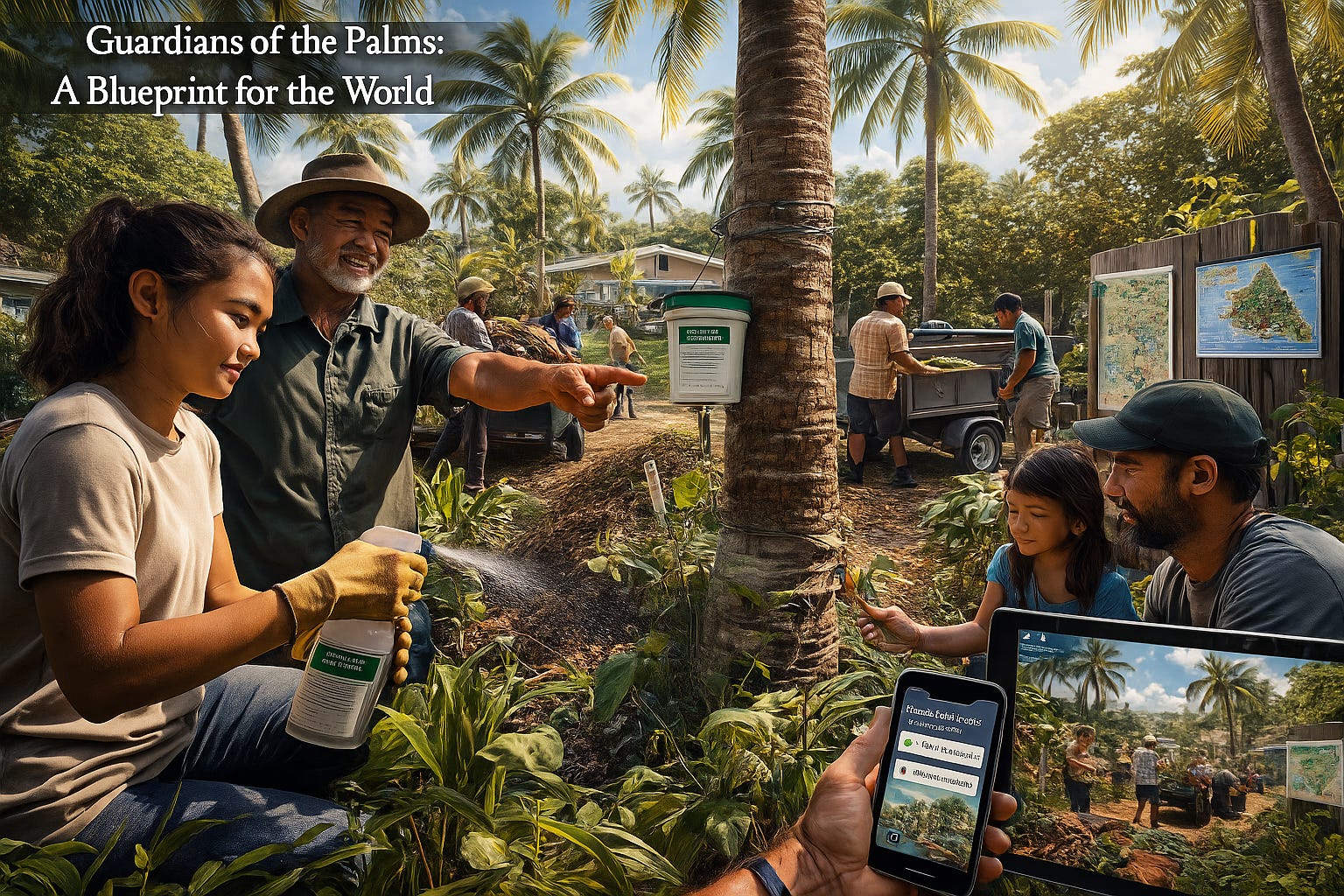
Preamble: A Big Problem Needs Practical Solutions
I should stop scrolling on social media I stumbled on this Solving this could save Hawai’i! and it piqued my interest and I had an hour to kill .
Hawai‘i is fighting a pest that threatens not just trees, but landscapes, culture, and livelihoods. The Coconut Rhinoceros Beetle (CRB) is killing palms across O‘ahu, and the destructive CRB-G strain is now resistant to the virus that once kept it in check. That resistance has raised the stakes for communities trying to protect coconut palms, Loulu species, and the ecosystems that depend on them.
The good news is that Hawai‘i does not need to wait for expensive high-tech systems or future biocontrol breakthroughs to take meaningful action. The attached analysis shows that affordable, community-powered solutions can slow spread, reduce breeding sites, and buy valuable time for longer-term scientific work. These approaches work because they distribute responsibility, expand detection coverage, and use tools people already understand or can learn quickly .
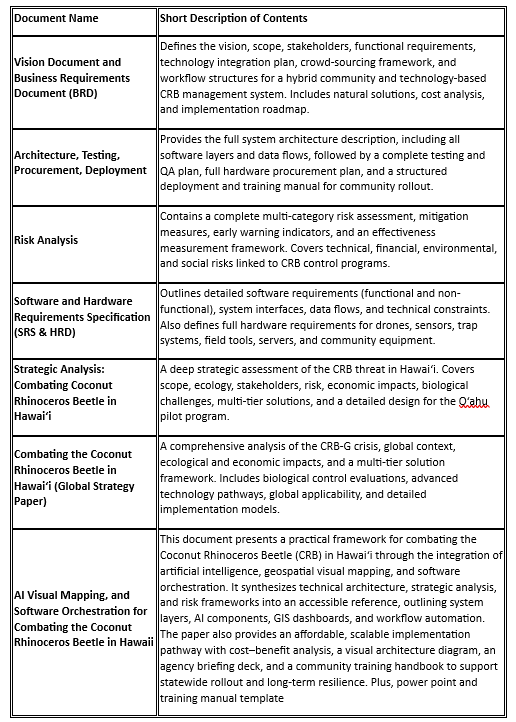
As usual my artifacts including the outline SRS for crowd and open source solutions Coconut Rhinoceros Beetle Crisis artifacts
Document Summary Table
Affordable Ways Communities Can Fight CRB
1. Community-Led Habitat Sanitation
Most CRB breeding starts in unmanaged green waste. Piles of dead fronds and decaying logs become perfect nurseries for larvae. Community cleanups, neighborhood composting programs, and coordinated green waste collection days reduce breeding sites at very low cost.
When compost piles reach 50°C, larvae die naturally, making heat management one of the cheapest and most effective methods available. This simple technique has kept some Hawai‘i facilities completely beetle-free .
2. Low-Cost Trap Networks
Pheromone bucket traps cost roughly $30 to $50, making them affordable for farms, schools, parks, and community groups. A distributed trap network helps detect new beetle activity early, track movement, and guide response teams to hotspots.
Volunteers can easily learn trap placement and weekly inspection habits, creating a living surveillance grid across neighborhoods.
3. Citizen Reporting Through Smartphones
People already notice fallen fronds and damaged palms. A simple photo, GPS tag, and upload can give agencies and researchers much-needed real-time data. The document highlights that citizen reporting dramatically expands coverage compared with agency-only monitoring. With a simple app or form, detection becomes a shared community responsibility.
4. Organic, Natural Treatments
Affordable natural repellents like neem oil or fermented plant extracts can be applied to vulnerable trees and breeding zones. These options offer communities safer, low-cost choices while avoiding the ecological risks and regulatory barriers of chemical pesticides.
5. Local Biological Allies
Nature offers helpers that cost little or nothing to deploy. Ants, birds, parasitoid wasps, and black soldier fly larvae can suppress CRB populations by attacking larvae at breeding sites. While not a perfect solution, these local predators reduce beetle pressure and complement other affordable interventions.
Why These Affordable Strategies Matter
These community-centered actions build resilience from the ground up. They are:
- Scalable, because communities can organize quickly.
- Cost-effective, with materials and tools priced for everyday use.
- Empowering, giving farmers, residents, and cultural groups direct ways to protect their landscapes.
- Flexible, working alongside future technologies, biocontrols, and state-led initiatives.
They also create the early detection and containment foundation that more advanced approaches depend on. Without this foundation, high-tech interventions would be too slow or too expensive to deploy effectively.
Conclusion: Hawai‘i Can Lead With Practical, People-Powered Innovation
The CRB threat is real, but so is the power of Hawai‘i’s communities. The attached report shows that affordable, grassroots action is not a fallback option. It is the core strategy that keeps palms standing while scientists and policymakers work on long-term solutions. By combining simple tools, local knowledge, and community collaboration, Hawai‘i can create a model of invasive species management that other islands and regions can learn from.
Protecting palms protects culture, ecosystems, and identity. And the solutions start right in our neighborhoods, with tools and techniques that are within reach for everyone.