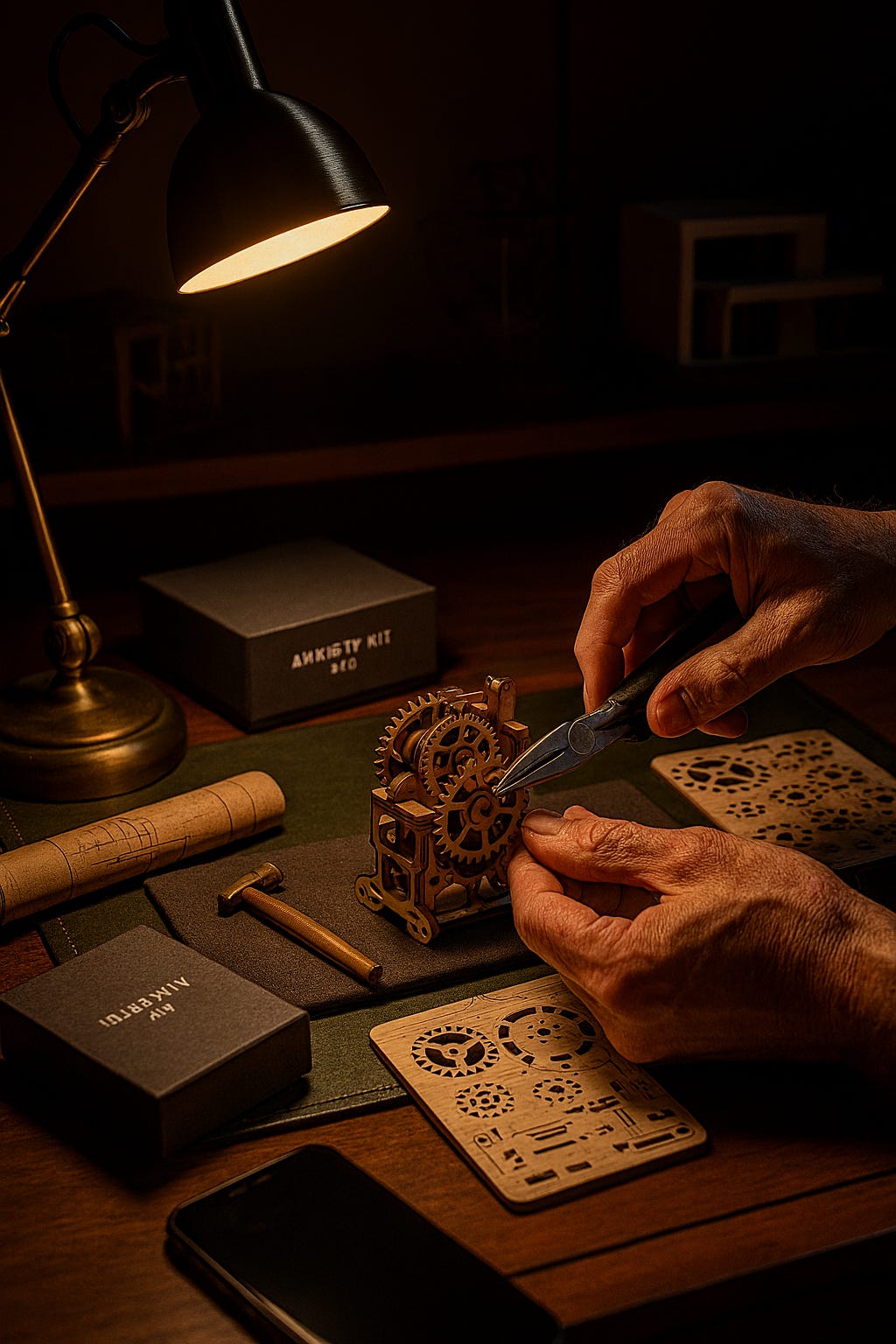
Preamble
Part 16 of a recurring series that injects emerging market intelligence and counter-intuitive business triggers designed to spark new ventures. Each post acts as a catalyst not a fully fleshed-out plan, but the seed of something bold, timely, and market-aware. Today: the intersection of global craftsmanship, wellness capitalism, and the hunger for screen-free sanctuary.
Concept Summary
The adult hobby kit market is exploding $219M in model kits alone, growing at 9% CAGR but it’s fragmented, toy-coded, and missing its wellness moment. What if the next breakout brand is not another meditation app or fitness tracker it is a globally-curated platform that turns Japanese mechanical puzzles, Ukrainian wooden automata, and Danish architectural miniatures into prescribable mindfulness tools for professionals, educators, and corporate wellness programs?
This is not about toys. It is about engineering calm, one precision-cut piece at a time.
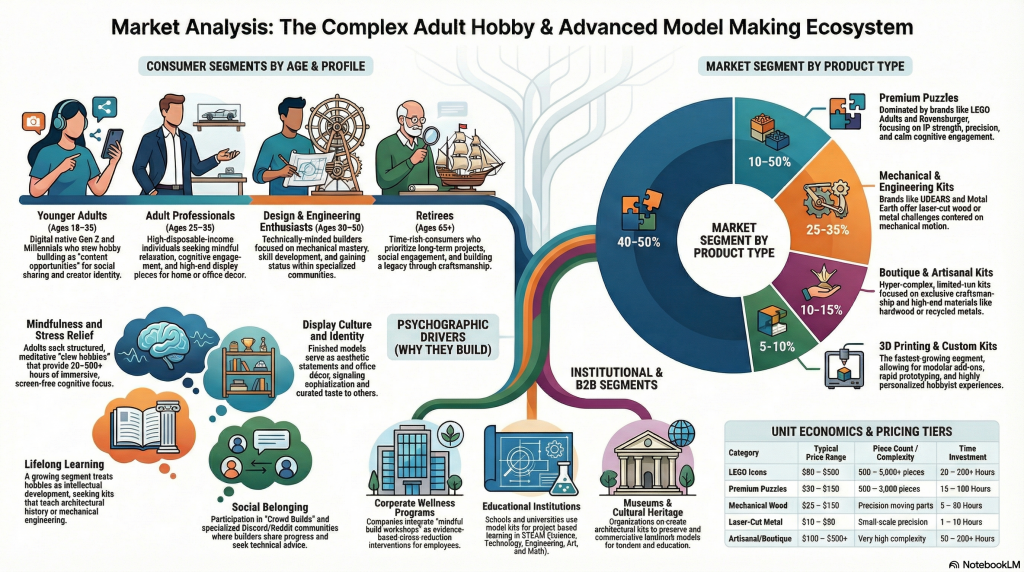
As usual there is a comprehensive survey Market Survey Analysis Complex Adult Hobbies and Advanced Model Making
Stakeholder Identification: Needs & Features
1. Burned-Out Professionals (Ages 30-55)
- Need: Structured escape from screens; cognitive engagement without decision fatigue
- Feature Demand: 20-40 hour builds, display-worthy results, “mindful session” packaging (30-min increments)
2. Educational Institutions & Makerspaces
- Need: STEAM-aligned hands-on learning tools; bulk purchasing reliability
- Feature Demand: Curriculum bundles, safety certifications, mechanical engineering teaching moments
3. Corporate Wellness Programs
- Need: Evidence-based stress reduction interventions; measurable engagement
- Feature Demand: “Build night” event kits, progress tracking, therapeutic positioning data
4. Global Artisan Manufacturers
- Need: Access to premium US market; logistics/compliance support
- Feature Demand: Low MOQs for testing, co-branding opportunities, storytelling amplification
5. Content Creators & Maker Communities
- Need: Monetizable content, exclusive access, modding ecosystems
- Feature Demand: STL files for 3D-printed upgrades, affiliate programs (5-15% commission), creator partner early access
Why Now? “The Triggers: Why This Explodes in 2025-2027”
(Subtitle: “Forces Colliding to Make This Inevitable”)
- Technology: 3D printing democratizes customization; AR instruction overlays reduce assembly friction; AI design tools enable rapid kit variations and difficulty tiers. Digital twins let buyers “test build” in VR before purchase.
- Regulatory/Institutional Shifts: Corporate wellness budgets hit $60B+ annually; schools mandate hands-on STEM; mental health parity laws expand what “therapy” looks like. Hobby kits positioned as therapeutic tools qualify for HSA/FSA spending.
- Market Conditions: LEGO Adults line generates $500M+ annually, proving premium adult kits work. Post-pandemic screen fatigue persists. “Slow hobbies” trend mirrors slow food movement—quality over speed. Camping revenue hit $44B; craft hobbies peak seasonally at 7x baseline search volume.
- Social/Cultural Momentum: Destigmatization of adult play as wellness. Creator economy (YouTube, Discord, Patreon) monetizes niche hobbies. Display culture—Instagram-optimized finished builds—transforms kits into aesthetic status symbols. “Third place” makerspaces replace dying retail.
Trigger Questions → “The Idea Sparks”
(Subtitle: “Fuel for Your Brainstorm”)
- What if health insurance covered hobby kits? Could you partner with therapists to “prescribe” mechanical puzzles for anxiety management, with clinical trials proving cortisol reduction during 30-min build sessions?
- What if you became the “Netflix of Complex Kits”? Tiered subscriptions: $49/mo gets a beginner kit + AR app access; $149/mo delivers expert-tier builds + Discord community + STL mod library. Churn drops because unfinished kits create completion pressure.
- What if maker culture went B2B? Sell “Build Night in a Box” to corporations—50-person events with facilitators, branded kits, and post-event display cases for lobbies. Charge $15K per event; scale through train-the-trainer certification.
- What if the kit WAS the instruction manual? Embed NFC chips in every piece; tap your phone to unlock AR step-by-step overlays, cultural origin stories, and mechanical engineering explainers. Gamify it: unlock achievement badges, share progress to social.
- Wildcard: What if you launched a “Build for Equity” fund—where 10% of profits fund makerspaces in underserved communities, AND customers can “sponsor a builder” (donate a kit to a school), earning tax write-offs and feel-good content for their feeds?
PESTLE Analysis (Outline Format)
Political:
- Growing STEAM education mandates benefit institutional sales
- Potential tariff risks on imported goods (China, EU)—mitigated by diversified global sourcing
Economic:
- Discretionary spending holds in upper-middle class despite recession fears
- Subscription models create revenue smoothing
- 50-65% margins on premium kits support profitability even at lower volumes
Social:
- Normalization of adult hobbies as legitimate self-care
- Generational shift: Gen Z/Millennials treat hobbies as content opportunities
- Decline of stigma around “playing” as adult
Technological:
- AR/VR reduce return rates (fewer assembly errors)
- 3D printing enables micro-batch customization
- AI recommendation engines increase basket size by 30-50%
Legal:
- Product safety compliance (CPSC, material certifications) required but manageable
- IP protection challenges with 3D-printable mods—solve via open-source licensing with attribution
Environmental:
- Sustainability as differentiator: bamboo, recycled metals, carbon-neutral shipping command 15-25% premiums
- Institutional buyers increasingly require certified eco-materials
SWOT: People, Process, Technology
Strengths:
- Curated global access unavailable elsewhere in US
- Premium positioning avoids race-to-bottom pricing
- Multi-revenue streams: product sales, subscriptions, B2B, digital content
Weaknesses:
- Logistics complexity (fragile goods, international sourcing)
- High customer acquisition cost in crowded hobby space
- Requires deep supplier relationships and QC oversight
Opportunities:
- Corporate wellness market underserved by physical products
- Creator partnerships for co-designed exclusive kits
- Educational curriculum integration creates annuity revenue
Threats:
- Amazon commodification—cheap knockoffs flood market
- LEGO/Ravensburger vertical integration threatens niche suppliers
- Economic downturn hits discretionary hobby spending first
Wildcard or Novel Ideas
“Micro-Residency Model”: What if buyers could “adopt” a global artisan—pay $20/mo to get behind-the-scenes videos, vote on next kit designs, and receive a signed limited-edition piece annually? Think Patreon meets fair-trade coffee subscriptions. Revenue: membership fees + upsell on exclusive kits.
“The Anti-Doom-Scroll Box”: A physical lock-box that holds your phone. Only opens when you complete 30 minutes of building (NFC chip in kit pieces tracks progress). Partner with screen-time-concerned parents and employers. Revenue: $99 one-time purchase + kit subscriptions.
“Build Olympics”: Annual global competition—fastest build, most creative mod, best display setup. Live-streamed on Twitch. Sponsors pay $50K+ for brand integration. Winners get cash prizes + influencer status. Revenue: sponsorships, ticket sales, merch.
Call to Action
Which layer breaks first? Do you build the logistics backbone and become the Shopify of hobby imports? Do you go full DTC wellness brand and own the customer relationship? Or do you bet on becoming the content platform—where the money is in community, not cardboard?
Your turn: What would you name this company? How would you price a “therapist-approved” kit differently than a “mechanical engineer enthusiast” kit? Drop your take below.
Appendices
Appendix 1: Expanded “Why Now?”
Technology:
- Shopify + AR plugins (e.g., Zakeke, Threekit) enable easy digital twin integration
- Blender + AI generative design tools (e.g., DALL-E for kit concepts) slash design time
- Discord/Patreon infrastructure ready-made for paid communities
Regulatory:
- 30+ US states now allow HSA/FSA spending on mental health products (including “therapeutic hobbies”)
- Department of Education grants available for STEAM equipment purchases
- Import tariff exemptions for educational goods (if classified correctly)
Market:
- LEGO Adults grew 27% YoY (2023-2024)—proof of concept at scale
- 70% of surveyed adults report “seeking screen-free activities” (IDEO Play Lab study)
- Makerspace membership up 18% annually in US metros
Social:
- #MindfulMaking TikTok tag: 47M views (and growing)
- Corporate “no-meeting Fridays” trend creates time for hobbies
- Display culture: 62% of hobbyists photograph builds for social media (Glimpse data)
Appendix 2: Novel Ideas Zone
- “The Prescription Kit”: Partner with therapists to prescribe specific kits for anxiety, ADHD, grief. Insurance reimburses $50/kit. Revenue model: B2B sales to clinics + direct insurance billing. Hook: Medical legitimacy unlocks HSA/FSA market.
- “Heritage Archive Kits”: Partner with UNESCO World Heritage sites—build exact-scale models of endangered landmarks. 10% of sales fund preservation. Revenue model: Premium pricing ($250-500/kit) + cause marketing. Hook: Educational + philanthropic positioning.
- “Mod Marketplace”: Open platform where makers upload STL files for kit upgrades (lighting, custom parts). You take 30% of sales. Revenue model: Platform fees. Hook: Turns customers into revenue-generating creators.
- Wildcard: “The Breakup Box”: Kits specifically marketed for post-breakup, post-layoff, or post-loss healing. Therapeutic build times (50-100 hours). Packaging includes journaling prompts. Revenue model: DTC at $120-180. Hook: Viral emotional marketing (”I survived my divorce one tiny screw at a time”).
Call to Action:
Which idea is 1) viable, 2) scalable, and 3) impactful? The best solutions thread all three. If you had to launch one by Q3 2025, which would it be—and why?
Wildcard Pitch
“Imagine if Peloton sold focus instead of fitness—where your ‘streak’ wasn’t workouts, but consecutive nights you picked up needle-nose pliers instead of doomscrolling. Now imagine the leaderboard isn’t fastest mile, but most intricate miniature cathedral built this month. That’s not a hobby brand. That’s a mental health platform disguised as imported wood and brass.”
Research & References
- Market Survey Analysis: Complex Adult Hobbies and Advanced Model Making (2025)
- Product & Curation Selection Criteria Framework
- Vision Document: Global Adult Hobby & Advanced Model Making (US Market)
- IDEO Play Lab Adult Play Research (2024)
- DataInsights Market: Industrial Model Design Forecast 2025-2033
- Credence Research: Model Kits for Hobbyists Market Growth Report