Preamble
In today’s rapidly evolving world, countless individuals walk around with brilliant ideas, partial solutions to problems that may not yet be visible or clearly defined. I have encountered such people; scientist-entrepreneurs, inventors, and creative technologists who sense the shape of a solution before they can articulate the problem it is meant to solve.
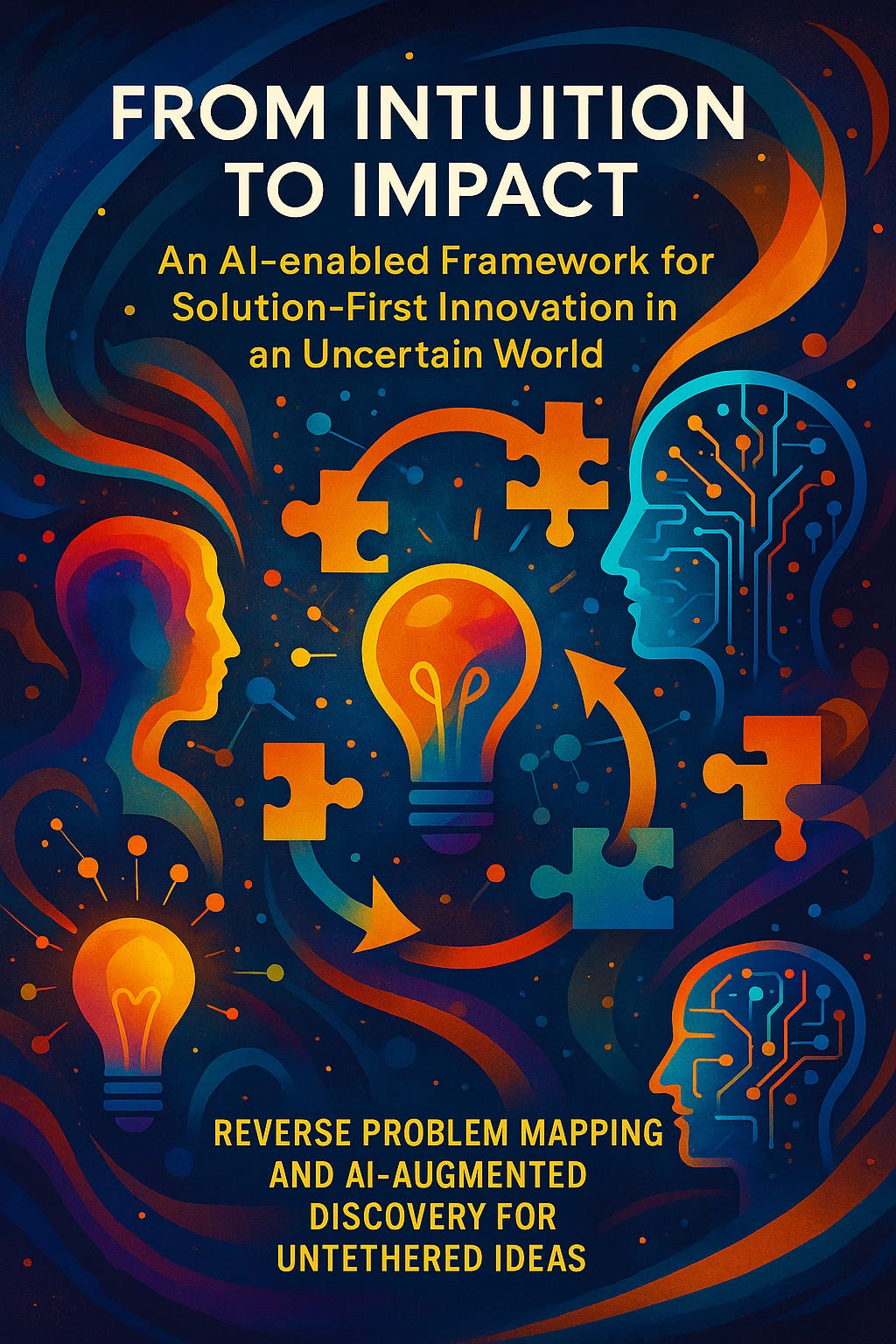
This document is an invitation to those working in the in-between: the realm where discovery, intuition, and imagination converge. As artificial intelligence reshapes how we process complexity and connect the dots, we ask a provocative question: Can we design systems digital and human that document and align innovative ideas with potential real-world problems, even when those problems are not yet fully known?
This is not just a thought experiment. It is a call to develop a flexible, AI-augmented framework for exploratory problem-solving; an approach that supports those who live in a “solution-first” mindset. It aims to relieve the cognitive burden of individuals who are always seeking to make sense of their insights and inventions. And it offers a methodology for translating emergent ideas into actionable opportunities through reverse problem mapping and continuous feedback
Introduction
My start was to create a prompt (not my best work)
An example prompt
Prompt Title: Frame working the Unknown: Building Adaptive Structures for Solution Discovery
Challenge Prompt for Visionaries
Design a meta-framework that enables individuals and teams to:
- Document raw ideas without needing to define a problem statement up front
- Analyse emergent patterns, constraints, or potential use-cases
- Frame possible solutions using interdisciplinary lenses (e.g., systems thinking, design theory, technical modelling)
- Backtrack from these potential solutions to identify foundational or hidden problems they might resolve
Objectives:
- Support the creative process when a person has a “solution in search of a problem”
- Enable non-linear analysis and cross-disciplinary interpretation
- Allow for iteration, pivoting, and recursive insight generation
Framework Should Include:
- Idea Inception Layer: A structured way to capture fragmented insights, metaphors, technologies, or novel combinations
- Pattern Recognition Toolkit: Use analogical thinking, biomimicry, systems maps, or speculative use-case modelling
- Solution Profiling Canvas: Define the attributes, implications, and potential of the idea as a partial solution
- Reverse Problem Mapping: Work backward to hypothesize the types of real-world issues that this solution could meaningfully address
- Feedback Loop: Allow insights from reverse mapping to reshape the initial solution and surface emergent opportunities
Who Should Use It: People with brilliant but untethered ideas—scientists stumbling on discoveries, technologists prototyping new materials, entrepreneurs sensing future shifts, inventors thinking ahead of market signals.
Although there is a framework output section immediately below is my interest the AI enabled matching of solution to possible problem : Reverse Problem Mapping, I discovered in my research DARPA calls it a “capability first” model it is good to know that my thinking is not new.
In my next post I will create a sample case study and link it here: Mega Evaporator
The Software requirement Document to build the AI agent is here: AI Agent for Solution Discovery
Reverse Problem Mapping
While AI acts as the scalable engine to automate and enhance the process. Together, they form a dynamic system for “solution-first” innovation.
The “AI-enabled matching of solution to possible problem” refers to the use of artificial intelligence to systematically connect innovative solutions (which may lack clearly defined problems) with potential real-world problems they could address. This is particularly relevant for scenarios where individuals or teams have creative ideas, technologies, or discoveries (“solutions”) but are unsure of the specific problems these solutions might solve. Here is a breakdown of what this looks like and how it works:
Key Components of AI-Enabled Matching
- Data Collection and Documentation
- AI systems aggregate raw ideas, fragmented insights, and solution attributes (e.g., from the Idea Inception Layer in the framework).
- Inputs include text, sketches, voice notes, or prototypes, tagged with contextual metadata (e.g., domain, constraints, inspirations).
- Pattern Recognition and Analysis
- AI uses techniques like:
- Natural Language Processing (NLP): To extract themes, analogies, and interdisciplinary connections.
- Machine Learning (ML): To identify recurring patterns or clusters among solutions (e.g., biomimicry-inspired designs, systemic behaviours).
- Graph Networks: To map relationships between solutions and known problems across domains (e.g., healthcare, logistics, sustainability).
- AI uses techniques like:
- Reverse Problem Mapping
- AI “works backward” from a solution’s attributes to hypothesize problems:
- Semantic Matching: Links solution keywords (e.g., “low-energy cooling”) to problem databases (e.g., “urban heat islands”).
- Constraint Analysis: Identifies problems where the solution’s limitations (e.g., cost, scalability) align with unmet needs.
- Scenario Simulation: Generates hypothetical use-cases (e.g., “Could this material solve battery overheating in EVs?”).
- AI “works backward” from a solution’s attributes to hypothesize problems:
- Feedback and Iteration
- AI refines matches by:
- User Feedback: Learning from human input on proposed problem-solution pairs.
- Dynamic Updating: Incorporating new data (e.g., emerging trends, failed matches) to improve future recommendations.
- AI refines matches by:
Real-World Analogues or Related Practices
These practices align with the principle of “solution-first thinking” even if they do not use the exact term Reverse Problem Mapping. While the term “Reverse Problem Mapping” may be unique or emergent, similar practices are seen in:
- Technology Transfer Offices: Finding commercial uses for university research.
- Solution Scouting in Innovation Hubs: Identifying possible markets for patented but unutilized technologies.
- Design Fiction and Speculative Design: Creating future scenarios where speculative solutions find relevance.
- DARPA’s “capability first” model: Developing capabilities before matching them to missions.
- Medical and science : data base of failed drugs and science discovery looking for a solution.
- Out of patent or copyright reuse: searching for new solves for existing or future problems
Practical Example
- Solution: A novel adhesive inspired by gecko feet (strong, reusable, non-toxic).
- AI Matching Process:
- Documentation: The adhesive’s properties are logged in the system (e.g., “biomimetic,” “works in vacuum”).
- Pattern Recognition: AI links it to problems like “medical adhesives that don’t damage skin” or “spacecraft repair materials.”
- Reverse Mapping: AI cross-references with databases of medical or aerospace challenges, suggesting:
- Problem: “Need for surgical tapes that don’t tear delicate tissues.”
- Problem: “Adhesives for zero-gravity equipment repair.”
- Feedback Loop: Users validate or reject matches, improving the AI’s accuracy.
Why This Matters
- For Innovators: Accelerates the path from idea to impact by revealing hidden applications.
- For Society: Uncovers unconventional solutions to pressing challenges (e.g., climate change, healthcare).
- For AI Development: Pushes boundaries in creative reasoning and cross-domain knowledge synthesis.
Challenges (“Conundrum”)
- Ambiguity: Solutions without clear problems require probabilistic, not deterministic, matching.
- Bias: AI may overlook novel problems if trained on historical data alone.
- Human-AI Collaboration: Balancing automated suggestions with human intuition is critical.
Frame working the Unknown: Adaptive Problem-Solution Discovery
A meta-framework for scientist-entrepreneurs, inventors, and idea-driven creatives
Framework Overview
This framework is itself a living system, designed to evolve through use and to adapt to the unique needs of each explorer. The goal is not to find the “right” answer, but to develop the capacity for continuous discovery and adaptive problem-solving in an uncertain world.
This framework transforms the traditional linear problem-solving approach into a dynamic, adaptive system that embraces uncertainty and leverages the creative potential of undefined ideas. It operates on the principle that breakthrough innovations often emerge from solutions seeking their proper problems, rather than problems seeking solutions.
Layer 1: Idea Inception Capture System
Core Components
1.1 Raw Idea Documentation
- Stream-of-Consciousness Capture: Record ideas without editing or judgment
- Multi-Modal Input: Text, sketches, voice notes, images, prototypes
- Contextual Tagging: Capture the conditions, triggers, and emotional state during ideation
- Temporal Markers: Track idea evolution over time
1.2 Idea Archaeology
- Origin Story: What sparked this idea? What were you doing/thinking/experiencing?
- Metaphor Mapping: What does this idea remind you of? What analogies come to mind?
- Constraint Documentation: What limitations or assumptions are you working within?
- Inspiration Sources: Books, conversations, observations, dreams, failures
1.3 Fragmented Insight Synthesis
- Idea Clustering: Group related fragments without forcing connections
- Emergence Tracking: Note when new insights spontaneously arise
- Cross-Pollination Log: Document when ideas from different domains collide
- Anomaly Highlighting: Identify elements that do not fit existing patterns
Tools & Templates
Idea Inception Canvas
Date/Time: _______________
Trigger Context: _______________
Core Idea (unfiltered): _______________
Key Metaphors: _______________
Emotional Response: _______________
Immediate Associations: _______________
What This Reminds Me Of: _______________
Potential Energy (1-10): _______________
Layer 2: Pattern Recognition Toolkit
2.1 Analogical Thinking Engine
Cross-Domain Pattern Mining
- Nature’s Solutions: How does biology solve similar challenges?
- Historical Precedents: What similar patterns exist in history?
- Cultural Variations: How do different cultures approach this?
- Scale Transformations: How does this work at micro/macro levels?
Pattern Recognition Methods
- Biomimicry Lens: What biological systems exhibit similar behaviours?
- Systems Archetypes: What universal patterns does this idea embody?
- Fractal Analysis: Where do you see self-similar patterns?
- Edge Case Exploration: What happens at the extremes?
2.2 Speculative Use-Case Modelling
Scenario Generation
- Best Case Scenarios: If this worked perfectly, what would happen?
- Worst Case Analysis: What could go wrong?
- Lateral Applications: What unexpected uses might emerge?
- Temporal Scenarios: How might this evolve over 1, 5, 20 years?
Stakeholder Ecosystem Mapping
- Primary Users: Who would directly interact with this?
- Secondary Effects: Who else would be impacted?
- Resistance Sources: Who might oppose this?
- Amplification Partners: Who could scale this?
2.3 Constraint-Opportunity Matrix
Constraint Analysis
- Technical Limitations: What is technically challenging?
- Economic Barriers: What is the cost/resource constraints?
- Social Factors: What cultural or behavioural barriers exist?
- Regulatory Environment: What legal/policy constraints apply?
Opportunity Identification
- Constraint Inversions: How could limitations become advantages?
- Gap Analysis: What is missing in current solutions?
- Convergence Points: Where do trends intersect?
- Disruption Potential: What established systems could this challenge?
Layer 3: Solution Profiling Canvas
3.1 Attribute Mapping
Functional Characteristics
- Core Mechanism: How does this fundamentally work?
- Key Performance Indicators: What metrics matter most?
- Scalability Factors: What enables/limits growth?
- Reliability Patterns: What makes this stable or unstable?
Systemic Properties
- Network Effects: How does value increase with adoption?
- Feedback Loops: What self-reinforcing cycles exist?
- Emergence Properties: What new behaviours arise from the system?
- Resilience Factors: How does this adapt to disruption?
3.2 Implication Analysis
Immediate Implications
- Direct Benefits: What problems does this solve?
- Unintended Consequences: What side effects might emerge?
- Resource Requirements: What does implementation require?
- Timeline Considerations: How long would deployment take?
Ripple Effects
- Industry Impact: How might this reshape markets?
- Social Implications: What behavioural changes might occur?
- Environmental Consequences: What is the ecological footprint?
- Ethical Considerations: What moral questions arise?
3.3 Potential Assessment
Innovation Potential
- Novelty Score: How original is this approach?
- Utility Assessment: How useful would this be?
- Feasibility Analysis: How achievable is this?
- Market Readiness: How prepared is the world for this?
Strategic Positioning
- Competitive Advantages: What makes this unique?
- Defensibility: How sustainable is the advantage?
- Ecosystem Fit: How well does this integrate with existing systems?
- Timing Assessment: Is this the right moment?
Layer 4: Reverse Problem Mapping
4.1 Problem Archaeology
Pain Point Excavation
- Symptom Analysis: What observable problems might this address?
- Root Cause Investigation: What deeper issues could this solve?
- Latent Needs: What unrecognized needs might this fulfil?
- Future Problems: What emerging challenges might this prevent?
Problem Categorization
- Individual Problems: Personal pain points and inefficiencies
- Organizational Challenges: Business and institutional needs
- Societal Issues: Community and cultural problems
- Global Challenges: Planetary and species-level concerns
4.2 Solution-Problem Fit Analysis
Alignment Assessment
- Direct Fit: Problems this solution obviously addresses
- Indirect Fit: Problems this could address with modification
- Emergent Fit: Problems that might arise from widespread adoption
- Transformative Fit: Problems that require reframing to see the fit
Gap Identification
- Missing Links: What connections are not obvious?
- Bridging Requirements: What would make the fit clearer?
- Pivot Opportunities: How might the solution evolve?
- Synthesis Possibilities: What other solutions might combine with this?
4.3 Market Reality Check
Demand Validation
- Evidence of Need: What data supports problem existence?
- Current Solutions: How do people solve this now?
- Frustration Indicators: Where do current, solutions fail?
- Willingness to Pay: What is the economic value of solving this?
Adoption Pathway
- Early Adopters: Who would try this first?
- Adoption Barriers: What slows down uptake?
- Network Effects: How does adoption accelerate?
- Mainstream Transition: What enables broad acceptance?
Layer 5: Adaptive Feedback Loop
5.1 Insight Integration
Learning Synthesis
- Pattern Recognition: What new patterns emerged from reverse mapping?
- Assumption Challenges: What beliefs were questioned?
- Unexpected Connections: What surprising links appeared?
- Emergent Opportunities: What new possibilities surfaced?
Solution Evolution
- Refinement Opportunities: How can the core idea improve?
- Pivot Considerations: Should the solution change direction?
- Expansion Possibilities: What related solutions might emerge?
- Combination Potential: What other ideas might merge with this?
5.2 Iteration Framework
Rapid Prototyping Cycles
- Hypothesis Formation: What specific assumptions need testing?
- Minimum Viable Experiments: What is the smallest test possible?
- Feedback Collection: How will you gather learning?
- Pivot Triggers: What results would prompt direction changes?
Recursive Development
- Nested Problem Discovery: What new problems emerge from solutions?
- Meta-Learning: What are you learning about your learning process?
- Framework Adaptation: How is your approach evolving?
- Serendipity Harvesting: How do you capture unexpected insights?
5.3 Ecosystem Expansion
Network Building
- Collaborator Identification: Who else should be involved?
- Resource Mapping: What capabilities do you need?
- Partnership Opportunities: Who might co-develop this?
- Community Building: How can you create a movement?
Knowledge Sharing
- Documentation: How do you capture learnings?
- Teaching: How do you help others use this framework?
- Mentorship: How do you guide other explorers?
- Contribution: How do you give back to the innovation ecosystem?
Implementation Guide
Phase 1: Foundation Setting (Weeks 1-2)
- Set up documentation systems
- Practice idea capture techniques
- Begin pattern recognition training
- Establish feedback loops
Phase 2: Active Exploration (Weeks 3-8)
- Regular idea capture sessions
- Pattern analysis workshops
- Solution profiling exercises
- Reverse problem mapping
Phase 3: Integration & Iteration (Weeks 9-12)
- Synthesize insights across layers
- Refine most promising ideas
- Test key assumptions
- Plan next exploration cycle
Phase 4: Ecosystem Engagement (Ongoing)
- Share learnings with community
- Seek collaboration opportunities
- Mentor other explorers
- Contribute to framework evolution
Success Metrics
Quantitative Indicators
- Number of ideas captured and processed
- Patterns identified and connections made
- Problems mapped and validated
- Iterations completed and insights gained
Qualitative Assessments
- Depth of insight and understanding
- Quality of connections and analogies
- Novelty and originality of solutions
- Alignment between solutions and problems
Outcome Measures
- Ideas that progress to development
- Problems that find meaningful solutions
- Collaborations and partnerships formed
- Knowledge contributed to the field
Framework Maintenance
Regular Reviews
- Monthly framework effectiveness assessment
- Quarterly pattern recognition updates
- Annual methodology refinement
- Continuous learning integration
Community Engagement
- Share insights with fellow explorers
- Contribute to framework evolution
- Mentor newcomers
- Build supportive networks
Personal Development
- Skill building in key areas
- Mindset cultivation for uncertainty
- Creativity and intuition enhancement
- Systems thinking development
Conclusion
In a world defined by accelerating change and nonlinear complexity, we need new tools for innovation—ones that don’t begin with problems alone, but with the intuitive flashes and half-formed insights that often precede them. The framework outlined in this document embraces the ambiguity of the unknown and empowers innovators to work productively with it. By using AI to enhance our capacity to recognize patterns, generate speculative use cases, and map solutions to latent or future problems, we shift the innovation paradigm. We move from reactive problem-solving to proactive exploration. This shift doesn’t eliminate uncertainty—it harnesses it as creative fuel.
Whether you are a lone inventor, a research team, a startup founder, or an innovation lab, this solution-first approach invites you to cultivate a mindset of continuous discovery. And with each iteration, every untethered idea becomes a potential answer to the world’s yet-unspoken questions.