Preamble
The Aria.org (Home) Nature Computes Better opportunity reimagines what computation could become when we look to nature not just for metaphors, but for deep structural insight. Instead of brute-force silicon-based architectures, what if our next-generation compute paradigms were grown, not manufactured—emergent, not engineered?
Backed by ARIA’s ambitious goals Nature Computes Better—including reducing the cost of AI hardware by more than 1000x—this Ideas Trigger contributes to an ongoing exploration of how we might step beyond current compute limits through principles borrowed from life itself. They have allocated some funds Nature Computes Better opportunity seeds look at it and contribute your ideas.
As an ideas broker at the initial call, I provided my feedback here is the updated table with my responses included: Nature Computes Better Response . As usual I performed an up-to-date review: Nature Computes Review 2025
📌 The Idea
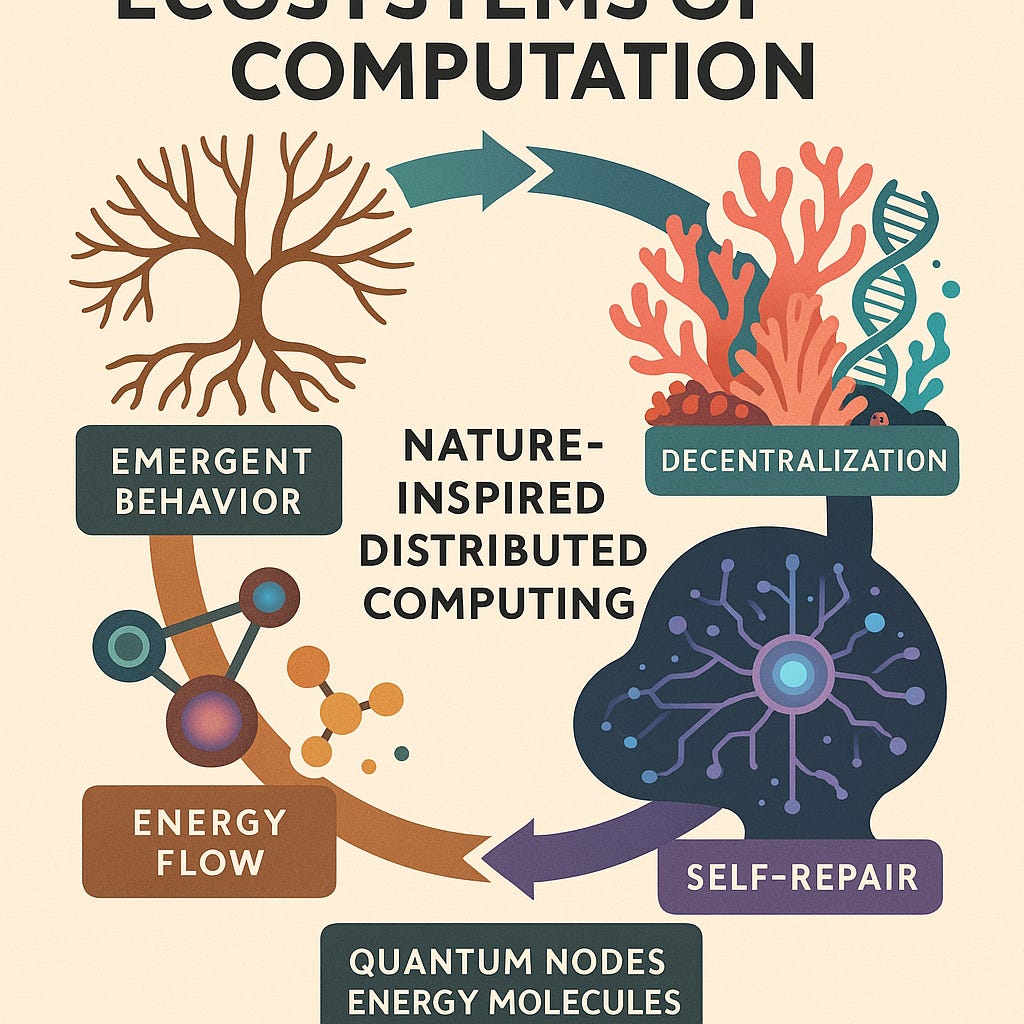
Title: Ecosystems of Computation: Learning from Nature’s Distributed Intelligence
Can we shift away from centralized processing by modelling computation on the distributed, resilient, and self-regulating systems found in ecosystems—from fungal networks and coral reefs to microbial colonies and plant vascular systems?
📉 Back-of-the-Envelope Thinking
Nature does not compute like we do. It does not run algorithms line-by-line on a rigid substrate. Instead, it adapts, optimizes, repairs, and evolves without ever stopping.
Consider fungal mycelium networks that route nutrients across miles with no central controller. Or coral ecosystems that maintain biochemical stability despite extreme environmental flux. These biological systems are computational in the sense that they solve resource allocation, sensing, and adaptation problems in real time, efficiently and locally.
What if we treated entire ecosystems as blueprints for the future of computation?
🔬 What Might Be Possible
- AI systems inspired by swarm dynamics, quorum sensing, and mycelial communication, enabling adaptive control and decentralised optimisation.
- Hardware that mimics adaptive biological resource routing to minimize latency and energy loss.
- Hybrid materials that self-assemble or self-repair based on protein folding or DNA origami, enhancing hardware longevity.
- Quantum processors modelled on photosynthesis or neural energy transfer to improve coherence and signal retention.
- A reframing of computation as metabolic: a system where energy in equals cognitive function out, without rigid circuits.
🛠️ Thing to consider: Novel Ideas and Solutions in Nature Computes Better in no order of preference:
· AI-Enabled Knowledge Database: A dynamic, open-source platform aggregating global research on nature-inspired computing, equipped with ML tools for analysis, gap detection, and technology foresight.
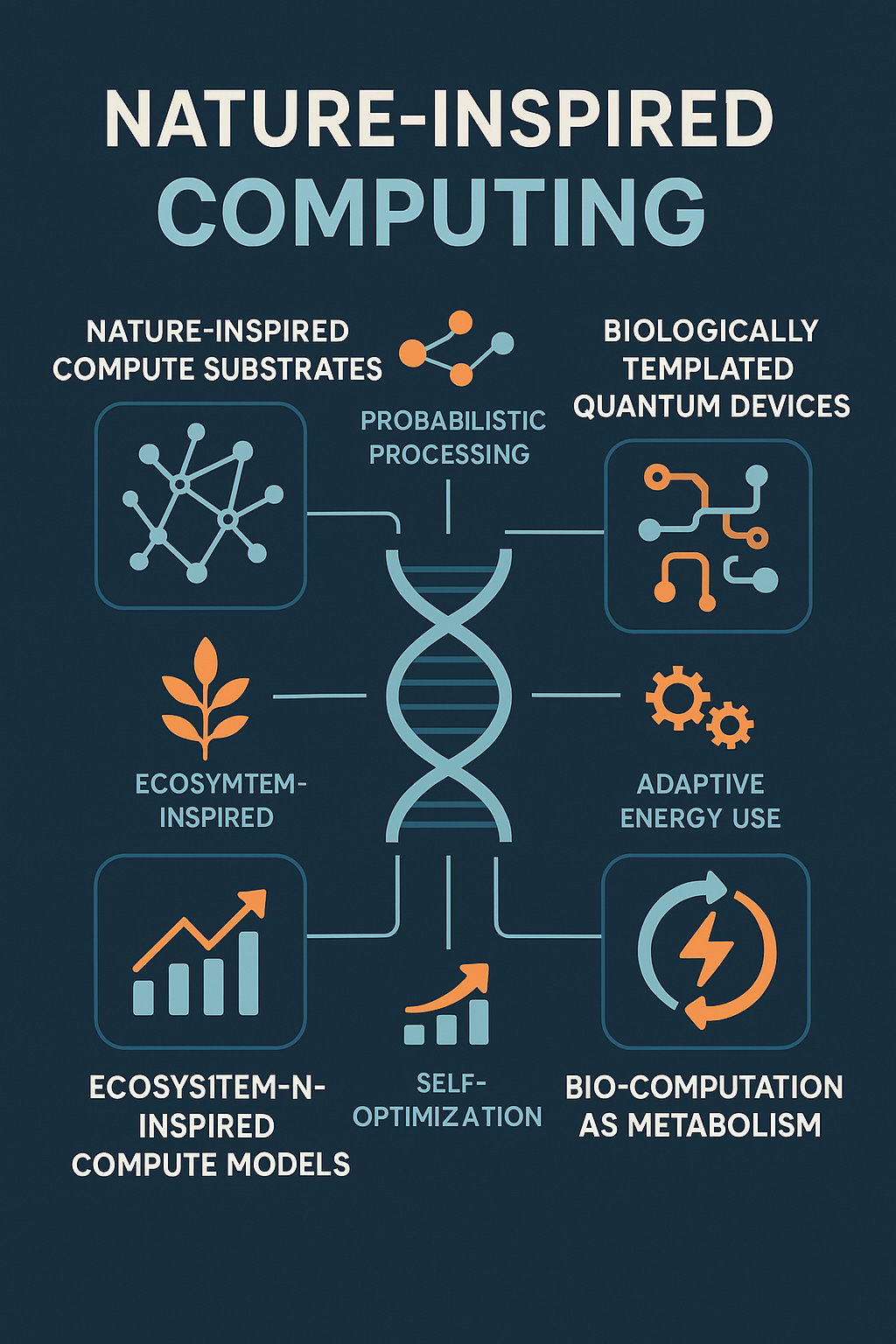
· Nature-Inspired Compute Substrates: New classes of hardware inspired by biological systems like fungal networks, using distributed and adaptive architectures.
· Biologically Templated Quantum Devices: Devices leveraging structures from photosynthesis, proteins, or DNA to enhance coherence, energy efficiency, and quantum error resilience.
· Ecosystem-Inspired Compute Models: Computing systems modeled on biological ecosystems (e.g., nutrient routing in mycelium), enabling self-optimization and fault tolerance.
· Bio-Computation as Metabolism: A paradigm where computation is framed as energy regulation—computation becomes an emergent property of adaptive energy use, like in cells.
· DNA-Templated Quantum Circuits : Using DNA self-assembly to fabricate precise and scalable quantum circuitry.
· Quantum Genetic Algorithms: Evolutionary algorithms implemented via quantum states, enabling rapid solution search via superposition and interference.
· Quantum Swarm Intelligence: Translating ant/bee/swarm behaviors into quantum-enhanced pathfinding, resource allocation, and decision-making systems.
· Metabolic Quantum Batteries: Bio-inspired quantum energy storage units modeled after ATP cycles in cells.
· Living Quantum Computers: Hybrid systems integrating genetically engineered biological systems capable of performing quantum computations.
· Neuromorphic-Quantum Hybrids: Merging brain-like spiking networks with quantum logic for context-sensitive learning and inference.
· Quantum-Coherence-Inspired Hardware Design: Hardware that mimics natural systems (e.g., photosynthetic complexes) that preserve coherence in noisy, room-temperature environments.
· Fungal Network-Inspired Routing Algorithms: Decentralized routing logic based on mycelial networks for use in AI, logistics, or telecommunications.
· AI-Augmented Tech Gap Analysis Framework : A structured AI-supported methodology to map the distance between future computing visions and present capabilities, identifying leverage points and bottlenecks.
· Cross-Disciplinary Knowledge Commons: A collaboratively built database connecting biology, physics, AI, and materials science to accelerate nature-inspired breakthroughs.
· Resilience from Biological Error Correction : Learning from DNA repair and immune systems to improve fault tolerance in future AI and quantum systems.
· Programmable Molecular Electronics : Devices that use principles from molecular biology (e.g., protein conformations) to switch states, replacing binary transistor logic.
· Self-Assembling Quantum Architectures : Use of bio-derived templates (DNA origami, protein scaffolds) to build scalable quantum systems without traditional lithography.
· Quantum Evolutionary Pressure Algorithms: Dynamic quantum systems that evolve their own structure or algorithm based on performance feedback, mirroring biological evolution.
· Nature-Inspired Compute Roadmapping: Forecasting and planning model that traces historical precedents (precursors) and speculative future pathways for biomimetic computing tech.
· A Bio-Inspired Compute Fabric: A low-energy, scalable, distributed prototype compute substrate modelled after biological ecosystems—specifically slime mould decision-making or fungal networks. It would support probabilistic processing and adaptive routing, potentially replacing or augmenting current chip-based architectures.
🧭 Notes + Alignment
- Directly aligned with ARIA’s Nature Computes Better challenge to leap beyond legacy compute models.
- Complements current funded projects focused on bio-computational logic, probabilistic processors, and non-silicon substrates.
- Positions computation as an emergent property of complex, adaptive systems—not a hardwired function.
- Potentially alleviates geopolitical and manufacturing dependencies on advanced silicon fabrication.
📚 Further Reading
- ARIA’s Programme Overview Nature Computes Better
- Scaling Compute Nature Scaling Compute
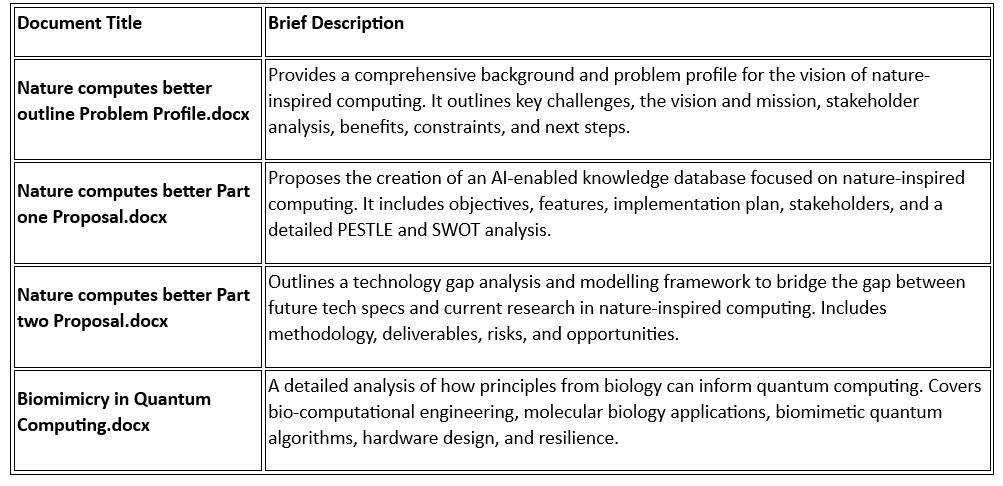
- Computes Better Part One & Two Proposals Biomimicry in Quantum ComputingNature Computes Better Response
- The biomimicry Institute Home – The Biomimicry Institute
💬 What Do You Think?
Could ecosystems—not just neurons—be the next inspiration for scalable, resilient, and energy-efficient AI?
Leave a comment, share this trigger, or pitch your take on what kind of “living architecture” might become tomorrow’s computing infrastructure to ARIA