Preamble
Part 12 of a recurring series that injects emerging tech strategy and concrete idea triggers to spark new ventures. In this post we examine, Phytomining, or Agromining and the possible intersection with Ecological Remediation. Each post is a catalyst, not a full plan. I hope it triggers exploration or thoughts. Use it to shape further research , a pilot, a pitch, or a partnership.
Concept Summary
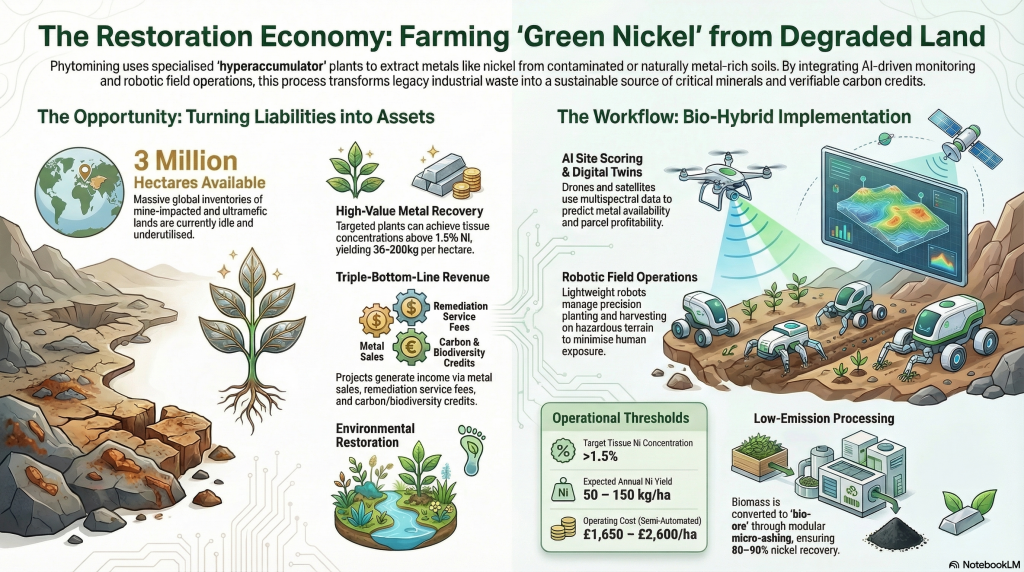
Degraded, metal rich land is a cost and a liability. What if the next profitable mine is a field of hyperaccumulator plants that pull nickel and other metals from soil while restoring ecosystems? You sell recovered metals, remediation services, and verifiable impact data. You run AI guided screening, semi-autonomous field ops, and tight MRV.
As usual Analysis and vision artifacts: Industry analysis and Vision
- Hybrid Vision and Business Case
Short description, A strategy and business case for a biohybrid metal recovery platform. It covers nickel focused phytomining, biohybrid water and soil filters, AI and robotics for field operations, MRV, stakeholder needs, use cases, features, and a phased scale plan. - Phytomining Industry Analysis, Vision Document for Sustainable Metal Recovery
Short description, An industry level vision and analysis of phytomining. It details market drivers, yields and viability thresholds, stakeholder maps, product features and roadmaps, financial models, PESTLE and SWOT, risks, and multi year scenarios for scale.
Why Now? The Triggers
Technology
- AI models to score parcels and forecast uptake.
- Robotics for planting, weeding, and harvesting in hazardous terrain.
- Low emission micro ashing with inline analytics.
- Digital twins with MRV that regulators and financiers can trust.
Regulatory shifts
- Closure liabilities push miners and municipalities to seek lower cost, auditable remediation.
- National critical minerals policies raise interest in domestic and allied supply.
- Carbon and biodiversity markets add revenue layers to nature based projects.
Market conditions
- Nickel demand tied to EVs. Volatile prices create windows for differentiated, green supply.
- Millions of hectares of ultramafic and mine impacted lands sit idle.
- Field proven tissue concentrations above 1.5 percent Ni and yields in the 36 to 200 kg Ni per hectare per year range are now on record.
Social and cultural momentum
- Communities want visible health and habitat improvements, not just paperwork.
- ESG buyers will pay attention to traceable bio ore with third party verified MRV.
Trigger Questions
- What if your remediation unit economics work first, and metal sales plus credits turn good projects into great ones? Build breakeven on remediation fees, then stack metals and carbon to raise IRR.
- How would you productize MRV as a service for land banks and mine closure teams, even before you run the first harvest? Offer parcel scoring, uptake forecasts, and verifier ready ledgers.
- What is your native species portfolio for each target country, and how do you prove no invasive risk while keeping yields high? Plan seed sourcing, density, and co crops.
- Could you create a buyers club for green nickel salts that locks price floors in return for traceability and public MRV data?
Wildcard
What if Patagonia built the Tesla of remediation, a visible, audited, nature first operation that sells metals, data, and restoration stories to the same customer set?
Call to Action
Pick one region with ultramafic soils and active closure pressure. Secure two 10 hectare pilots, a hydromet partner, and an ESG offtaker for samples. Publish MRV within 12 months. Send your spin, and share one trigger you will test first.
Appendices
Appendix 1: Expanded Why Now
Technology
- Site scoring: satellite and drone multispectral, thermal, and geology layers, trained on success and failure sets.
- Field automation: lightweight tracked robots for planting, weeding, and harvest, with teleoperation fallback.
- Processing: modular micro asher with scrubbers, sealed ash handling, 80 to 90 percent Ni recovery via sulfuric leach.
- MRV: chain of custody for biomass and ash, dashboards for soil drawdown, water, and biodiversity, verifier exports.
Regulatory
- Early regulator engagement, sandbox framing, and open MRV reduce approval friction.
- Use existing waste and invasive species rules, and prefer native accumulators.
Market
- Base case viability at or above 100 kg Ni per hectare per year, or with stacked revenues that include remediation fees and carbon.
- Nickel price swings, 15,000 to 50,000 dollars per tonne historically, reward optionality.
Social
- Health gains from dust reduction and vegetative cover.
- Local jobs with low exposure robotics and clear exclusion zones.
Appendix 2: Novel Ideas Zone
BRaaS, Bioremediation as a Service
Pitch: A cloud platform that runs monitoring, robotic interventions, and credit issuance for contaminated parcels.
Revenue model: Annual subscription per hectare plus success fees.
Hook: Turn capex into opex with verifiable outcomes.
Floating Metal Wetlands
Pitch: Raft modules with root mat cassettes that strip metals from pit lakes and channels, swapped by amphibious robots.
Revenue model: Hardware as a service plus remediation SLAs.
Hook: Safe harvest from water bodies with minimal human exposure.
Green Nickel Buyers Club
Pitch: Aggregate bio derived nickel salts with provenance data for ESG hungry cathode producers.
Revenue model: Offtake fees, price floor options, and data access tiers.
Hook: “Grown not mined,” with audit trails.
MRV Marketplace
Pitch: Sell parcel scoring, digital twins, and verifier ready reports to miners, municipalities, and land banks.
Revenue model: SaaS per parcel, plus integration fees.
Hook: Many customers need the data before they buy the operations.
SynBio Boosters, Contained First
Pitch: Use engineered microbial consortia or chelators in contained systems to raise uptake, then step out under biosafety frameworks.
Revenue model: Licensing and consumables.
Hook: 2 to 3x tissue metal without field release at the start.
Wildcard Pitch
Imagine if qualifying a phytomining site worked like a credit score app. Upload your soil tests and satellite tiles. Get a score, a projected kg Ni per hectare per year, and a one click path to pilots, offtakers, and credits.
Field Notes You Can Use
- Start with nickel on ultramafic soils and tailings. Target tissue Ni of 1.5 to 2.5 percent using Odontarrhena and Alyssum species. Plan two to three harvests per year in suitable climates.
- Design units at 10 to 300 hectares per region. Use modular playbooks for species selection, density, and local rules.
- Stack three revenues. Metals, remediation contracts with bonuses, and MRV subscriptions or credits.
- Publish your field book yearly. Yields, drawdown, biodiversity, and incidents at zero. This builds trust and shortens sales.
Your move
Choose your first trigger. Site scoring, MRV as a service, or buyers club. Draft the one page pilot brief and send it to the three partners you need to start.