Preamble
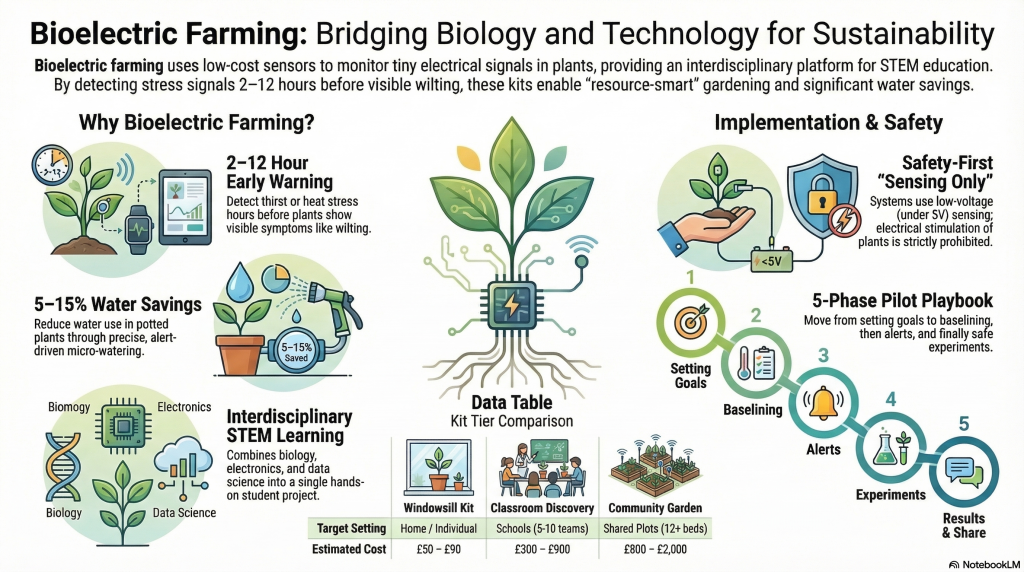
Bioelectric farming lets people see, hear, and analyse tiny electrical signals from plants. The attached market work shows a UK opportunity of £45 to £75 million per year across schools, community gardens, makerspaces, and hobbyists, with realistic year one targets of £2 to £4 million through focused go to market. Starter builds come in under £100, which fits tight education budgets and widens access for families. Classroom and community kits teach biology, electronics, and data, and they can also save water. Pilots routinely catch water stress 2 to 12 hours before visible wilt, and cut potted plant water use by 5 to 15 percent when people act on alerts. The attachments include safe hardware lists, lesson-friendly routines, and a simple process you can run in any setting.
As usual some artifacts: Bioelectric Farming Education and Recreation Business Plan and Implementation Guide
Bioelectric Farming Education and Recreation, Business Plan and Implementation Guide
Short summary, A practical plan for hands-on kits, workshops, and community installations that teach plant bioelectric signals and smart gardening. It defines target customers, evidence based activities, pilot steps, business model, and safety ready classroom routines.
Executive Summary
The bioelectric farming education sector represents a high-potential, early-stage opportunity at the intersection of STEM education, climate resilience, and hands-on learning. The opportunites might be less obvious for other stakeholders such as hobbyists. With starter costs under £100 and alignment to multiple educational and sustainability trends, this market offers attractive unit economics and mission-driven positioning. However, success requires navigating regulatory uncertainty, building educator confidence, and establishing proof points before scaling.
📊 MARKET ANALYSIS
Market Sizing & Segmentation
Primary Target Markets (UK-focused, expandable globally):
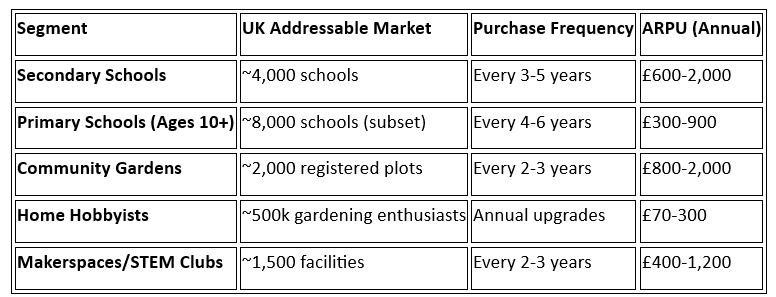
Total Addressable Market (TAM): £45-75M annually (UK only)
Serviceable Addressable Market (SAM): £12-20M in first 3 years (early adopters)
Serviceable Obtainable Market (SOM): £2-4M in Year 1 with focused go-to-market
Demand Drivers & Adoption Catalysts
Educational Trends Supporting Adoption:
- STEM Skills Gap Crisis: UK government pushing hands-on science (Royal Society reports 40% of secondary schools struggle to recruit physics/chemistry teachers—interdisciplinary kits reduce dependency)
- Climate Curriculum Mandates: England’s new sustainability curriculum (2024) requires practical environmental projects—bioelectric farming provides quantifiable data on resource efficiency
- Project-Based Learning (PBL) Movement: 73% of educators report increased effectiveness with experiential learning vs. traditional lectures (Edutopia 2024 survey)
- Post-Pandemic Lab Gaps: Many schools lost lab equipment/expertise during closures—low-cost, flexible kits enable recovery without major capital investment
Sustainability & Resilience Trends:
- Water Scarcity Awareness: 2022 UK droughts raised public consciousness; early detection systems resonate with “do more with less” messaging
- Urban Agriculture Growth: 67% increase in community garden waitlists since 2020 (National Allotment Society data)
- Circular Economy Education: Microbial fuel cells demonstrate energy-from-waste principles aligned with Net Zero targets
Recreational/Hobbyist Trends:
- Maker Movement Maturation: 2.3M active Arduino users globally; existing electronics skills reduce learning curve
- Citizen Science Boom: Platforms like Zooniverse show 500k+ volunteers willing to contribute data—potential network effects
- Premium Home Gardening: £2.4B UK market growing 8% annually; tech-augmented gardening represents natural premium segment
🧠 STRATEGIC ANALYSIS
PESTLE Analysis
Political:
- ✅ Opportunity: Government STEM funding (£300M Levelling Up fund includes education tech); potential grants for schools
- ⚠️ Risk: Post-Brexit regulatory divergence on electronics/safety standards; need separate CE/UKCA compliance paths
- ✅ Opportunity: Local authority sustainability mandates creating pull for community garden upgrades
Economic:
- ✅ Opportunity: Cost-effective vs. traditional lab equipment (bioelectric kit £600 vs. £5k+ for traditional plant physiology setup)
- ⚠️ Risk: School budget constraints—need to position as multi-year curriculum investment, not disposable consumable
- ✅ Opportunity: Inflation driving “grow your own” movement; efficiency tools gain traction
Social:
- ✅ Opportunity: 82% of parents want more practical STEM for children (NESTA 2023 survey)
- ✅ Opportunity: Climate anxiety among youth (75% of 16-25 year-olds report concern)—provides tangible action outlet
- ⚠️ Risk: Initial “weird science” perception—requires trusted endorsements and proof points
Technological:
- ✅ Opportunity: Commoditization of IoT components (ESP32 now <£5); economics improve yearly
- ✅ Opportunity: Cloud platforms (Grafana, ThingSpeak) free tiers enable low-friction data visualization
- ⚠️ Risk: Rapid obsolescence of specific components—need modular, upgradeable design philosophy
Legal:
- ⚠️ Risk: Electrical safety regulations (BS 7671) for educational settings require clear documentation/compliance
- ⚠️ Risk: GDPR implications if student data collected—must design privacy-first systems
- ✅ Opportunity: No novel regulatory category (uses existing sensor/education classifications)
Environmental:
- ✅ Opportunity: Demonstrable water savings (5-15%) support sustainability credentials
- ✅ Opportunity: E-waste reduction narrative (rechargeable batteries, durable electrodes vs. disposable sensors)
- ⚠️ Risk: Battery disposal and electrode materials require responsible sourcing/end-of-life planning
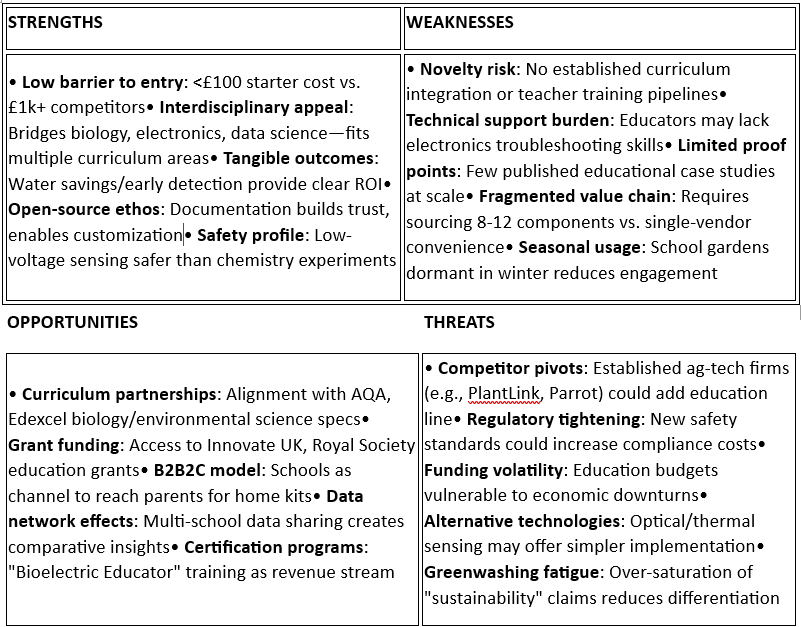
SWOT Analysis
Porter’s Five Forces
1. Threat of New Entrants: MODERATE
- Low capital requirements (£10-50k for initial inventory/marketing)
- BUT: Requires rare combination of agriculture, electronics, and education expertise
- Network effects from data sharing create modest moat over time
- Safety certifications (UKCA, educational compliance) add 6-12 month barrier
2. Bargaining Power of Suppliers: LOW
- Components (ESP32, sensors, electrodes) available from 10+ global distributors (Digi-Key, Mouser, RS Components)
- No proprietary dependencies—design uses commodity parts intentionally
- Carbon felt and AgCl electrodes have established supply chains (medical/industrial)
3. Bargaining Power of Buyers: MODERATE-HIGH
- Schools: Highly price-sensitive, long decision cycles (6-18 months), need extensive validation
- Hobbyists: Low switching costs, expect DIY-friendly documentation
- Community gardens: Often volunteer-led, require grant funding, need turnkey solutions
- Differentiation through curriculum alignment and support reduces buyer power
4. Threat of Substitutes: MODERATE
- Traditional methods: Visual inspection free but less precise
- Soil moisture sensors alone: Simpler (£20-40) but miss broader stress signals
- Thermal cameras: Effective for heat stress but £300+ and single-use case
- Bioelectric approach’s multi-signal advantage justifies premium IF education value clear
5. Competitive Rivalry: LOW-MODERATE
- Educational science kits: Broad market (£50M+ UK) but few bioelectric-specific players
- Ag-tech incumbents: Focus on commercial farms (PlantLink, CropX)—don’t serve education
- Maker kits: Arduino starter sets abundant but lack agriculture context
- Current rivalry mostly indirect—opportunity for category creation vs. displacement
Overall Attractiveness: FAVORABLE
Low rivalry and supplier power offset moderate buyer power and substitute threats. Success depends on execution, not structural disadvantages.
💼 BUSINESS CASE DEVELOPMENT
Value Proposition by Segment
Educational Institutions (Primary Customer):
Core Promise: “Turn every student into a data scientist and steward—with one kit, three disciplines, and real-world impact.”
- Curriculum Fit: Maps to Biology (plant physiology, ecosystems), Physics (electricity, sensors), Computer Science (data logging, coding), Geography (sustainability)
- Engagement: 78% of teachers report hands-on projects increase participation vs. lectures (source: Wellcome Trust STEM survey)
- Cost-Effectiveness: £60-120 per student (assuming 5-student team, 3-year kit life) vs. £200+ for traditional consumable-based experiments
- Measurable Outcomes: Water savings data, plant survival rates, student competency in electronics/data analysis
Recreational Users/Hobbyists:
Core Promise: “Speak plant—detect stress before damage, save resources, and join a community of bio-hackers.”
- Cost Savings: 10% water reduction = £15-30/year for keen gardener; kit pays for itself in 2-4 years
- Skill Development: Entry point to IoT, data science, and biology without formal training
- Community Status: Early adopter positioning; shareable results on social platforms
Community Gardens/Urban Ag:
Core Promise: “Resilience through data—optimize shared resources, prove impact to funders, and teach the neighborhood.”
- Resource Optimization: 12-bed community garden saving 500-800L water/month demonstrates stewardship
- Grant Attraction: Quantified sustainability metrics strengthen funding applications (£2k-10k grants typical)
- Educational Outreach: Demonstration sites for schools, youth groups, local councils
Quantified Impact & ROI
Water Savings (Conservative Model):
- Baseline: 10L/week for potted tomato plant under manual watering
- Bioelectric optimization: 5-1
Action plan
- Define the offer and outcomes, 2 weeks.
Choose three products, a windowsill starter, a classroom discovery kit, and a community garden kit. Set measurable outcomes, lead time to stress, water saved, and student artifacts. Use low voltage sensing only for education and amateur settings. - Build ten pilot kits and three sites, month 1.
Assemble ESP32 based sensing nodes with Ag or AgCl clips, a high impedance front end, soil moisture, and temp and humidity. Run one school, one community garden, and one retail demo. Keep BOMs within the ranges in the attachments. - Run the five phase pilot playbook, weeks 2 to 6.
Baseline for 3 to 5 days. Turn on alerts that combine plant features and soil moisture. Take only small actions, for example 5 percent of pot volume when alerts persist for 30 minutes. Log lead time, recovery, and water saved. - Package curriculum and safety, month 2.
Publish one period labs, roles for teams, and assessment rubrics. Enclose boards, keep everything at 5 V, label nodes, and use clear stop rules. Add a microbial fuel cell demo and a plant music mode for engagement. - Stand up simple data and dashboards, month 2.
Ship firmware that buffers and features at the edge. Use MQTT into a laptop or Pi with InfluxDB and Grafana for class and garden dashboards. Provide CSV export for schools. - Go to market with two channels, months 3 to 6.
Education, sell classroom bundles with teacher training and a three year plan. Community, sell garden installations with signage and a weekend music station. Price at 2 to 3 times BOM depending on service level. Use the segment sizes and ARPU bands from the market work to set targets.
Conclusion
You can create a visible, measurable learning experience that also improves garden practice. The market is large enough to support a focused venture, and the hardware and software are mature and low cost. The attachments give you everything you need to run credible pilots, publish results, and scale with partners in education and community channels. Keep safety simple, measure what matters, and lead with proof that people can see.