Preamble
Part 11 of a recurring series: This post injects emerging agricultural technologies and radical business model triggers designed to spark new ventures. Each post in the series acts as a catalyst—not a fully fleshed-out plan, but the seed of something bold, timely, and market-aware.
Concept Summary
Plants generate electricity. Soil microbes generate electricity. We’ve been walking past free diagnostic signals and power sources for centuries. What if the next unicorn isn’t building more sensors, it’s making the farm itself the sensor?
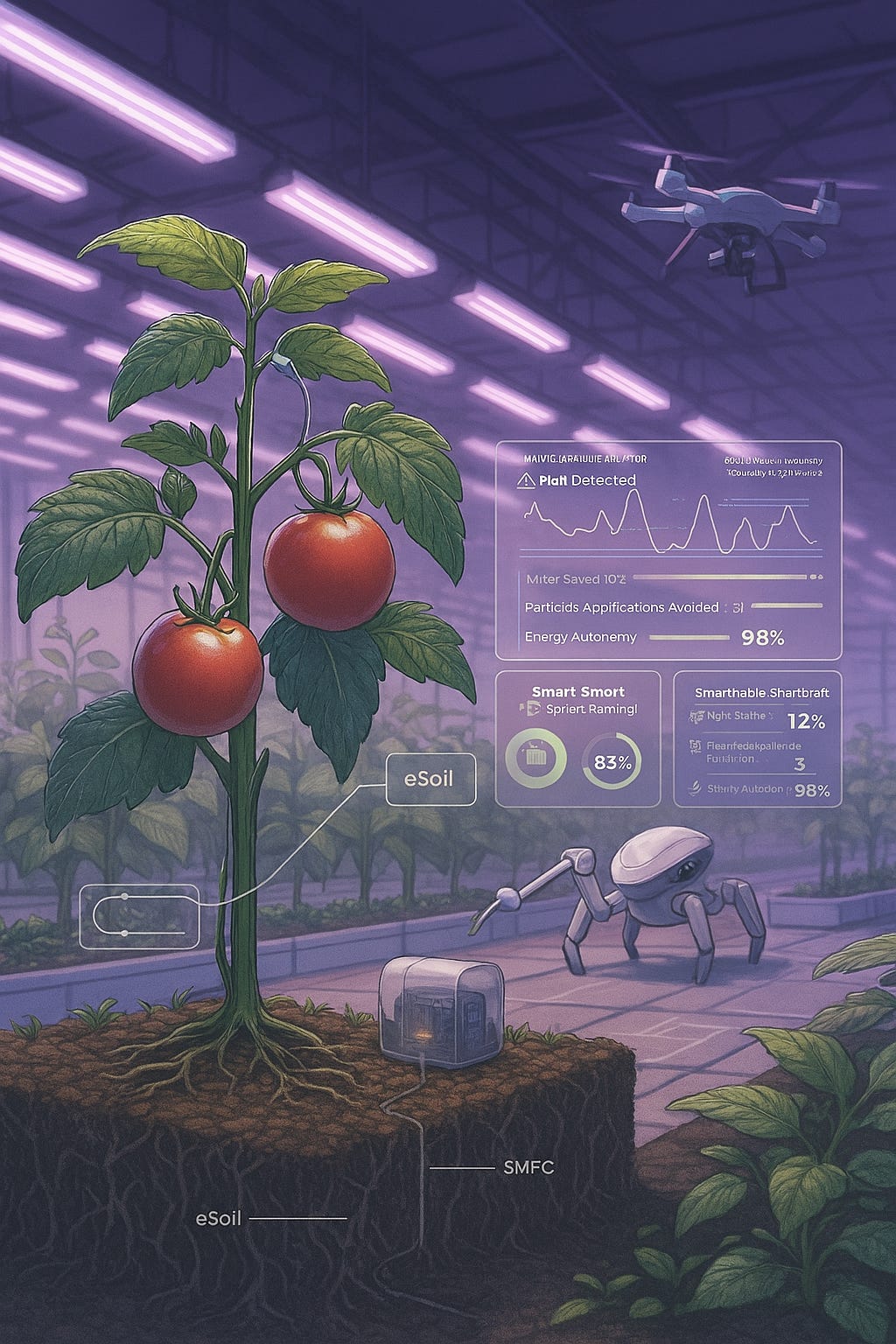
Bioelectric farming treats voltage fluctuations in leaves, stems, and soil as real-time stress indicators and control surfaces. You catch nitrogen deficiency 12+ hours before visual symptoms. You power remote sensors using electrons harvested from dirt. You nudge germination and rooting with microcurrents no chemicals required.
The tech is peer-reviewed. The market timing is perfect. The business models are wide open.
The supporting artifacts: Bioelectric farming : Overview Document and Vision (business case)
Here are clear names and short summaries for the attached documents.
- Bioelectric farming, signals, growth, and a roadmap to scale
Short summary, An applied overview of bioelectric farming that explains plant electrophysiology, soil and rhizosphere bioelectrochemistry, and low power microbial fuel cells. It maps current uses in greenhouses and irrigated crops, evidence from peer reviewed studies, early vendor activity, scale paths, and practical playbooks for pilots and MRV. - Bioelectric Farming, Vision & Business Case 2025
Short summary, A business focused plan for a plant driven sensing and control stack. It defines the product concept, core features, target beachheads, stakeholder needs, differentiation, go to market, ROI targets, risks, and a 90 day pilot plan, with acceptance benchmarks for scale.
Why Now? “The Triggers: Why This Explodes in 2025-2027” ( “Forces Colliding to Make This Inevitable”)
- Technology: Deep learning models now detect stress from raw plant voltages with 88-96% accuracy. Ultra-low-power LoRaWAN radios run for years on milliwatts. Microbial fuel cells deliver 900+ days of continuous operation in production trials.
- Regulatory Shifts: Water-use mandates tightening globally. EU pesticide reduction targets (50% by 2030) demand auditable precision. Carbon credit programs need verifiable MRV data—bioelectric sensors generate compliance logs by default.
- Market Conditions: Precision farming market at $10.5B (2024) with double-digit CAGR. Agriculture sensor market growing 11-12% annually. Controlled environment ag exploding from $55-93B (2025) toward $140-507B (2030-2034). Agrifoodtech investment stabilizing at $16B after correction—pilots need tight ROI, which this delivers.
- Social/Cultural Momentum: Climate volatility makes early warnings worth their weight in gold. Growers face labor shortages—automation that reduces scouting time and false positives wins. Battery waste in remote sensors becoming an ESG liability; soil-powered nodes solve it elegantly.
Bioelectric Farming: Real-Time Plant Signals as the Next Precision Agriculture Frontier
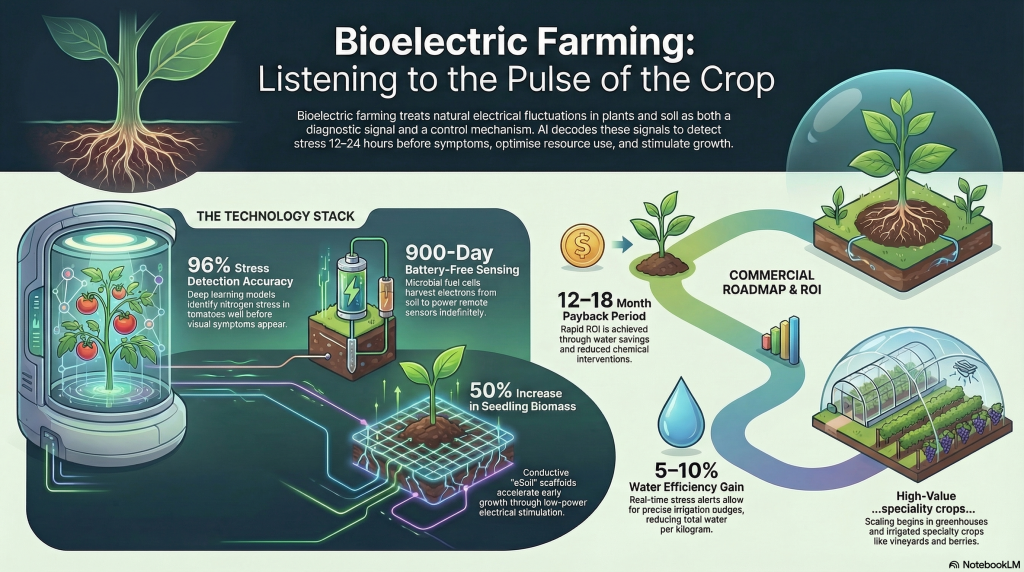
Bioelectric farming uses naturally occurring electrical signals from plants, soil, and microbes as both diagnostic sensors and control mechanisms for crop management. Plant electrodes detect stress conditions (water deficit, nutrient imbalance, heat, disease) 12-24 hours before visible symptoms, enabling earlier interventions that protect yield and reduce input waste. Soil microbial fuel cells harvest electrons to power remote sensors in shaded or wet environments where solar panels underperform, operating continuously for 900+ days in field trials.
The technology combines three validated capabilities: (1) machine learning models that classify stress from plant voltage patterns with 88-96% accuracy in commercial greenhouses, (2) battery-free sensor networks powered by soil microbes delivering milliwatt-level continuous power, and (3) controlled electrical stimulation of growth media that has shown 50% biomass increases in laboratory seedling trials.
Commercial pathways target greenhouse tomatoes, irrigated vineyards, and controlled environment agriculture, with 12-18 month payback from water savings (5-10% reduction per kilogram), reduced scouting labor (20% time savings), and auditable sustainability data for compliance programs. The business case positions plant-signal sensing as the beachhead, microbial power as an enabling technology for difficult deployments, and growth stimulation as bounded R&D requiring rigorous controls.
The market opportunity sits at the intersection of precision farming ($10.5B, 2024), agriculture sensors ($2.25B, 2025), and controlled environment agriculture ($55-93B, 2025), with regulatory drivers including EU pesticide reduction mandates (50% by 2030) and tightening water allocations globally. Early adopters include greenhouse operators, specialty crop growers, and operations facing labor shortages or battery maintenance costs in remote sensing locations.
Trigger Questions → “The Idea Sparks” ( “Fuel for Your Brainstorm”)
- What if greenhouse tomatoes paid you back in 12 months just by catching stress 24 hours early?
88% accuracy on nitrogen stress before visual symptoms. Five percent water savings per kilogram. Fewer pesticide interventions. The ROI math is already there—someone just needs to package it for growers who hate tech. - What if the “Intel Inside” of regenerative agriculture was a microbial fuel cell the size of a deck of cards?
Plant-e and Bactery are proving soil microbes can trickle-power sensors indefinitely. Who builds the standardized module that slots into every IoT platform and carries a “Powered by Living Soil” badge consumers actually care about? - What if precision ag data became legally inadmissible because models drift across cultivars—and you’re the one who solved provenance?
Every farm needs per-block baselines and traceable model versions. There’s a compliance SaaS hiding here: blockchain-stamped signal logs, explainable AI playbooks, and audit-ready MRV exports for water credits and carbon programs. - What if electrical stimulation became the next “organic” label—but only if you get there first with tight standards?
The eSoil study showed 50% barley growth boost in 15 days. Uncontrolled “electroculture” hype is already polluting YouTube. Race to define the certified parameters, own the IP, and license to substrate manufacturers before snake oil ruins the category.
Wildcard
“What if an app became the Spotify of plant stress—and farmers subscribed to ‘workout plans’ for their crops?”
Imagine: A monthly SaaS where AI generates custom irrigation and fertigation “routines” based on live plant voltage feeds, soil redox states, and weather forecasts. Growers get push notifications like “Your Block 3 tomatoes need a recovery day—dial back 10%.” Gamify it: badges for water saved, leaderboards by region, integration with farm ERPs. Revenue: $50-200/hectare/year. Sell the anonymized data stream to seed companies and insurers. Exit to John Deere or Bayer in 36 months.
Call to Action
What’s your spin? Is the wedge a hardware play (modular SMFC power packs), a data play (plant-signal MRV for carbon markets), or a vertical integration (greenhouse-as-a-service with bioelectric sensing baked in)? whater the proving ground and business template , is there a global warming or sustanability consideration?
Appendices
Appendix 1: Expanded “Why Now?”
Technology
- Plant electrophysiology ML: Validated in commercial tomatoes (Nature, 2023). Nitrogen stress detected with 88-96% accuracy before visible symptoms.
- Long-duration microbial fuel cells: 900-day papyrus-based systems powering wireless sensors proven in field trials (ScienceDirect, 2024).
- Electrically conductive growth media: eSoil scaffold increased barley seedling biomass ~50% in 15 days (PNAS, 2024).
- Edge AI and LoRaWAN: Sub-milliwatt compute + years-long battery life = always-on sensing in shaded/remote plots.
Regulatory
- EU Farm to Fork: 50% pesticide reduction by 2030 → demand for targeted interventions.
- Water scarcity mandates: California, Spain, Australia tightening allocations → early stress detection = survival.
- Carbon credit MRV standards: Voluntary markets requiring sensor-backed proof of practice changes.
Market
- Precision farming: $10.5B (2024), double-digit CAGR to 2034 (Global Market Insights).
- Agriculture IoT: $8.9-33B (2025) depending on scope, mid-high single-digit growth.
- CEA (Controlled Environment Ag): $55-93B (2025) → $140-507B (2030-34), variance based on inclusion of equipment/inputs.
- Agrifoodtech VC: $16B (2024), down 4% YoY but stabilizing. Upstream down 22% → need fast payback.
Social
- Climate anxiety → precision obsession: Growers facing heat domes, droughts, erratic seasons demand better forecasting.
- Labor crunch: Automation that reduces scouting hours and electrode maintenance (via robots) wins adoption.
- ESG pressure: Lithium battery waste in wetlands/rice fields becoming unacceptable; SMFC-powered nodes offer “living infrastructure” narrative.
Appendix 2: Novel Ideas Zone
1. “Stress-as-a-Service” Greenhouse Platform
Pitch: Retrofit existing greenhouses with bioelectric monitoring + AI playbooks; charge per bay per month.
Revenue model: $100-300/bay/month SaaS + equipment financing. Exit via acquisition by Priva/Hoogendoorn or roll up regional growers.
Hook: 12-18 month payback from water/fertilizer savings alone. Market entry via tomato/pepper growers in Spain/Netherlands.
2. “Living Battery” Licensing Play
Pitch: Patent-protected modular SMFC units (standardized footprint, plug-and-play connectors) licensed to IoT sensor manufacturers.
Revenue model: $5-15/unit royalty + $500K+ upfront licensing fees per manufacturer. Target: soil moisture, weather station, and livestock monitoring companies.
Hook: “Powered by BioBattery™” label. Market differentiation for ESG-conscious buyers. Upsell: Data marketplace where SMFC performance = soil health proxy.
3. “Carbon Credit MRV Middleware”
Pitch: Blockchain-stamped bioelectric signal logs + explainable AI to certify water/input reductions for carbon/water credit programs.
Revenue model: Take 10-15% of credit value as platform fee. Sell compliance reports to registries (Verra, Gold Standard).
Hook: First mover on “electrophysiology-verified regenerative ag.” Partner with existing credit aggregators (Indigo Ag, Nori) or sell directly to corporates with net-zero commitments.
4. “ElectroBreed” Phenotyping Service
Pitch: Voltage-based stress resilience traits for seed breeders. Screen 10,000 seedlings in weeks vs. years.
Revenue model: $50K-200K per breeding program per season. Hybrid SaaS + service model.
Hook: Fuse plant voltage features with hyperspectral/genomic data. License trait discovery IP back to breeders. Exit to KWS, Bayer, Corteva.
5. Wildcard: “Plant Peloton” Consumer Edition
Pitch: $99 home kit (electrode clips + app) for houseplant enthusiasts. App shows real-time “plant mood” and coaching tips.
Revenue model: Hardware ($99) + $4.99/month premium features (historical tracking, plant care courses, community challenges).
Hook: TikTok-ready UX. Partner with The Sill, Bloomscape for co-branding. Data goldmine: What makes millennials’ fiddle-leaf figs actually thrive? Sell anonymized insights to Miracle-Gro.
6. Wildcard Wildcard: “Electro-Phenotyping Futures Market”
Pitch: Let breeders, traders, and growers bet on which voltage-signature traits will matter in 2030 climate scenarios.
Revenue model: Transaction fees on futures contracts. Sell predictive models to insurers and commodity desks.
Hook: Totally untested. Possibly illegal in some jurisdictions. Definitely would get press.
Call to Action
Which idea is 1) viable, 2) scalable, and 3) impactful? The best solutions thread all three.
Vote in replies or pitch a remix. If you can crack the distribution problem (growers hate new tech), you’ve got a $100M+ exit in 3-5 years.
Wildcard Pitch
“Imagine if solving nitrogen stress worked like Waze—but for plants.”
Crowdsourced voltage data from thousands of farms. Real-time alerts: “Stress spike detected 2 km north—check your tomatoes.” Predictive routing for irrigation scheders. Sponsored results from fertilizer companies. Freemium for small growers, enterprise tier for co-ops. The network effect is everything. First mover takes the category.