Idea Snapshots Brief, strategic glimpses into business possibilities.
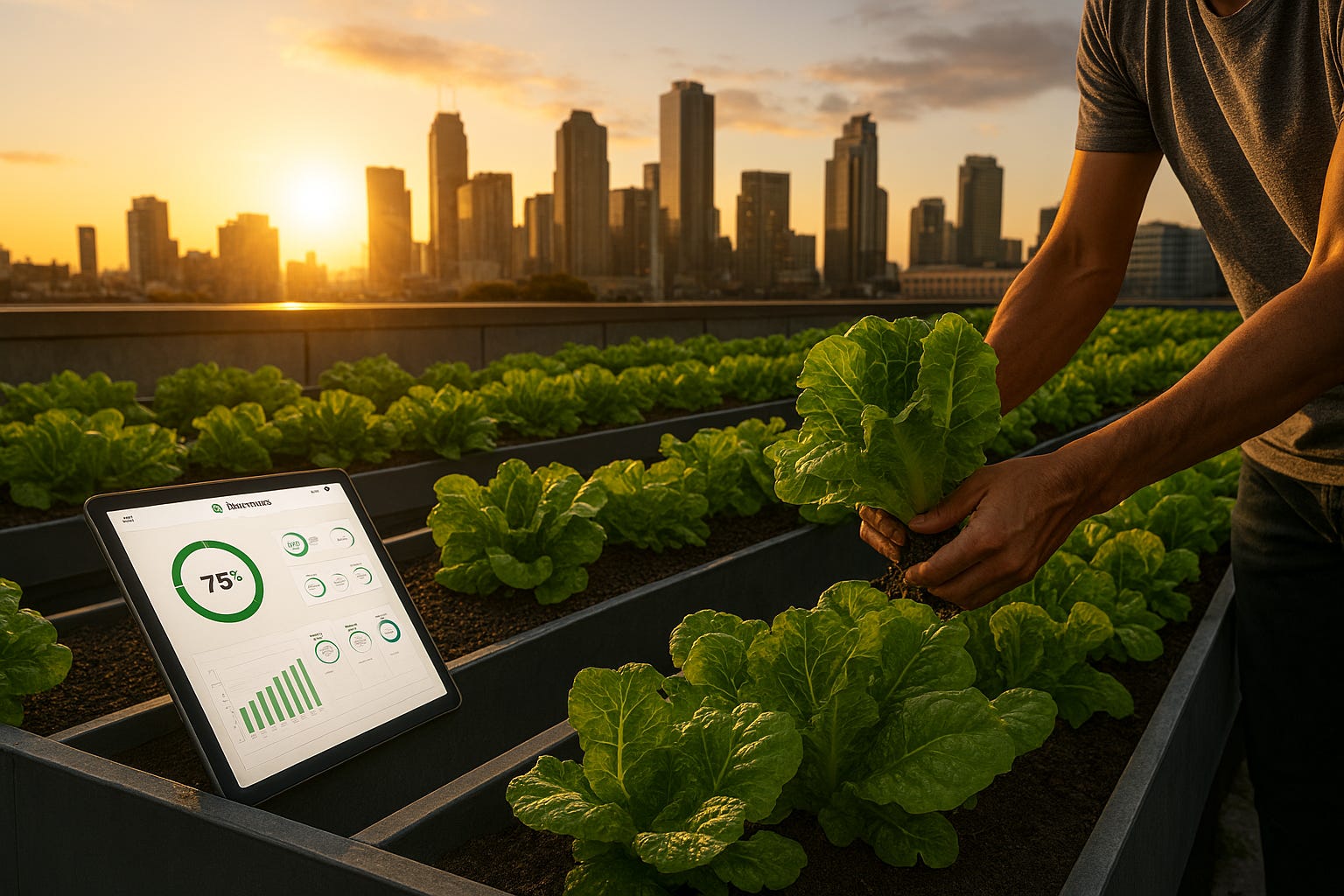
Urban agriculture sounds romantic: transforming concrete wastelands into lush food sources, reducing food miles, building community resilience. But here’s the reality between enthusiastic interest and actual production lies a minefield of technical complexity, regulatory confusion, and economic uncertainty that stops 95% of would-be urban farmers before they plant a single seed. TerraNova is an integrated AI platform that serves as virtual agronomist, project manager, regulatory advisor, and market analyst essentially democratizing urban farming by synthesizing GPS technology, IoT sensors, agricultural databases, and machine learning to guide anyone from “I want to grow food” to “I’m harvesting 500 pounds per season” without needing a degree in horticulture or a trust fund.
The global food system faces converging crises: 9.7 billion people by 2050 requiring 70% more food production, accelerating climate instability, and 55% of humanity now living in cities that consume vast quantities while sitting on underutilized growing space. This isn’t about hobby gardening it’s about transforming how cities feed themselves.
Is This New?
Originality Check:
- [X] Remix of existing concepts
- [X] Cross-domain adaptation
Analysis:
Urban agriculture platforms exist there are site assessment tools, sensor systems, online forums, and farming courses scattered across the internet. What doesn’t exist is integration. Current solutions force aspiring farmers to cobble together information from a dozen sources: climate data from NOAA, soil maps from USDA, zoning codes from city websites, equipment specs from manufacturer catalogs, market research from farmers market associations, and growing advice from YouTube.
TerraNova’s differentiation isn’t novelty it’s synthesis. The platform applies the “super-app” model to urban agriculture: one interface, one data model, one community, with AI orchestrating complexity behind a simple user experience. Think TurboTax for farming takes something genuinely complicated (in TurboTax’s case, tax law; in TerraNova’s case, agronomy + engineering + regulation + business) and makes it navigable through intelligent questioning and personalized guidance.
The closest comparable might be SmartThings or Wink for home automation, but applied to food production. Or Zillow’s transformation of real estate data taking scattered, opaque information and making it searchable, comparable, and actionable.
References : Executive Summary cultivating in the concrete jungle and SRS
Market Position
The Landscape:
The urban agriculture market is fragmented across multiple segments: equipment suppliers, educational programs, consulting services, software tools, and community organizations. Market size estimates vary wildly ($130B-$200B globally by 2030) because “urban agriculture” encompasses everything from backyard tomatoes to vertical farms in repurposed warehouses. The controlled environment agriculture (CEA) segment alone is projected at $8-10B by 2026.
Current solutions break down into:
- Enterprise SaaS (FarmOS, Agworld): Built for commercial operations, overwhelming for beginners, $50-500/month
- DIY Communities (Reddit’s r/UrbanFarming, forums): Free but fragmented, quality varies, requires significant time investment
- Consulting Services: Expensive ($2,000-15,000 per project), limited availability, doesn’t scale
- Educational Platforms (Udemy courses, university extensions): Good for learning but don’t provide personalized, site-specific guidance
The Opportunity:
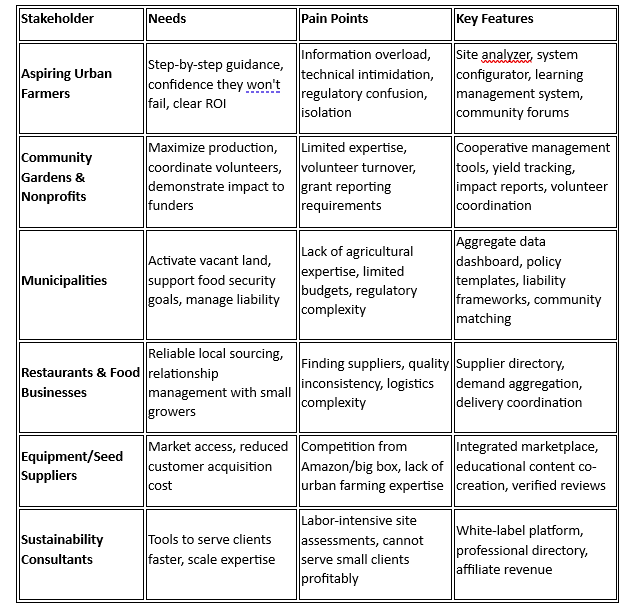
There’s a massive gap between “interested in urban farming” (millions) and “successfully operating urban farms” (thousands). This isn’t a market failure it’s a complexity problem that technology can solve. TerraNova targets the “missing middle”: individuals and small organizations (community gardens, schools, social enterprises) with budgets of $1,000-50,000 who are serious enough to invest time and money but can’t afford $10,000 consultants or navigate complexity alone.
Three market drivers create urgency:
- Food security concerns post-COVID exposed supply chain vulnerability
- ESG pressure on corporations seeking local carbon offset and sustainability initiatives
- Municipal policy shifts toward urban agriculture (200+ cities now have explicit urban ag zoning)
The Scale:
This isn’t unicorn territory, and that’s fine. Realistic success looks like:
- 5-year target: 50,000 active users generating $15-25M ARR
- Revenue model: Freemium base + premium features ($15-50/month) + marketplace transaction fees (10-15%) + enterprise licensing for municipalities and nonprofits
- Exit path: Acquisition by agricultural technology companies (John Deere, Bayer, Climate Corporation), smart city platforms, or food distribution networks seeking supply chain diversification
The total addressable market isn’t “everyone who gardens” it’s specifically urban residents in food-insecure areas (23 million Americans in food deserts), sustainability-focused enterprises (B Corps, social impact organizations), and municipalities with vacant land challenges (Detroit has 40 square miles of vacant lots; Chicago has 13,000+ vacant lots).
Stakeholder Ecosystem
Product vs. Feature
The Test:
Could John Deere or Bayer simply add this as a feature to their existing platforms? Theoretically yes but that misunderstands the barrier. Enterprise agricultural technology companies optimize for large-scale commercial farms ($500K+ revenue). Their UI, pricing, feature sets, and sales models don’t translate to someone with a 400-square-foot backyard.
More realistically, this could be absorbed by:
- Smart garden hardware companies (Click & Grow, AeroGarden) expanding into guidance
- Home improvement retailers (Home Depot, Lowe’s) creating digital companion experiences
- Food delivery platforms (Instacart, DoorDash) vertically integrating into hyper-local supply
The Defense:
TerraNova’s defensibility comes from data network effects and community:
- Proprietary performance database: As thousands of users document what works where, the platform builds location-specific, method-specific, crop-specific performance data that generic advice can’t match. “In your microclimate (urban heat island zone 3, afternoon wind tunnel), these three tomato varieties outperform by 30%.”
- Regulatory intelligence: Continuously updated, jurisdiction-specific compliance information creates high switching costs. Users won’t abandon a platform that knows Chicago’s rooftop permitting process intimately.
- Community lock-in: Tool-sharing networks, bulk-purchase coalitions, and local mentorship relationships create social switching costs beyond software functionality.
- Speed advantage: First-mover advantage in this specific niche means TerraNova can establish partnerships (municipalities, universities, suppliers) before competitors mobilize.
The key is to avoid becoming mere infrastructure. Stay application-layer, user-facing, and community-centric. Don’t try to compete on sensors or IoT hardware—integrate with existing solutions. The value is orchestration and intelligence, not components.
Core Components
What You’d Need:
- AI/ML infrastructure: Natural language processing for regulatory parsing, computer vision for pest/disease identification, recommendation engines for crop-site-method matching, predictive models for yield and labor estimation
- Geospatial data integrations: Climate databases (NOAA, Weather Underground), soil surveys (USDA NRCS), satellite imagery (Planet Labs, USGS), GIS/LIDAR for site modeling, municipal parcel data
- Agricultural domain expertise: Partnerships with land-grant universities, master gardeners, certified crop advisors for content validation, method-specific specialists (aquaponics engineers, permaculture designers)
- Regulatory intelligence engine: Web scraping infrastructure for municipal codes, natural language processing for legal document parsing, crowdsourced verification system, alert mechanisms for regulatory changes
- Community platform infrastructure: Forums, user-generated content moderation, matching algorithms (mentors, bulk purchases, tool sharing), reputation systems, content management
- E-commerce/marketplace capabilities: Product catalog aggregation, price comparison engines, vendor relationship management, transaction processing, logistics coordination
First Steps:
- Build MVP focusing on Module 1 (Site & Crop Suitability Analyzer) + Module 2 (Farming Method Configurator): These create immediate “wow” value—user inputs address, gets personalized farm plan in minutes. This is the hook that demonstrates platform intelligence while being feasible to build (existing APIs + rules engine + basic ML).
- Establish 3-5 university partnerships for content licensing and validation: Reach out to urban agriculture programs at land-grant universities (UC Davis, Cornell, Michigan State, Rutgers). Offer free platform access to students/faculty in exchange for content licensing and advisory board participation. This builds credibility and content library simultaneously.
- Launch in single pilot city with strong urban ag movement (Detroit, Portland, Seattle, or Chicago): Deep localization for one city—perfect regulatory intelligence, supplier directory, community building—creates replicable playbook for expansion. Partner with city’s urban agriculture coordinator, 2-3 established community gardens, and local agricultural extension office for beta user recruitment.
The Contrarian View
Challenge This Idea:
1. The “feature not product” critique is actually correct: What prevents Home Depot from launching “Home Depot Garden Planner powered by AI” and bundling it with equipment purchases? They have customer relationships, supply chain, retail footprint, and brand trust. TerraNova might build a great product that simply validates market opportunity for an incumbent.
2. Urban farming is fundamentally uneconomical: Despite enthusiasm, most urban farms fail or remain permanently subsidized hobbies. The unit economics don’t work—expensive urban land, high labor costs, small scale. If the farms themselves aren’t viable, a platform serving them inherits that fragility.
3. The complexity is a feature, not a bug: People who succeed at urban farming often want the challenge—it’s part of the identity and satisfaction. “Making it easy” might remove the barrier but also the reward. The platform could solve a problem people don’t actually want solved.
4. Regulatory arbitrage is temporary: As urban agriculture grows, regulations will standardize and simplify. The platform’s regulatory intelligence moat dissolves if cities adopt model ordinances making compliance straightforward.
5. Community can’t be engineered: Real community emerges organically from shared struggle and local proximity. A platform-mediated community might feel hollow compared to authentic local networks—people might use TerraNova as a tool but build real relationships elsewhere.
Why It Might Still Work:
Re: Feature vs. Product – Home Depot’s strength (mass market retail) is a weakness here. Urban farming attracts sustainability-conscious consumers often skeptical of big-box retailers. TerraNova can position as the community-driven, mission-aligned alternative. Plus, Home Depot’s incentive is selling products; TerraNova’s incentive is successful farms (aligned with users). If acquisition happens, it validates the market and rewards early movers.
Re: Economics – This is accurate for purely commercial urban farms competing with industrial agriculture. But economics change when you account for: (1) Premium pricing for hyper-local/ultra-fresh (microgreens at $30/lb, not commodity lettuce at $2/lb), (2) Non-monetary value (food security, education, mental health, community cohesion), (3) Avoided costs (stormwater management, vacant lot maintenance), and (4) Carbon/ESG value increasingly monetized through credits and corporate partnerships. TerraNova can help users find the viable models (CSA, restaurant direct sales, educational programming) rather than failing commodity production.
Re: Complexity as identity – Yes, some users want difficulty. They’re not the target market. TerraNova targets the 90% who have interest but get defeated by complexity, not the 10% of masochistic hobbyists. There’s room for both DIY hard mode and guided experience.
Re: Regulatory standardization – Even if regulations simplify (optimistic 10-15 year timeline), the platform’s value shifts rather than disappears. It becomes less about “navigating complexity” and more about “optimizing within clear rules.” The broader value proposition (site analysis, system design, market intelligence, community) remains.
Re: Engineered community – Fair critique. The response is to facilitate rather than engineer—provide tools for organic community building (local meetups, skill shares, farm tours) rather than forcing connection. Think Meetup.com’s model: infrastructure for self-organizing communities, not top-down community management.
Cross-Domain Potential
If This Doesn’t Work for Urban Agriculture:
The underlying framework—AI-powered guidance through complex, location-specific, multi-stakeholder challenges—is remarkably adaptable:
1. DIY Renewable Energy Installation: Same pattern—interested homeowners intimidated by complexity of solar/wind/geothermal installation, regulatory requirements, economic analysis, equipment selection. Platform guides site assessment (roof angle, shading, climate), system design, permitting, installer matching, financing.
2. Small-Scale Aquaculture/Mariculture: For coastal communities, same barriers exist for backyard oyster farming, sea vegetable cultivation, or integrated multi-trophic aquaculture. Replace soil analysis with water quality, zoning with maritime regulations, crops with species selection.
3. Adaptive Reuse Development: Property owners wanting to convert vacant buildings to productive use face similar complexity—zoning analysis, structural assessment, market viability, contractor matching, community engagement. Platform becomes “Adaptive Reuse Navigator.”
4. Residential Rainwater/Greywater Systems: Water scarcity driving interest in residential water recycling. Same regulatory confusion, technical complexity, economic uncertainty. Platform assesses site, designs system, navigates permits, sources equipment.
5. Community-Scale Climate Adaptation: Neighborhoods wanting to implement climate resilience measures (bioswales, permeable paving, microgrids, cooling centers) face coordination and technical challenges. Platform facilitates community planning, grant identification, contractor coordination.
The core playbook: Take a sustainability practice with broad interest but high complexity barrier → Apply AI to synthesize scattered information → Build community infrastructure for knowledge sharing → Create marketplace connecting users with suppliers → Partner with institutions for credibility.
Next Steps for Builders
If you wanted to pursue this:
Week 1 – Validation Sprint:
- Interview 20 aspiring urban farmers (find them in relevant Facebook/Reddit groups, local community garden waitlists, urban ag meetups). Ask: “Walk me through your journey from interest to getting started. Where did you get stuck? What would have helped?” You’re looking for recurring pain points and willingness to pay signals.
- Identify 3 potential university partners with urban agriculture programs. Cold email professors: “I’m exploring a platform to democratize urban farming. Would you spend 20 minutes discussing challenges your students/extension clients face?”
- Build Wizard of Oz MVP: Google Form that takes address + growing goals, manually runs analysis using existing tools (USDA Web Soil Survey, climate data, local zoning codes), delivers personalized report. Charge $50. Goal: 5 paying customers to validate problem/solution fit.
Month 1 – Technical Foundation:
- Hire/partner with full-stack developer to build proper site analyzer MVP integrating: weather APIs, USDA soil data, basic crop database, simple recommendation engine. Focus on Module 1 + 2 (site analysis + system recommendation). Goal: Automated version of Week 1 manual process.
- Establish formal partnership with one university urban ag program (content licensing, beta testing, advisory relationship).
- Launch in pilot city: Identify urban ag coordinator, attend 3 community garden meetings, recruit 25 beta users (mix of beginners and experienced growers for feedback).
Quarter 1 – Platform Buildout:
- Expand to Modules 3-4 (regulatory compliance + budget engine): Most differentiated features that incumbents don’t serve well.
- Launch community forum and first “bulk purchase coalition” test: Can you coordinate 10 users to split compost delivery?
- Establish 3 supplier partnerships for marketplace: Seed company, equipment supplier, amendment supplier. Negotiate affiliate revenue (10-15%) in exchange for featured placement.
- Fundraise: If metrics hit (>100 active users, <20% churn, $10K+ GMV through marketplace), seed round target $500K-1M for 12-18 month runway to expand to 3 cities.
Resources to Explore
Comparable Platforms (Different Domains):
- Houzz – Home renovation inspiration + contractor matching + product marketplace (similar orchestration model)
- LegalZoom – Simplifying legal complexity through guided questionnaires (similar regulatory navigation)
- OpenFarm – Open-source growing guide database (could be data source or collaboration partner)
Market Research:
- BrightFarms, Gotham Greens, AeroFarms – Commercial urban ag companies; study their operations to identify pain points TerraNova could solve for smaller entrants
- Urban Agriculture Magazine, Growing for Market, BioCycle – Trade publications revealing industry challenges
- USDA “People’s Garden” initiative – Federal program supporting community gardens; potential partnership channel
Technical Infrastructure:
- Google Maps Platform (geospatial), Dark Sky API (weather data), USDA Web Soil Survey API (soil data)
- OpenAI GPT or Anthropic Claude for natural language processing of regulations
- Teachable or Thinkific for learning management system white-label
- Sharetribe or Arcadier for marketplace infrastructure
Potential Advisors:
- Urban agriculture program directors at land-grant universities
- Municipal urban agriculture coordinators (many large cities now have these roles)
- Founders of defunct urban ag startups (learn from failures—Farmigo, PodPonics, Local Orbit all had interesting models)
Final Thoughts
Urban agriculture represents a rare convergence: environmental urgency meets technological capability meets cultural momentum. The barriers preventing scale-up aren’t insurmountable—they’re exactly the kind of complexity problems software excels at solving.
What makes this compelling isn’t the revolutionary nature (it’s not) but the inexplicable absence. Why doesn’t this already exist? Why is someone interested in rooftop farming still cobbling together information from 15 sources in 2025? The gap between problem clarity and solution availability suggests market inefficiency, not impossibility.
The real test isn’t “Can this be built?” (obviously yes) but “Can this be defended?” The answer depends on speed—building data moats and community network effects before incumbents notice—and on understanding that this isn’t a technology play masquerading as agriculture, but an agriculture solution leveraging technology appropriately.
If you build this, two principles:
- Stay application-layer: Don’t get seduced into hardware (building better sensors or grow lights). Your value is orchestration and intelligence, not components.
- Community is the moat: Technology can be copied; genuine community relationships, local knowledge networks, and established trust cannot.
Alternative takes:
- Non-profit route: Instead of venture-backed SaaS, structure as social enterprise or B-Corp with mission-driven funding (foundations, impact investors). Removes pressure for hockey-stick growth, aligns better with food justice mission.
- Municipal licensing model: Build for one city with deep partnership, then license to other cities as white-label solution. City provides users (residents, community gardens), platform provides technology.
- Franchise model for local experts: TerraNova provides software infrastructure; local agricultural consultants become franchisees delivering white-glove service powered by platform intelligence.
This is part of Ideas Snapshots – a collection of lightweight business blueprints, strategic outlines, and entrepreneurial prompts. Not every idea needs to be built. Some are meant to inspire, remix, or adapt.
What would you do differently with this idea? Would you focus on a narrower niche (just rooftop farms, just schools)? Would you prioritize different modules? How would you think about defensibility?